
Poland Unpacked week 51 (15-21 December 2025)

Welcome to this week’s edition of our Poland Unpacked, where we deliver key insights and trends shaping the economic, corporate and political landscape. Catch the most important insights from Poland in this week’s briefing.

Loading the Elevenlabs Text to Speech AudioNative Player...
POland unpacked on tour
French connection
Michał Szcześniewski

The discussion on the future of European industry in the regions, moderated by Grzegorz Nawacki, editor-in-chief of XYZ.pl, brought together nearly 100 participants: representatives of French and Polish companies and partners of the French-Polish Chamber of Commerce.

Poland Unpacked was on site to cover the event, highlighting how French and Polish regions are forging strategic partnerships, supporting innovation, and redefining competitiveness in a rapidly changing global economy.

From the largest Michelin factory in Olsztyn to an EUR 150 million high-potency pharmaceutical center in Warsaw, European regions are proving that industry still matters. French and Polish leaders are investing billions, modernizing factories, and supporting innovation to secure jobs, supply chains, and economic sovereignty. In a world of rising global competition, energy crises, and geopolitical uncertainty, regions like Auvergne–Rhône-Alpes and Mazovia are showing how local action can have continental impact. Read on to see how these industrial powerhouses are shaping Europe’s economic future.

Business
From power plants to shoe shelves
Małgorzata Grzegorczyk

Several major state-owned firms have recently replaced their CEOs. On December 8, Dariusz Marzec was dismissed from PGE, the Warsaw-listed energy producer (60.86% state-owned). Sources say Mr. Marzec, a tough negotiator, had been opting for price increases for consumers. Dariusz Lubera, former Tauron CEO, is acting CEO.

The same day, PM Donald Tusk removed Leszek Stypułkowski as CEO of BGK, the fully state-owned development bank. He is replaced by former state assets minister Jakub Jaworowski.

And then Marcin Wojewódka, ex-CEO and supervisory board member of PKP Cargo railway company, was dismissed after selling and repurchasing company shares on the same day.

Poland aims to strengthen its military industry as Europe arms itself. “We should have the best military sector in a few years – unless we make mistakes today,” says Magdalena Sobkowiak-Czarnecka, minister for the SAFE program, in an interview with XYZ. EUR 43.7bn of EU funds will support 139 projects, including initiatives involving Ukraine, with significant funds remaining in Polish industry.

CCC, the footwear and apparel e-commerce giant, has seen its shares fall from PLN 168 to PLN 121 (EUR 39 to EUR 28) after being targeted by short-seller Ninga Research. The company acknowledges challenges in regaining investor trust, especially abroad, and pledges a more cautious forecasting approach. XYZ has covered the story.

Hungary’s Viktor Orbán shows regional cooperation with him is possible. On December 4, leaders of Poland, Italy, Bulgaria, Czechia, Hungary, and Slovakia wrote to EU Commission President Ursula von der Leyen, urging CO₂ reduction rules to better support the automotive sector. The Commission’s Automotive Package, initially due December 10, is now scheduled for December 16.

Maspex, Poland’s largest food and beverage producer, may not match last year’s PLN 16bn (EUR 3.8bn) revenue. CEO Krzysztof Pawiński cites falling demand, a new deposit system costing up to PLN 37bn (EUR 8.6bn), and stricter environmental rules. He has appealed to President Karol Nawrocki to veto new taxes and regulatory burdens.

Economy & Markets
Falling FDI and a pension system under strain
Marek Skawiński

This week in Poland offered few current macroeconomic data points or events. For this reason, at XYZ we focused on two structural issues: foreign direct investment (FDI) and the pension system.

FDI was one of the key drivers of Poland’s rapid post-1990 development, providing two crucial resources that the economy lacked: technology and knowledge. However, in 2024 (the latest full-year data), the value of FDI fell to just 1.5% of GDP - one of the lowest levels in the past 25 years.

The main reasons include the fading impact of one-off factors such as nearshoring, friendshoring, and a favourable European economic cycle. While the decline in FDI appears largely cyclical, pressures on European industries (notably automotive and household appliances) and rising competition from China may limit future inflows.

Another contributing factor may be the sharp rise in labor costs in Poland when measured in euros or dollars. Between 2020 and 2024, the nominal average cost of employing a worker per hour -including wages, taxes, and social contributions - rose by 59%, the second-highest increase in the EU after Bulgaria (61%).

Since the 1999 reform, Poland has been one of the few countries with a defined-contribution pension system. This system theoretically keeps state pension spending under control, as projections show spending remaining broadly stable relative to GDP. In practice, however, an ageing population translates into very low future net replacement rates. According to OECD models, these are expected to be around 40% - significantly below the level of other member countries. In the longer term, raising the low statutory retirement age for women in Poland (currently 60) and/or increasing pension contribution rates appears unavoidable.

Politics & Policy
Poland’s political right splits as Tusk marks two years in office
Krzysztof Figlarz

After a heated previous week, dominated by President Karol Nawrocki’s veto on the ban of dog chains and cryptocurrency regulations, Polish politics has taken a bit of a breather in recent days. Public attention has largely shifted overseas, focusing on the new U.S. National Security Strategy (NSS). The strategy’s apparent loosening of ties with European Union countries in Washington’s transatlantic policy, while not entirely surprising, has sparked intense reactions among Polish politicians. A recent pro-EU post by Prime Minister Donald Tusk on X, countering Elon Musk’s narrative, garnered over 30 million views:

And drew critical responses from Polish right-wing politicians like Marek Jakubiak who asked about whether Mr. Tusk is the PM of Poland or Europe.

This is hardly unexpected, given that a strong pro-American orientation has long been embedded in both Law and Justice (PiS) and the Confederation. Yet recent developments show that Poland’s right-wing is increasingly fragmented beyond a shared opposition to the Tusk government, Brussels, and a fondness for the U.S. One might even say that an open struggle has erupted within the right.

The highlight on the political social media bubble was the “Polish Fox News” moment - Telewizja Republika aired a graphic dividing PiS into warring factions where the two key ones were charmingly nicknamed the “Harcerze” (boy scouts; Mr. Morawiecki's people) and the “Maślarze” (butter boys; nicknamed after an incident on board a Polish LOT airlines plane when one of these politicians was served German-branded butter and loudly complained about it in the social media):
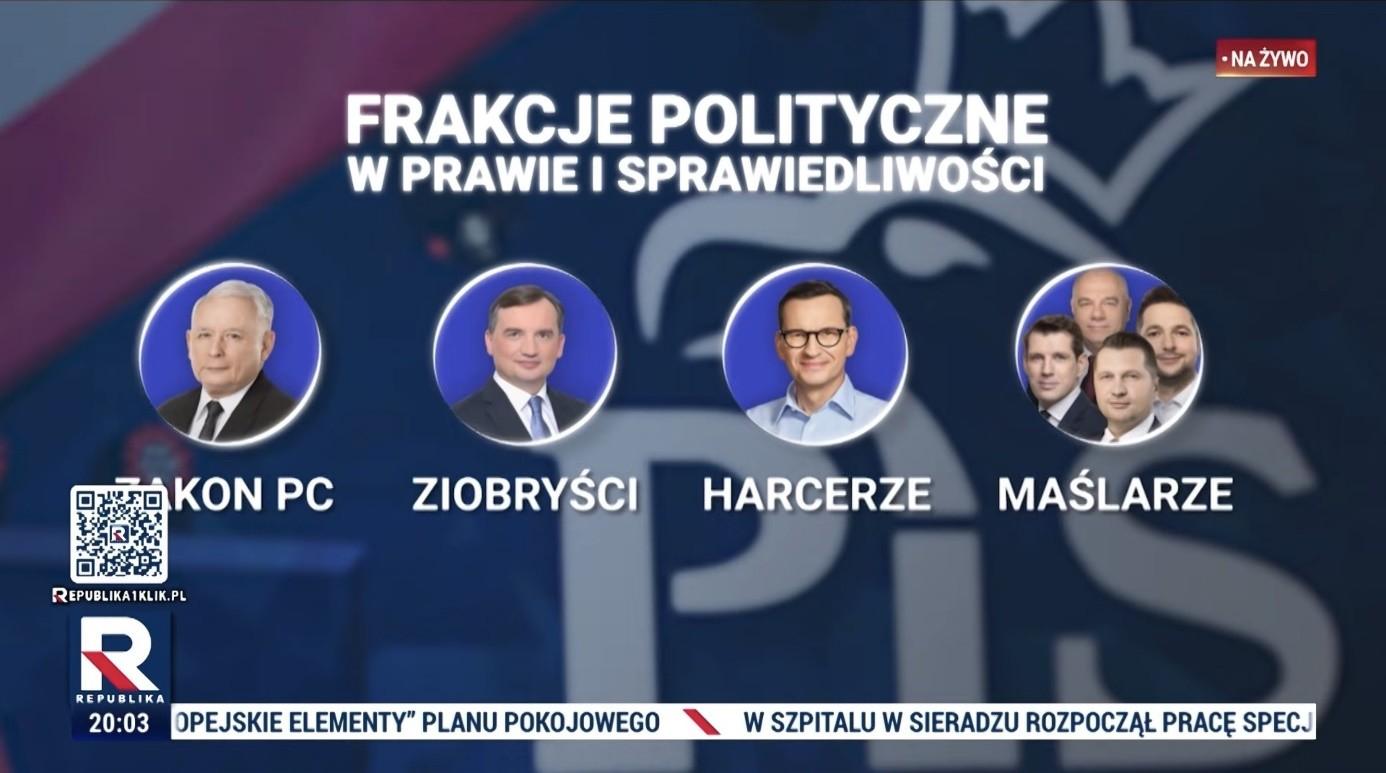
Source: https://x.com/szczesniak__a/status/1998497989422403729

This right-wing struggle is more than just a spectacle for political enthusiasts; it reflects a dispute over the dominant ideological direction on the right. Law and Justice is increasingly losing support to the far-right, pro-Russian Confederation of the Polish Crown led by Grzegorz Braun, which attacks Ukrainians in Poland, opposes the EU, and whitewashes Russian policy. Former Prime Minister Mateusz Morawiecki, from the “Harcerze” faction, criticizes the “Maślarze” for cozying up to Braun. Morawiecki, while critical of the EU, does not advocate leaving it, supports Ukraine, and condemns Russia. Rafał Mrowicki explores the secrets of these right-wing power struggles and their implications for Polish politics.

Meanwhile, the government is celebrating. December 13 marked two years since the formation of Donald Tusk’s cabinet. For several weeks, the administration has conducted a communication offensive, highlighting its achievements, while the opposition continues to critique it. At XYZ, we examined how the government performed legislatively and which ministries were the most active over the past two years - and thus had the greatest impact on the lives of Poles.

Startups / VC / Tech
Mind the gap: Poland’s push to marry academia and capital
Cezary Szczepański

Another week marked by public support for Poland’s technology sector. On Tuesday, December 9, PFR Ventures - the venture-capital arm of the Polish Development Fund (PFR), which supports the start-up market – announced four additional fund management teams. As a result, more than PLN 250m (around EUR 60m) will flow into the market. The new investment vehicles will manage a combined PLN 258m in capital, of which PLN 196m comes from PFR Ventures. The funds are to be used to finance innovative Polish start-ups at various stages of development.

Following the announcement, the number of funds backed under the latest round of EU financing (FENG) has risen to 15. Capital allocated by PFR Ventures will be channelled to Betacluster Ventures, Cofounder VC, Stelo Ventures and VO2 Ventures. With the exception of Cofounder VC, all of the vehicles will focus on early-stage start-ups. Cofounder VC, by contrast, will target companies at the growth stage. Here are the details of their respective strategies.

The program for investing EU funds in Polish start-ups is gathering pace. PFR Ventures and the Polish Development Fund (PFR) itself, however, want to introduce certain changes to how two schemes operate: Starter (aimed at new start-ups) and CVC (targeted at corporate venture funds). Under the former proposal, the public institution wants to stimulate investment in companies emerging directly from the scientific and academic community.

Why? In Poland there is a pronounced gap between the expectations of venture-capital funds and the realities of academia. VC funds often point out that university-born projects tend to be unstructured, require substantial capital already at the deal-formation stage, are time-consuming, and come with complications linked to the parent institution. Looking for projects in other parts of the market is more likely to deliver success, which is why funds devote less attention to academia.

On the other side, research institutions – including special-purpose vehicles and technology-transfer centers – accuse funds of setting excessively high expectations and lacking patience. The result? Poland’s level of innovation is not rising at a satisfactory pace. The main objective of the proposed changes is to redirect fund managers’ attention towards the more demanding and time-intensive university environment. Through PFR Ventures, PFR plans to offer funds financial mechanisms that will compensate for the increased workload and time.

PFR also wants to revise the rules governing the CVC program. For more than a year, not a single such fund has been launched with support from EU resources. The institution would like to liberalize the framework, giving fund managers greater freedom of decision-making, including when it comes to the sources of start-up financing. Both proposals require approval from Poland’s Ministry of Funds and Regional Policy.

There were no major announcements of new funding rounds for Polish start-ups last week. Rest assured – this is the calm before the wave that is about to arrive.

This week’s headline may well be the acquisition of PrestaShop by cyber_Folks (the owner of the Shoper platform) together with Sylius. The deal is set to strengthen the group’s presence in Western Europe, Central and Eastern Europe, and global markets. PrestaShop serves 230,000 active online stores worldwide, which generated EUR 22bn in gross merchandise value (GMV) in 2024.

The region has also seen the launch of a new investment fund, Aneli Capital. Over its first five years of operation, it plans to make 20 investments with a total value of EUR 35m. The vehicle has attracted capital from the Polish fund Magna Polonia, and Jacek Błoński has joined the management team.

Another international highlight was the success of a start-up backed in its early days by the Polish fund Expeditions. The British company Nu Quantum raised USD 60m in a Series A round.

A significant, though forward-looking, development is the expansion of the Romanian tech giant UiPath. On Thursday, December 11, the company signed an agreement with the AGH University of Science and Technology in Kraków. The collaboration focuses on artificial-intelligence technologies, including the development of large language models. To date, the UiPath–AGH agreement represents the largest collaboration of its kind announced by a Polish university.

Looking ahead
Polish economy next week: Inflation, employment, and activity updates
Marek Skawiński

Next week will bring a significantly larger flow of new economic data. The final reading of November inflation will be released. According to preliminary estimates, the consumer price index (CPI) rose by 2.4% year-on-year, nearly matching the National Bank of Poland’s (NBP) inflation target of 2.5%, with a tolerance of ±1 percentage point.

Poland Statistics (GUS) will also publish data on average employment and wages in the corporate sector. Wage growth is closely monitored by members of the Monetary Policy Council (RPP), the NBP decision-making body setting interest rates, as it influences inflationary pressure. The latest reading for October showed a marked slowdown in nominal wage growth to 6.6% year-on-year, down from 7.5% in September – the lowest increase since February 2021, nearly five years ago.

Additionally, key indicators for November regarding current economic activity will be released, including industrial production and construction output. With a lag, data on service sector production (for September) will also be published.

After hours
Europe's final wilderness
Michał Szcześniewski

Three hours' drive from Warsaw lies Europe's final lowland wilderness. Białowieża Forest, a UNESCO World Heritage Site straddling the Polish-Belarus border, preserves 1,500 square kilometres of woodland largely untouched for millennia.

Its star attraction: 800 European bisons, the continent's largest land mammals and a conservation triumph. Nearly extinct after the first world war, these ton-heavy beasts now roam freely - most visible in autumn and winter, when they venture into clearings. Morning walks through villages often yield sightings; guided safaris guarantee them.

Yes, you might have spotted this guy on a bottle. Source: Michal Fludra/NurPhoto via Getty Images

Local cuisine mirrors the forest. Goulash, honey fungus soup harvested from surrounding woods, and potato-based staples like haluski and pierogis define the region's heritage cooking. Here the food and wilderness remain inseparable. Go on, take a weekend escape from obligations. Białowieża forest delivers what urban parks cannot.

Fun fact about poland
Long on charm, short on corners
Michał Szcześniewski

You know one-hit wonders. Now meet a one-street wonder from southern Poland. Welcome to Sułoszowa, the Polish village where everyone’s neighbors - literally! All 3,361 residents share one epic 9‑kilometer street, lined with colorful roofs, tidy gardens, and golden fields stretching like a rainbow of crops.

No cutting corners here. Source: Maciej Uchmanski/Getty Images