

This article is a part of Poland Unpacked. Weekly intelligence for decision-makers
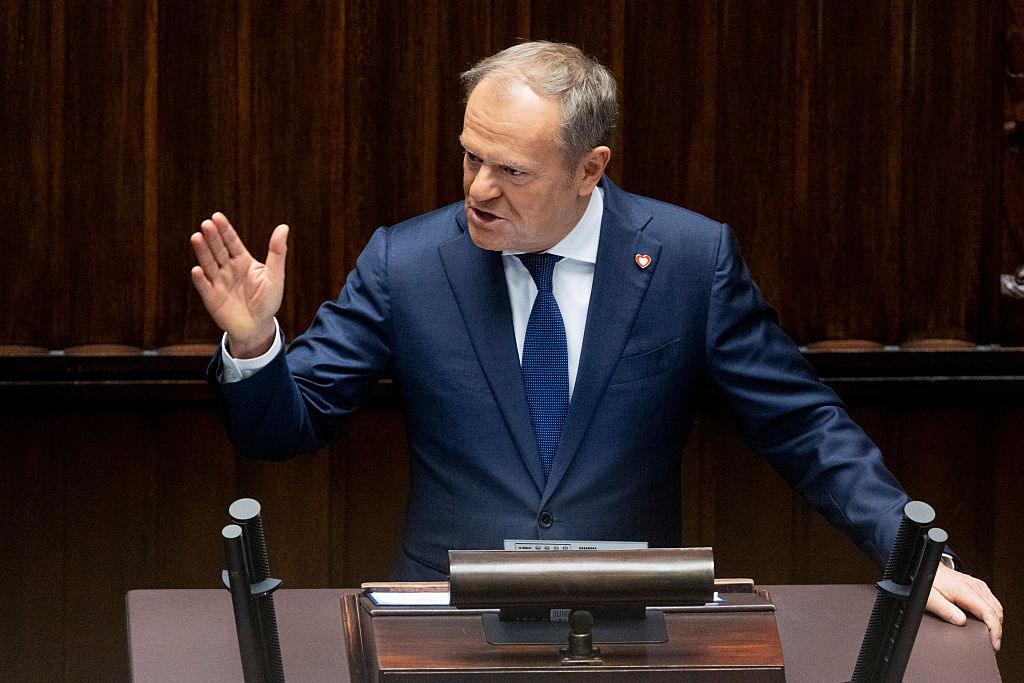
December 13 marked two years since Donald Tusk’s cabinet was sworn in. During this period, the government has experienced several personnel changes, one major (though still unfinished) reshuffle, and several high-profile legislative initiatives, including deregulation efforts.
Opposition politicians point to many unfulfilled promises, particularly the so-called “one hundred concrete measures” of the Civic Coalition (KO). During a meeting with voters in Piotrków Trybunalski, Prime Minister Tusk distanced himself from delivering the full set of promises. He admitted that about one third had been fulfilled, which, in light of the Civic Coalition’s support from roughly one third of citizens, he described as “probably a fair assessment.”
Among the promises that have been implemented are the reinstatement of state funding for in vitro procedures, the “Active Parent” benefit, and the unlocking of EU funds under the National Recovery Plan. Some pledges, such as lowering the tax-free allowance, continue to be postponed.
The Ministry of Finance (and Economy) leads in drafting bills
We decided to examine how individual ministries are performing in creating new legislation. The analysis covers bills—not including regulations—drafted between 13 December 2023 and the date of publication of this article.
The Ministry of Finance tops the list, with 105 bills. A methodological note is important here: data from the Government Legislation Centre show which minister is listed as the bill’s proposer. This means that projects under Andrzej Domański’s remit also include bills originating from the former Ministry of Development, which he currently heads as Minister of Finance and Economy.
Justice and Family ministries follow on the podium
Next on the legislative podium is the Ministry of Justice, led first by Adam Bodnar and later by Waldemar Żurek. In third place is the Ministry of Family, Labour and Social Policy, headed by Agnieszka Dziemianowicz-Bąk of the New Left.
 Interactive chart
 The Ministry of Justice produced 61 bills, while the Ministry of Family and Labour prepared 42. Close behind, with 40 bills, is the Ministry of Climate and Environment, led by Paulina Hennig-Kloska from Poland 2050.
The Ministry of Health drafted 34 bills, under the leadership of MP Izabela Leszczyna from the Civic Coalition for the first 1.5 years, and since July by non-partisan Jolanta Sobierańska-Grenda.
Similar results for PSL ministers
The next three ministries in terms of legislative activity are headed by politicians from the Polish People’s Party (PSL), each having drafted 31 bills. These are the Ministry of Infrastructure, led by Dariusz Klimczak (PSL); the Ministry of Agriculture, headed by Stefan Krajewski (who replaced Czesław Siekierski in July); and the Ministry of Development and Technology. Since July, this last ministry has been under Andrzej Domański as Minister of Finance and Economy. Previously, Krzysztof Paszyk held the post, having succeeded Krzysztof Hetman following the 2024 European Parliament elections.
The Ministry of Interior and Administration prepared 28 bills. Its current minister since July is Marcin Kierwiński, while for a year the position was held by Tomasz Siemoniak. The Ministry of Defence, under Deputy Prime Minister Władysław Kosiniak-Kamysz (PSL), drafted 12 bills.
The Ministry of Culture and National Heritage is credited with 10 bills, despite multiple leadership changes. Bartłomiej Sienkiewicz (KO) initially held the position before becoming an MEP in 2024. He was replaced by non-partisan Hanna Wróblewska, and since July the ministry has been led by Marta Cienkowska from Poland 2050.
A transitional period in science
The Ministry of Science has drafted 17 bills. It has been led for the past year by Marcin Kulasek (New Left), who replaced fellow party member Dariusz Wieczorek. This tally also includes projects signed by the Minister of Education and Science, reflecting the early phase of the government when ministries were being reorganised and competencies reassigned. At the end of the PiS government, education and higher education were combined in a single ministry, so transitional projects are included here. Meanwhile, the Ministry of Education under Barbara Nowacka (KO) drafted nine bills.
The Ministry of Funds, led by Katarzyna Pełczyńska-Nałęcz (Poland 2050), prepared seven bills. Six bills each were drafted by the now-dissolved Ministry of Industry, previously led by Marzena Czarnecka; the Ministry of Energy, established in July under Miłosz Motyka (PSL); and the Ministry of Foreign Affairs, under Radosław Sikorski (KO).
Finally, the Ministry of Sport and Tourism prepared five bills, with Jakub Rutnicki replacing Sławomir Nitras in July.
Ministers without a portfolio and those with the fewest bills
Three bills were drafted by the Minister for Equality, Katarzyna Kotula, who since July has held the lower-ranking post of Secretary of State, as well as by the Ministry of State Assets. This ministry has also seen significant personnel changes: following the 2024 European Parliament elections, Borys Budka (KO) was replaced by non-partisan Jakub Jaworowski (now a member of the management board of Bank Gospodarstwa Krajowego), who in July was succeeded by non-partisan Wojciech Balczun.
Two bills each were prepared by Tomasz Siemoniak as Coordinator of Special Services, Marzena Okła-Drewnowicz as Minister for Senior Policy (whose rank was also reduced to Secretary of State in July), and Wojciech Wrochna, Government Plenipotentiary for Strategic Energy Infrastructure.
One bill each was drafted by Jan Grabiec, Head of the Chancellery of the Prime Minister; Maciej Lasek, Government Plenipotentiary for the Central Communication Port; Maciej Berek, Head of the Standing Committee of the Council of Ministers; and Adriana Porowska, Minister for Civil Society (currently also Secretary of State) from Poland 2050. Marcin Kierwiński also prepared one bill while serving as Minister responsible for the reconstruction of areas affected by the 2024 floods.
Interactive chart A bill is only the beginning
Legislative activity does not guarantee that a bill will become law. A clear example is the proposed legislation to reduce the health insurance contribution for entrepreneurs, which was on the election promise list. The bill was vetoed by President Andrzej Duda. Last Wednesday, Minister Andrzej Domański told Radio Zet that, in his view, there is currently no room to lower the health insurance contribution.
In XYZ, we have repeatedly reported on internal disputes over issues such as the bill on civil partnerships or increasing the powers of the State Labour Inspectorate.
A bill on the status of a “closest person” in a partnership or cohabitation agreement is expected to be published soon. The Government Information Centre informed us that the final adjustments and financial calculations for the Regulatory Impact Assessment are ongoing. These calculations could be crucial for plans to equalise the tax preferences of people in informal partnerships with those granted to married couples. The reform is included in a draft presented by politicians from the Left and the Polish People’s Party.
A key player in the legislative process for several months has also been President Karol Nawrocki, who regularly uses the veto power.
The nature of ministries shapes the volume of new legislation
It is important to note that a quantitative analysis of legislative output only tells part of the story. Ministries such as Finance or Justice naturally generate a large number of legal acts, whereas the Ministry of Foreign Affairs, by its nature, produces relatively few. Dr. Tomasz Sawczuk, co-author of a recent ministerial rating by Polityka Insight, emphasises this point.
“An alarming sign would be a lack of necessary activity - for example, delays in implementing EU regulations. But the sheer production of law is neutral from our perspective, because what matters is whether the legislation makes sense, not the number of acts,” Sawczuk notes.
He also highlights the activity of the Ministry of Family, Labour and Social Policy, led by Agnieszka Dziemianowicz-Bąk.
“There are many initiatives there. On the other hand, political difficulties occur. For example, proposals concerning the State Labour Inspectorate did not gain full government support, and for some projects tensions appeared already during the legislative process,” Sawczuk observes.
He further notes that the minister is attempting to push the government’s agenda to the left in certain areas.
“This is characteristic of her and more pronounced than among other left-wing members of the government. Whether people like it or not is, of course, a matter of political opinion on the issue,” Sawczuk concludes.


Key Takeaways
- The Ministry of Finance leads in legislative activity with 105 bills, partly due to its combined competencies with the ministries of Economy and Development. The ministries of Justice and Family, Labour and Social Policy also rank high. However, Tomasz Sawczuk from Polityka Insight stresses that the nature of a ministry (e.g., MFA vs. MF) naturally determines the number of legislative acts and is not the sole measure of diligence.
- After two years in office, Donald Tusk rebuffs opposition criticism over failing to deliver the “one hundred concrete measures,” viewing the fulfilment of one-third of promises as proportionate to the Civic Coalition’s electoral support. He describes this balance as a “fair assessment,” despite the government still dealing with an unfinished reshuffle at the vice-minister level.
- A high volume of legislative initiatives, particularly visible in Agnieszka Dziemianowicz-Bąk’s ministry, does not always translate into effective law due to a lack of support across the government and the active use of the veto by President Karol Nawrocki. Attempts to shift the government agenda leftward—for instance, regarding the powers of the State Labour Inspectorate - create coalition tensions and block legislative processes.