

This article is a part of Poland Unpacked. Weekly intelligence for decision-makers
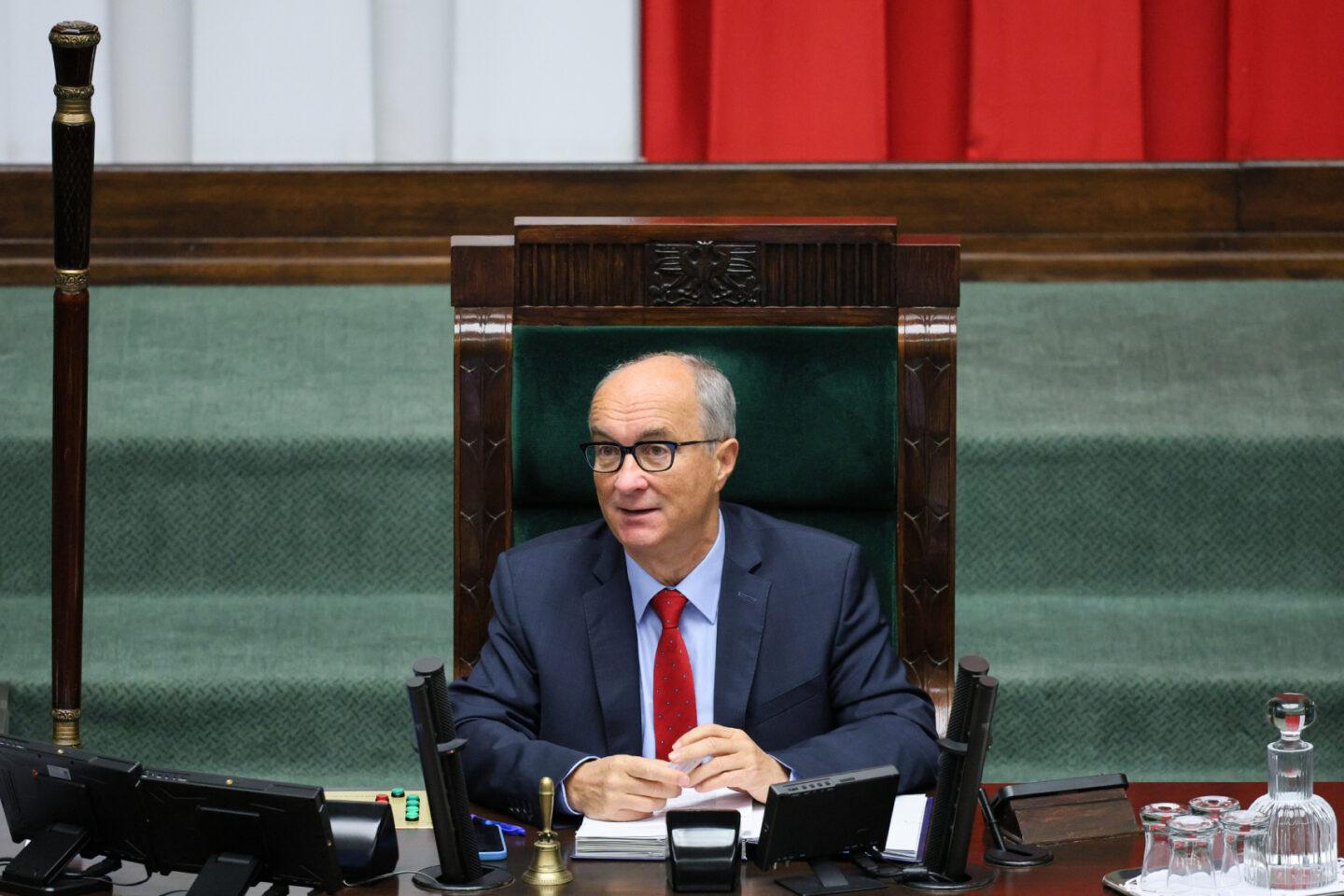
Mr. Czarzasty had long delayed announcing his candidacy for the leadership of the New Left. In early December, we reported that he was already the favorite, even before making his declaration.
By that time, the party had held elections for regional chairpersons. At the provincial level, Mr. Czarzasty’s supporters came to dominate the party. The leader toured the regions, and at the provincial congresses, his allies were elected as heads of local structures.
The Speaker of the Sejm announced his decision to seek re-election as party chairman a few days after the provincial congress in Lublin, in south-eastern Poland. When he made the announcement, he was accompanied by politicians who had, for months, declared their candidacies for the chairmanship.
Mr. Czarzasty reaches deal with rivals
Deputy Prime Minister and Minister of Digital Affairs Krzysztof Gawkowski had previously served as the party’s vice-chairman. He was representing the Spring (Wiosna) faction, a party founded earlier by Robert Biedroń. Before joining Mr. Biedroń’s movement, he spent two years as vice-chairman of the Democratic Left Alliance, which Czarzasty also led. Mr. Gawkowski had signaled that he would challenge Czarzasty.
Some party activists pinned their hopes for change on Agnieszka Dziemianowicz-Bąk. The Minister of Family, Labor and Social Policy was formerly a member of the Razem (Together) party and, like Mr. Gawkowski, joined the New Left through the Spring faction. The government’s achievements in social and welfare policy – such as widow’s pensions and the so-called “grandmother’s allowance” – stem from her ministry.
Ambitions were also evident in MP Tomasz Trela, who last autumn became head of the New Left’s structures in the Łódź region (central Poland).
Good to know
Widow’s pension and grandmother's allowance
The widow’s pension is a social benefit that, from mid‑2025, lets a widow or widower keep their own pension in full and add a percentage of the deceased spouse’s pension instead of having to choose just one, with the extra share starting at 15% and planned to rise to 25%, up to a cap of three times the minimum pension. It is meant to reduce old‑age poverty, especially among women, and applies if the surviving spouse is of retirement age, had a formal marital/common property relationship until death, and meets standard conditions for a survivor’s pension.
The so‑called “grandmother’s allowance” (babciowe) is a targeted childcare‑related support for families where parents are active on the job market. The official name is 'Active parents'.
Would-be rivals invited to party leadership
All three accompanied Mr. Czarzasty as he announced his candidacy for party chairman. Each emphasized that both the party and the coalition needed stability. Mr. Czarzasty himself stated that he would like all three to join the party leadership, with Mr. Gawkowski serving as first vice-chairman.
Tomasz Trela acknowledged that the party congress marked the beginning of the New Left’s parliamentary campaign ahead of the 2027 elections. Krzysztof Gawkowski added that the New Left would then go to the polls to “renew its mandate to govern Poland, in this or another coalition, but one that is good for Poland.”
Mr. Kwaśniewski attends New Left congress
At the congress, Włodzimierz Czarzasty stood as the sole candidate. The event’s special guest was former President Aleksander Kwaśniewski, who praised Mr. Czarzasty for bringing the left back into parliament in 2019 and into government in 2023.
“Włodek [a friendly diminutive for Włodzimierz – ed.], as a veteran of Polish politics, I want to express my respect for what you have accomplished and wish that the next four years are marked by dialogue and unity within the left-wing community. I am pleased that behind you stands a group of colleagues representing a new generation. The 2027 elections will be a moment to give this younger generation a voice. The left is ready for it. It has proven essential to Poland by returning to parliament, and in 2023 it confirmed that mandate by forming a coalition.
Coalitions are never easy, but from a two-year perspective, we know that the Left is a loyal and substantive participant in the democratic coalition. It restores focus to issues such as justice, social services, and higher education. It is also a fight for modernity,” Mr. Kwaśniewski said at the New Left congress.
Mr. Nawrocki on “Post-communists with marginal support”: Mr. Kwaśniewski responds
The former president Kwaśniewski, while noting that “the left has a long history,” also addressed remarks by President Karol Nawrocki. On the anniversary of the imposition of martial law (13 December 1981), Nawrocki stated that “post-communists with marginal social support, thanks to political and party deals, are receiving the most important positions in the Polish state.” He was referring to the election of Włodzimierz Czarzasty as Speaker of the Sejm.
Aleksander Kwaśniewski urged New Left politicians to defend “the dignity of people with roots in the PRL [Polish People’s Republic – official name of Polish state before the fall of communism – ed.], who are not few among Left voters.”
“President Nawrocki, who was born just months before martial law was lifted, expressed an opinion that zealously misinformed historians have the right to hold - historians who distort history to the point that they themselves believe it [Mr. Nawrocki holds a PhD in history - ed.]. Such views do not suit a president, who should seek what unites Poles and understand nuance. Since the late 1980s, the Polish left has been working to build the foundations of a democratic Poland. Today, we have a quarter-century of alternating governments from parties emerging from the Solidarity movement [anti-communist – ed.]. But, Mr. President, do we have more consensus, or less?
Mr. Czarzasty wins party elections
Following the former president, Włodzimierz Czarzasty took the floor. The New Left chairman recalled that when he took the party’s helm in 2016, it polled at 2 percent and was outside parliament. For the past two years, it has been a partner in government.
From the stage, Mr. Czarzasty praised left-wing ministers. In addition to Agnieszka Dziemianowicz-Bąk and Krzysztof Gawkowski, he highlighted Tomasz Lewandowski, responsible for housing policy and implementing social housing programs, and Anita Sowińska, who oversees the deposit return system.
Mr. Czarzasty issues warning to Mr. Nawrocki
Pointing to the party’s goals for the coming years, the New Left leader spoke of objectives whose “horizon extends beyond the terms of the Sejm and the presidency.”
He highlighted the liberalization of abortion laws and the separation of church and state – issues on which there is neither consensus within the ruling coalition nor any green light from the Presidential Palace. A substantial portion of Mr. Czarzasty’s speech was directed at President Karol Nawrocki.
“This struggle will not end, at the very least, as long as Mr. Nawrocki is president. He is a man shaped by nationalist obsessions and a continuator of the worst traditions of Roman Dmowski – not intellectual traditions, but stadium-level nationalism [see the explainer below - ed.]. That kind of stadium-nurtured nationalist approach must be confronted. I will fight Mr. Nawrocki when he seeks to attack our constitution or accuse the Sejm of passing populist laws meant to divide society. As Speaker of the Sejm, I would prefer a more conciliatory president as a partner. I would extend a hand if I saw any possibility of cooperation. But Mr. Nawrocki understands only the language of force. Fine then. It will be veto for veto,” Włodzimierz Czarzasty declared.
Explainer
Dmowski's legacy and stadiums
Roman Dmowski (1864–1939) was a Polish statesman and nationalist leader who championed Poland's independence through diplomacy and cooperation with Russia against the greater threat of German expansionism. During the Great War, he shifted focus to Western Allies, leading the Polish National Committee in Lausanne (recognized by France, Britain, Italy, and the US) and representing Poland at the 1919 Paris Peace Conference, where he signed the Treaty of Versailles and advocated for territorial gains.
Mr. Dmowski envisioned a centralized “national state” with assimilated minorities, serving briefly as foreign minister in 1923 before leading right-wing opposition groups like the Camp of Great Poland until his death. He embodies nationalist realism – honored in monuments and rhetoric – but controversies over his anti-minority views fuel debates on identity and immigration.
Mr. Czarzasty’s stadium reference carries double significance. Polish football stadiums have long been strongholds of anti-left sentiment, with many supporters backing political movements aligned with Mr. Nawrocki and often anti-immigrant. Mr. Nawrocki himself is a devoted football enthusiast, making the venue a natural rallying point for his base.
Signal to coalition partners
Włodzimierz Czarzasty emphasized that he would not consent to the constitutional changes proposed by President Nawrocki. He stressed that Poland’s priority is membership in the European Union and NATO, accusing leaders of right-wing parties of seeking a “Polexit.” He declared his intention to rebuild a coalition in 2027 with the current partners: Civic Coalition (KO), Polish People’s Party (PSL), and Poland 2050.
“If we can show tens of millions of Poles that the right-wing wave can be stopped, in two years we will build a great white-and-red [the colors of the Polish flag – ed.] wall to hold back the flood of nationalists, anti-Semites, and thieves,” said the New Left leader.
The party’s new-old leader also underlined that “there is no enemy on the left.” When listing potential partners for electoral lists, he mentioned the Labor Union, the Polish Socialist Party, and trade unions – but made no reference to the Razem party. Krzysztof Gawkowski addressed this in his speech, referring to “brothers in violet” [the colors of the Razem party – ed.] and explaining the rationale for the New Left’s continued participation in the coalition.
Mr. Czarzasty strengthened by role as Speaker of the Sejm
Even before the congress, the New Left was dominated by Włodzimierz Czarzasty. His allies won the regional elections, while potential rivals were neutralized. Professor Tomasz Słomka, a political scientist at the University of Warsaw, told XYZ that Mr. Czarzasty’s leadership had proven “remarkably effective and stronger than one might have anticipated.”
“Many New Left activists may have been misled by Mr. Czarzasty’s hints that his time was ending, and that serving as Speaker of the Sejm would be the culmination of his career, leaving political space for younger figures. They did not notice that, in recent weeks, he carried out enormous work on the ground. He toured the party, spoke with activists, and set up the front that ultimately supported him in the elections.
At present, the New Left is becoming synonymous with the old-guard party. The image and program were supposed to be refreshed; the party was supposed to be feminized - but instead, it remains the party of an older, male establishment. Mr. Czarzasty now holds a major asset in the form of the Speaker’s office. It sends a signal that he is a strong figure, with the tools to act and high visibility,” Professor Słomka assessed.
Surviving until the elections: “No risk and no new idea”
According to political analysts, the role of Speaker of the Sejm could give a boost to the New Left. Włodzimierz Czarzasty himself hopes it will help stabilize the party’s currently volatile ratings.
“In recent polls, the New Left is the only coalition party, aside from the Civic Coalition (KO), to consistently surpass the electoral threshold (5 percent). The PSL and Poland 2050 regularly fall below it. The New Left sometimes dips as well, but apart from KO, it is the only party to clear the threshold. The New Left is now at the stage of simply surviving until the 2027 elections, hovering just above the threshold. No risk, but also no new ideas,” the expert said.
The political scientist did not rule out that both left-wing Sejm parties – the New Left and Razem – could be forced onto joint electoral lists in 2027 if they cannot independently cross the threshold. Tensions are already evident between the two.
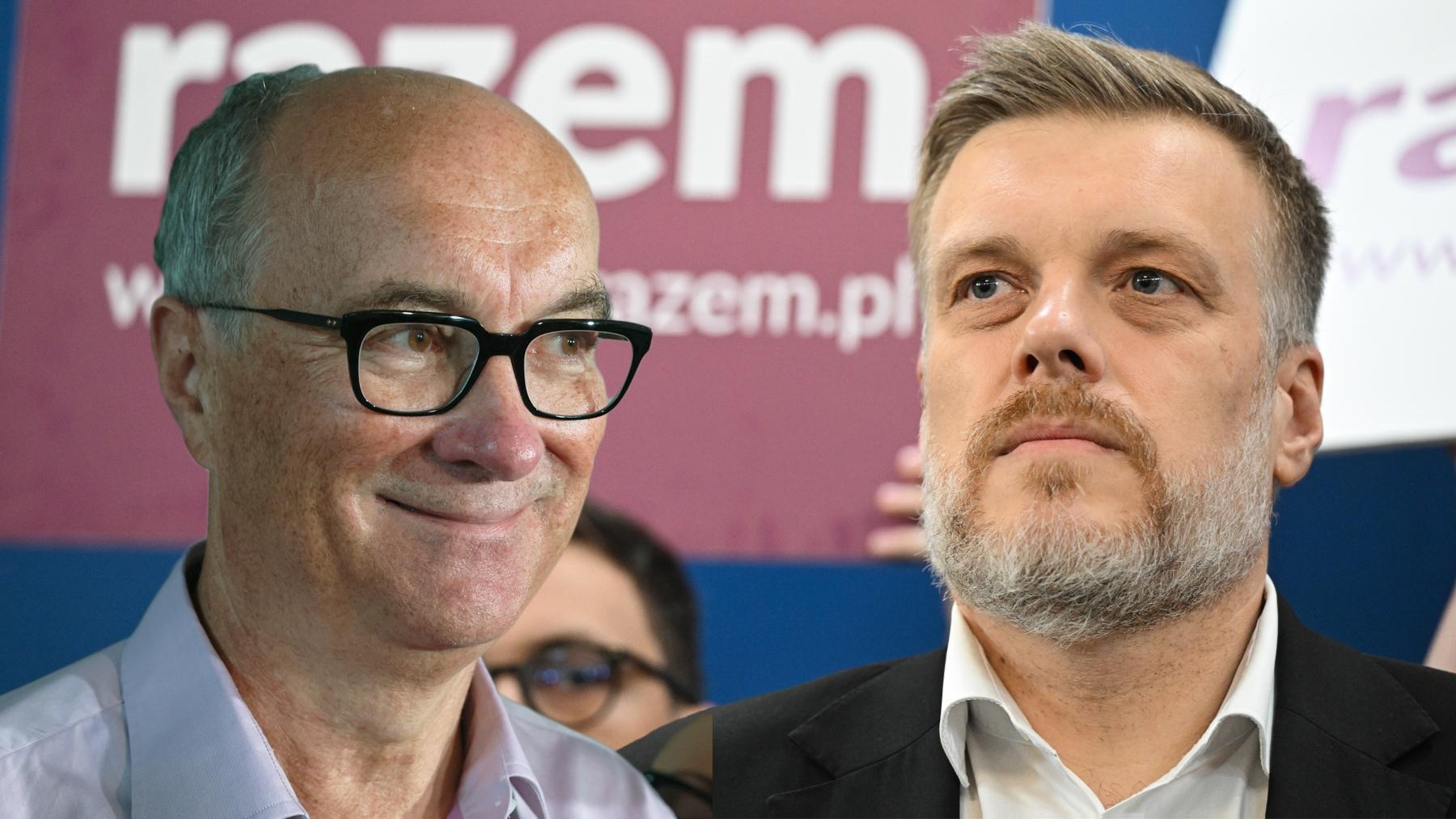
Razem MPs did not support Mr. Czarzasty in the vote to appoint him Speaker. The new Speaker responded by excluding Razem’s parliamentary group from the Senior Convention. He also excluded the other two parliamentary groups: the Free Republicans and the Confederation of the Polish Crown. The Sejm’s regulations do not mandate participation of parliamentary groups in the convention, though the previous Speaker, Szymon Hołownia, had invited them. Razem politicians have criticized the current Speaker’s decision.
Competition within the coalition
Professor Tomasz Słomka does not rule out the possibility that the New Left could run on joint lists with the Civic Coalition (KO).
“It would still be a left without a fully developed strategy beyond crossing the threshold and maintaining a share in government – assuming the current power arrangement can be sustained after 2027,” the political scientist said.
According to Professor Słomka, defining what the left should stand for is increasingly difficult. He notes that a significant portion of left-leaning voters’ expectations is being captured by KO, particularly on socio-cultural issues. If the New Left’s polling remains unstable, for some voters, KO may become their first-choice option in 2027.
“The simple Duverger effect works in favor of KO. A voter uncertain whether their preferred party will cross the electoral threshold may shift their vote to the next closest party, ensuring it isn’t wasted. I get the impression that Donald Tusk is playing this game, subtly pressuring Mr. Czarzasty by saying the New Left needs to stay closer to KO or risk being consumed. For the New Left, the problem is losing part of its electorate to KO. While the party tries to push a social agenda, it faces competition from Razem. Younger voters tend to trust Razem more than the New Left. Unable to reach younger voters, the New Left is instead trying to consolidate support among older, established left-wing supporters,” Professor Słomka observed.


Key Takeaways
- Politicians within the New Left who had intended to challenge Włodzimierz Czarzasty acknowledged his dominance and withdrew from the party leadership race. In return, they were invited to join the party’s leadership team.
- Włodzimierz Czarzasty has signaled a combative stance toward President Karol Nawrocki. As Speaker of the Sejm, he intends to use the next two years to score political points for the party on this front. He also aims to maintain the current governing coalition beyond the next parliamentary elections.
- Political scientist Professor Tomasz Słomka believes that under Mr. Czarzasty’s leadership, the New Left is focused on safely surviving until the next elections. He notes that the party is becoming synonymous with the old-guard establishment. According to the expert, Mr. Czarzasty’s party may struggle to attract young left-leaning voters, who tend to favor Razem, while older voters may see the Civic Coalition (KO) as their primary choice.