

This article is a part of Poland Unpacked. Weekly intelligence for decision-makers
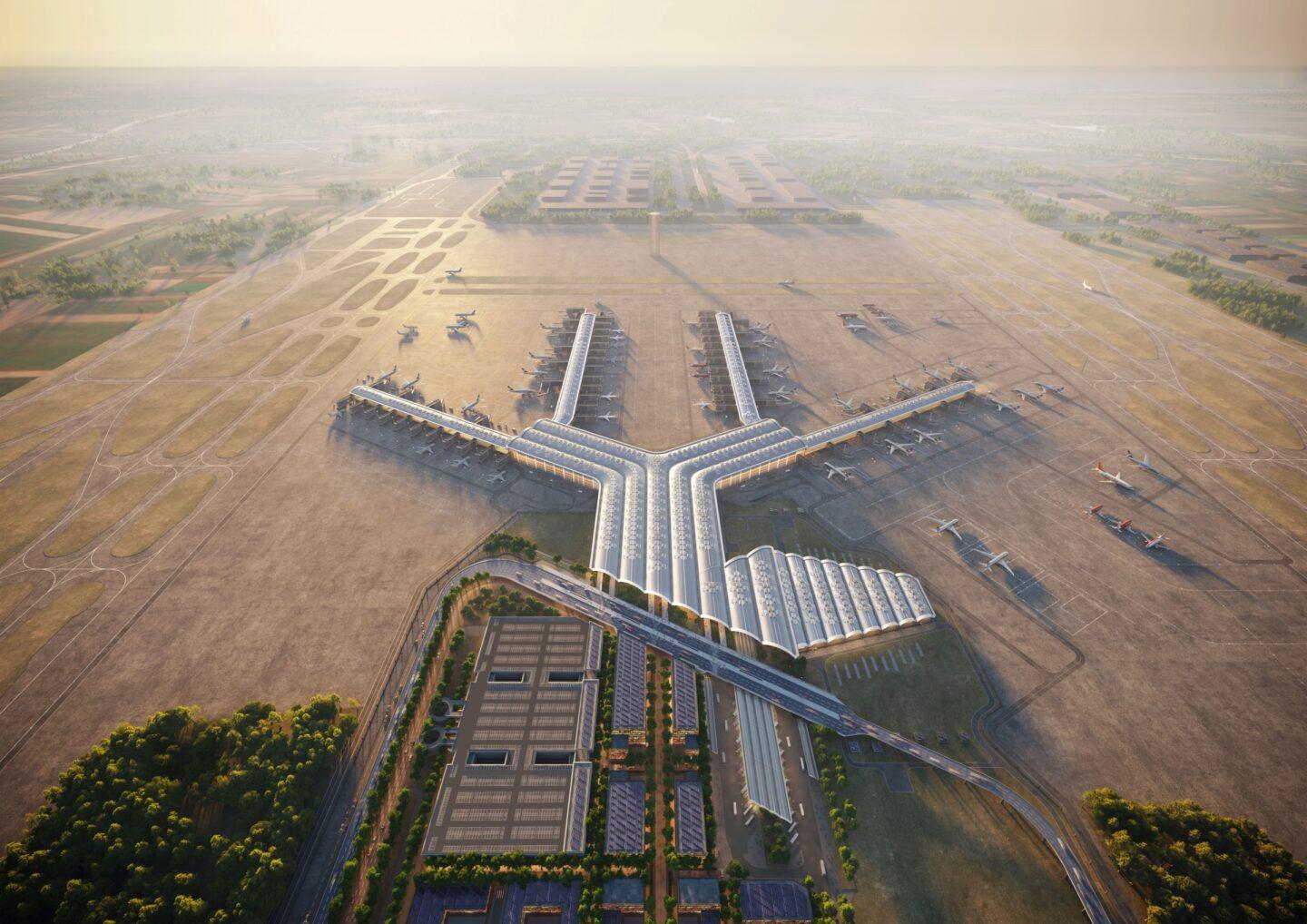
The second half of 2026 is scheduled to see the symbolic first spade driven into the ground for the mega-airport, the Central Communication Port (CPK). The facility is planned between Łódź and Warsaw and, in its initial phase, will be able to handle 34 million passengers.
However, as we learned in early December from Prime Minister Donald Tusk himself, the first spade will not so much mark the construction of CPK as… Port Polska. In the meantime, the airport’s name was changed, dismantling a concept that had been in development for years and ending the CPK brand. Yet, in the context of the broader shifts in the project, the CPK rebranding proved to be just the tip of the iceberg.
The Central Airport: A project Poland needed back in the communist era
The need for a hub airport in Poland – and for relief of the increasingly congested Warsaw Chopin airport – was already being discussed in the 1970s. The idea of building a new airport resurfaced in 2005, when the Civil Aviation Authority commissioned a feasibility study for a central airport.
The concept was only taken seriously in 2017, when discussions focused on the Central Airport (CPL). With the creation of a dedicated company the following year, the project was rebranded as the Central Communication Port (CPK or Solidarity Hub in English), emphasizing its role as a transit hub. CPK, envisioned as a hub, would integrate a railway station, a bus terminal, and an airport. A key element of the plan was an expanded railway network.
Formally, work on CPK began under the Law and Justice (PiS) government. In May 2018, the Central Communication Port Act was passed, legally establishing CPK and defining the scope of the investment. Details such as the budget and timeline were later clarified in a multi-year program adopted at the end of PiS’s term.
The first changes to the airport’s design
The Law and Justice (PiS) camp was responsible for the initial concept of CPK. For a long time, however, there was no coherent plan for the final shape of the mega-airport. Discussions included, among other things, the airport’s capacity. The original assumption was that CPK could handle up to 100 million passengers annually – an ambitious figure that, in 2017, was only achieved by the world’s largest airports, including Atlanta in the U.S.
A range of more or less realistic ideas also emerged regarding the airport’s design. One proposal even envisioned integration with a hyperloop network – a high-speed train operating mainly in vacuum tunnels.
When the Civic Coalition (KO) assumed power after the 15 October 2023 elections, it significantly reduced the planned airport capacity. The new plan now calls for 34 million, at most 38 million, passengers annually. The start date was also pushed back – the original concept anticipated the first plane taking off from CPK in 2027, while the new authorities set the date for 2032.
The public and opposition parties interpreted this as a “scaling back” of the project. Meanwhile, CPK’s new management argued that the changes were merely intended to “realistically adjust” investment timelines and strip away the overblown vision of their predecessors. The Civic Coalition’s position was partially supported by the Supreme Audit Office (NIK) in a September 2025 report, which found that the CPK project had not been properly managed and that the government’s plenipotentiary for the airport’s construction “unreliably defined the scale, scope, and timelines of the investment.”
And more changes to the idea
The concept for the high-speed rail network (KDP), designed to connect Polish cities to CPK in relatively short travel times, has also undergone significant changes. The groundbreaking for Line Y, the first section of the KDP, is scheduled for 2026. Like other parts of the project, this plan has transformed considerably from one government to the next.
Under PiS, the vision included nearly 2,000 km of new railway lines, with ten main lines – or “spokes.” The layout resembled the spokes of a bicycle wheel, all converging on a single point: the Central Communication Port.
The current government, however, did not favor this approach. The Civic Coalition abandoned the spokes in favor of a less centralized rail network. As Piotr Malepszak, Deputy Minister of Infrastructure, explained in early October, a fully centralized network would not work because 70% of passengers passing through the airport would not actually use it. Further analyses confirmed this assessment. The government concluded that the final rail network must also integrate regional, subregional, and national lines.
CPK’s management is now developing a project for the Integrated Railway Network (ZSK). Of ten proposed development scenarios, the optimal model will be selected – likely by the end of 2026. At this stage, it is already clear that the network will expand by more than 2,000 km of railway lines compared with the original plan.
It’s no longer CPK. It’s Port Polska!
Unexpectedly, in mid-December 2025, Prime Minister Donald Tusk announced a rebranding of the mega-airport project. The CPK, promoted since 2018, was renamed Port Polska, although the company’s legal name remained unchanged. Why Port Polska? The prime minister argued that the previous name, too closely associated with his predecessors, compromised the credibility of the entire infrastructure project.
The announcement sparked a public outcry. Changing such a widely recognized and established abbreviation stirred debate among investment observers, and opposition parties did not spare the government their criticism. Experts, including Dr. Michał Beim from the Poznań University of Life Sciences, emphasized that the new name serves purely a political function and will have no impact on the course of the investment itself.
President Karol Nawrocki, however, has pushed for a return to the original CPK concept. Reinstating the old name was among his first legislative initiatives. With parliamentary elections looming, it is reasonable to expect that the airport’s concept may undergo further changes before long.
Chopin Airport modernization left on the back burner
Law and Justice (PiS) also chose not to pursue the expansion (modernization) of Warsaw’s Chopin Airport, which has been operating at near-full capacity for years. During peak travel periods, such as summer holidays, massive security lines often spill out of the terminal itself. For the PiS government, the priority was building CPK.
The idea of expanding Chopin Airport was revived by the Civic Coalition (KO). Modernization is set to begin in 2026. The terminal will be enlarged by 15%, mainly through an extension of the south pier, increasing the number of aircraft parking stands. As a result, the airport – which handled 22 million passengers in the past year – will be able to accommodate around 30 million passengers annually.
Janusz Piechociński: The state fails on long-term investments
The year 2026 promises to be particularly interesting in terms of new infrastructure projects. Yet, given the shifting circumstances surrounding the planning of these multibillion-zloty investments, it is perhaps unsurprising that the final shape of these projects is viewed with some skepticism.
Janusz Piechociński, former Deputy Prime Minister and Minister of Economy, told XYZ that the state has consistently fallen short when it comes to major infrastructure projects.
Who's who
Janusz Piechociński
Janusz Piechociński is a Polish politician and economist best known for leading the Polish People’s Party (PSL – Polskie Stronnictwo Ludowe) and serving as Deputy Prime Minister and Minister of Economy in a Donald Tusk government.
Piechociński led PSL from 2012 to 2015, taking over the agrarian party during a difficult period. PSL traditionally represents rural interests, farmers, and small-town Poland – it’s been a kingmaker party that has formed coalitions with both center-right and center-left parties depending on electoral math.
He served as Deputy Prime Minister and Minister of Economy from 2012-2015 in the Civic Platform (PO) and PSL coalition government. During his tenure, he dealt with economic policy during Poland’s continued growth period, though PSL’s junior position meant limited influence over major decisions.
The 2015 collapse
Under Mr. Piechociński’s leadership, PSL suffered a devastating defeat in the 2015 parliamentary elections, falling below the 5% threshold needed to enter parliament for the first time since 1989. This was catastrophic for a party that had been in every government since the fall of communism in 1989. The loss was attributed to rural voters shifting to PiS (Law and Justice), which successfully appealed to small-town and rural Poland with its social programs and conservative message.
Mr. Piechociński resigned as party leader after this debacle. PSL eventually recovered enough to re-enter parliament in 2019.
“Especially in the area of long-term investments, which take more than a single parliamentary term to execute – from preparation and design to, most importantly, economic analysis – the Polish state, in its governmental and political-administrative capacity, clearly fails to rise to the challenge,” Mr. Piechociński said.
He cited the example of Radom Airport, built under the PiS government with the intention of transferring part of Warsaw Chopin Airport’s traffic. Warsaw-Radom Airport was also supposed to complement CPK. Today, it handles only a handful of flights per week. Even LOT Polish Airlines pulled out of operations there. The airport has since become something of a meme – a symbol of a costly, failed investment built without a solid economic foundation.
“When discussing investments, one needs some measure, some respect, and a willingness to listen and assess matters substantively. At present, there is no serious economic debate in Poland involving politicians,” Mr. Piechociński added.
The former deputy prime minister also reflected on the evolving concept of CPK.
“In 2017, the largest delegation of Chinese infrastructure business ever visited Poland. After our presentation of the CPK project, an important Chinese entrepreneur sitting next to me said: ‘What exactly do you want to build? A CPK for 30, 40, or 100 million passengers? Because those are completely different projects.’ And he was right – the previous government was not substantively prepared at all,” Mr. Piechociński recalled.
The only program that has remained largely consistent over the years, he notes, is the network of highways and expressways.
“That program was always a priority and had its financing legally secured. For example, the railways did not have this during the first 15 years of democratic Poland and incurred debt using old assets,” Mr. Piechociński concluded.


Key Takeaways
- The problem lies not in the investments themselves, but in the absence of mature economic debate. As Janusz Piechociński notes, Poland struggles to conduct substantive, cross-party discussions on projects spanning more than a single parliamentary term. Without robust economic analyses and political accountability, even key investments remain vulnerable to chaos and continual redefinition..
- CPK is a project without conceptual continuity, dependent on the political moment. Over the years, its name, scale, and function have shifted—from a central airport to a mega-hub with a hyperloop, and now to Port Polska. Every change of government brings adjustments that undermine planning stability and public confidence in the project.
- The new vision moves away from centralization toward a polycentric network. The government abandoned the “spoke” model of rail lines radiating from the airport, judging it poorly aligned with actual passenger needs. In its place, the Integrated Railway Network (ZSK) is being developed to connect regions rather than subordinating them to a single hub.