

This article is a part of Poland Unpacked. Weekly intelligence for decision-makers
Law and Justice (PiS) is calling for the construction of a new port. Port Haller – named after General Józef Haller, who fought for the restoration of Pomerania to Poland – would be built in Lubiatowo, within the Choczewo municipality. The same municipality is also slated to host Poland’s first nuclear power plant.
XYZ has previously outlined the project’s main assumptions, as presented by party leader Jarosław Kaczyński, PiS parliamentary caucus head and former defense minister Mariusz Błaszczak, and Gdańsk MP Kacper Płażyński. This time, we ask Mr. Płażyński to elaborate on the details behind the proposal to establish a new seaport.
Fireside chat
Cost of a new port? PiS MP puts the price at PLN 3 billion (EUR 700m)
Is the Port Haller concept based on concrete analyses? Do we know how much the investment might cost?
It is difficult to speak of detailed analyses and hard data when no tenders have yet been issued. This is a matter of sectoral expertise – people who have worked on such projects for years and are able to estimate costs with reasonable accuracy. According to our estimates, the total cost would be around PLN 3 billion (approx. EUR 700 million). The single largest expense would be the breakwater, at roughly PLN 1 billion (about EUR 230 million).
Who are these experts?
We have a group of experts, not all of whom can be publicly identified for various reasons. They include, among others, Jarosław Kiepura (rail transport expert), Tomasz Smoleń (transport expert), Lech Kuchnowski (former CEO of the Maritime Economy Design Office PROJMORS), Piotr Koenig (formerly, among other roles, a member of the supervisory board of the Port of Gdańsk), Tomasz Mostowski (a manager in rail companies), and Andrzej Osipów (a manager associated with the rail sector).
Lech Kuchnowski ran Poland’s largest company specializing in hydrotechnical infrastructure for many years. He was, among other things, the author of the Central Port concept for the Port of Gdańsk, which formally remains in force. Andrzej Osipów has spent his entire professional life in rail transport. These are figures well known within the logistics and transport community.
You estimate the cost at PLN 3 billion. How long would construction take?
That depends on the formal pathway. Last year, the government adopted legislation on special rules for the preparation and implementation of strategic investments for defense purposes. If Port Haller were included under those provisions, the process could be significantly accelerated.
The government is currently working on another bill that would further shorten procedures. If the Port Haller project were placed on the list of such investments, preparation of the documentation – including environmental decisions – could take no more than about 18 months. Construction could then begin.
And how long would construction itself last?
This would not be a giant port on the scale of Gdańsk or Gdynia. We are talking about a port with very straightforward logistics access. The project involves more than 300 hectares of undeveloped land designated for industrial and service activity. The site is prepared in such a way that implementation would not encounter serious technical or transport barriers. I believe three years is a very realistic timeframe, provided there are no execution-side problems.
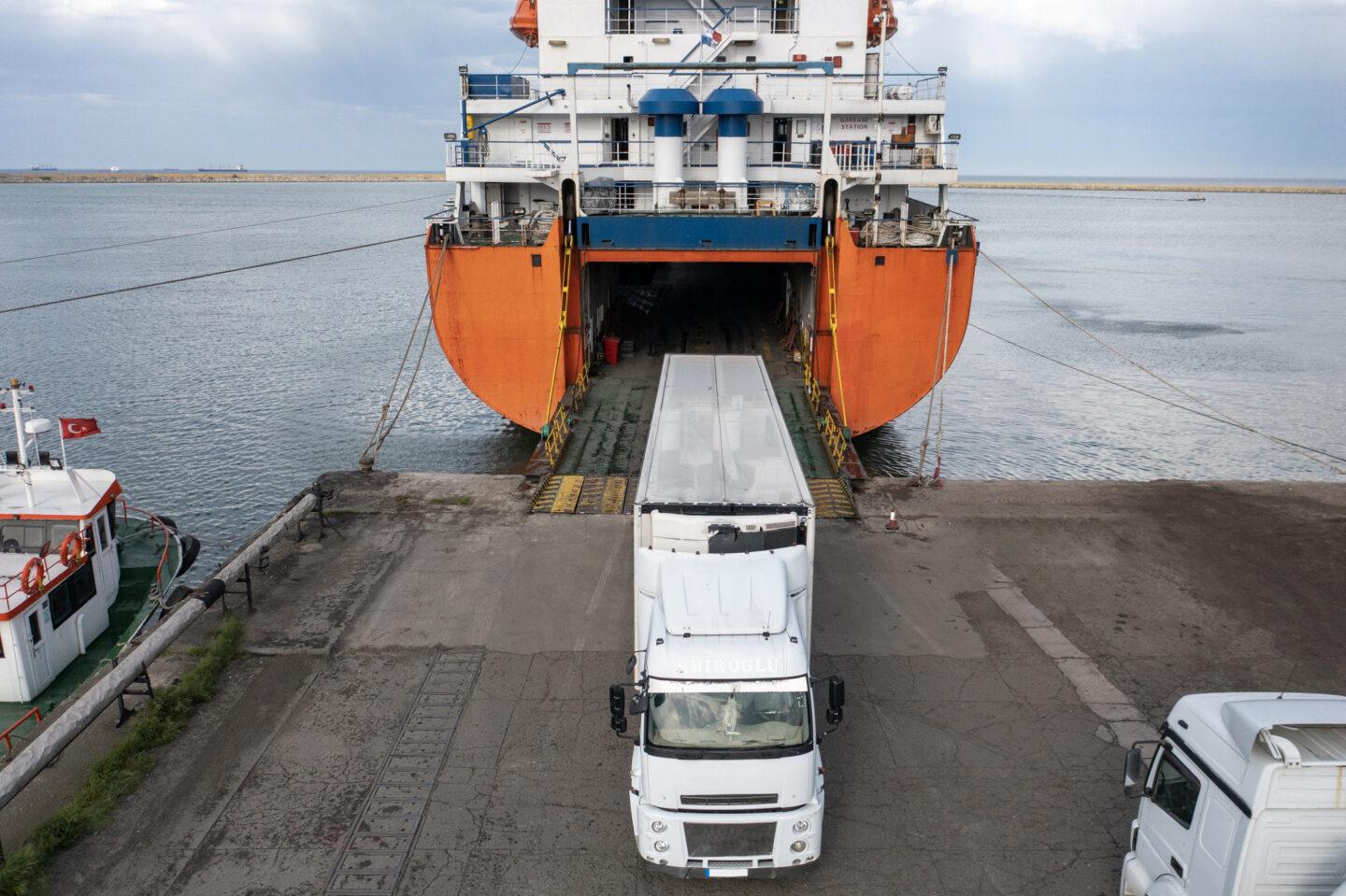
The port would specialize in handling ro-ro (roll-on/roll-off) vessels, which carry wheeled cargo. It would not be a container port like Gdańsk or Gdynia. Poland’s coastline lacks a fully fledged ro-ro port. Such a facility requires a great deal of space – above all, yards for trucks and a rail siding that allows trailers to be transported by rail. These ships are also used to carry cars.
From a logistics standpoint, this requires substantial back-up facilities. No such space has been planned in either Gdańsk or Gdynia. In the planned Central Port in Gdańsk, only about 30 hectares have been earmarked as part of so-called land reclamation – the creation of a new island for port investment. That is still far too little to build the back-up facilities for a full-scale ro-ro port. In the location we are discussing, that space simply already exists.
Construction itself would also be neither as complex nor as expensive as in many other infrastructure projects. Nor is it a given that the port would need a separate management structure. I would lean toward it operating as an outlying unit of one of the existing ports – most likely the Port of Gdańsk.
So, effectively, a branch of the Port of Gdańsk?
Gdynia never even planned a port of this nature. There are several small areas there - together a dozen or so hectares – that function as ro-ro facilities, but they are scattered across the city center. That suffices for ad hoc needs. By comparison, the ro-ro port in Antwerp covers 125 hectares, while in Scandinavia such ports typically span several dozen hectares.
So far, no large port of this type has been planned in Poland, even though cargo flows from Poland, Ukraine, Turkey, the South Caucasus, and the Adriatic route – including Europe’s largest multimodal hub specializing in truck trailers in Verona, as well as several Italian ports – constitute a volume of freight that would guarantee Port Haller ample business. Primarily this would be traffic to Scandinavia, but the port could also be attractive for the United Kingdom.
Why build a new port instead of expanding existing ones?
Because in practice that is extremely difficult. It would be extraordinarily costly and logistically complex. The Port of Szczecin–Świnoujście lies far from the main rail corridors – its infrastructure would have to be built virtually from scratch. By contrast, in the Choczewo municipality infrastructure is already being developed in connection with the construction of the nuclear power plant.
We are talking about road and rail investments built to the highest load-bearing standards, adapted to transporting very heavy components. This infrastructure costs around PLN 5 billion (approx. EUR 1.15 billion) and can naturally also be used by the port.
In Gdańsk, there are plans to allocate around 30 hectares for a ro-ro port, but that is still far too little. Moreover, this would be reclaimed land, which significantly raises costs. The rail line to the Port of Gdańsk is already operating at the limit of its capacity. In a city, every meter of space counts.
In Choczewo, the situation is different. More than 300 hectares have already been designated in planning documents as investment back-up for the nuclear power plant. That is a potential no other port location in Poland has. Since the infrastructure is being built anyway, it makes sense to use it rationally. The social costs have already been incurred.
Wouldn’t that mean too many strategic facilities in one place?
On the contrary – the location is an asset. Lubiatowo is more than twice as far from Baltiysk as the Tri-City ports. Iskander-type missiles would need more time to reach it, increasing the chances of interception.
As for long-range artillery, which Defence24 has written about – even assuming a range of around 70 kilometers – this area lies beyond the realistic reach of effective fire. In addition, in the event of a military threat, no military equipment would be routed there.
The port would be built in the immediate vicinity of the nuclear power plant, which for obvious reasons will be subject to the highest level of protection. The same security systems would protect both facilities. Moreover, according to my conversations with military officers, the range of defensive systems from the Redzikowo area also covers the Choczewo municipality.
So the Port Haller concept was consulted with the military?
Yes, although I cannot disclose names. I can confirm that discussions with high-ranking officers did take place.
And with local governments?
Informally, yes – with local officials from Wejherowo County. The reactions have been positive. For these municipalities, it would be a major development impulse.
Have you considered financing models?
That requires market sounding. There are various models. One can build independently or with a private partner. In the case of the port in Świnoujście, the previous government had a partner who withdrew after the change of power. I requested documents on the matter but was refused, on the grounds of corporate confidentiality.
Another option is to build the port for a specific operator, who then pays a lower lease fee. Alternatively, it can be built with public funds and the infrastructure subsequently leased out.
Is the project linked to the presidential bill “Yes to Polish Ports”?
I have not yet received the draft in committee, so it is difficult to comment. These are separate initiatives.
Will there be a legislative initiative in this parliamentary term?
There is no time to lose. I do not expect full support from the current government, but I will speak with Minister Marchewka, Minister Malepszaki, and Prime Minister Kosiniak-Kamysz. I will try to persuade MPs from all parties not to treat this as an “opposition idea,” but as a strategic investment.


Chair of the Parliamentary Committee on Maritime Economy
Explainer
The Tri-City
The Tri-City (Trójmiasto in Polish) refers to the metropolitan area formed by three neighboring cities on Poland's Baltic coast: Gdańsk, Gdynia, and Sopot. Together they create one of Poland's most important urban areas with around 750,000-800,000 people.
Gdańsk is the largest and historic anchor - a beautiful port city with over 1,000 years of history, famous for its reconstructed old town, amber trade, and as the birthplace of the Solidarity movement that helped end communism. It's the economic and cultural center with around 470,000 people.
Gdynia is the youngest, built essentially from scratch in the 1920s-30s when Poland needed a modern port after regaining independence. It's more modernist in architecture, has a major commercial port and navy base, and feels more business-oriented. Population around 245,000.
Sopot is the smallest (around 35,000) but punches above its weight - it's Poland's premier seaside resort town, squeezed between the other two. Famous for its long wooden pier, beaches, the Forest Opera amphitheater, and upscale atmosphere.
The three cities blend seamlessly together, connected by the SKM (fast urban railway) that runs along the coast. You can live in one, work in another, and go out in the third without really noticing you've crossed city borders. The transport integration makes it function as one metropolitan area.
The Port Haller proposal: Political reactions
The Port Haller concept has drawn responses from several politicians, including Katarzyna Pełczyńska-Nałęcz, minister of funds and regional policy. She described the project as “the antithesis of a development-oriented investment,” noting that Poland already has four strategic ports and four regional ones, and that the global trend is to expand existing ports rather than build new ones.
In her view, a new port would amount to a waste of public funds and an unfriendly gesture toward Pomerania. She also pointed out that Choczewo is not located on European transport corridors, which would limit the project’s ability to attract EU funding.
Criticism of Port Haller: Płażyński pushes back
The Law and Justice (PiS) MP rejects these arguments. He stresses that none of Poland’s existing ports has any realistic capacity to expand a ro-ro facility, while the growing volume of cargo flows along the Rail Baltica and Rail Intermarinum corridors will exceed current infrastructure capabilities.
He also argues that ports around the world are expanded where conditions allow – and where they do not, new ones are built. He points to Wilhelmshaven and London Gateway as examples.
Addressing the ownership issue, he notes that local governments’ stakes in ports are largely symbolic: in the Port of Gdańsk, the city holds around 2 percent of the shares, and even less in Gdynia. In his view, Choczewo could be incorporated into the TEN-T network once a new port is established.
“Port Haller would not compete with Gdańsk or Gdynia. It would handle cargo that those ports are currently unable to accommodate,” the PiS MP concludes.
The Port Haller proposal has also been criticized by Maciej Samsonowicz, an adviser to Defense Minister Władysław Kosiniak-Kamysz and head of the Polish People’s Party (PSL) in Gdynia. Samsonowicz is coordinating work on the “Green Industrial District-Kashubia” project.
He took aim at the rhetoric used by Mariusz Błaszczak. The PiS parliamentary caucus leader and former defense minister had suggested that Port Haller could serve as a transport hub for allied forces and as a logistics back-up facility. According to the defense minister’s adviser, the PiS politicians’ proposal runs counter to existing strategic documents. In his view, Central Pomerania should focus on developing ports that already exist – Ustka and Kołobrzeg – as outlined in a report prepared under the Pact for Poland’s Security-Central Pomerania initiative.
The PSL politician also suggests that building a new port in the Choczewo municipality could create an opportunity for Daniel Obajtek to enrich himself. The PiS MEP and former CEO of Orlen owns plots of land in the municipality.
Explainer
Daniel Obajtek
Daniel Obajtek is a controversial Polish politician and businessman who served as CEO of PKN Orlen, Poland’s state-controlled oil refining giant, from 2018 to 2024 under the previous Law and Justice (PiS) government.
During his tenure, he oversaw massive expansion projects including the acquisition of smaller rival Lotos and German refiner Bayernoil, transforming Orlen into Central Europe's largest energy company, though critics accused him of empire-building and politically-motivated deals that benefited the ruling party.
His leadership was marked by allegations of conflicts of interest, questionable business practices dating back to his time as mayor of a small town, and a combative relationship with independent media, while supporters praised his ambition and business acumen.
After PiS lost power in late 2023, Obajtek became the target of multiple investigations by the new government and prosecutors, fled to Hungary (avoiding a parliamentary summons), and was elected to the European Parliament on a PiS ticket – a move seen as seeking parliamentary immunity from prosecution.
He remains a deeply polarizing figure who embodies the broader political divisions in Poland, with opponents viewing him as a symbol of cronyism under PiS rule and allies defending him as a victim of political persecution by the current Tusk government.
Not just the government: Confederation also critical
Winning support for the Port Haller idea will not be easy for Law and Justice (PiS) politicians on the opposition benches either. The proposal has also been criticized by Krzysztof Szymański, a Confederation (Konfederacja) MP from the Gdynia–Słupsk district and deputy chair of the parliamentary committee on maritime economy.
Mr. Szymański argues that there is no clear natural market niche for ro-ro cargo handling. In his view, demand in this segment does not justify building a new port; instead, it would warrant expanding quays and ramps at existing strategic ports.
Kacper Płażyński responds that ro-ro cargo handling is not a challenge for today, but for a horizon of at least five years. The PiS politician believes that within that timeframe new maritime routes will open up, particularly toward Scandinavia and as part of inter-sea connections with the United Kingdom.
To the Confederation MP’s argument about a lack of economic competitiveness vis-à-vis existing ports, Mr. Płażyński replies that Port Haller is not meant to compete with them, but to complement their capacities. Addressing the military angle, he stresses that the port is not intended to be a military facility. It is to remain a civilian port that, if necessary, could serve as a logistics back-up for allied forces.
Responding to the suggestion that alternatives based on existing infrastructure have been overlooked, Mr. Płażyński says that in Władysławowo and Ustka there is no room for the unconstrained development of road and rail infrastructure due to the tourist character of those towns. In his view, there are also no reserves for such an investment in Kołobrzeg, where the rail line runs through the city center.


Key Takeaways
- Law and Justice (PiS) MP Kacper Płażyński explains the rationale for building a ro-ro port by pointing to the limited capacity of existing ports to handle this type of cargo. He argues that the ports of Gdańsk and Gdynia lack the space needed to serve the ro-ro niche, which he believes will grow rapidly. According to PiS politicians, the road and logistics infrastructure being developed for the nuclear power plant could facilitate the creation of a new seaport in the same municipality.
- According to the PiS MP, the cost of building the new port could amount to around PLN 3 billion (approximately EUR 700 million). The most expensive component would be the construction of the breakwater, estimated at about PLN 1 billion (around EUR 230 million). If Port Haller were designated an investment of key importance for defense needs, the formal procedures and design work would take roughly 18 months, with construction itself lasting about three years.
- MP Kacper Płażyński has announced plans to hold talks with representatives of other parliamentary groups as well as government members responsible for infrastructure. He wants to persuade them to launch work on the project within the current parliamentary term. However, critical voices have emerged both from the governing coalition and from the opposition Confederation party.