

This article is a part of Poland Unpacked. Weekly intelligence for decision-makers
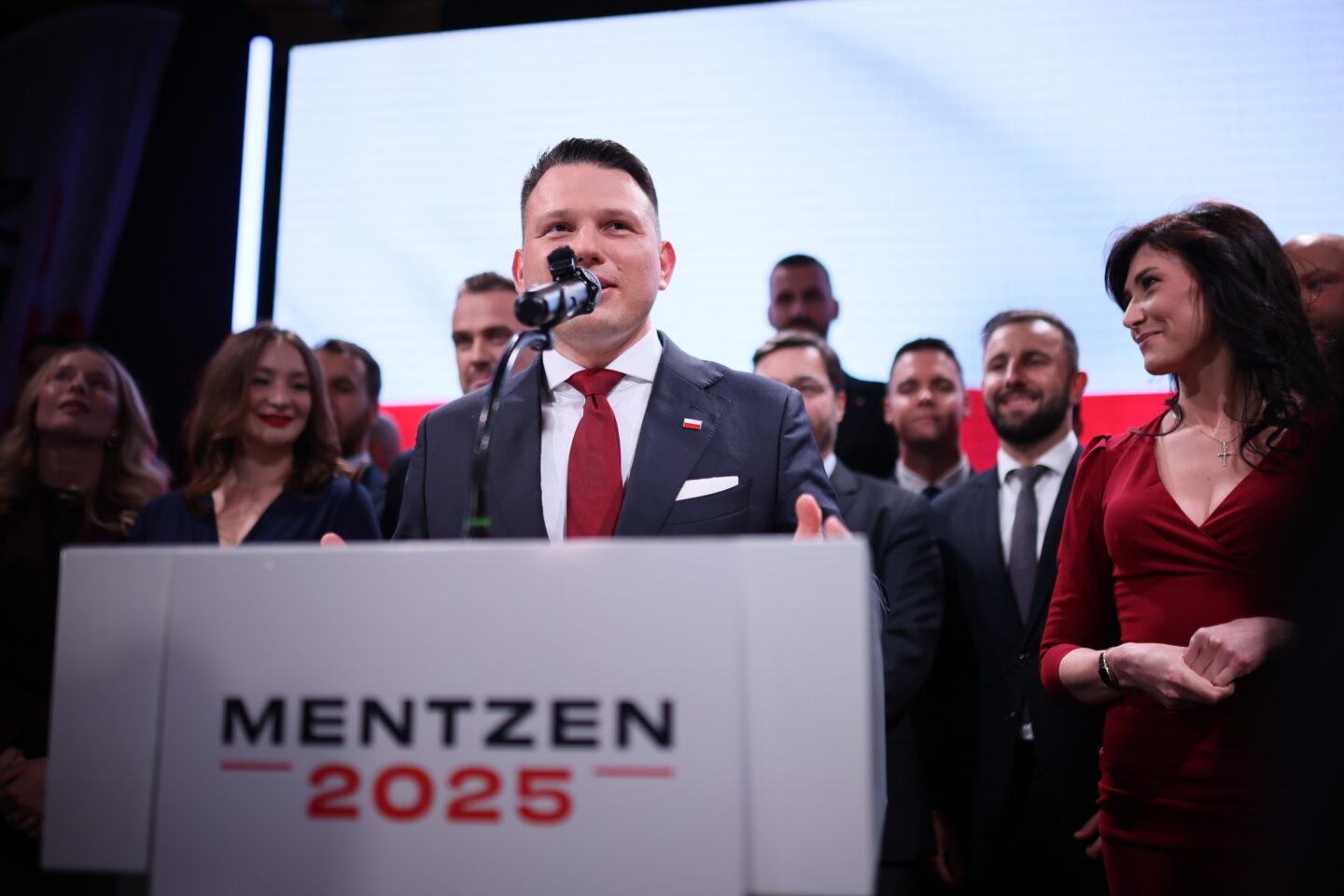
Political competition on the right is intensifying. Confederation (Konfederacja) leader Sławomir Mentzen has announced the launch of a platform called Project 27, allowing the party’s supporters to submit proposals for its 2027 election program. It is another clear signal that the party is already positioning itself for the next parliamentary campaign.
Although the official election campaign has yet to begin, Confederation is clearly preparing for the next stage of political rivalry.
This is not the first time the party has used pre-campaign tools. In August 2024, Mr. Mentzen was the first to announce the start of his presidential pre-campaign, which translated into third place in the election and nearly 3 million votes.
Confederation’s plan to accelerate
Several months later, Confederation consistently holds third place in the polls, well behind the Civic Coalition (KO) and Law and Justice (PiS), yet with a noticeable lead over other parties. At the same time, the party is aware of the limitations of this position. Recent months have seen a lower intensity of its political activity.
Pressure from the right is increasing, however, with Grzegorz Braun and the Confederation of the Polish Crown (KPP). Public opinion surveys show that the radical current centered around the so-called “fire extinguisher movement” is gaining traction, while the ratings of the formation led by Mr. Mentzen and Mr. Bosak remain stagnant.
Explainer
Mr. Braun’s Fire Extinguisher Movement
“Braun’s Fire Extinguisher Movement” (Ruch Gaśnicowy Brauna) originated from an incident in December 2023 when Polish MP Grzegorz Braun used a fire extinguisher to disrupt a Hanukkah candle-lighting ceremony in the Sejm, parliament's lower house, prompting his temporary exclusion from proceedings and widespread media coverage.
The phrase has since been adopted by Mr. Braun and his supporters as a rallying slogan for his Confederation of the Polish Crown (KKP) faction, framing it as symbolic resistance against perceived cultural and political threats during his 2025 presidential bid and efforts to form a parliamentary group.
In this context, Confederation has decided to go on the offensive - not by presenting ready-made program solutions, but by launching the Project 27 platform, where party supporters can submit proposals for the 2027 election program. As Mr. Mentzen emphasized in a YouTube video, the consultations are intended to help create a program that best reflects voters’ expectations.
Vox populi, vox dei?
“I wanted to create a platform that allows anyone to submit an idea and then have it evaluated by experts. Perhaps some of them will eventually make it into our program. I felt there was no point in locking ourselves in a room. It’s better to open up to you, the voters, and let you participate in creating the 2027 program. Project 27 is, therefore, our joint work, our shared project,” Mr. Mentzen said in the announcement video.
Ideas can be submitted across 18 categories, including digitalization, deregulation, culture, local government, education, and labor law. Each category is assigned a leader responsible for reviewing submissions and guiding them to further discussion. The leadership team is dominated by Confederation politicians, including MPs Przemysław Wipler and Bronisław Foltyn, and MEP Marcin Sypniewski. There are exceptions, such as MP Tomasz Rzymkowski, formally unaffiliated, elected to the Sejm on a Law and Justice (PiS) ticket.
In the promotional video, Mr. Mentzen encouraged prompt submission of proposals:
“I would very much like to launch a series of thematic debates and panels by late spring, inviting experts to discuss these ideas. The goal is to debate them and move program work forward,” he said.
This gives a clear timeline for when Confederation intends to initiate public debate on new issues. The question remains: which ideas are attracting the most interest so far?
By the time of publication, over 4,000 ideas had been submitted, with the most popular viewed several thousand times. On February 3, 2025, the site went down for several hours but was eventually restored. The platform’s creators attributed the disruption to hosting problems.
Déjà vu?
Even a cursory look shows a dominance of proposals aligned with the party’s established line. These include calls for the elimination of taxes and levies such as the Belka tax, the sugar levy, or the RTV fee, and even the abolition of unemployment offices.
Explainer
Belka's tax, sugar levy, RTV fee
The Belka's tax: Named after former Prime Minister Marek Belka who introduced it in 2004, this is a 19% flat tax on capital gains from savings and investments - interest on bank deposits, dividends, stock market profits. It's controversial because it treats passive investment income more favorably than earned wages (which face progressive rates up to 32%), leading to debates about fairness and whether it benefits the wealthy at workers' expense.
The sugar levy: Introduced in 2021, this is an excise tax on sugary drinks and high-caffeine energy drinks, charged per liter based on sugar content. It's framed as a public health measure to combat obesity and diabetes, but critics see it as a revenue grab that hits lower-income consumers hardest while having questionable health impact.
The RTV Fee (abonament RTV): This is a monthly fee (currently around PLN 27.50) theoretically required from anyone owning a TV or radio to fund public broadcasters TVP and Polish Radio. In practice, enforcement is weak, collection rates are low, and many Poles simply don't pay it.
Top submissions also reflect the so-called libertarian wing of Confederation, represented by Mr. Mentzen’s New Hope party. Proposals include legalizing marijuana, reinstating Sunday trading, and deregulating homeschooling.
Popular, smaller-scale suggestions, outside major ideological disputes, have also emerged, such as withdrawing low-denomination coins from circulation or recognizing military retirees’ and pensioners’ IDs in the mObywatel app.
There are also proposals consistent with Confederation’s worldview. Among the most read and supported are suggestions like “restore normal language in job advertisements” [using forms that in Polish clearly indicate gender - ed.] or “return the Polish flag to license plates.” Notably, both were submitted by Confederation spokesperson Wojciech Machulski. Meanwhile, MEP Stanisław Tyszka submitted the proposal to abolish the sugar levy. In practice, this indicates that Confederation politicians are also using the platform to test their own proposals among potential voters.
A turn toward the electorate as a breath of fresh air
Internet polls carry the risk that users may push narratives that do not necessarily align with the organizers’ ideological profile. The most popular idea on Project 27 - by a clear margin - was a proposal to introduce same-sex marriage. It was eventually removed from the site. Unsurprisingly, it sparked lively debate, though not necessarily in a supportive tone.
The final evaluation of proposals rests with experts. Based on their recommendations, submissions will be further processed within party structures. The expert group includes both Confederation politicians and individuals who volunteered for the role and were approved by category leaders.
A similar consultation model has not previously been used by political parties. In the broader public sphere, however, it is not entirely new. A year ago, entrepreneurs including Rafał Brzoska launched the SprawdzaMY platform in response to Prime Minister Donald Tusk’s invitation to collaborate on deregulation. Some proposals submitted then were eventually implemented.
Mr. Mentzen’s opportunities and goals
Michał Piedziuk, a political analyst at Polityka Insight, notes that the initiative has real potential to strengthen Confederation’s position.
“The online portal is Mentzen’s own initiative, supported by his closest political circle in New Hope. The party wants to tell a story of a program created by people and for people, responding to social needs and expectations. It’s an interesting project and, above all, easy to sell in political competition. On the other hand, the risk of users posting radical proposals and the media automatically associating them with Confederation appeared in the first days of the portal’s operation,” Mr. Piedziuk observes.
Beyond setting a programmatic direction and declaring a readiness to implement changes if in power, Confederation is pursuing other political goals. Until mid-last year, the party under Mr. Mentzen shaped a significant part of the right-wing narrative. One need only recall the visits of Karol Nawrocki and Rafał Trzaskowski to Toruń, where they sought talks with Mentzen ahead of the second round of elections.
Paradoxically, Mr. Mentzen’s strong showing proved the last clear moment of growth for the so-called “big Confederation” in 2025. After the presidential election, the narrative on the right was taken over by the new president and the steadily rising Grzegorz Braun. In the second half of the year, Mr. Mentzen stepped back, and Krzysztof Bosak and his national wing could not effectively counter the offensives of Mr. Nawrocki and Mr. Braun.
Confederation’s support has regularly exceeded several percentage points, but gradually declined, primarily to the more radical Confederation of the Polish Crown. In this context, Mr. Mentzen and Mr. Bosak’s party has already publicly opened a chapter under the banner “2027 parliamentary campaign.”
Meanwhile, the Confederation of the Polish Crown held its first congress, and Law and Justice - according to media reports - is preparing to announce a candidate for prime minister. The race for right-wing dominance has clearly accelerated.


Key Takeaways
- Confederation has begun early preparations for the 2027 parliamentary campaign, attempting to break poll stagnation. Mentzen and Bosak’s party faces growing competition from Grzegorz Braun and the Confederation of the Polish Crown. Recent months saw reduced activity and loss of narrative initiative to other right-wing actors. The new offensive aims to stop voter attrition and regain influence over the public debate agenda.
- The centerpiece of this strategy is the online Project 27 platform, allowing voters to submit program proposals across 18 thematic categories. The process is overseen by designated leaders—both senior party politicians and outsiders, including MP Tomasz Rzymkowski. Mentzen has announced that collected proposals will be used in expert debates scheduled for late spring and further program work.
- The platform’s operation has revealed both high engagement from party supporters and risks associated with an open consultation format. Most submissions align with Confederation’s free-market line and focus on deregulation and tax cuts. The proposal to introduce same-sex marriage, however, gained the most popularity, contradicting the party’s ideological profile. The final shape of the program will depend on the decisions of party experts and category leaders, who retain the decisive say on submitted proposals.