

This article is a part of Poland Unpacked. Weekly intelligence for decision-makers
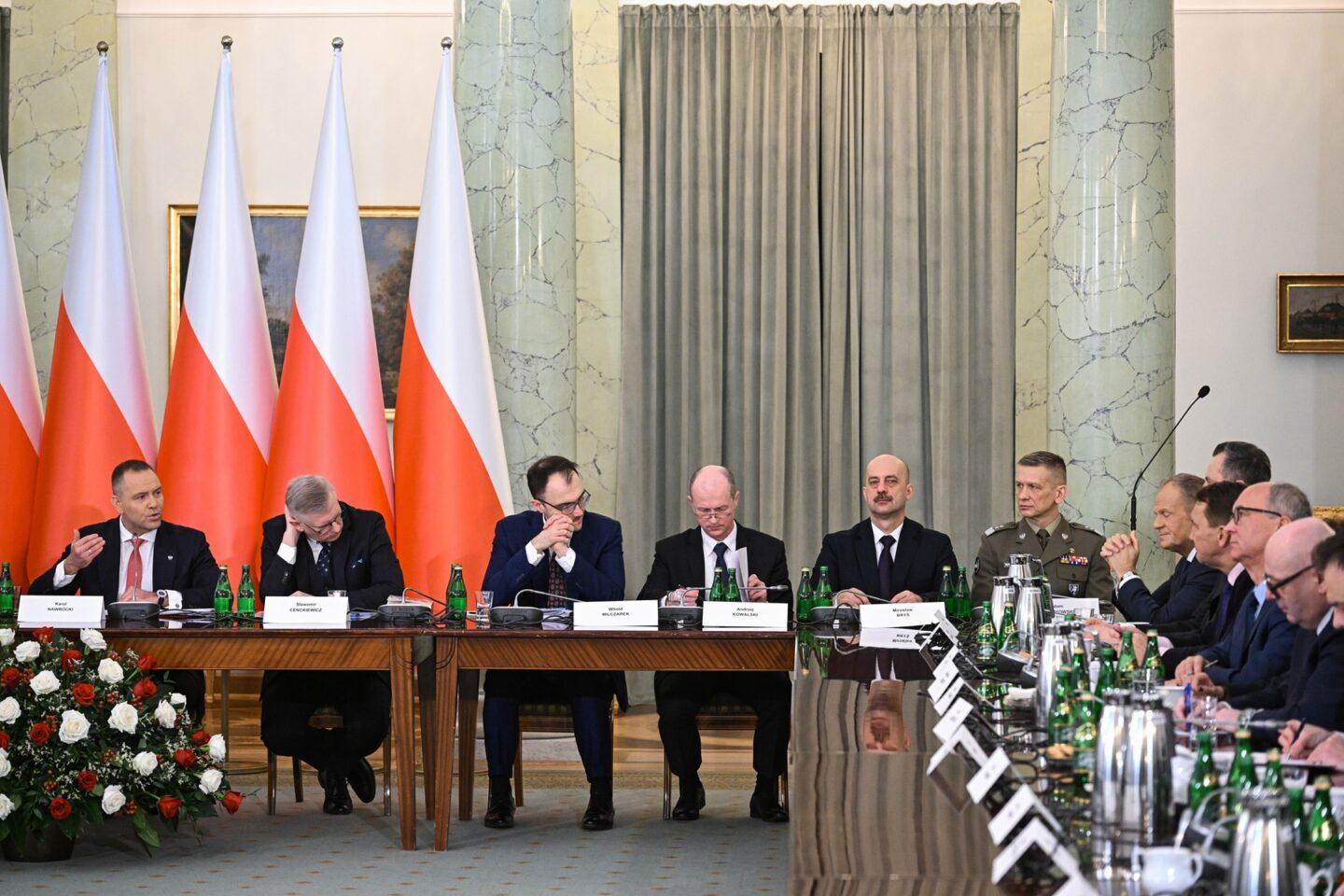
A controversial lineup, high tension between the government and the president, and billions of złoty at stake – this is difficult terrain for debate. Such were the conditions of the meeting of the National Security Council (RBN), convened by President Karol Nawrocki. Just ahead of the Council’s session, the government adopted a draft bill on the SAFE program.
The meeting of the National Security Council was marked by disputes. They centered on SAFE – whose unexpected opponent turned out to be the head of the National Security Bureau (BBN), Sławomir Cenckiewicz – as well as on Donald Trump and the Speaker of the Sejm, Włodzimierz Czarzasty.
Politicians from the governing coalition went to the Presidential Palace hoping that President Karol Nawrocki would sign the SAFE bill – that is, the EU instrument designed to strengthen state security. Poland is set to receive the largest share of SAFE funds – nearly EUR 44 billion.
Concerns about the president’s signature, however, run high. The funds from the EU instrument have been sharply criticized by the aforementioned head of the BBN, Sławomir Cenckiewicz. The “presidential defense minister,” as he is often described, has argued on social media above all that the funds cannot be used to purchase weapons and equipment from the United States and South Korea.
Speaker Czarzasty under scrutiny
The second issue concerned tensions between Karol Nawrocki and Włodzimierz Czarzasty. Media outlets have raised questions about Mr. Czarzasty’s unclear ties to a Russian national. In addition, there is a recent dispute involving the Speaker, who clashed on social media with the U.S. ambassador, Tom Rose.
Despite this, when asked about the mood ahead of the Council meeting, Sławomir Cenckiewicz responded tersely: “conciliatory.” Within the governing coalition, however, concerns were real – and serious. One minister told XYZ ahead of the meeting: “They want a fight.” “They,” of course, meaning the presidential camp.
“A week ago, they circulated the RBN agenda with a confrontational item on it. If the president truly wanted to learn something about Mr. Czarzasty, he should have requested information under Article 18,” we hear.
This refers to Article 18 of the Act on the Protection of Classified Information – in other words, proceeding through the classified information security officer.
The Speaker of the Sejm formally asked the Presidential Palace to expand the agenda of the National Security Council meeting. He wanted the president to explain his own associations with figures from the criminal underworld. Consent for such an item, however, was not given. According to people close to Włodzimierz Czarzasty, the Speaker intended to raise the issue during the Council meeting regardless of the president’s wishes and those of his aides.
Controversy also surrounded the invitation to the National Security Council of MP Włodzimierz Skalik from the Confederation of the Polish Crown (KKP) party. At a recent congress of that party led by Grzegorz Braun, openly pro-Russian views were presented.
Government moves on the SAFE program
Immediately ahead of the National Security Council meeting, the Council of Ministers adopted the legislation implementing the SAFE program. The move was announced by Deputy Prime Minister and Minister of National Defense Władysław Kosiniak-Kamysz.
In a statement posted on social media, he said the bill had been approved by the government “despite everyone who wished Poland ill.” He added: “We are not distracted by political spite – we are consistently strengthening the state and building its power, regardless of whom this displeases.” The deputy prime minister said the first funds could reach Poland as early as March.
At the cabinet meeting, Prime Minister Donald Tusk said that the SAFE program had become the subject of an “unnecessary and harmful political confrontation” between the government, the opposition, and the presidential camp.
“I have no doubts about this, and it is clearly evident from the messages coming both from the opposition benches and from the Presidential Palace, that our opponents would like to torpedo this project. This is an attempt to destabilize the whole of Europe; it is an attempt to reduce Poland’s role in the European Union,” Prime Minister Donald Tusk said at the cabinet meeting preceding the National Security Council session.
Prime Minister on the Peace Council: Poland will not join
At the cabinet meeting, the prime minister also addressed a second item on the National Security Council’s agenda. He said that Poland’s embassy in Washington had received an invitation to the inaugural meeting of the Peace Council, scheduled for February 19.
“This is probably the moment to state clearly and unequivocally that, under the current circumstances – given the principles involved, the status of this Council, its immediate objectives, mainly related to the reconstruction of Gaza, as well as certain constitutional doubts regarding the Council’s structure – Poland will not join the work of the Peace Council,” Prime Minister Donald Tusk said.
“At the same time, we will continue to assess the situation in a very flexible and, of course, very open manner. So if circumstances change in a way that would allow Poland to participate in the Council’s work, we do not rule out any scenario,” he added.
National Security Council: The President’s doubts
The meeting of the National Security Council began a few minutes after 2:00 p.m. During roughly half an hour of the public session, President Karol Nawrocki laid out his arguments on the issues before the Council. He spoke about the need to verify whether the SAFE program would, in fact, serve Poland’s security.
“The government should strive to ensure that everyone is involved in this process. I will encourage all of you to engage beyond party politics. I will propose specific amendments to the draft legislation that respond to Poland’s interests. In recent days, we have seen a great deal of communicative euphoria from the government following the approval of the loan under SAFE. But Poles have not received full information about this program, and that is what I would like to discuss with you,” President Karol Nawrocki said.
His doubts focused on the terms under which the loan would be granted to Poland and on its political conditionality. He expressed concern that the funds might be disbursed to Poland in a manner similar to the National Recovery Plan, under which money was released only after a change of government.
The president also questioned the government’s declarations that 80 percent of SAFE funds would be spent in Poland, saying he hoped the government would present documents to substantiate this claim. In addition, he challenged the lack of transparency surrounding contracts concluded under the SAFE program.
The Peace Council
President Karol Nawrocki also addressed the invitation for February 19 that Prime Minister Donald Tusk had mentioned at the cabinet meeting. He said he still hoped the government would express its position and consent to Poland joining the Council.
“The problem is not whether the government has doubts. The problem is that, despite my conversations with the prime minister, the government has not presented me, as president, with any concrete position. I appeal to the government to take a decision. As of today, there is no recommendation, no substantive analysis, and no opinion,” President Karol Nawrocki said.
The president also argued that there was disinformation surrounding the USD 1 billion required for permanent membership in the Peace Council. As he explained, joining the Council for an initial three-year period would be free of charge, and only after that time would the Council’s chair decide on possible continued membership for a given country. According to the president, term limits would not apply to states that pay USD 1 billion in the first year of membership.
President takes aim at Mr. Czarzasty
In the context of the Peace Council, the president delivered his first political broadside against the Speaker of the Sejm, Włodzimierz Czarzasty.
“During the election campaign, I was asked whether I would sit down at the table with Vladimir Putin. I replied that I would sit down with anyone if the interests of the Republic so required. I am in no hurry to sit with the criminal Putin or with a representative of the Alexander Lukashenko regime. But if the interests of the Polish state demand it, then as president of Poland I am ready to do so. Certainly, some of you would not like to spend time with me, and I would not like to look at the Speaker nodding his head – and, as I understand it, the Speaker would feel the same. But the interests of Poland’s security require that we sit together,” the president said.
In the third item on the agenda, directly referring to Mr. Czarzasty, the president compared his situation to that of Russian agent Paweł Rubcow. He argued that the Speaker of the Sejm’s access to classified information is a matter of state security standards. He also referred to events from 16 years ago, when, following the death of President Lech Kaczyński, presidential duties were assumed by the Speaker of the Sejm.
“The Speaker of the Sejm is one heartbeat away from the presidency. If God were to decide to take the President of the Republic from this world today, tomorrow the duties of the president would be performed by Speaker Czarzasty. We cannot allow the responsibilities of head of state to be assumed by a person without access to classified information,” the president said.
Six hours of debate
The National Security Council meeting concluded after 8:00 p.m. Shortly before 9:00 p.m., ministers from the Presidential Chancellery held a press conference.
Zbigniew Bogucki, Head of the Chancellery of the President of the Republic of Poland, said that many questions had been raised regarding the SAFE program, but that not all of the president’s and his administration’s doubts had been dispelled. He added that no decisions had yet been taken on a potential presidential signature of the SAFE implementation bill once it is passed by parliament.
He spoke in similar terms about the Peace Council. Although Prime Minister Donald Tusk had said earlier at a cabinet meeting that he currently sees no possibility of Poland joining the Council, this form of response did not satisfy the president’s ministers.
Zbigniew Bogucki noted that the third item on the agenda – concerning the Speaker of the Sejm – had generated the strongest emotions.
A similar tone was struck after the meeting by Mariusz Błaszczak, head of the parliamentary caucus of law and Justice (PiS) and former minister of national defense. He announced that the PiS caucus would submit amendments to the SAFE bill, including provisions related to the repayment of the EU loan.
Also speaking after the meeting, Deputy Speaker of the Sejm Krzysztof Bosak of the Konfederacja (Confederation) said that despite an in-depth discussion, not all doubts surrounding the SAFE program had been resolved. The Confederation leader acknowledged that all three agenda items had been discussed thoroughly, with the debate on SAFE lasting the longest.
A different note was struck by a representative of the left-wing opposition. Adrian Zandberg, leader of the Razem (Together) party, said that although he had not received answers to all of his questions, European funding for defense should not be dismissed. He also emphasized the importance of spending the bulk of those funds within Poland’s domestic defense industry, in the context of national economic development.
“Doubts have been addressed”
Striking a markedly different tone from representatives of the right-wing opposition, Piotr Zgorzelski, Deputy Speaker of the Sejm from the Polish Peasants’ Party (PSL), said that the governing coalition had addressed all of the president’s doubts regarding the SAFE program.
“If I were to place a bet, I would say that only political considerations unrelated to the SAFE program itself could lead the president not to sign it,” Piotr Zgorzelski said on TVN24 media outlet.
On the Peace Council, the president and the prime minister remained aligned with their previous positions. On the third issue, the PSL politician said that Speaker Włodzimierz Czarzasty had been well prepared for the discussion. He added that Mr. Czarzasty had not been alone in advancing his arguments.
Włodzimierz Czarzasty himself issued a brief statement on X. He wrote that the discussions on SAFE and the Peace Council had been important, and that in his personal case “the setup did not succeed.”
Prime Minister: A veto would be a loss
On Thursday, shortly after 6:00 a.m., Prime Minister Donald Tusk issued a statement. In his view, the answers provided during the National Security Council meeting should have dispelled the doubts of the Presidential Palace.
“To be honest, I did not fully understand what the doubts or uncertainty of the president and his associates actually concern when it comes to the added value that SAFE brings. I hope that these doubts – or the grimaces of reluctance that appeared during the discussion – are not a prelude to a veto. I hope the entire National Security Council was not convened solely to prepare public opinion for a presidential veto. That would be an irreparable loss if the president were to choose that path,” the prime minister said on Thursday morning.
He spoke in a similar vein about the differences between the government and the president over the Peace Council.
“Allied relations cannot be based on someone constantly nodding along and trying to achieve something through flattery – that simply does not work. I know this very well by now. I have observed politicians who overdid that kind of deference and achieved no results whatsoever. That is why, as a government, we presented our position to the president clearly and unambiguously,” Donald Tusk said.
Referring to the case of Włodzimierz Czarzasty, the prime minister warned the president that accusing someone of keeping bad company is, in his own case, imprudent and could easily backfire. He also criticized the format adopted by the president, in which the president was the only person to speak publicly during the open session, leaving no room for response.
“I am convinced that this kind of method has nothing to do with the noble arts of hand-to-hand combat. Why the president opts for formats that are so comfortable for himself? I don’t know – but I can guess,” the prime minister concluded.


Key Takeaways
- The second National Security Council meeting convened by President Karol Nawrocki focused on three topics: the SAFE program, Poland’s invitation to join the Peace Council, and the eastern contacts of Speaker of the Sejm Włodzimierz Czarzasty.
- Politicians from the governing coalition hope that the president will sign the SAFE implementation bill. The president, however, has reservations. He believes that contracts financed through the program should be fully transparent. Regarding the Peace Council, the government considers that Poland should not join at this stage, while the president hopes otherwise and wishes to represent Poland at the Council’s inaugural meeting on February 19. Prime Minister Donald Tusk argues that both the president and the opposition seek to derail the SAFE program. Defense Minister Władysław Kosiniak-Kamysz describes the presidential camp’s stance as political spite. The president fears that the fund could be treated by the European Commission like the National Recovery Plan, which under PiS was effectively frozen.
- The presidential camp maintains that doubts regarding SAFE have not been resolved and that the Peace Council issue remains open. The government takes a different view, expressing hope that President Nawrocki will not block the bill implementing investments under SAFE.