

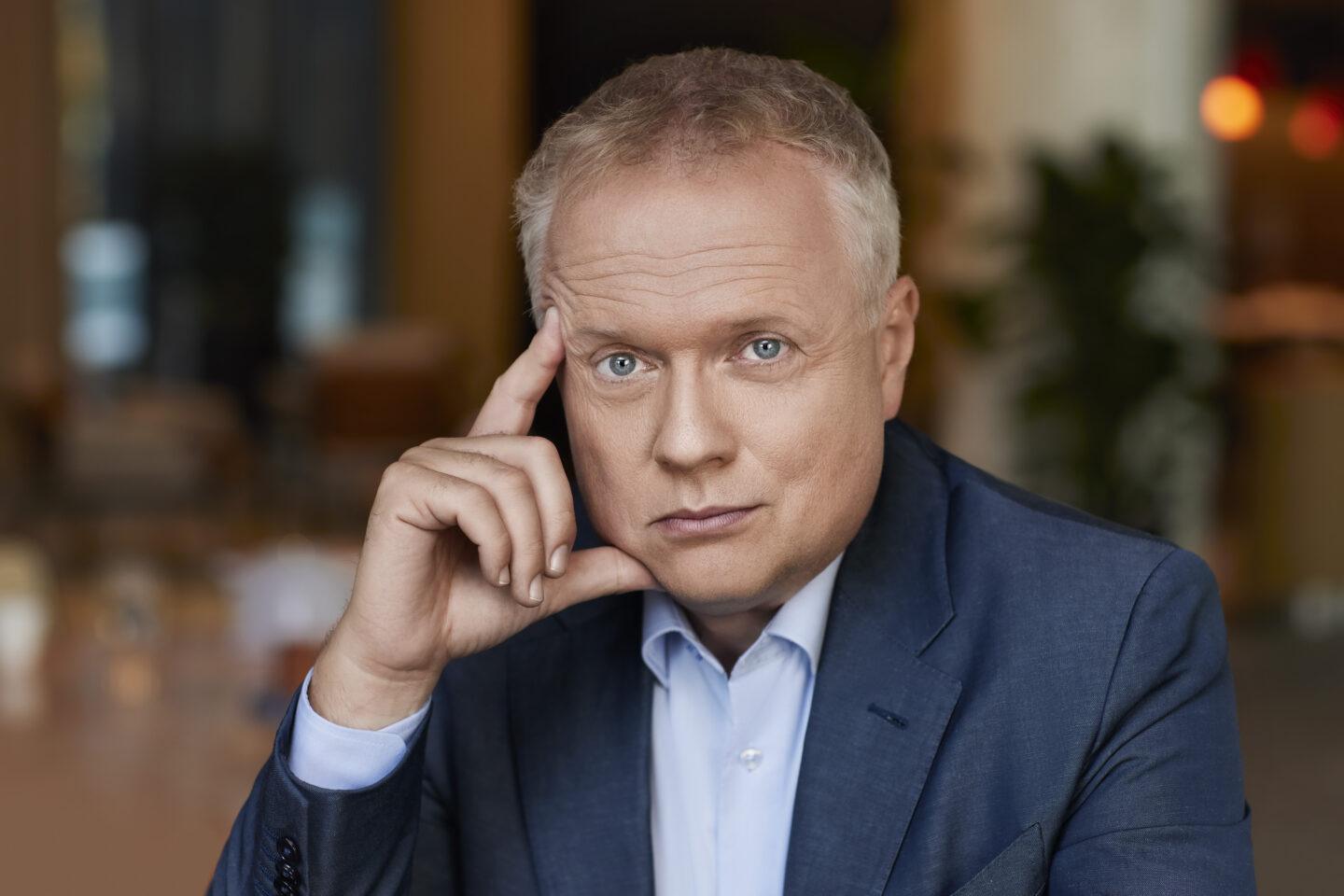
This article is a part of Poland Unpacked. Weekly intelligence for decision-makers
Growing organically for decades, ING Bank Śląski now has PLN 282 billion in assets and a real chance to climb onto the sector’s podium. “Standing out? Our greatest advantage is precisely predictability,” says Michał Bolesławski, who has led the bank for the past 10 months.
Piotr Sobolewski, XYZ: The first banks have published their 2025 results. Santander, which will soon change its name to Erste, has assets of PLN 308bn (around EUR 72bn), after excluding the assets of Santander Consumer Bank, which will remain with the Spanish group. ING Bank Śląski reports total assets of PLN 282bn (around EUR 66bn). Do you see an opportunity to capitalize on the moment and move from fourth place in the sector onto the podium?
Michał Bolesławski, CEO of ING Bank Śląski: From an asset perspective, a gap of PLN 26bn (about EUR 6bn) is still a sizeable distance to make up. Our balance-sheet structure is also somewhat different from Santander’s.
The scale of operations is better reflected in the loan book. On that measure, we were already third in the sector in the third quarter of 2025. The same was true for deposits, where the gap between us was just PLN 5bn (around EUR 1.2bn), compared with PLN 14bn (about EUR 3.3bn) in loans. That is a narrow enough margin for the balance of power to shift at any time.
Who's who
Michał Bolesławski has been with the ING Group for a quarter of a century.
He has been leading ING Bank Śląski since April 2025, succeeding Bruno Bartkiewicz, who had headed the bank continuously since 2016.
Like his predecessor, Mr. Bolesławski is a product of the ING Group, having joined the institution in 2000. He began his career as a project specialist and product manager, and between 2008 and 2020 served on the management board of ING Bank Śląski. He then spent several years in ING’s international operations in director-level roles. Immediately prior to returning to Poland, he was director of business banking within the ING Group
ING is not focused on moving onto the podium by assets
Piotr Sobolewski, XYZ: Doesn’t it tempt you to also claim the number-three spot in assets?
Michał Bolesławski, CEO of ING Bank Śląski: Being on the podium is not our goal. We focus on the loan and deposit portfolio, because that is the bank’s core business – not total assets or equity. ING has been growing steadily on its own for years [having acquired only the small Wielkopolski Bank Rolniczy in 2004 and Bieszczadzka SKOK in 2017, standing out in a sector that was otherwise expanding through mergers and acquisitions]. If we were to reach third place as a result of organic growth, we would be pleased – but it is not an objective in itself.
Let’s turn to competitive pressures in the bank’s core business: lending. At the results conference, you mentioned intense competition in mortgage lending, which has pushed margins down. Is this a sign of rising competition from new players such as Erste and UniCredit?
I don’t think so. Margin pressure comes from banks that have been active in this market for years.
And will this competition intensify?
I believe it will be strongest where there is no demand for credit, which is the case in the corporate lending segment. In mortgage lending, however, demand exists.
Polish banks losing ground to foreign competitors
Piotr Sobolewski, XYZ: According to ING’s strategy, the bank’s mortgage portfolio is expected to grow 2.5-fold over the next decade – from PLN 61bn to PLN 152.5bn (EUR 14bn to EUR 36bn). If more aggressive competitors push mortgage margins even lower in the battle for market share, would you reconsider this target?
Michał Bolesławski, CEO of ING Bank Śląski: Yes, because in that case it wouldn’t make sense. We are not aiming for growth at any cost. Our growth is healthy. But if it turns out that loans do not cover the bank tax and the risk margin, then a fight for market share would be unjustified.
I would also point out that fair competition requires all players in this market to operate under the same rules, meaning they should all pay the bank tax in Poland. If foreign banks want to offer mortgages without being present here as a local bank or branch, they are exempt from this tax. That puts local players like us at a disadvantage and may encourage other foreign entities to follow the same approach.
A similar issue affects corporate financing, for example in the defense sector. Foreign firms can offer better terms – around 0.5 percentage points – than Polish banks that are subject to the bank tax.
Piotr Sobolewski, XYZ: Are politicians willing to address this?
They recognize the problem. This situation puts local banks at a disadvantage. The competitive environment is changing, and concrete measures are worth taking.
Piotr Sobolewski, XYZ: The bank tax has existed in Poland for a decade, yet only now are CEOs – yourself and, for instance, Cezary Stypułkowski of Pekao – publicly highlighting the issue of unequal competition. Has the activity of foreign banks increased so sharply recently?
Yes, we are seeing an intensification of such competition.
Demand for mortgages remains healthy
Piotr Sobolewski, XYZ: So in both markets – corporate and mortgage lending – we are seeing stronger price competition than before. What else will affect credit demand and sales?
Michał Bolesławski, CEO of ING Bank Śląski: In corporate lending, margins have fallen sharply, and there is also regulatory and legal uncertainty. As a result, it is harder to predict the success of business initiatives. Private investment is growing too slowly, although we see the public sector beginning to catch up, which in turn supports more private investment.
For mortgages, we are seeing changes in society’s structure – single-person households are increasing, which will boost demand for housing. In addition, a significant share of housing is overcrowded – this affects 34 percent of the population. Thirdly, we are dealing with the “large-panel” housing stock, which will eventually need attention. These buildings were designed for 40–70 years of use and are approaching the end of their intended lifespan. This will also drive demand, as people move into other buildings.
Mortgage demand is healthy, and so is its composition – the majority is in the hands of individuals rather than investment funds [buying to rent]. Abroad, the situation looks somewhat different. The key now is to avoid excessive appreciation in housing prices.
Piotr Sobolewski, XYZ:BIK projects that mortgage lending will grow by more than 20 percent in 2026. In just three years, we went from PLN 64bn in annual mortgage sales to PLN 105bn in 2025, with forecasts pointing to PLN 127bn this year (EUR 30.5bn). Do you see this as healthy growth?
Look at the rise in housing prices and factor in inflation. From that perspective, nominal values alone are not decisive – it is the ratio [of the loan portfolio] to, for example, the country’s GDP that matters. This product will continue to drive banks’ lending activity, and I see no reason why that would change.
Mortgage refinancing? “It’s natural – let’s not complain”
Piotr Sobolewski, XYZ: How much of this mortgage activity will be refinancing? According to BIK, already one in five of these loans is paying off previous obligations. Doesn’t such a high share concern you?
Michał Bolesławski, CEO of ING Bank Śląski: No, it’s completely natural. If someone took out a loan at 7 percent interest and today rates are 4 percent, it’s rational to refinance. This is a natural stage in a cycle of rate cuts. When rates remain low, we will need to consider how to extend financing and possibly switch to a fixed rate.
Poland has a high share of variable-rate mortgages, which sets us apart from other countries. Another characteristic is that Poles tend to pay off their loans in full. In some European countries, loans are continuously refinanced, and the financing effectively becomes permanent. Even in retirement, people often still have outstanding mortgages – they sell the property, settle with the bank, and move into a smaller home.
Piotr Sobolewski, XYZ: It’s interesting that you speak from the client’s perspective. Some bankers, when asked about refinancing, immediately start complaining that fixed-rate loans are risky and need regulation.
Since we legally allow refinancing, let’s allow it and stop complaining. If we want to change that, we should simply stop permitting it – but then the clients will speak up, and a spiral of criticism will follow, claiming they didn’t know what they were signing up for.
In Poland, there is a trend of challenging contracts. It started with Swiss-franc loans, then WIBOR, and now we may be facing a discussion about fixed-rate mortgages. We cannot ignore borrowers’ voices, but that doesn’t mean we do it without checking creditworthiness. When we grant new exposure, we must assess it.
Michał Bolesławski’s ING emphasizes new priorities
Piotr Sobolewski, XYZ: And shouldn’t such a client be “punished” for that? By signing a fixed-rate agreement, they committed not to change the loan terms for five years.
Michał Bolesławski, CEO of ING Bank Śląski: That would be prohibited in Poland, but if someone signs a contract for a set period and breaks it early, the bank should be able to charge the client for the cost of the broken financing. In the West, this is standard practice.
Piotr Sobolewski, XYZ: Let’s move to the bank’s strategy. One analyst, Michał Sobolewski from DM BOŚ, summarized it by saying that over the next 10 years, the bank will be high-margin and generous with dividends. In other words, it will… essentially be what it is today. Does that mean a lot has to change for everything to stay the same?
Michał Bolesławski, CEO of ING Bank Śląski: Yes, largely we are continuing what we started in previous years, while also setting new directions. You mentioned mortgage growth – it’s not as large as it sounds if you consider our current activity and the fact that the portfolio will still grow 2.5-fold over the next decade at the current pace. We are not accelerating the portfolio per se, but rather increasing the number of clients.
Piotr Sobolewski, XYZ: So how will Michał Bolesławski’s ING differ from Bruno Bartkiewicz’s ING?
Michał Bolesławski, CEO of ING Bank Śląski: These are new accents, not a break with the past. We continue to monitor society and the economy closely, and we build our long-term strategy on that basis. New phenomena are emerging – demographic changes, an aging population, new behaviors among younger generations – and we respond to them. We are placing greater emphasis on private banking, but also on investments, as demonstrated by the acquisition of Goldman Sachs TFI.
What remains unchanged is that, regardless of who leads the bank, we deliver on what we promise. We have never disappointed the market. And looking at what we pledged in the autumn of 2025 and how implementation is proceeding, I believe we will achieve that again this time.
ING’s new CEO aims to project the image of a stable bank
Piotr Sobolewski, XYZ: Don’t you want to stand out?
Michał Bolesławski, CEO of ING Bank Śląski: I have no such ambitions. I think our greatest advantage is precisely our predictability and the trust that when we make a commitment, we follow through.
Piotr Sobolewski, XYZ: Like a rock in a stormy sea…
Michał Bolesławski, CEO of ING Bank Śląski: Exactly. We want to be seen as a bank that remains stable, no matter what happens. Like that rock. Other banks have weathered crises differently over the past 20 years, but we have generally managed well.
Piotr Sobolewski, XYZ: You brought two managers from competing banks onto your management board. Some in the industry say this signals a more aggressive stance. Are they right?
Michał Bolesławski, CEO of ING Bank Śląski: I wouldn’t call it aggressive, because that would imply a desire for rapid, abrupt growth. We aim to steadily increase our market share in the areas we have previously defined.
Acquiring a bank with PLN 50bn in assets? Probably not worth it
Piotr Sobolewski, XYZ: And no bank acquisitions are on the table? The former PKO BP CEO, Zbigniew Jagiełło, once said that if a bank were to acquire, it would only be rivals with over PLN 100bn (around EUR 23bn) in assets. Would ING be interested in, say, a bank with PLN 50bn (around EUR 11.5bn)?
Michał Bolesławski, CEO of ING Bank Śląski: Probably not, because any merger of that scale would need to be justified. How long would it take us to build PLN 50bn (EUR 11.5bn) in assets ourselves? Three years. If we can grow that much organically in three years, it’s probably not worth it. If we were talking about a larger bank, then we might consider it.
Piotr Sobolewski, XYZ: Are the Dutch open to that possibility? After all, in terms of net profit, you are their third-largest business.
Michał Bolesławski, CEO of ING Bank Śląski: Yes, the ING Group places great emphasis on the Polish market – it is key to its strategy. ING is present in 33 countries, with universal banks in nine, so our position reflects both high profitability and strategic importance for the group. We account for several percent of the group’s global result, and Poland’s potential is recognized.
The bank wants to encourage young clients to save
Piotr Sobolewski, XYZ: How do you grow organically today in a responsible way, without significantly increasing risk appetite? What builds competitive advantages?
Michał Bolesławski, CEO of ING Bank Śląski: We stand out through our brand. That includes how we treat clients during difficult moments. Long-term strength and the safety of the bank are crucial – when clients entrust us with their money, they want assurance that the bank will not fail. We see that this also helps attract employees.
The app and digital offerings are also important, allowing clients to handle matters without visiting a branch. We are not yet where we want to be, but we are working on it intensively. Social responsibility matters too, as does offering products for both older and younger clients. Among the younger generation, we want to anchor a habit of saving rather than relying, for example, on cryptocurrencies available on popular platforms.
Building the right image takes years, and we have been doing it consistently for a long time. I don’t want to say it is easy, but thanks to this consistency, people trust us.
Entering the personal loan market requires accepting higher risk
Piotr Sobolewski, XYZ: For years you’ve attracted clients with savings products and mortgages, but now you want to use personal loans for acquisition as well. Why?
Michał Bolesławski, CEO of ING Bank Śląski: Our share of this market is small – 4.9 percent. That is well below our natural market share, so we want to increase it.
Piotr Sobolewski, XYZ: Aren’t you worried that this will attract riskier clients?
It certainly requires more active product management, so that clients are aware we offer this as well – today ING is not associated with personal loans. Yes, it also means accepting a higher level of risk, but at the same time we have a very low share of loans that are not repaid on time.
Piotr Sobolewski, XYZ: I ask because you could say that you are targeting these loans only at your existing client base, whom you know better.
It’s a trade-off. Offering them only to our own clients reduces risk but also lowers margins. Expanding more broadly into the market changes the parameters. However, this is not a move that would change the overall profile of the bank. In terms of volume, it is a niche product – it is repaid quickly, rotates fast, and slightly improves the margin structure.
The bank aims to be more active in client communication
Piotr Sobolewski, XYZ: Beyond acquiring new clients, you also promised to reduce attrition. How do you achieve that?
Michał Bolesławski, CEO of ING Bank Śląski: We need to be more proactive in communicating with the clients we acquire. The goal is to ensure they don’t feel abandoned once a promotional period ends.
It’s at that moment we want to actively influence clients’ decisions and retain them. We aim to cut attrition by tens of thousands annually, which would keep net client growth in line with our plan – around 200,000 per year. This year we won’t fully achieve that, but the long-term goal is 6.6 million clients.
Piotr Sobolewski, XYZ: How many products should such an active client have – one or five?
We track this and see gradual growth. However, when net client numbers increase, the average number of products per client doesn’t necessarily rise, because the denominator grows. Again, it’s a trade-off: either expand the base or increase products per client. But this doesn’t mean we aren’t developing relationships with existing clients.
I’m not focused on competing over the number of products per client. What matters more now is building an active client base first, and then increasing product penetration – rather than the other way around.
Subscription plans to be unveiled in a few weeks
Piotr Sobolewski, XYZ: What about subscription plans? You mentioned new services for clients that could strengthen their connection to the bank.
Michał Bolesławski, CEO of ING Bank Śląski: Introducing accounts on a subscription model is one element of our strategy. We plan to keep the basic package of services free for clients, while extended plans, offering additional benefits, will be available as paid options. We will present the details in the coming weeks. Our goal is to use subscription plans to build lasting relationships with our clients.
AI has significant potential in source code
Piotr Sobolewski, XYZ: Finally, let’s talk about artificial intelligence. At the strategic conference, you said ING intends to make AI an ally, not an enemy. How will you do that? So far, in Polish banks, AI is more talked about than it is demonstrably applied.
Michał Bolesławski, CEO of ING Bank Śląski: Contrary to media reports, the solutions provided by AI agents are not yet promising enough in quality to replace traditional methods of producing code or products. Our internal data, consistent with market data, show that only about 26 percent of source code generated by AI is suitable for further implementation. That’s a very unfavorable statistic. Therefore, we are not yet at the stage where AI can be truly transformative. I focus on code because programming is where I see the most significant potential for AI applications.
Piotr Sobolewski, XYZ: What about credit processes?
We won’t be able to use AI there without being able to explain why we approved or denied a loan. AI, by its nature, modifies its reasoning depending on circumstances. For that reason, application in this area is not straightforward.
The greater potential lies in source code. I believe that within a year or two, 90 percent of AI-generated code will be ready for implementation – and at that point, adoption will accelerate.
AI will transform the labor market, including banking
Piotr Sobolewski, XYZ: So more internal use, rather than client-facing applications, like chatbots?
Michał Bolesławski, CEO of ING Bank Śląski: Artificial intelligence has passed the Turing test, so people can’t always tell whether they are talking to a human or AI. But chatbots are not decision-makers – they can at most explain things or make decisions within a very narrow scope. Customer communication, by contrast, needs to be organized to give clients a sense of being heard and to adapt the message to the other party’s emotions – in a sense, to be on the client’s side. A chatbot can’t argue with a client, though sometimes that happens. It needs to show signs of empathetic behavior. But let’s be realistic – AI will never fully exhibit such empathy.
Piotr Sobolewski, XYZ: One final question. A banker recently told XYZ that AI implementation in banks is comparable to the revolution when banking moved from branches to digital. Would you agree?
I wouldn’t say it’s the same kind of revolution. That change was more spectacular – it happened in the spotlight and affected everyone. Here, we’re talking about internal changes in banks: how we process information and produce lines of code. What will definitely change because of AI is the labor market. It will affect many professions, including those in banking, in an irreversible way. I see people who don’t believe this. There are articles saying we are hiring people to operate AI. But we are not at that stage yet. This wave is just on the horizon. It’s coming – and we will not stop it.


Key Takeaways
- ING is not chasing an asset podium, but portfolio size and profitability. The PLN 26bn gap in assets with Santander is not an obsession for the bank, because the key focus is on loans and deposits, where ING already holds a PLN 14bn and PLN 5bn advantage, respectively, over the bank that is currently changing ownership. Growth is intended to be organic, although ING CEO Michał Bolesławski does not rule out acquisitions. He admits, however, that acquiring players with less than PLN 50bn (around EUR 11.5bn) in assets is generally not worthwhile—since the bank can achieve that growth on its own in just three years.
- Competition is intensifying in the mortgage and corporate lending markets. In mortgages, long-established banks are particularly active, seeking to reclaim market share lost in previous years. In corporate lending, foreign banks are entering the market aggressively. They enjoy a privileged position because they are exempt from Poland’s bank tax, enabling them to offer more attractive margins.
- The bank aims to be a rock in a stormy sea, not to go on the offensive. Even with new managers from competing institutions joining ING, there are no plans for a significant acceleration of balance-sheet growth. Instead, the focus is on acquiring active clients, including—new for ING—through personal loans. In the coming weeks, the bank will also unveil subscription plans designed to increase client loyalty.