

This article is a part of Poland Unpacked. Weekly intelligence for decision-makers
Wednesday conference…
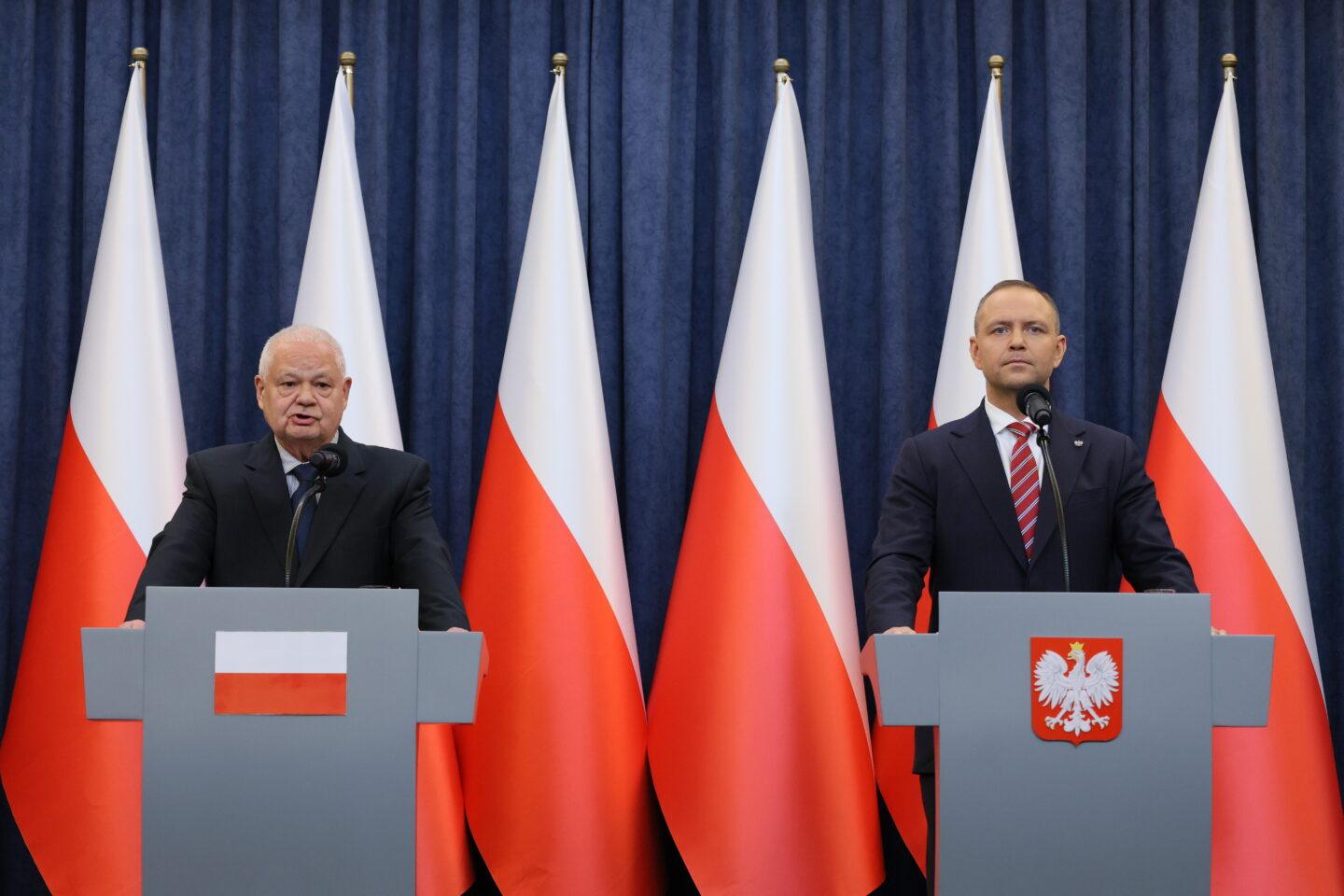
On Wednesday, during a joint press conference, President Karol Nawrocki and Adam Glapiński, Governor of the National Bank of Poland (NBP), unexpectedly presented an alternative to the SAFE loan program. Details of the mechanism were scarce, so much of what follows is necessarily speculative.
The NBP governor ruled out two possibilities. First, the program does not involve transferring central bank reserves for defense purposes, as this would be illegal. Second, it is not a quantitative easing scheme, in which the central bank purchases long-term assets (including government bonds) on the secondary market, creating money in the process. Such measures are only feasible under zero interest rates. Glapiński, speaking somewhat enigmatically, indicated the possibility of transferring NBP profits to the budget.
…and Thursday follow-up
On Thursday, Mr. Glapiński held another press conference, fielding questions specifically about the “SAFE 0%” program. He stated that the program would comply with current law and would not reduce the level of reserves. Legislative changes would serve solely to ensure that funds directed to the public finance sector are used for defense purposes. Presumably, this means that the funds would flow into the Armed Forces Support Fund (FWSZ), rather than the state budget, where money is not earmarked and can be spent on any purpose.
At the same time, Mr. Glapiński did not disclose further details of the program. These are expected to be made public only after being formally presented to the president (in writing) and the government.
Scenario
The most likely mechanism involves the NBP selling its gold holdings with a simultaneous repurchase operation. This would allow the central bank to convert paper, unrealized gains into actual accounting profit, of which 95% would then be transferred to the state budget – or to the Armed Forces Support Fund (FWSZ). Before considering the pros and cons of this approach, it is worth examining what has driven the increase in the value of gold in the NBP reserves.
Gold, gold, and more gold
The chart above shows the evolution of gold’s share in NBP reserves (as a percentage) and its value in billions of U.S. dollars over the past ten years. At the start of the period, gold accounted for roughly 4–5% of reserves, until a sudden jump in June 2019 to 8.8%. Its share exceeded 10% in April 2020 – after the outbreak of the COVID-19 pandemic – but this was only a temporary spike. Over the next three-plus years, gold’s share in reserves fluctuated between 8 and 10%.
Since July 2023 (when it reached 10.4%), gold has been on a continuous “upward march.” Successive milestones were reached ever more quickly: 15% in August 2024, 20% in March 2025, 25% in October 2025, and the most recent data (January 2026) indicate that the share has surpassed 30%. At that point, the NBP’s gold reserves were valued at roughly USD 90 billion.
Drivers of gold’s growing share in reserves
The increase in gold’s share of NBP reserves stems from two factors. First, from purchases made by the central bank. As recently as January this year, the NBP governor announced a plan to raise gold reserves to 700 tons, which would place Poland among the ten countries with the largest gold holdings in the world. From early 2022 to October 2025, Poland was second only to China in gold acquisitions, as illustrated in the chart below. In 2025 alone, according to Adam Glapiński, Poland had become the global leader in this regard.
 Interactive chart
 The second factor is the rise in gold prices. Over the past year, the price of gold relative to the U.S. dollar increased by around 77%, and over three years by roughly 180%. Recent events, including the U.S. strike on Iran, have temporarily pushed gold prices higher and contributed to a depreciation of the złoty against major global currencies. Both factors increase the NBP’s potential profit.
It is important to note, however, that the gold value cited for the end of January 2026 does not represent profit – it reflects the current market value of reserves held in this asset. Profit, of course, is the difference between the selling price and the purchase price.
Legal framework
Returning to the core issue: under the NBP Act, 14 days after the approval of the annual financial statements, a portion of the annual profit (the profit remittance) must be transferred to the state budget. At the same time, 5% of the annual profit is allocated to the reserve fund – within the same timeframe – intended to cover losses from previous years. This likely explains the 95% remittance to the budget mentioned at Wednesday’s press conference.
Some voices argue that profits should only be transferred to the state budget after covering total losses from prior years and creating financial reserves deemed necessary to protect the real value of the central bank’s capital and assets. This requirement would derive from the Treaty on the Functioning of the European Union.
The European Central Bank (ECB) has repeatedly reviewed legislative proposals amending national central bank laws regarding profit distribution. It has placed particular emphasis on decision-making procedures that preserve the central bank’s independence, rather than on the prior coverage of losses. Nevertheless, this is primarily a legal rather than an economic question – I do not attempt to draw a definitive conclusion on the matter.
During Thursday’s press conference, Governor Adam Glapiński also noted that the issue would be discussed within the framework of the European System of Central Banks (ESCB).
Higher profits now mean lower profits later
At the same time, such a program implies at least temporary costs. After a sale-and-repurchase operation, the purchase price of the assets would be higher than the original price. Consequently, generating profits in subsequent years would be significantly less likely.
The second issue is also technical but far from trivial: a counterparty would need to be found for the transaction, and at such large amounts, this is not straightforward. Perhaps for this reason, Thursday’s press conference referred to a plan that would secure roughly PLN 60 billion per year, rather than a one-off amount of PLN 185 billion as mentioned on Wednesday.
Timing of fund availability
Another question concerns when the government would actually be able to deploy the funds. Under the NBP Act, the central bank approves its annual financial statements by April 30 of each year. This means that if the sale-and-repurchase operations were only to be executed afterward, the remittance would likely only occur around mid-2027. By comparison, the parliamentary elections are scheduled for autumn 2027. Under the original SAFE program, the waiting time would have been much shorter – just a few months from now.
The original SAFE
It is worth recalling that the European SAFE program involves a loan with a 45-year repayment period and a possible 10-year grace period on principal repayment. The European Commission would be responsible for the loan, and its credibility means that in most scenarios the interest rate would be lower than if Poland were to borrow on its own – considering the scale and currency risks involved. For this reason, countries with lower bond yields than those expected under the EU program do not participate (for example, Germany).
It is also worth noting that debt mutualization has long been a taboo subject in the EU, often for decades, due to opposition from Germany and other fiscally conservative countries such as the Netherlands. Poland’s nominal GDP is expected to grow over this period, meaning that the loan amount would gradually represent a smaller share of GDP.
One or two pianos
Finally, there is a strictly strategic question. The original SAFE would strengthen the broader European defense industry. Yet, during the press conference, the president repeatedly praised American military equipment. Considering Poland’s previous purchases from the U.S. and South Korea, the question becomes whether we ultimately want to “play on two pianos” or just one.
It is also worth noting that, logically, an alternative remains valid even if all of its components are true. In other words, the SAFE 0% program does not preclude taking advantage of the original SAFE program. Timing is, of course, crucial. A SAFE loan can be secured now, whereas the option of SAFE 0% (if legally permissible once fully defined) could be reserved for a subsequent phase of defense spending. Using both programs simultaneously would likely exceed Poland’s current defense needs.