

This article is a part of Poland Unpacked. Weekly intelligence for decision-makers
Law and Justice (PiS) has entered a new phase of its pre-campaign ahead of the 2027 elections. The selection of Przemysław Czarnek as the party’s candidate for prime minister carries a range of consequences – not only for the party itself but also for the broader dynamics on Poland’s right. We take a closer look at the Kraków event and the behind-the-scenes reasoning behind Jarosław Kaczyński’s decision to steer his political camp further to the right.
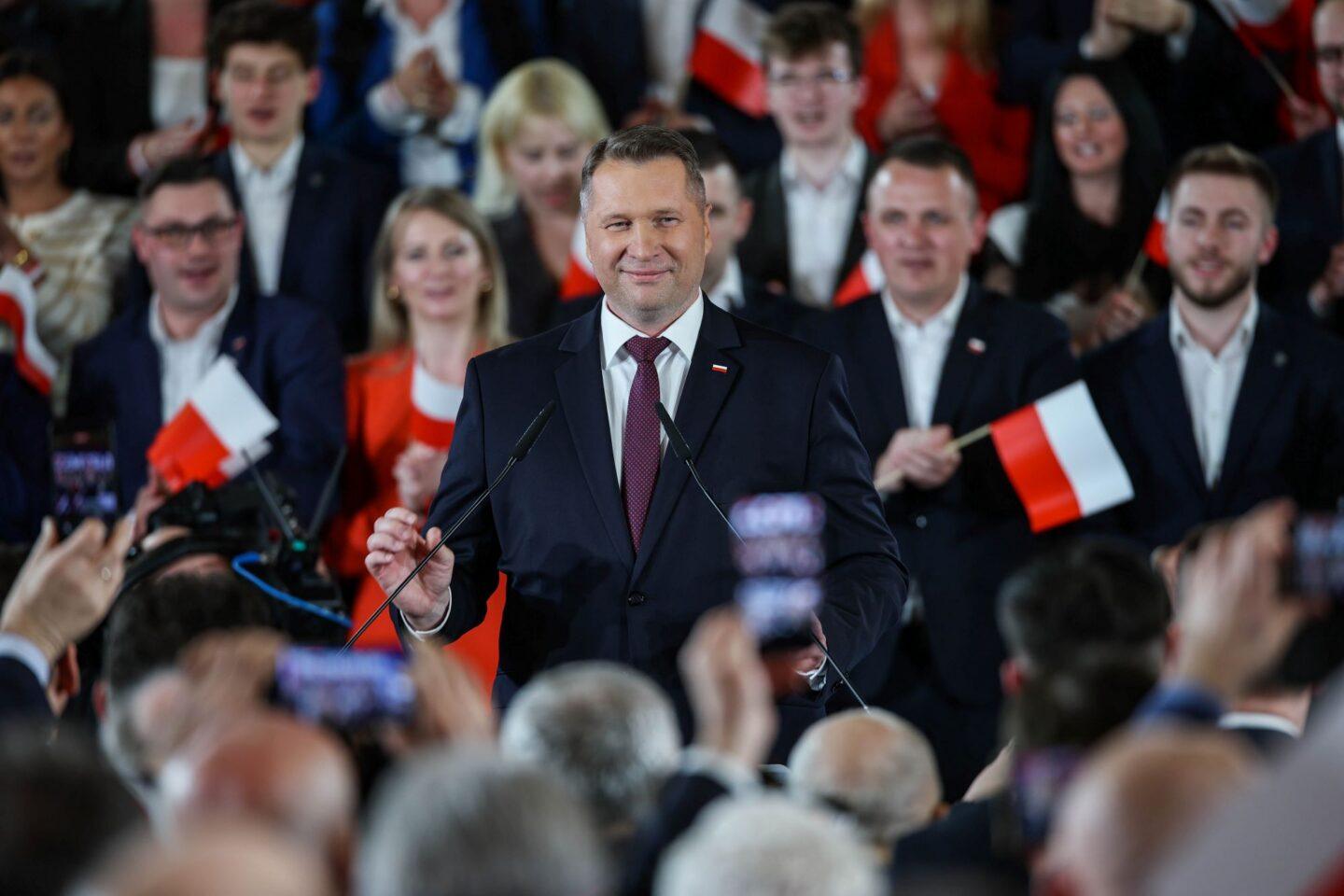
Przemysław Czarnek has been named Law and Justice’s candidate for prime minister. In Kraków’s Sokół Hall, a new PiS contender for one of the country’s highest offices was announced for the third time. In 2014, the venue hosted the unveiling of Andrzej Duda as the party’s presidential candidate. A decade later, the same stage served to introduce Karol Nawrocki as PiS’s presidential nominee. The party hopes the venue – long considered a lucky stage for its political launches – will again prove a good omen, this time for Przemysław Czarnek as its candidate for prime minister in 2027.
Breaking with “fresh faces” in favor of a party hardliner
Even before the event in Kraków began, party activists and journalists gathered around the venue were already speculating about the name of PiS’s candidate for prime minister. Shortly after 1 p.m., the guessing game had essentially narrowed to a single name: Przemysław Czarnek. The hall filled to capacity very quickly. In fairness, the historic venue was far too small for the number of party activists who had come to Kraków. Yet that worked to the organizers’ advantage: television footage showed what appeared to be an endless crowd, while the atmosphere inside the hall remained – literally and figuratively – heated throughout.
Attentive observers of Jarosław Kaczyński’s words will note that Mr. Czarnek – the former education minister – is hardly a fresh face, nor someone unburdened by the legacy of Law and Justice’s time in power. Nor does Mr. Czarnek embody a figure capable of uniting a divided party across internal fault lines. The former Lublin voivode (south eastern Poland) is, after all, a leading figure within the so-called “butter boys” -politicians who advocate pushing PiS further to the right, into direct competition with the Konfederacja party of Sławomir Mentzen and Krzysztof Bosak, as well as the Confederation of the Polish Crown (KKP) led by Grzegorz Braun.
Explainer
Butter boys
Butter boys (maślarze) are nicknamed after an incident on board a Polish LOT airlines plane when one of these politicians was served German-branded butter and loudly complained about it in the social media.
Several weeks ago, Mr. Czarnek also announced a nationwide tour under the banner “Change Our Minds,” alongside Patryk Jaki and Tobiasz Bocheński – politicians aligned with the same “butter boys” faction. Curiously, however, Mr. Czarnek himself did not appear at any of the meetings, despite lending his name to the initiative. Now that he has effectively been “crowned” the party’s prime-ministerial candidate, that situation will most likely change.
Local government candidates as a smokescreen
In recent days, a variety of names had circulated in the political rumor mill – including that of Przemysław Czarnek, which appeared regularly. Skeptics, however, believed that Jarosław Kaczyński would once again opt – much as he did with Andrzej Duda or Karol Nawrocki – for a fresh face unburdened by negative associations. Much of the speculation centered on local government leaders, including the mayor of Stalowa Wola in south eastern Poland, Lucjusz Nadbereżny; the mayor of Otwock near Warsaw Jarosław Margielski; and the mayor of Chełm in eastern Poland, Jakub Banaszek.
In the end, however, the PiS chairman chose to change course. Never before has he faced such a strong challenge from competitors on the right. Mr. Kaczyński is well aware that talk of Law and Justice governing alone amounts to wishful thinking. Mr. Czarnek’s nomination is meant to serve two purposes: to help Law and Justice compete more effectively for voters further to the right, and to position Mr. Czarnek himself as a prime-ministerial candidate acceptable to both the Confederation and the Confederation of the Polish Crown.
Mr. Kaczyński calls for unity within the party
In his opening address at the party convention, Jarosław Kaczyński, the leader of Law and Justice, announced that regular party meetings would now be held. The former prime minister – speaking more briefly than usual – focused largely on criticizing the government of Donald Tusk, while also recalling the cabinets led by Beata Szydło and Mateusz Morawiecki.
“We were able to build very good governments. (…) The government of Prime Minister Beata Szydło and that of Prime Minister Mateusz Morawiecki. (…) Those governments, ladies and gentlemen, delivered,” Mr. Kaczyński declared.
Among the activists and supporters gathered in Sokół Hall, particular warmth was shown toward Beata Szydło, now a member of the European Parliament. The audience greeted the former prime minister with loud chants of “Beata, Beata!”
Mr. Kaczyński, who had just called for unity within the PiS camp, quickly encouraged the crowd to chant “Mateusz, Mateusz” in honor of Mateusz Morawiecki as well.
“We must all move forward together!” the party leader urged.
For the former prime minister and his allies, however, the moment represents a difficult test of unity. The faction associated with Mateusz Morawiecki - often referred to as the “boy scouts” – has clearly lost out. Mr. Morawiecki, who had pushed for a more centrist direction for PiS focused on a development-oriented agenda, has been marginalized within the party. For now, however, he is not planning any drastic moves, according to a source within Law and Justice cited by XYZ.
Prime Minister in waiting?
Before anything else, it is worth noting the enthusiastic reception Przemysław Czarnek received from party activists. Even before he began speaking, the audience spent several minutes chanting “Przemysław, Przemysław!”
Although Kraków’s Sokół Hall has been a lucky venue for PiS, the first speeches delivered there by Andrzej Duda and Karol Nawrocki did not make much of a splash. Mr. Czarnek’s debut in his new role appears to have generated more enthusiasm among those gathered than the earlier presidential candidates did. Yet it is also hard to single out anything in the speech likely to linger in listeners’ minds.
Mr. Czarnek largely spoke about the same issues that party MPs have been addressing – more or less intensely – for weeks. There was the customary criticism of the government, including attacks on the EU’s SAFE program, which Law and Justice routinely opposes.
“Ms. Sobkowiak-Czarnecka admitted it openly. We don’t know how much of it [SAFE funds—ed.] we will have to give to Ukraine,” Mr Czarnek warned.
Magdalena Sobkowiak‑Czarnecka quickly corrected the statement. The SAFE program does not require sharing funds with Ukraine, as the government’s plenipotentiary for the initiative explained in an interview with Telewizja Republika.
Mr. Czarnek also struck a somewhat surprising note by criticizing the government’s lack of support for Poles stranded in Dubai and elsewhere in the Middle East.
“‘I suggest contacting the Department of Tourism in Dubai.’ Good heavens! Can you imagine that Polish citizen now – hungry, poor. (…) This is the picture of a wretched state that abandons a Pole in need. And do you remember what it was like when we had to evacuate Poles from Afghanistan or Israel? They spoke about us, they wrote to Mateusz Morawiecki. Jens Stoltenberg wrote: ‘One can learn from Poland.’ Poland was the first to act – only that was once upon a time. That was once upon a time,” Mr. Czarnek mocked, taking aim at the government.
Mr. Czarnek’s concern for ordinary Poles – and for coal
The speech also featured numerous impassioned declarations about the fate of ordinary Poles.
“A normal, ordinary Pole is a nurse, superbly educated at our medical universities. (…) A normal Pole is a doctor heading into yet another shift to save lives. (…) A normal Pole is a driver, a railway worker who keeps Poland connected,” declared Przemysław Czarnek, who in Kraków seemed fully at ease in the role of a tribune of the people.
He did not stop there.
“A Pole is also an entrepreneur who every morning, evening – sometimes even at night – wonders how to keep the company going. (…) A normal, ordinary Pole is a mother and father, a grandmother and grandfather,” he continued, repeatedly drawing cheers from the audience.
Mr. Czarnek also received loud applause for pledging a firm fight against EU Emissions Trading System II (ETS2) and renewable energy sources.
“We will have no Green Deal, no more of that renewables fantasy, heavily subsidized with handouts. We have our own coal-based energy mix, because we have our own natural resources – and keep your hands off them. We have our coal!” Mr. Czarnek declared.
The remark amounted to another pointed jab at Mateusz Morawiecki, who agreed to the adoption of the European Green Deal during his tenure as prime minister. It was also under Mr. Morawiecki’s government that Poland made record investments in renewable energy, as journalist Jakub Wiech – writing extensively about energy and renewables – has noted.
PiS as a high-speed train
Notably, Przemysław Czarnek’s speech also contained appeals for party unity. This time, the message came wrapped in a railway metaphor.
“We are boarding this superbly oiled, superbly prepared high-speed train – a Polish high-speed train. (…) The conductor of this train is and will remain Chairman Jarosław Kaczyński,” Mr. Czarnek said, making clear he had not forgotten the party leader’s still-preeminent role.
At the same time, the new prime-ministerial candidate insisted that there was room for everyone within the party.
“Everyone has their place on this train. The entire Law and Justice family,” Mr. Czarnek declared.
In programmatic terms, however, there was little that could be described as new. There was no room this time for announcing a fresh flagship policy on the scale of the earlier “500+” child-benefit program. The primary aim of the convention, in Jarosław Kaczyński’s eyes, was to consolidate the party. And few things bind a political camp more effectively than sharpening polarization against the government. Mr. Czarnek stepped into that role immediately – without much in the way of diplomatic restraint.
Of “empty heads” and Four Tank-Men and a Little Dog
“So if I’m a blockhead – and all of you as well – then we say to Donald Tusk: ‘you empty head.’ Because it’s better to be thick-headed than empty,” Przemysław Czarnek retorted to the prime minister, prompting one of the loudest rounds of applause of the day.
Mr. Czarnek also ventured into culture-war territory – an area in which he first made a name for himself several years ago while serving as Lublin’s regional governor. On the issue of the proposed “closest person” law, he struck some of the most polarizing and abrasive notes of the speech.
“So if that’s not marriage, then I ask those colleagues from that pseudo-conservative party: why not three men? Let’s have more ambition, more modernity!” Mr. Czarnek quipped.
He then mocked what he called the “new model of the family.”
“Four tank-men and a little dog,” he said – prompting widespread laughter in the hall, a reference to the classic Polish TV series Four Tank-Men and a Dog.
Explainer
Four Tank-Men and a Dog - Poland's beloved and complicated TV series
Ask any Pole of a certain age to hum a TV theme tune, and there's a good chance they'll launch into the jaunty opening of Czterej pancerni i pies — Four Tank-Men and a Dog.
First airing in 1966, the show follows a T-34 tank crew fighting on the Eastern Front in the final years of WW2 — 4 guys and Szarik [pron. shareek], a German Shepherd from Siberia who became perhaps the most famous dog in Polish television history.
The show blended genuinely sad moments with adventure and humour and a bit of romance. It was rerun yearly until 1989, and even after communism fell, each broadcast drew over a million viewers.
Here is where things get complicated. The show was produced squarely within the communist propaganda machine, and it shows: Polish and Soviet soldiers are depicted as brothers in arms full of warmth and mutual respect, while everything inconvenient — the Soviet invasion of Poland in September 1939, the Katyń massacre, the Home Army (Armia Krajowa) — goes entirely unmentioned.
That gap — between what the show was made to do and what people actually took from it — is what makes Czterej pancerni so fascinating as a cultural artifact. You could say: the ideology fades, Szarik remains.
Ukraine: Yes, Zelensky: No
Przemysław Czarnek concluded his speech with a forceful critique directed largely at Volodymyr Zelenskyy.
“We will continue to help Ukraine, but we demand respect. We demand respect from Mr. Zelenskyy and from the Ukrainian authorities. We will help if we have a partner in the Ukrainian government – a partner, not arrogance,” Mr. Czarnek declared firmly.
Although he did not say so outright, the remarks also amounted to a veiled criticism of Mateusz Morawiecki and Andrzej Duda, both of whom maintained good relations with the Ukrainian government. For Mr. Morawiecki, it was another subtle jab.
“We are launching an assault in the fight for Poland!” Mr. Czarnek concluded, once again calling for unity within the party.
The cheers and applause for Mr. Czarnek lasted a long time. Yet what may resonate even more loudly is what was not heard – the voices of those who favor a “softer” course under Mr. Morawiecki’s leadership.
Mr. Czarnek’s nomination aimed at a right-wing coalition
The choice of Przemysław Czarnek carries significant consequences for the entire political camp. Jarosław Kaczyński has opted for a version of Law and Justice that is moving toward greater radicalism and direct rivalry with Confederation and the Confederation of the Polish Crown (KKP). Such a decision will most likely intensify competition on the right flank of Poland’s political scene. It remains unclear what the ultimate outcome will be. Can Mr. Czarnek win back voters who have drifted – above all – to the KKP?
It is also worth remembering that although Mr. Czarnek’s nomination is aimed at appealing to right-wing voters, it is paradoxically also a gesture toward competitors on the right. Ideologically, Mr. Czarnek is closer to the Confederation camp and to the supporters of Grzegorz Braun than to figures associated with the old Center Alliance tradition – or especially to Mateusz Morawiecki.
What ultimately persuaded Mr. Kaczyński to back Mr. Czarnek? According to our source within PiS, the party leader’s choice was driven by political pragmatism.
“The choice of Mr. Czarnek isn’t strictly about the party itself. The more important issue is a future coalition with right-wing competitors,” a PiS activist said.
The source added that the decision remained closely guarded until the very end.
“It was made at the beginning of the week. Chairman Kaczyński informed only Mariusz Błaszczak and the man concerned. He did not want to notify the other vice-chairmen to avoid leaks,” the politician told XYZ.
Mr. Morawiecki was a step away from leaving the party?
Where did Mateusz Morawiecki fit into this picture?
“The former prime minister was only informed that he would not be the candidate. If the chairman had backed Tobiasz Bocheński, Mr. Morawiecki would have announced his departure from PiS with his team as early as Friday,” a politician told us.
On Friday, March 6, Morawiecki held his own event in Warsaw, presenting a strategy “for a modern economy.” According to our source, this was when Mr. Morawiecki had planned to announce his exit.
“It ultimately did not happen because the choice did not fall on Mr. Bocheński. Such a decision would have been humiliating for Mr. Morawiecki. For now, he accepts Mr. Czarnek’s candidacy,” the Law and Justice activist concluded.
Will this situation hold? That remains uncertain. One thing is clear: today’s announcement opens a new dynamic not only within PiS but across the entire political landscape in Poland.


Key Takeaways
- According to our source, Mr. Kaczyński’s main motive is political pragmatism and laying the groundwork for a potential coalition with smaller right-wing parties. For now, Morawiecki has accepted the new situation and abandoned his earlier plans to leave the party. Whether this state of affairs will endure remains uncertain.
- Law and Justice (PiS) has officially designated Przemysław Czarnek as its candidate for prime minister in the upcoming parliamentary elections. The decision marks a clear shift of the party toward the radical right and an attempt to compete directly for voters with Confederation and the Confederation of the Polish Crown. Chairman Jarosław Kaczyński considered this move necessary due to the growing threat from right-wing political competitors.
- The selection of the new candidate entails the deep marginalization of Mateusz Morawiecki’s faction within the party’s structures. In his speech, Mr. Czarnek openly criticized the former prime minister’s record on climate policy and diplomatic relations with Ukraine. At the same time, PiS’s centrist vision for development was defeated in favor of a tougher, more hardline course.