

This article is a part of Poland Unpacked. Weekly intelligence for decision-makers
In sports, an away game usually means battling not only the opponent but also a hostile crowd. The meeting between Patryk Jaki and Tobiasz Bocheński and Warsaw students could be compared to exactly that kind of away match. The outcome? Hard to call – but in terms of the intensity of the confrontation, the series resembled its American counterpart more than ever before.
March is meant to mark a turning point for Law and Justice (PiS). A lot has indeed been happening around the party lately. Jarosław Kaczyński has endorsed Przemysław Czarnek as a candidate for prime minister, while President Karol Nawrocki has not opposed the party line on the perceived dangers of SAFE and has vetoed legislation related to the program.
The consequences of Mr. Czarnek’s nomination and the presidential veto for the entire political scene
The combined effect of these two decisions has triggered an exceptional surge of activity on the liberal-left side. Many politicians and commentators point to Law and Justice’s shift from rhetorical opposition to the EU to concrete action, with the consequence of strengthening anti-EU sentiment in society. Professor Sławomir Sowiński noted in XYZ that this shift traps the mainstream of the Polish right in a difficult position.
Prime Minister Donald Tusk has described PiS with Mr. Czarnek as prime minister as “the third Confederation,” equating the stakes of the 2027 elections with the decision on Poland’s continued membership in the European Union.
In this context, the latest meeting between PiS politicians and students in the “Change Our Mind” series took on a very different significance compared with the gatherings in Wrocław or Lublin, which we covered in XYZ.
Mr. Jaki: Double standards
It is worth noting that this was already the fifth stop on the series’ tour. Yet the Warsaw meeting was the first to take place in the wake of recent, pivotal political events for PiS. At earlier gatherings, questions about SAFE were as rare as questions about internal factional disputes with Mateusz Morawiecki. On Wednesday morning, however, the program dominated the confrontation between politicians and students.
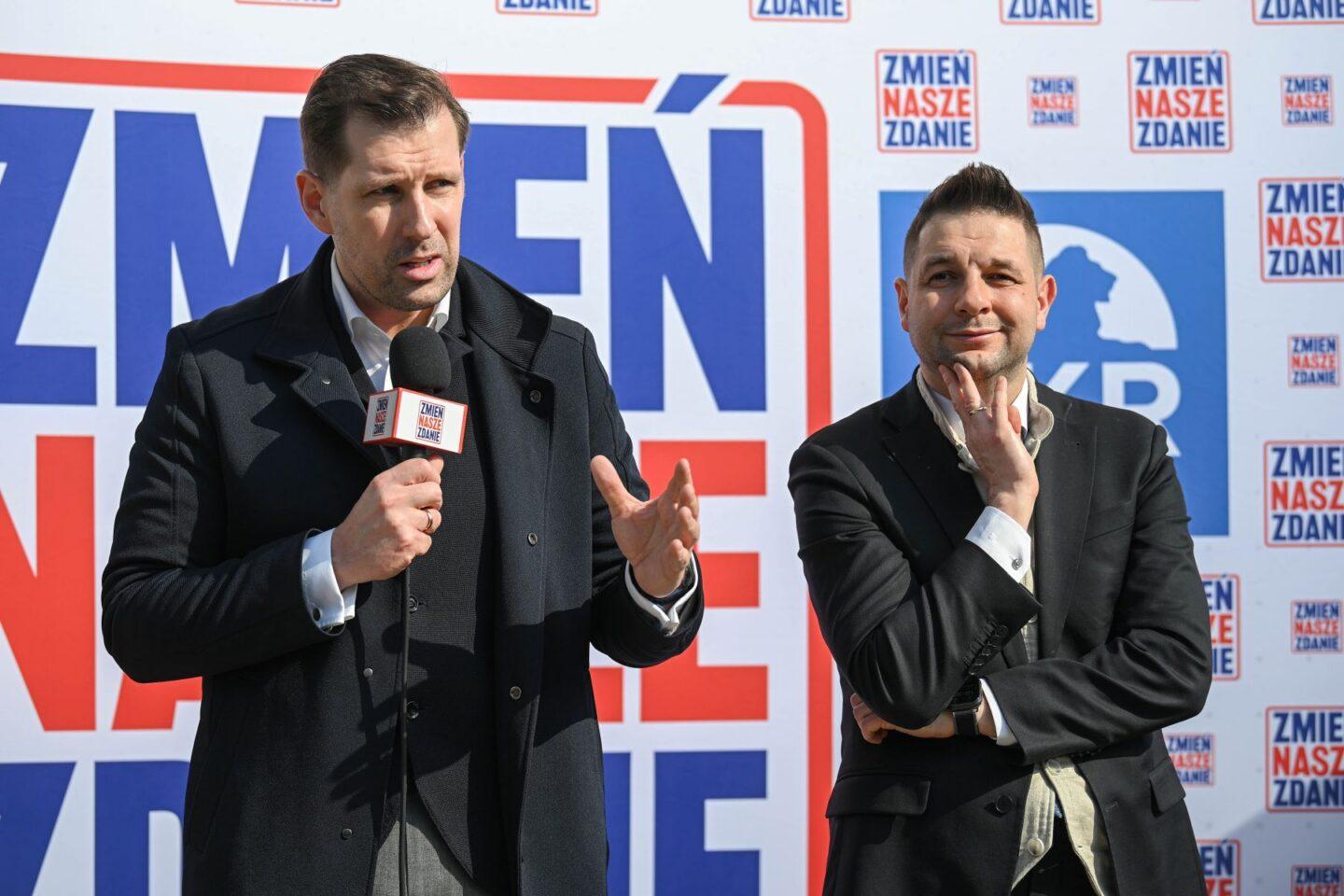
But step by step. Patryk Jaki and Tobiasz Bocheński took time to speak with the media before the main discussion. The politicians complained about what they called the double standards of the University of Warsaw authorities, who had refused to allow the event on campus. As a result, the gathering took place outside the main gate of the university on Krakowskie Przedmieście street.
“What kind of brazen double standards are these? (…) One has to ask why this is happening at all. In my view, the answer is simple. It is because the people who support one political option here, in violation of the law that requires them to apply equal rules to everyone, are very afraid. Fear motivates their actions. They are afraid that people like us will come and expose these corrupt lies,” the MEP Jaki told journalists, visibly upset.
Universities expel “Butter Boys,” while local PiS authorities lend a hand
Both MEPs also criticized the University of Warsaw authorities for hosting meetings with government politicians on campus. A recent example was a session with Waldemar Żurek, the Minister of Justice.
Explainer
Butter boys
Butter boys (maślarze) are nicknamed after an incident on board a Polish LOT airlines plane when one of these politicians was served German-branded butter and loudly complained about it in the social media.
“I would like to remind the university authorities – and all those arbiters who comment on what counts as political – that there are different definitions of politics throughout history. Let us refer to Aristotle’s definition: politics is concerned with the common good. I see no reason why one should not be able to debate with any politician at a university. This is absurd,” the MEP continued.
For context, it is worth noting that Patryk Jaki’s meeting with students in Lublin took place at the Lublin Conference Center, which is overseen by the Lublin Voivodeship Board. Law and Justice (PiS) controls the provincial government, and the board’s chairman is Jarosław Stawiarski – a PiS member. Previously, politicians were refused room rentals by the Catholic University of Lublin (KUL) and, in Wrocław, by the University of Wrocław.
“Leave our university alone!”
The press briefing was interrupted by Dominika Lasota, a UW student and activist with the East Initiative (Inicjatywa Wschód), who engaged in a heated exchange with Patryk Jaki.
“Leave our university alone! You’re trying to bring your politics in here, and it’s simply absurd. You gather, put on a show, while people have real needs – and you want to push your own agenda,” Mr. Lasota argued passionately.
The dispute between Patryk Jaki and Dominika Lasota heightened emotions in the crowd and effectively launched the discussion between politicians and students.
It was hardly surprising that the University of Warsaw would not be a friendly environment for the right, especially its more radical elements. The atmosphere was further charged by the presence of the Border Defense Movement (Ruch Obrony Granic) – an anti-immigration organization led by nationalist PiS member Robert Bąkiewicz. Attendees were greeted with leaflets encouraging them to support an initiative calling for Poland to withdraw from the UN Global Compact for Migration.
Activists from the anti-immigration Border Defense Movement were also present at the gathering in front of the University of Warsaw. Photo: Krzysztof Figlarz/XYZ
SAFE, the Weimar Republic, and Cuba – but first… butter as a “gift”
The meeting was, by all accounts, intense. One notable exception came in the form of a comic gesture by one participant. A man, long past his student days, was recognized by Mr. Jaki as a frequent attendee of political gatherings.
“And what degree did you complete?” Mr. Jaki asked him. The reply: “In your language: crap,” followed by the participant handing the politicians… cubes of butter at the end of their exchange.
At times, the atmosphere resembled a bustling fair or a fiercely contested regional football match. Emotions flared repeatedly whenever the politicians clashed with attendees. Topics ranged from assessments of crimes in Gaza to the Cuban regime’s responsibility for the humanitarian crisis on the island. Occasionally, the discussion drifted far from not only Polish but also global realities in 2026.
Yet the main battlefield for Patryk Jaki and Tobiasz Bocheński was the SAFE program. The PiS MEPs were repeatedly asked why they opposed EU loans for the modernization of the Polish army.
Mr. Bocheński emphasized that “those who produce weaponry hold the keys to the state’s security.” There were also historical comparisons of contemporary Germany to the Weimar Republic of 1920, which refused to allow transit of ammunition for the Polish army fighting the Bolsheviks. In Mr. Jaki and Mr. Bocheński’s narrative, hostility toward Germany was more than evident.
Germany: no, the U.S.: yes
The politicians repeatedly emphasized the importance of Poland’s alliance with the United States, even in an era of uncertain leadership under Donald Trump.
“The United States has the means to defend itself, unlike the European Union countries,” Mr. Bocheński stressed.
Sovereignty was invoked in every case – implicitly meaning independence from the EU while maintaining a close alliance with the U.S. When one participant asked whether Poland might also be an economic semi-colony of the United States, Mr. Bocheński replied, “Not the U.S., fortunately,” provoking general laughter among the attendees.
Mr. Bocheński: We do not want “polexit”
The meeting’s agenda also included questions about a potential “Polexit.” Tobiasz Bocheński, before answering directly, noted that the Polexit narrative serves only Prime Minister Donald Tusk and Grzegorz Braun.
“We are not saying ‘Polexit.’ We say that the current shape of the European Union needs reform,” Mr. Bocheński replied, deflecting accusations that PiS harbors ambitions to leave the EU.
Among other notable political sparring, Mr. Bocheński offered his perspective on PiS’s relationship with the Confederation. He distanced himself from the Confederation leader, Sławomir Mentzen, recalling Mr. Mentzen’s description of Jarosław Kaczyński as a “political gangster.” According to Mr. Bocheński, Mr. Mentzen does not align with a traditionally right-wing worldview, but rather with a libertarian one.
In other words, in a somewhat veiled form, Mr. Bocheński criticized both Mr. Mentzen and Mr. Bosak’s party as well as Grzegorz Braun’s formation. This only underscores the intensity of disputes on the Polish right.
The gathering outside the University of Warsaw will be remembered chiefly for the fleeting emotional clashes between politicians and some students, who seemed to differ on almost everything. Yet there were also fairly detailed discussions, particularly on SAFE. It was clear that both MEPs held firmly to a hardline, party-driven stance, maintaining maximum polarization on the issue.
OGB poll confirms PiS closing the narrative gap on SAFE
Even if Mr. Jaki and Mr. Bocheński failed to sway many students, the party’s strategy of turning SAFE into a polarizing political weapon appears to be working.
A poll published Wednesday morning by the OGB group confirmed that support for the European SAFE initiative and President Nawrocki’s proposal has effectively equalized. Respondents were asked, “Which approach to financing arms purchases do you think would be more beneficial for Poland?” Forty-three percent favored EU SAFE, while almost as many – 42.2 percent – supported the presidential plan.
“This is a major success for Karol Nawrocki, for the right, and for Law and Justice, because for many weeks the EU SAFE version appeared to be leading in the public debate in Poland,” explained OGB head Łukasz Pawłowski on YouTube.
He compared the equalization of Polish sentiment on SAFE to catching up in a race:
“It’s as if one runner started far ahead, and another appeared near the end, and they managed to finish in a tie,” Mr. Pawłowski summarized.
Patryk Jaki, Tobiasz Bocheński, and the absent Przemysław Czarnek are closing the gap – but the finish line is still far away.


Key Takeaways
- Despite a cool reception from the academic environment, the party’s polarizing strategy is yielding tangible results. The latest polls show an almost complete equalization of public support for the EU SAFE initiative and the competing proposal from President Karol Nawrocki. This demonstrates the effectiveness of the new narrative in mobilizing the electorate and building social acceptance for PiS’s own vision of military financing.
- The gathering of Law and Justice (PiS) politicians outside the university was marked by tension and numerous verbal clashes with students. The university authorities’ decision to ban the event on campus drew sharp criticism from MEPs Patryk Jaki and Tobiasz Bocheński. The meeting highlighted the party’s increasingly hardline Eurosceptic stance and its desire to distance itself from other right-wing groups.
- The EU defense program SAFE emerged as the central topic of the animated discussions. Right-wing representatives framed their opposition around concerns for national sovereignty and historical distrust of Western neighbors. A close alliance with the United States was presented as a safer alternative to European mechanisms, forming the core of the political message during the debate.