

This article is a part of Poland Unpacked. Weekly intelligence for decision-makers
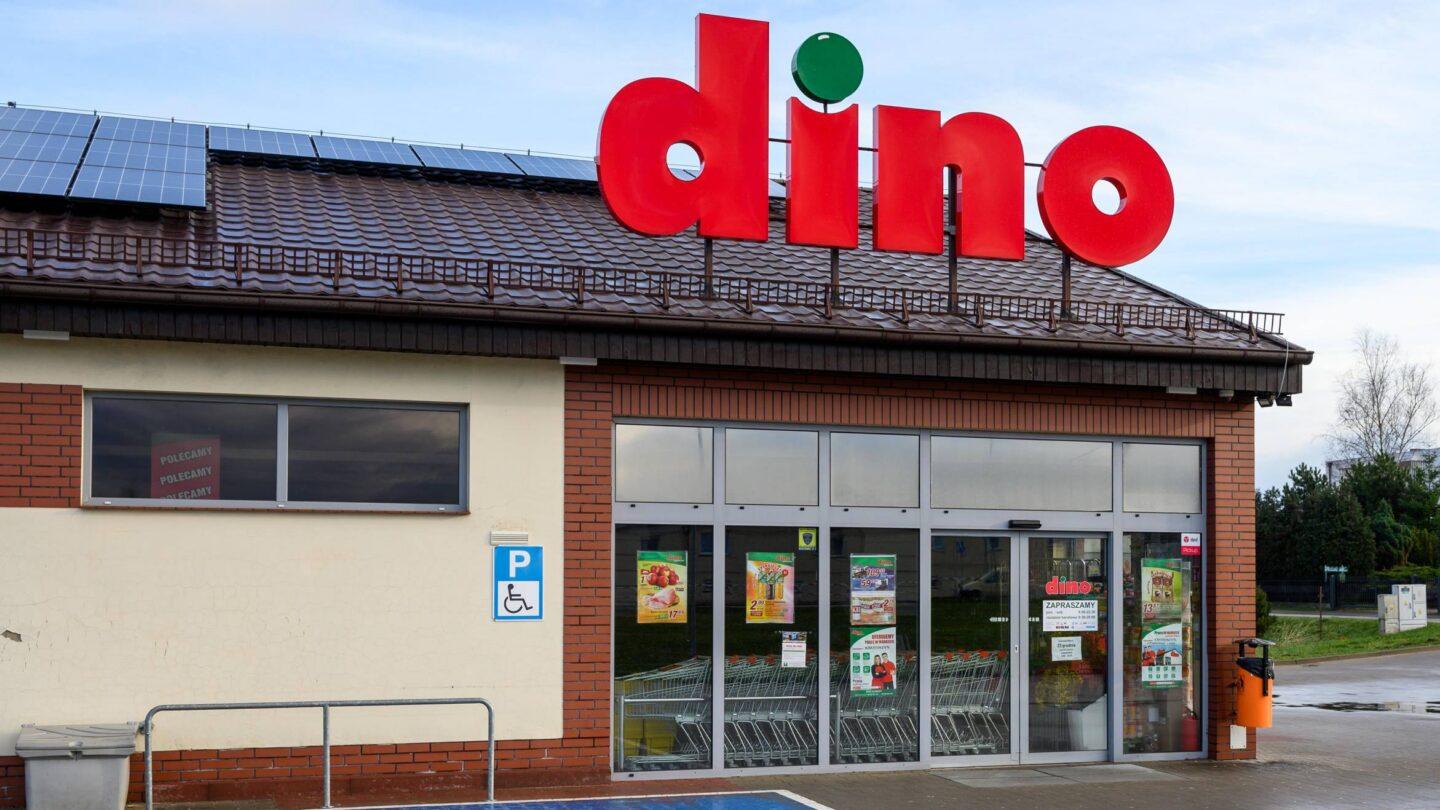
A sharp sell-off in Dino Polska shares – down more than 15% following the release of its 2025 results – signals that the good run for Polish grocery chains may be coming to an end. Investors are increasingly factoring in margin pressure and the impact of a bruising price war that is eroding profitability – even for the fastest-growing players.
The largest listed grocery chains have now reported their 2025 results. Despite nominal revenue growth, these are not strong numbers – at least not by the standards investors had come to expect. Dino’s share price fell 15% today following yesterday evening’s (March 26, 2026) results release. Meanwhile, Jerónimo Martins – the parent company of Biedronka (which accounts for 70% of group revenues) – saw its share price drop by more than 7% on the day of its results announcement. Żabka stood out as the exception, with its shares rising by over 4% after publishing its annual figures.
What spooked investors in the results from Biedronka and Dino? What should be expected in the coming quarters? And what are the likely long-term consequences of this fierce competition in Polish retail?
1. Biedronka remains the undisputed revenue leader
Last year, Biedronka generated more than PLN 107bn (approx. EUR 25bn). That is more than Dino, Żabka and Carrefour Polska combined. Lidl has yet to report, as its financial year runs from March to February, and its parent company is not publicly listed.
 Interactive chart
 2. Żabka leads by number of stores
Żabka ended 2025 with more than 12,300 outlets, making it unrivalled in this category—though this reflects its distinct business model. Among discounters, Biedronka led with nearly 3,900 stores, followed by Dino with over 3,000.
Interactive chart 3. Diverging business models
Differences in operating models become clear when looking at the average number of employees per store. Kaufland, which runs hypermarkets, leads with nearly 62 employees per location. It is followed by Lidl (28.3), Biedronka (21.9), and Dino (18.4). Lidl stores are significantly larger than those of the other two, though their operating models are broadly similar. Carrefour, smaller discount chains, and Żabka follow further behind.
Interactive chart 4. The big three: Dino vs Biedronka vs Lidl
The competitive dynamics of the market are best understood by focusing on Biedronka, Lidl and Dino. Their rivalry is central, given their similar business models and direct competition. They are also the three largest and fastest-growing players. In 2025, Biedronka posted nearly PLN 108bn (approx. EUR 25.2bn) in revenue, Dino PLN 34bn (approx. EUR 7.9bn), and Lidl around PLN 45bn (approx. EUR 10.5bn). Since 2019, Biedronka and Lidl have doubled their revenues, while Dino has increased its fourfold.
Interactive chart 5. Expansion of store networks
Competition among the three plays out along two main axes. The first is store expansion. Since 2019, Dino has grown its network 2.5 times—from 1,200 to 3,000 locations by the end of 2025. Lidl’s footprint has expanded by nearly 40%, and Biedronka’s by 30%.
Interactive chart In particular, Biedronka and Dino are increasingly encroaching on each other’s turf. Biedronka has begun entering smaller towns (5,000–10,000 residents), traditionally Dino’s stronghold. Dino, in turn, is opening stores on the outskirts of larger cities, where Biedronka has historically dominated.
6. Biedronka has been battling shopping basket deflation for over two years
Interactive chart The second axis is pricing. The core battleground is the rivalry between Lidl and Biedronka, which intensified at the end of 2023. The result has been a marked slowdown in like-for-like (LfL) sales growth—that is, in stores operating for at least a year.
During the high-inflation period, chains were able to grow sales faster than food price inflation in Poland. That trend has since reversed.
Dino has also seen weaker growth dynamics. Until recently, it appeared to possess a “superpower”—the ability to deliver strong sales growth even in a low-inflation environment, partly because many of its stores faced no direct competition. In recent quarters, however, that advantage has faded.
7. Dino has lost its edge
Interactive chart This is evident when comparing like-for-like sales growth between Dino and Biedronka. Until Q2 2025, Dino’s growth outpaced Biedronka’s by at least 2.5 percentage points in almost every quarter (with one exception in 2021). By Q3, the gap had narrowed sharply to just 0.9 percentage points, and in Q4 it stood at only 1.3 percentage points.
As both chains increasingly compete in the same locations, their growth trajectories are converging. At the same time, both report rising consumer price sensitivity.
8. Margin compression
Interactive chart Geographic overlap combined with aggressive price competition has translated into margin compression for both companies. Dino’s EBITDA margin stood at 7.6% in 2025, falling to just 6.9% in Q4. It has been on a downward trend since 2020.
Biedronka’s EBITDA margin (excluding broader Jerónimo Martins data) came in at 7.9%, up 0.2 percentage points year-on-year. Historically, however, this remains a low level. Rising costs—particularly wages—are adding further pressure.
9. The market is cooling on Dino
Interactive chart Market sentiment reflects these trends. Dino’s share price has fallen by nearly 30% over the past six months. Jerónimo Martins has traded sideways over the past year. Even so, both stocks remain well above pre-pandemic levels—more than three times higher for Dino and roughly double for Jerónimo Martins.
Jerónimo Martins is currently valued at around PLN 56bn (approx. EUR 13.1bn), while Dino stands at roughly PLN 33bn (approx. EUR 7.7bn).
What next?
The coming quarters are likely to be challenging for the leading retail chains. Consumers remain cautious. Whereas inflation between 2021 and 2023 supported revenue growth, the current environment is markedly different—and competition far more intense.
More chains are struggling to withstand the pressure. Recent reports suggest that Carrefour may seek to exit the Polish market. The longer the price war persists, the fewer players will survive—though those that do are likely to emerge in a much stronger position.


Key Takeaways
- Intensifying competition is driving margin compression and weakening short-term prospects amid rising costs and a cautious consumer. In the longer term, however, this may lead to market consolidation, with the strongest players further strengthening their positions.
- Despite revenue growth, the 2025 results of major grocery chains disappointed investors, triggering share price declines—particularly for Dino and Jerónimo Martins.
- The core competitive battle is between Biedronka, Lidl and Dino, driven by store expansion and aggressive pricing. Encroachment into each other’s territories and rising price sensitivity have led to slower like-for-like growth and the erosion of competitive advantages, especially for Dino.