

This article is a part of Poland Unpacked. Weekly intelligence for decision-makers
The sporting goods powerhouse is increasingly selling and producing in Poland – and still sees plenty of room to grow. An investment of PLN 75 million (approximately EUR 17.4 million) in recent years is only a prelude to a much larger expansion. Competitors are not making things easier; in fact, they are benefiting from Decathlon’s growth.
Decathlon, the French sports retail giant, is celebrating its 50th anniversary this year and 25 years in Poland. For the local team, it is a major milestone: among its 3,500 employees are people who have been with the company since the very beginning.
The mood within the organization is celebratory. The company has just delivered another record year in Poland. In 2022, it generated revenues of PLN 2.41 billion (approximately EUR 560 million) and net profit of PLN 73.5 million (approximately EUR 17.1 million). By 2024, these figures had risen to PLN 2.99 billion (approximately EUR 695 million) and PLN 86.8 million (approximately EUR 20.2 million), respectively. A significant share of employees are shareholders, meaning they benefit from regular dividend payouts.
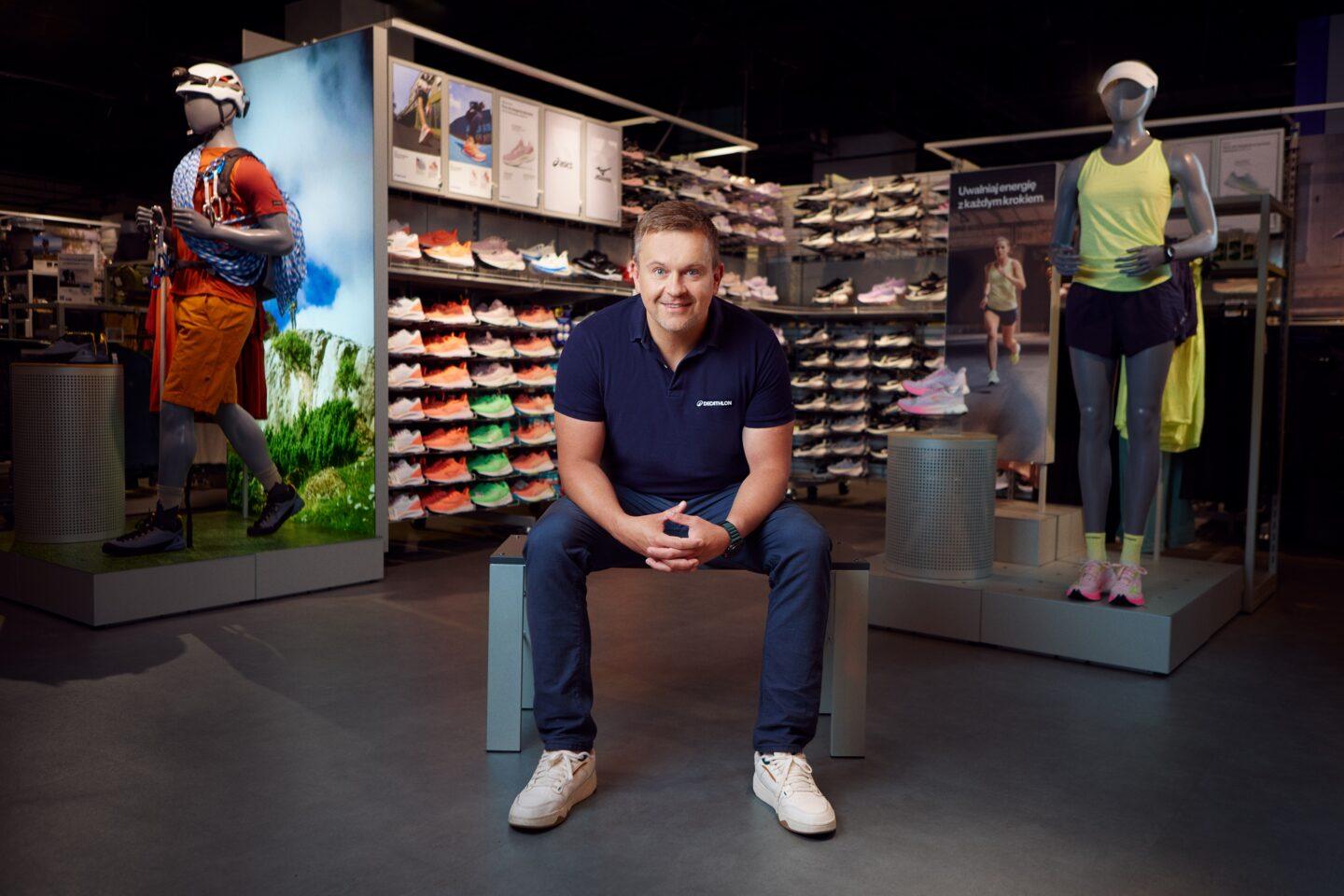
“Last year was a good one for us in terms of sales, and in terms of efficiency it was very good indeed. We grew revenue slightly above the market, which, according to various sources, expanded by 5–7 percent. We crossed the PLN 3 billion threshold,” says Paweł Krawczyk, CEO of Decathlon Poland.
Strong start to the year in the sports industry
The company had an excellent beginning and end of the year. Late spring and summer, however, proved more challenging for the sector.
“The volatile weather primarily affected water sports and outdoor activities [including mountain tourism – ed.]. Our diversification – we offer products for more than 70 sports disciplines – allows us to perform better than competitors under such conditions,” explains Paweł Krawczyk.
He stresses that the current year is shaping up to be even better than the previous one. This winter season was favorable for many retail chains. LPP, among others, communicated above-average margins.
“The sports sector also entered spring very strongly. In the first months, we increased sales by several dozen percent. Like-for-like growth [LFL, i.e. sales in stores operating in the same locations as in the previous year – ed.] was also in double digits. Our results are driven by many different factors. One of them is the rapidly growing importance of our services, particularly in the area of circular economy,” says Paweł Krawczyk.
Good to know
The sports powerhouse in numbers
Decathlon is one of the companies owned by the French Mulliez family, whose fortune is estimated at several tens of billions of euros. It is also one of the world’s largest retailers of sporting goods. In 2025, it grew by a few percent and improved its profitability.
Last year, Decathlon sold 1.23 billion products worth EUR 20.7 billion (approximately PLN 88 billion at current exchange rates), which translated into EUR 16.8 billion in revenue. EBITDA reached EUR 1.8 billion, while net profit stood at EUR 910 million.
The company employs nearly 103,000 people across 82 countries – 51% of them are shareholders in the business. E-commerce accounted for 20.2% of sales in 2025. The remainder was generated through a network of 1,902 stores.
Services as Decathlon’s growth engine
Circular services (rentals, buyback schemes, repairs, and second-life products) increased their share of turnover from 2.29% to 3.45% between 2023 and 2024. The main and longest-established service remains equipment repair.
“We are continuously improving its quality. In parallel, we are developing other services and introducing new ones. The fastest-growing area is product buyback and – after potential refurbishment – reselling them for use. Initially, we offered vouchers for purchases at Decathlon, and for the past two months we have been testing bank transfers,” says Paweł Krawczyk.
Demand for short-term equipment rental is also rising. In winter, this mainly concerns crampons and microspikes for mountain hiking, while in summer it is trekking baby carriers.
“This has led us to consider a long-term subscription model. We will launch a pilot still this year in children’s bicycles where customers quickly outgrow products – or at the beginning of next year in winter sports,” the executive announces.
 Interactive chart
 A new approach to the product offer is paying off
Beyond the development of services, Decathlon Poland has additional growth drivers. The company acknowledges that it has learned its lessons and implemented a far more flexible marketing and communications strategy. It is also working to maintain a high standard of customer service, including in e-commerce. A broad range of products ordered by 8 p.m. is already delivered the next day.
“Above all, however, our new approach to the assortment has worked extremely well. Since last summer, we have expanded the availability of certain categories – including bicycles, mountain tourism, and running. This winter, we stocked up more heavily on winter sports equipment, and it turned out to be a hit. In March, bicycles took off very strongly for us,” says Paweł Krawczyk.
After a period of relative stabilization in this category in recent years, he considers the start of this year’s season to be strong. He also observes robust demand for rollerblades, skateboards, and scooters, including electric models. He assures that the company is well prepared in terms of inventory and pricing.
Interactive chart Poland increasingly important on the global stage
Year after year, Poland is steadily strengthening its role within Decathlon. In terms of turnover, it is already the sixth-largest market. In recent years, it has overtaken Belgium, with only truly large economies and strong group markets such as Germany and China ahead.
“However, in terms of growth dynamics, we are among the very top performers. Poland is one of several engines of the entire group. Importantly, we are consistently narrowing the gap with larger markets. This is not a sprint, after which you easily run out of breath, but a marathon we are very well prepared for,” says Paweł Krawczyk.
There are areas in which the Polish subsidiary sets the tone for the entire group. One of them is standards for managing strategic projects, including media campaigns. Another highly important area is the mobile application and its integrated loyalty program. The share of sales generated via the mobile app is growing at a double-digit rate.
“We are continuously expanding the base of participants in our loyalty program. In 2025, their number in Poland increased by more than 15%. At the same time, we are working both on acquiring new customers and increasing the purchasing activity of existing ones,” says the head of Decathlon Poland.
Analyst's perspective
Poles still exercise little, but physical activity is gaining popularity
These figures indicate that Poland still has significant room to further popularize sport and physical activity. Women are particularly less active. The share of female respondents declaring they exercise rarely or never stood at 84% in Poland, compared with an EU average of 45%. Among men, the figures were 70% and 57%, respectively. Older age groups are the least active. Among both women and men aged 55+, as many as 93% reported rare or no physical activity. By contrast, in the 15–24 age group, only 22% of young men gave such answers (5 percentage points less than in the EU), while among young women the figure was 58%, compared with 42% in the EU.
However, data from various sources in recent years point to rapidly growing interest in physical activity. This is visible, for example, in the number of Multisport cards issued by Benefit Systems. At the end of Q1 2026, there were 1.87 million such cards in Poland—nearly 12% more than a year earlier and over 60% more than in the last quarter before the pandemic.
Another example is the rising number of participants in road races in Poland. Data collected by the Polish Association of Road Races (PSB) shows that in 2025 nearly 98,000 runners took part in the 15 largest half-marathons in the country, compared with 79,000 a year earlier (an increase of 24%). This was the highest result in history. In the case of the 10 largest marathons, participation reached 27,500 in the past year, up from 23,300 a year earlier (+18%).
The upward trend continues, as evidenced by statistics from the Warsaw Half Marathon. This year’s edition attracted as many as 22,500 participants—54% more than a year earlier. According to the organizer, it was the largest road race in Poland’s history. Nearly one-third of participants belonged to Generation Z.
Also relevant for the sports apparel and accessories market is the increase in disposable household income. This translates into higher spending, which – according to the latest data from Statistics Poland (GUS) – reached PLN 1,800 (approximately EUR 420) per person per month in 2024. Of this, an average of PLN 71 (approximately EUR 16.5) was spent on clothing and footwear.
This represented a clear increase compared with the previous year. However, during the pandemic these expenditures declined sharply, and previously remained largely stagnant. As a result, their share in total household spending fell from 5.3% in 2013 to 3.9% in 2024.
The growing popularity of sport, combined with rising household incomes and a still low share of spending on clothing and footwear, creates significant potential for the development of the sports apparel and accessories market in the coming years.


Online retail gaining importance
E-commerce plays a major role in the company’s growth in Poland. A few years ago, it accounted for around 20% of domestic revenues; today, that figure is approximately 30%.
“Compared with the ten largest Decathlon markets, Poland is the leader in e-commerce. We see potential to further increase this share to around 35%. A significant part of this channel is the mobile app, where sales continue to grow at a rate of several dozen percent,” says Paweł Krawczyk.
In 2021, Decathlon implemented a marketplace model, opening its online store to external sellers. The proprietary platform now accounts for more than 5% of turnover.
“We have over 400 partners listing more than 600,000 products, and we are still in an expansion phase. We continuously optimize the assortment to make it as attractive as possible for customers. At the same time, we are giving Polish sellers the opportunity to grow in other markets within the group. The owner of one of the domestic brands has already entered the top ten largest Decathlon partners globally,” says Paweł Krawczyk.
Interactive chart Dozens of new stores in the pipeline
Brick-and-mortar retail remains the foundation of Decathlon’s business model. At the end of 2023, the company opened a new store near the Politechnika metro station in Warsaw.
“It turned out to be a very valuable testing ground for us. It helped us set higher standards of customer service across the entire network and prepare the launch of slightly different store concepts,” explains Paweł Krawczyk.
Since then, the company has opened a store in Westfield Arkadia in Warsaw, with an area of approximately 1,400 sqm, another in Zakopane’s Krupówki street (over 600 sqm, a prime location in the so-called winter capital of Poland – ed.), and in the Klif Gdynia shopping gallery (around 1,000 sqm). This was followed by a store in Widzew, Łódź, with an area exceeding 3,000 sqm, and in April a similarly large outlet is set to open in the Galeria Bronowice shopping center in Kraków.
“We ended 2025 with 68 stores, and this year there will be at least 70. In the long term, we see room for 85–100 locations across Poland. There is still space for one or two so-called big boxes, meaning large-format stores of around 3,000 sqm. Over the next several months, we plan to open several stores with an area of 800–1,200 sqm, depending on available premises. We want to enter additional mid-sized cities, such as Leszno,” the executive announces.
More amateurs, but also more advanced athletes
Decathlon, whose core business is affordable private-label products, is developing along two parallel tracks. It is observing a steady increase in physical activity among Poles, which translates into purchases of first-time sports equipment – often at Decathlon.
“However, at the same time, demand for higher-quality sports products is growing, and this is precisely the price segment where we are seeing the strongest growth. More and more Poles no longer want only basic equipment to start their sporting journey. They already have specific expectations, which we are continuously trying to meet,” explains Paweł Krawczyk.
For roughly two years now, the company has been seeing faster growth in products designed for regular sports practice than in entry-level offerings.
“We see this particularly in categories such as cycling, running, football, and mountain tourism. In response, we are expanding our mid-range assortment, introducing brands such as La Sportiva and Hoka,” says Paweł Krawczyk.
Good to know
After volleyball and cycling, climbing is next
In Poland, Decathlon is still mainly associated with mass-market sport, but in recent years the company has been steadily building recognition among more advanced athletes and professionals. In 2023, it signed a four-year agreement (with an option to extend) with the Polish Volleyball League (PLS), which manages PlusLiga and Tauron Liga – the country’s top men’s and women’s club competitions. The contract includes financial and in-kind support, as well as joint initiatives promoting physical activity, including volleyball.
This was by far the largest sponsorship deal in Decathlon Poland’s history. The following year brought another major agreement: the company became one of the main partners of Tour de Pologne (TdP), the largest cycling race in this part of Europe. The long-term contract includes financial backing, joint promotion of cycling in Poland, and local engagement of the public along the race route.
“We are maintaining our involvement in professional sports sponsorship. Investments in the Decathlon Pro Tour cycling team are starting to deliver results, which coincided very well with our cooperation with Tour de Pologne. We are continuing both partnerships, just as we are with PLS. There are still several popular disciplines in Poland we want to engage in, and we are already working on it. One of them is climbing,” says Paweł Krawczyk, CEO of Decathlon Poland.
Strong yet fragmented competition
Decathlon has built a clear leadership position in sports goods in Poland. Nevertheless, sustaining rapid growth is far from easy. While some players such as Go Sport have disappeared from the market, and Intersport has significantly reduced its scale of operations, other competitors continue to strengthen their positions.
Among them are specialist retailers such as 8a.pl, focused on mountain tourism and part of the Enterprise Investors portfolio. Meanwhile, Marcin Grzymkowski, founder of eObuwie, is aggressively building Sportano, a multi-brand online sports retailer, which in four years has reached nearly PLN 500 million (approximately EUR 116 million) in revenue. Large e-commerce platforms are also increasingly interested in the sports segment, including Allegro and Zalando.
“It is becoming increasingly difficult for us to define who our real, direct competitors are. For example, in the broadly defined sports footwear segment, we are not only competing with other retail chains in the industry. This category has a significant share, among others, in the Modivo group, and Zalando is also strongly focused on it. In bicycles, meanwhile, Centrum Rowerowe is growing dynamically both online and offline,” says Paweł Krawczyk.
Competition differs across each category, which is why Decathlon does not aim for direct confrontation – the market is too fragmented.
“We focus on doing our job as well as possible and on remaining the reference point for others. We do not need to take market share from anyone, because the market still has enormous growth potential. Interest in sport is increasing both among young people and older generations, driven by the longevity trend,” argues the head of Decathlon Poland.
Fireside chat
On Decathlon’s grassroots work, premium and specialist retailers are benefiting
XYZ: How would you summarize the stage of development of the Polish sports goods market?
Dariusz Frużyński, Chief Commercial Officer at Sportano: Based on available data, Poland is going through a natural phase of maturation in the sports market. On the one hand, the number of physically active people – and those generally interested in sport – is increasing. On the other, quality products, specialist equipment, and items tailored to specific disciplines are becoming increasingly important.
Statista forecasts that the sports equipment market in Poland will grow at around 5–6% annually until the end of the decade. This points to a stable growth trajectory. Such a pace is typical for developing markets, where both the number of customers and their level of sophistication are rising.
What comes next?
Eurostat data shows that household spending on sport in Poland is still lower than in Western Europe. This creates significant growth potential. In practice, it means that the Polish market is not yet fully mature, although it is maturing quickly.
A growing group of consumers is becoming more conscious—they are no longer looking for “any shoes or T-shirt.” They expect equipment matched to their training level, discipline, and style of sport, often from brands specialized in a given category.
What role has Decathlon played in this transformation?
Decathlon has become a clear market leader in Poland, primarily by offering very affordable products.
In this context, Decathlon’s role in developing the sports market in Poland has been – and continues to be – crucial. For years, the chain has been building “access to sport” through a year-round offer of products with a very strong price-to-quality ratio. This has enabled a broad group of Poles to start engaging in physical activity without a high financial barrier.
At the same time, Decathlon has played an important educational role. It has shown consumers that to fully benefit from sport, it is worth using equipment, apparel, and accessories tailored to specific activities.
It can therefore be said that Decathlon has done a significant amount of “groundwork” in Poland, building a culture of physical activity and product awareness among customers. Naturally, this has led to a situation in which part of the consumer base – after years of using basic offerings – has begun seeking more advanced and specialized products.
And they find them elsewhere?
In this sense, the development of premium stores and specialist platforms is a natural stage of market evolution, rather than competition driven by any gap in Decathlon’s offer. It is rather a result of the maturing sports consumer in Poland.
This segment of the market is still developing in Poland, particularly in terms of brick-and-mortar specialist stores. We therefore expect very dynamic growth over the next 3–4 years.
What else do you expect?
As the market develops, it is also becoming increasingly attractive for global sports brands, which are allocating more funds to marketing and product promotion in Poland. Higher advertising investment, sponsorship, and the presence of international brands are increasing awareness of product quality and stimulating demand, which further accelerates the sector’s development.
It is worth emphasizing, however, that even a player as strong as Decathlon cannot cover the entire sports market. The scale of disciplines, levels of advancement, and consumer expectations is so broad that there will always be space for specialized brands and retailers. In practice, this means that some companies are now benefiting from the foundations built by Decathlon – namely a growing number of active customers, higher product awareness, and an increasingly sports-oriented culture.

Millions invested in sales and production
The Polish market is critical for Decathlon for two main reasons. The first is local sales. For this purpose, the company has invested more than PLN 75 million (approximately EUR 17.4 million) in recent years in opening new stores, modernizing existing ones, and introducing technologies such as electronic shelf labels.
“We do not intend to slow down. We are planning additional stores, reshaping existing ones, and making significant investments in e-commerce technology. We need to adapt to changing customer needs. To that end, in the coming months we will launch a redesigned online store, and in the next step we will introduce additional features in the mobile application,” says Paweł Krawczyk.
The second key area is local production for the entire group. For example, a factory in Brześć Kujawski, launched in 2022 by RTE – a Decathlon partner – will produce its one-millionth bicycle this year.
“In addition, more than 6 million products are manufactured in Poland annually on our behalf, including over 20,000 table tennis tables alone. We are steadily expanding our base of subcontractors in the country, including in highly specialized segments such as bicycle power meters,” emphasizes Paweł Krawczyk.


Key Takeaways
- Poland is becoming increasingly important for Decathlon. Between 2022 and 2024, Decathlon Poland increased revenues from PLN 2.41 billion (approximately EUR 560 million) to PLN 2.99 billion (approximately EUR 695 million), while net profit rose from PLN 73.5 million (approximately EUR 17.1 million) to PLN 86.8 million (approximately EUR 20.2 million). In 2025, revenues surpassed PLN 3 billion (approximately EUR 700 million), with improved efficiency, and the current year is shaping up to be even better – starting with double-digit sales growth. After overtaking Belgium in recent years, Poland is now the sixth-largest market for Decathlon, which operates in 82 countries. In terms of growth dynamics, it is among the top performers.
- Investment in stores and production. In recent years, Decathlon has invested more than PLN 75 million (approximately EUR 17.4 million) in Poland in new store openings, modernization of existing locations, and technologies such as electronic shelf labels. The company has no intention of slowing down and is already planning further projects. It will end the year with at least 70 stores, and in the long term sees potential for 85–100 locations. In Poland, there is also room for one or two additional big-box stores (around 3,000 sqm), while within the next several months several outlets of 800–1,200 sqm are expected to open. At the same time, Decathlon is scaling up local production with partners for the group’s needs – more than 6 million products are already manufactured annually in Poland on its behalf.
- Changing sports activity among Poles. The sporting goods leader is developing in Poland along two parallel tracks. The number of sports beginners continues to grow, while existing customers are increasingly purchasing more expensive and advanced products. Decathlon has helped create the conditions for the development of specialist sports retailers. The growing popularity of sport in Poland, combined with rising household incomes and a relatively low share of spending on clothing and footwear compared with the EU, creates significant potential for the sports apparel and accessories market in the coming years.