

This article is a part of Poland Unpacked. Weekly intelligence for decision-makers
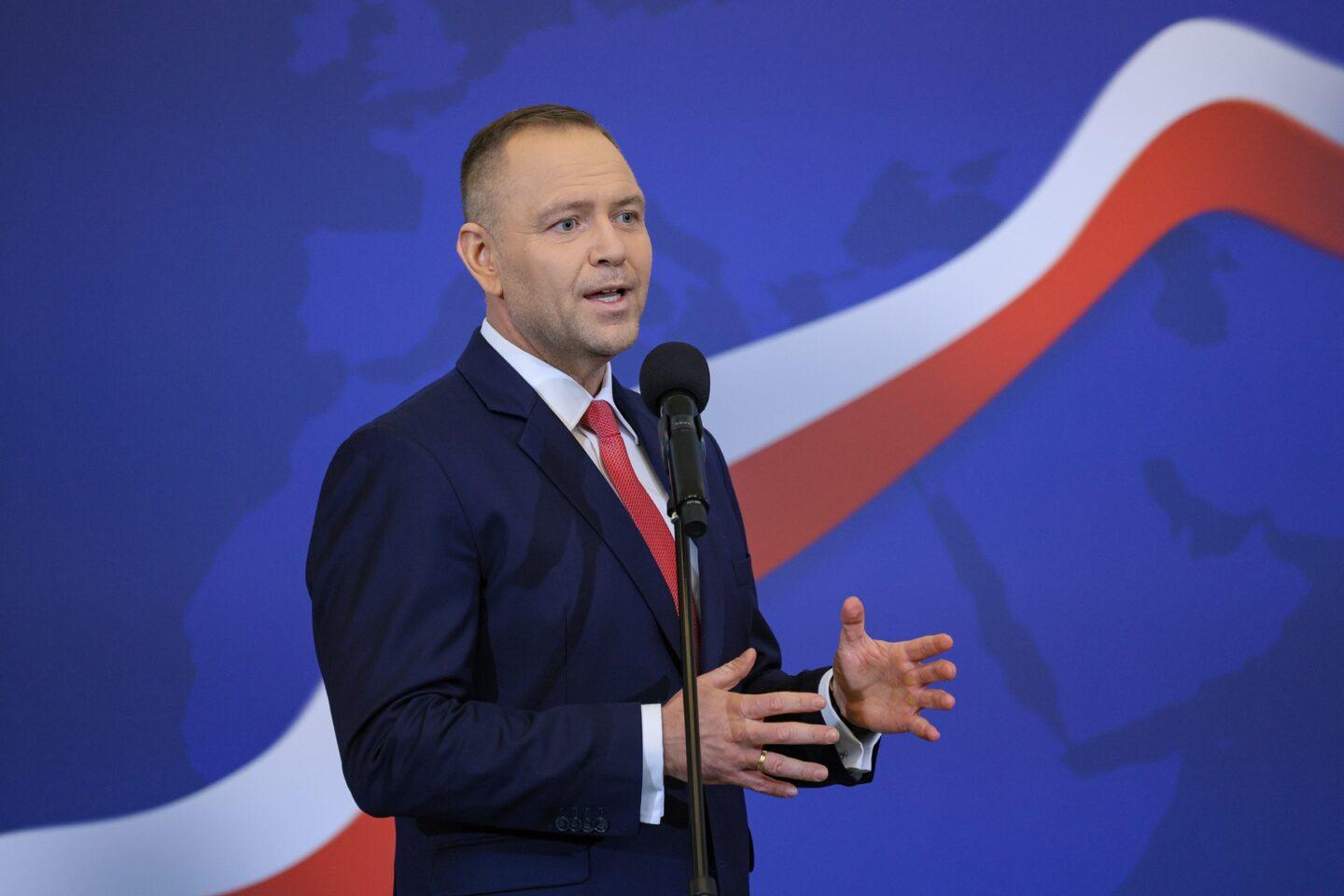
On Constitution Day (3 May), President Karol Nawrocki suggested strengthening the presidency by drafting a new constitution. Just four days later, he floated the idea of a referendum on EU climate policy. What political objectives is the president pursuing?
President Karol Nawrocki has wasted little time in May. On Constitution Day, May 3rd, he interrupted the politically sleepy holiday weekend with a speech calling for changes to the current constitution. The president argued for the need to unify executive power, which is currently divided between the “small palace” and the “large palace” — shorthand for the offices of the prime minister and the president.
That same day, the president established the Council for a New Constitution, which would ultimately be tasked with drafting a new basic law.
The first signs that the president had such ambitions could already be heard in his inaugural address. Until Sunday’s holiday, however, no concrete steps had been taken in that direction.
A new Constitutional Council – featuring the former head of the Constitutional Tribunal
The composition of the new constitutional council has prompted at least surprise, and in many quarters outright controversy. Its members include Marek Jurek and Professor Ryszard Legutko, both associated with the right, but also Józef Zych, the veteran figure of the Polish People’s Party (PSL), and Barbara Piwnik, who served as justice minister in Leszek Miller's left-wing government of early 2000s.
Beyond the absence of younger-generation politicians and legal scholars, the most controversial appointment was undoubtedly that of Julia Przyłębska, the former president of the Constitutional Tribunal installed during the Law and Justice (PiS) era. Even many on the right regard Ms. Przyłębska’s role as Jarosław Kaczyński’s “social discovery” as one of the previous government’s cardinal sins.
This has clearly not troubled President Nawrocki, whose presidency has so far shown no meaningful signs of distancing itself from the leadership of PiS. At the same time, Karol Nawrocki is pursuing a political strategy aimed at consolidating his position on the right. From the very first months of his presidency, he has sought to present himself as the right’s providential figure and its future ideological leader.
Mr. Nawrocki has also stopped short of drawing any firm line against the Confederation party led by Sławomir Mentzen and Krzysztof Bosak. In particular, he has maintained warm relations with the party’s nationalist wing. At Mr. Bosak’s invitation, the president took part in November’s Independence March. Even so, his main political anchor remains Law and Justice.
Law and Justice’s constitutional long jump
Against that backdrop, it is worth looking at the president’s political camp and its approach to a new constitution. After all, there is nothing particularly new about this. Every few years, Law and Justice ritualistically reintroduces the idea of replacing the 1997 Constitution into public debate.
Back in 2010, the party even produced a draft of a new constitution, which until recently remained available on party websites. Over time, however, the document appears to have become politically inconvenient and can now only be found in online archives. The old PiS proposal envisaged weakening and downsizing parliament while expanding the powers of both the president and the prime minister within the executive branch itself.
The tone of the document was marked by strong conservatism. Its authors declared that the draft had been written “in the name of Almighty God” and proposed constitutional protection for life from conception. Young people, meanwhile, were to be “protected from demoralization”, while citizens would be granted a constitutional right to defend the presence of religious symbols in public spaces.
In practice, the PiS constitution would have introduced a semi-presidential system in which the president could issue decrees carrying the force of law. The president would also have been able to refuse to appoint a prime minister or a specific minister. At the same time, the constitution would have strengthened the prime minister’s position within the government itself. The collegial nature of the cabinet was to disappear, leaving the prime minister as the sole figure exercising real authority.
And although years have passed and the party itself has largely forgotten the old draft, the vision of a state built around a powerful presidency remains very much alive.
Andrzej Duda’s initiative rejected by the Senate
Over the following years, PiS repeatedly attempted to revive the idea of a new constitution. During his first term (2015-2020), Andrzej Duda made a similar attempt. Like Mr. Nawrocki today, Mr. Duda submitted a proposal for what he called a “consultative referendum”. The referendum never took place because the proposal was rejected by the Senate – despite the chamber being dominated at the time by Law and Justice (PiS) itself.
PiS most recently pledged to pursue a new constitution during its merger with Zbigniew Ziobro’s Sovereign Poland in 2024. The grand declarations of a constitutional offensive against Donald Tusk’s government have since been forgotten even by the oldest hands on PiS leadership.
This brief historical dissection of the relationship between PiS and proposals for a new constitution is important for understanding the significance of Karol Nawrocki’s latest announcements. The president and his entourage are fully aware that no constitutional changes are realistically possible in the foreseeable future. At the same time, they know that calls for a new constitution resonate with part of the electorate, especially in periods of hostile cohabitation, when the limitations of the current constitutional framework become particularly visible.
Despite the obvious political obstacles to pushing through a new constitution, the presidential camp insists that work within the newly established council will continue. The ultimate goal is said to be a draft constitution put to a public vote. Alongside the ritual invocation of constitutional reform, referendums have become another political weapon that clearly appeals to the president.
A “neutral” referendum with a loaded question
On Thursday, May 7th, President Karol Nawrocki announced that he would submit a motion for a referendum on Poland’s implementation of EU climate policies.
The president wants Poles to answer the following question at the end of September this year: “Are you in favor of implementing EU climate policy, which has led to higher living costs for citizens, increased energy prices, and higher costs of doing business and farming?”
It is difficult to view the president’s proposed wording dispassionately. Although Nawrocki insists that, in his view, the referendum “is not directed against environmental protection or our membership in a united Europe”, both the phrasing of the question and its broader political context contradict those assurances.
The proposed wording is far from politically neutral. By its very construction, the question imposes a clear thesis on voters, explicitly framing the issue against the European Union.
Nor do the president’s previous speeches and decisions help sustain his claim of neutrality – including, for example, his veto regarding SAFE. Mr. Nawrocki’s argument that the referendum is politically neutral and merely hands the decision back to the nation also sits uneasily alongside the referendum documents published by the Chancellery of the President.
In the presidential decree announcing the referendum, one can read what the president believes an affirmative answer to the loaded referendum question would actually signify.
Will Poles say “yes”? The President sounds the alarm over the EU
“Answering ‘yes’ means agreeing to continue the European Union’s climate policy, including in particular:
- the introduction, from 2028, of CO2 emission charges on heating buildings with coal and gas, as well as on fuels for passenger cars (ETS2);
- imposing on property owners the obligation to carry out costly thermal modernization under the so-called Buildings Directive;
- restricting the sale of new passenger cars with internal combustion engines from 2035;
- rising costs for industry as a result of the gradual phase-out of free emissions allowances;
- imposing additional burdens on agriculture linked to crop and livestock production;
- Poland bearing the total costs of climate policy estimated at PLN 3.5trn (EUR 820bn) by 2040.”
Referendums as a political plaything
There is not a single word, however, about the potential benefits of EU climate policies – for example, lower energy costs for millions of Polish prosumers. Nor did the president mention Poland’s dependence on fossil fuels as a driver of rising living costs in recent years, a problem made even more visible in recent months by the blockade of the Strait of Hormuz.
Despite declarations to the contrary on social media, the president and his political camp do not appear to view the referendum as a neutral instrument for gauging public opinion. The Chancellery of the President openly employs anti-EU rhetoric that ignores any potential benefits of the energy transition for Poland. There is also no mention whatsoever of cooperation with the government, which is responsible for conducting negotiations within the EU framework.
Such declarations diminish both the stature and the credibility of the referendum as one of democracy’s core instruments, reducing it instead to yet another element of Poland’s daily political trench warfare.
A “no” to climate policy? The President heads for a clash with the EU
The president has also outlined what should happen if Poles reject the EU’s climate policy.
“Answering ‘no’ means obliging the relevant state authorities, within the scope of their competences, to:
- actively work within the European Union to block climate regulations whose costs are too high for Polish citizens, the Polish economy, and Polish agriculture;
- negotiate exemptions and derogations for Poland with the relevant EU institutions in order to shield Polish industry and citizens from the burdens of climate policy;
- introduce a system of financial protection against the costs of climate policy, covering households and businesses, particularly industry and agriculture.”
Should a majority of Poles reject the policy, Karol Nawrocki is effectively promising a political fight aimed at blocking EU regulations. Yet he offers nothing in return. The official presidential document presents no alternative to the current status quo. The president’s camp does not even refer to its own earlier initiative calling for electricity prices to be cut by 33%.
When is a referendum result legally binding?
It is worth recalling that under Poland’s current 1997 Constitution, the result of a nationwide referendum is legally binding only if more than half of eligible voters take part.
Under this provision, only one referendum in modern Polish history has produced a binding result: the vote held on June 7th and 8th 2003 on Poland’s accession to the European Union. Thanks to an exceptionally high level of public mobilization – and the introduction of two-day voting – turnout reached 58.85%.
In that referendum, 77.45% of voters answered “yes” to the question: “Do you consent to the Republic of Poland joining the European Union?”
2015: turnout of just 7.8%
In the other two cases, turnout fell short of the required threshold. In the referendum called by then President Bronisław Komorowski on September 6th, 2015, only 7.8% of eligible voters participated.
The questions concerned the electoral system, the financing of political parties, and the principle of resolving tax law ambiguities:
- Are you in favor of introducing single-member constituencies in elections to the Sejm of the Republic of Poland?
- Are you in favor of maintaining the current system of financing political parties from the state budget?
- Are you in favor of introducing a general principle that doubts regarding the interpretation of tax law should be resolved in favor of the taxpayer?
2023: referendum held alongside parliamentary elections
The most recent nationwide referendum took place on October 15th, 2023, alongside parliamentary elections. It was called by the Sejm, where the United Right held a majority. Turnout reached 40.91%, meaning the result was not legally binding.
Voters were asked four questions:
- Do you support the sale of state-owned assets to foreign entities, leading to a loss of control by Polish citizens over strategic sectors of the economy?
- Do you support raising the retirement age, including the restoration of the increased retirement age of 67 for both women and men?
- Do you support the removal of the barrier on Poland’s border with the Republic of Belarus?
- Do you support the acceptance of thousands of illegal immigrants from the Middle East and Africa, in accordance with the compulsory relocation mechanism imposed by the European bureaucracy?
Earlier referendums: before the turnout requirement
The three cases discussed above do not exhaust all nationwide referendums held in Poland after 1989.
Other votes took place under a different legal framework – before the adoption of the 1997 Constitution, which introduced the requirement that at least half of eligible voters must participate for a referendum result to be binding.
For example, in the May 1997 referendum on adopting the current Constitution, turnout reached 42.86%. Despite this, the Supreme Court deemed the referendum valid, even though fewer than half of eligible voters took part.
Referendum in Slovakia set for July 4
Nationwide referendums, which have become part of the current inter-party political disputes, are not a uniquely Polish phenomenon.
A referendum will be held on July 4 in Slovakia. It was called by President Peter Pellegrini following a citizen petition. Under Slovak law, the president is obliged to call a referendum if at least 350,000 citizens sign such a request (out of roughly 4.3 million eligible voters).
The initiative comes from an opposition party critical of both Prime Minister Robert Fico and President Pellegrini.
Only one binding referendum result
Slovaks will vote on the abolition of a lifetime pension recently granted by the governing coalition to Prime Minister Robert Fico, as well as on the restoration of the Special Prosecutor’s Office and the National Crime Agency, which had significant achievements in the fight against corruption.
The proposal also included a referendum question on shortening the parliamentary term, but President Peter Pellegrini ruled it unconstitutional.
As in Poland, a referendum result in Slovakia is binding only if more than half of eligible voters take part. According to the Slovak News Agency (TASR), since 1993 there have been nine nationwide referendums in Slovakia, but only one produced a binding result. That was the vote on Slovakia’s accession to the European Union – similarly to Poland’s experience.
The Senate will reject the referendum for now, but…
From past experience, referendums in Poland that are not tied to the adoption of specific legislation tend to end in failure. In the case of the latest referendum initiative, however, what matters above all is the use of the referendum as another tool for shaping political narratives. And that is most likely the main objective of the presidential camp. President Nawrocki and his circle are well aware that the referendum is unlikely to take place in the first place.
Under the Constitution, the president may call a nationwide referendum on matters of particular importance to the state, but only with the consent of the Senate.
To proceed, the Senate must agree to hold it. An absolute majority is required, with at least half of all senators present. The arithmetic in the upper house makes this outcome effectively impossible.
In the 100-seat Senate, 66 mandates are held by politicians of the Civic Coalition (KO) or senators supporting it. Law and Justice (PiS) holds 33 seats (Senator Jacek Włosowicz recently left the PiS caucus and is now unaffiliated). Even under the most unfavorable scenario for the government, the chances of Senate approval of a referendum initiative are close to zero.
…the real battle is about a right-wing Senate majority in 2027
At this point, it is worth stepping back from day-to-day politics and engaging in a thought experiment. With Karol Nawrocki in the Presidential Palace, next year’s Senate elections could take on far greater significance. The recurring idea of a right-wing Senate pact may gain additional weight in the context of the referendum debate.
In the previous elections, the Senate pact formed by the Civic Coalition (KO) secured a clear advantage over Law and Justice (PiS). According to the latest polling by the Ogólnopolska Grupa Badawcza (OGB), if the governing parties were again to run under a joint Senate pact, and PiS ran independently, the governing camp would once again hold a decisive majority in the Senate.
The picture becomes more interesting, however, if one assumes a contest between a government Senate pact on one side and a joint PiS–Confederation pact on the other. In that scenario, OGB simulations still show a victory for the governing camp, but by a much narrower margin: 53 to 47. In individual constituencies, differences could come down to a single percentage point.
A right-wing Senate Pact as the President’s secret weapon?
The question of victory in the Senate under such a configuration – not to mention the pivotal role of Grzegorz Braun in this political equation – will remain fiercely contested until the very end. The stakes are high: the ability for President Nawrocki to advance referendum initiatives.
And since Mr. Nawrocki is also sending signals of openness towards the Confederation, it is not out of the question that he himself could emerge as the providential figure behind such a Senate agreement.
In that scenario, Mr. Nawrocki would not only strengthen his position on the right, but also gain a realistic chance of pushing through referendum initiatives after 2027. At that point, the discussion about presidential referendums would move from political theory into a far more concrete reality.


Key Takeaways
- The lack of a supportive majority in the Senate effectively rules out the possibility of holding the proposed referendum in the near term. The Constitution strictly requires the upper chamber’s consent for any referendum called by the president. The current strategy of the presidential camp therefore appears to serve primarily as a means of laying political groundwork for a potential electoral alliance ahead of the 2027 vote.
- The President has established a Council for a New Constitution tasked with drafting a new constitutional proposal. Its composition includes figures associated with the former governing camp, which signals an attempt to consolidate the political right around the presidential center of power. These steps align with historical constitutional concepts aimed at significantly strengthening the powers of the head of state.
- Another initiative by Karol Nawrocki is the proposal to hold a referendum on EU climate policy. The referendum question is formulated in a way that suggests the negative consequences of the energy transition, while entirely omitting its potential benefits.