

This article is a part of Poland Unpacked. Weekly intelligence for decision-makers
Eighty organizations, mostly public institutions, have been testing a shorter working-time model for nearly six months now. We asked participants in the pilot scheme what it is like to work less – and, most importantly, whether they intend to continue once the state funding is cut off.
Ninety organizations qualified for the pilot, the overwhelming majority of them public-sector entities, as we reported back in October last year. More than one-third of the beneficiaries working shorter hours thanks to public subsidies are government offices – not counting other public institutions such as water utilities, museums or cultural centers. The labor ministry has signed agreements with 80 organizations and has already paid out funds to most of them. Some received several tens of thousands of zlotys, others as much as PLN 1m (USD 260,000 / EUR 235,000). Who received the money, and what was it spent on?
What was the shorter working-time pilot about?
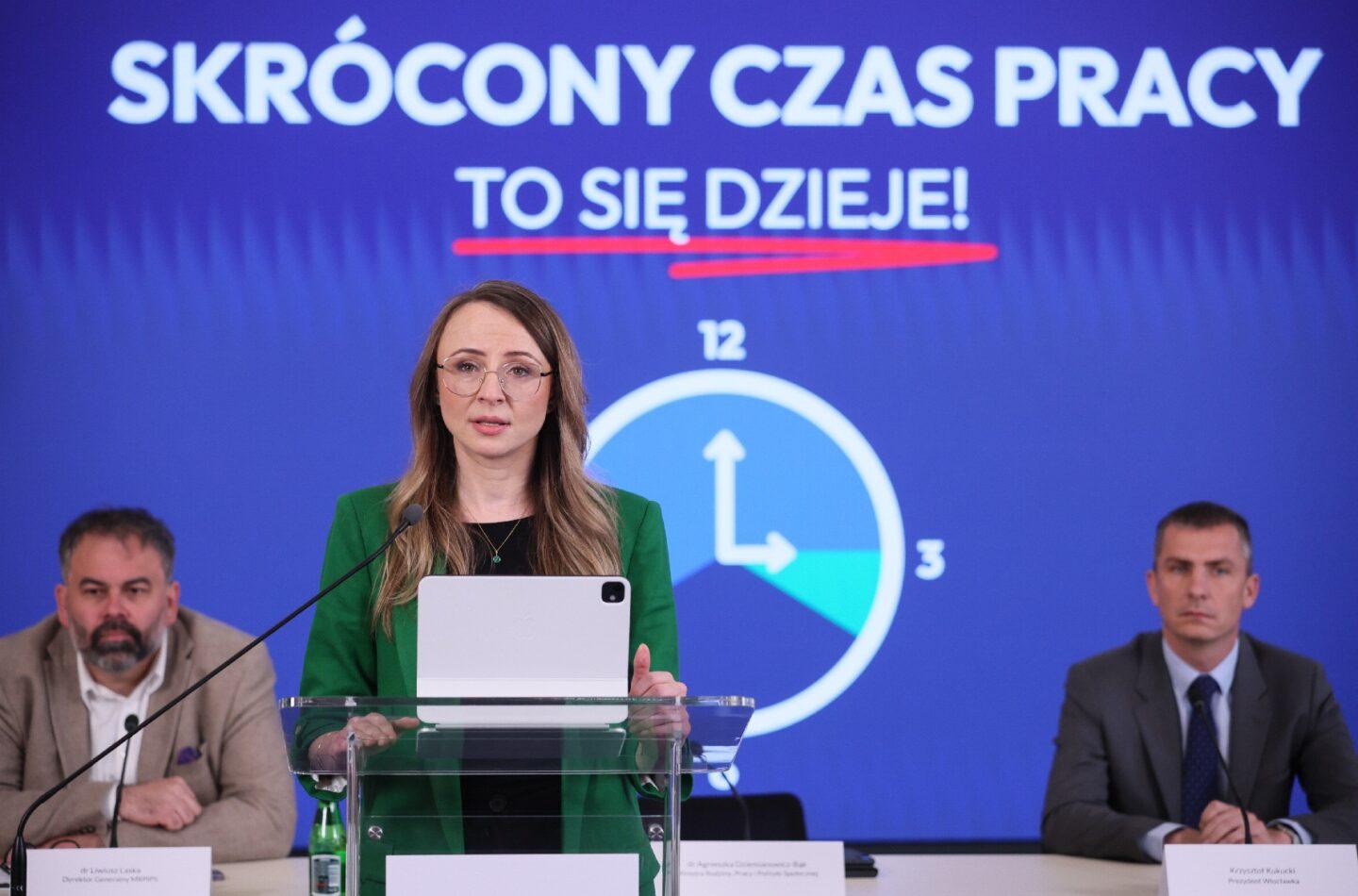
Let us begin with a reminder of what the shorter working-time pilot was – or rather was supposed to be – about. The Ministry of Family, Labor and Social Policy’s project, “Shorter working time – it’s happening!”, was concluded on October 15th 2025. By the end of the year, the ministry had signed agreements with 80 organizations, although 90 had qualified. The actual trial of reduced working hours began on January 1st 2026. Government offices, cultural institutions and – though in the minority – private companies are testing what work in a reduced-hours model looks like until December 31st this year. Their funding is guaranteed until then.
The program is financed with public money intended to offset any potential losses associated with reduced working hours. The maximum support available for a single pilot project is PLN 1m (USD 260,000 / EUR 235,000). The cost of a project per employee covered by the pilot may not exceed PLN 20,000 (USD 5,200 / EUR 4,700). The total funding pool amounts to PLN 50m (USD 13m / EUR 12m).
As labor minister Agnieszka Dziemianowicz-Bąk argued before the launch of the pilot, one of the key aims was to improve work-life balance. The government program is intended to test solutions that support a healthier balance between professional and family life.
“The workforce is getting older. More and more women want to combine professional and family life. Shorter working hours will be a major support for them. There is no single correct model for reducing working time. Solutions must be tailor-made and adapted to specific industries. Any changes will be gradual and phased in over time. The pilot project will be bottom-up in nature – it will be entrepreneurs and employees themselves who develop and test solutions suited to their organizations. Employers and employees are the ones blazing the trail; we simply pave it later,” the labor minister said.
So let us take a look at how the trials are progressing.
The shorter working-time pilot in private companies
Private companies – which, without the state subsidy, would be the only participants bearing the economic risk of reduced working hours themselves – are generally satisfied with how the pilot is progressing. KAJ Packaging, represented by Andrzej Janowski, had already experimented with a similar arrangement before. Back in 2025, the company tested shorter working hours under its own framework. This year, it joined the ministry’s official pilot program.
“We are currently in the second year of testing, focusing on refining the solutions we have developed and adapting them more effectively to the organization’s specific needs and to the project requirements. In particular, the project requirements made it necessary to modify some of the procedures we had developed earlier. However, we believe some of our original solutions were more effective, and we intend to recommend them in the final report submitted to the ministry. One example is the rule that, in a week containing a statutory public holiday, we do not add another day off. Otherwise, a five-day working week would effectively become a three-day week, which is not the objective of the program,” our interlocutor explains.
Artyści Uliczni Krakowa, which operates in the events industry, had not previously tested similar arrangements. As its representative, Juranda Król, explains, everyone would be satisfied were it not for one thing: bureaucracy.
“The pilot is going very well. Operationally, we are coping just fine, but the documentation side is struggling. The paperwork is overwhelming. In our case, the pilot involves reduced working hours combined with flexible accounting of working time. That is consistent with the nature of our services,” says Ms. Król.
Reporting requirements became a challenge for small businesses
In smaller organizations, where work schedules tended to be based more on informal arrangements than on formalized and documented procedures, reporting requirements have at times proved problematic.
“One challenge was measuring efficiency under the new conditions. We are a very small organization and had never previously conducted this type of analysis in a professional way. Intuitively, however, we can say that the pilot has not caused any major problems. In practice, the same amount of work is being completed with the same level of effectiveness, but with a better atmosphere within the company. Employees report a high level of satisfaction. Management also likes the new working model,” says Juranda Król.
In her view, reduced working hours have led to greater employee focus and motivation.
“We have shifted more towards a task-based model, and employees are trying to complete assigned tasks rather than stretching them across the entire working day,” Ms. Król adds.
The somewhat larger KAJ Packaging monitors both productivity and employee satisfaction.
“We are currently preparing for another employee survey, which we plan to conduct in June. Last year, employee satisfaction levels were high, while we also observed an increase in productivity. We measure productivity, among other things, by sales per employee. However, this year, owing to the geopolitical situation, including the conflict in the Middle East, it is difficult to make fully comparable assessments,” explains Andrzej Jankowski.
Not a loss, but an investment?
So does public funding fail to offset the costs? That appears to be the experience of KAJ Packaging, which received a total of PLN 982,000 (USD 255,000 / EUR 231,000).
“The funding does not fully compensate for the costs associated with introducing shorter working hours – particularly the additional paid days off. However, we do not see this as a loss, but rather as an investment in the future. The program helps build an attractive workplace. This matters especially for younger generations, including Generation Z. It also boosts employee creativity by giving people time to recover and pursue personal interests, while encouraging a healthier lifestyle,” says Andrzej Jankowski.
Will the company maintain the reduced-hours model once state funding ends? According to Mr. Jankowski, it is still too early for a definitive assessment. As he adds, the geopolitical situation does not make such decisions any easier.
Artyści Uliczni Krakowa, which secured PLN 60,000 (USD 16,000 / EUR 14,000), appears somewhat more optimistic about the future. In Juranda Król’s view, it would be difficult to retain employees whose working hours were suddenly increased again.
“We have not recorded any losses, but in the events industry seasonality is the dominant factor. A huge amount of time is being spent implementing systems to monitor productivity, working hours and the entire process. In that sense, perhaps there is a certain ‘cost’. In such a small company, we would not be doing this if the project did not require it. The truth is that we decided to join the program for two reasons. I believe in the philosophy of ‘shorter, but more efficient’ – what matters is completing the task, not the number of hours worked. We absolutely intend to continue with this working model. We greatly value employees’ improved attitude towards their responsibilities. What is more, we would have to dismiss the entire workforce and hire new people, because the current employees would no longer agree to a longer working day,” Ms. Król concludes.
How does it work in the public sector?
We examined how the pilot is being implemented in three municipal offices: the Town Hall in Woźniki, the Town Hall in Miastko, and the City Office in Malbork.
In Woźniki, the pilot is running without disruption. As Wojciech Zawadzki, Head of the Social Communication and Promotion Department, explains, residents were informed in advance about the organisational changes, and the office continues to operate Monday to Friday without interruption.
“Currently, we are implementing the first stage of the pilot, based on a hybrid model. Employees perform their duties in a system that ensures the continuity of the office’s operations and uninterrupted service for residents. From July, we will begin testing the second solution, namely a four-day working week,” says Mr. Zawadzki.
In Malbork, by contrast, working time was reduced by 12.5% in the first half of the year, and will be reduced by a quarter in the second half. Thanks to the pilot, municipal employees benefit from additional days off.
“We ensure continuity of public services. Citizens’ opinions on our work are important to us. As part of the office’s participation in the pilot, we are measuring service quality through anonymous surveys,” explains Ewa Dąbrowska, Secretary of Malbork City.
Meanwhile, Przemysław Namysłowski, Secretary of the municipal office in Miastko, explains that the local authority developed a detailed action plan and set up a coordination team to implement the new working model.
“The pilot is running without disruption, in line with a monthly work schedule for each employee. Most staff work under an equivalent working-time system – 35 hours per week in a four-day working week. Employees with a certified moderate or severe disability work a five-day week, at 30 hours per week,” explains Mr. Namysłowski.
More than PLN 860,000 (USD 224,000 / EUR 203,000) was allocated to Miastko. Whether the shorter working week will remain in place there in the longer term will be decided at the end of the year, according to Mr. Namysłowski.
Cash-deposit machines and chatbots: where the money goes
The City Office in Malbork received more than PLN 837,000 (USD 218,000 / EUR 197,000) under the pilot program. The funds will be used, among other things, to purchase a cash deposit machine for the office and to launch a chatbot for handling resident enquiries via the municipal website.
“The cash deposit machine will allow residents to pay taxes, local fees and other charges directly at the municipal building. This will reduce queues at the cashier’s desk and shorten service times. The chatbot, in turn, will answer the most frequently asked questions from residents and direct them to the appropriate forms or information on the website. This will improve service accessibility and reduce response times. We are also implementing the ‘Friendly e-Declarations’ system, enabling online submission of property tax, transport tax, agricultural tax and forestry tax declarations through a simple and intuitive form,” explains Ewa Dąbrowska.
More than half a million złoty was allocated to the municipality of Woźniki. However, as Wojciech Zawadzki notes, an equally important source of support is the project “Digital Future of the Woźniki Municipality: Modern Public and Administrative Services”. Under this program, the municipality is expected to receive PLN 2.5m from EU funds.
“These funds will be used, among other things, to digitize administrative processes. We will invest them in the development of e-services, the implementation of modern IT systems, staff training, and solutions that improve organizational efficiency,” explains a representative of the Town Hall in Woźniki.
Shorter working time and critical infrastructure
We also examined other public-sector entities: Wodociągi Chrzanowskie (a water supply company – ed.) and the Europejskie Centrum Bajki im. Koziołka Matołka w Pacanowie (a modern interactive museum and cultural center in southern Poland dedicated to fairy tales and the famous Polish comic character Koziołek Matołek, offering educational and entertainment activities for children and families – ed.).
Explainer
Koziołek Matołek
Koziołek Matołek is a classic Polish children’s comic hero from the 1930s: a well‑meaning but slightly clueless billy goat who roams the world trying to reach the town of Pacanów, where he believes goats can finally get proper shoes. Written by Kornel Makuszyński and illustrated by Marian Walentynowicz, his rhymed adventures became a cult staple of Polish childhood, quoted across generations and firmly embedded in the country’s literary canon.
For many Poles, Koziołek Matołek is less about the plot and more about a shared memory of pre‑war and communist‑era childhoods: dog‑eared books, simple rhymes, and a gentle, self‑ironic take on Polish naivety wandering through a confusing world. His quest also put the real town of Pacanów on the cultural map and ultimately inspired the European Fairy Tale Center there, turning a once‑obscure place into a small pilgrimage site for fans and families.
“All employees at Wodociągi Chrzanowskie are included in the pilot – without exception. This increases the scale of the challenge, as it covers the entire company rather than selected areas. We are implementing shorter working hours by increasing the number of days off per month while maintaining salaries. In the first half of 2026, this means 13 fewer working days, and in the second half – 26. In critical infrastructure, where water supply must be ensured continuously and failures can occur at any time, this is not merely a benefit. It is almost like open-heart surgery on the organization,” says Barbara Boba, project coordinator at Wodociągi Chrzanowskie.
As she adds, such a transformation cannot be managed “by intuition alone”. Continuous monitoring of work organization is therefore necessary. She stresses that the PLN 443,000 (USD 115,000 / EUR 104,000) received is not “survival money”, but funding for real change.
“We monitor service timeliness, effectiveness of repairs, absenteeism, costs, and levels of employee satisfaction and stress. After the first quarter of 2026, the conclusion is cautious but clear – and for many, surprising. Less working time does not mean less work done. We are able to maintain pace without losing quality. Water keeps flowing, the system works, and failures are resolved on time. That foundation remains intact,” she adds.
The company is investing in systems that take over some tasks previously performed by employees, such as monitoring and automation.
“We do not treat this funding as compensation for losses or a way to patch financial results,” Ms. Boba adds.
In the cultural sector: no major changes
Will shorter working hours in public offices and other public institutions survive beyond the pilot? All of our interviewees offer a near-unanimous answer: it is still too early to make such decisions.
Cultural institutions have somewhat greater flexibility in shaping their reduced working-time models. The Fairytale Center in Pacanów, which secured nearly PLN 1m (USD 260,000 / EUR 235,000) under the program, has introduced Mondays as a day off.
“In many cultural institutions, Mondays are excluded from tourist traffic. So far, this does not appear to have had a major impact on our activities. Although we do not formally measure the effectiveness of the system, employees themselves report that they are satisfied. We have specific activities and cultural events to deliver. The season has only just begun. It is too early to draw any firm conclusions,” says Katarzyna Pluta, funding acquisition specialist at the European Fairy Tale Centre in Pacanów.
What next? Final conclusions will come in a year
According to the ministry’s timetable, the pilot program will be formally concluded on May 15th 2027. By that date, the Ministry of Family, Labor and Social Policy is expected to receive final reports as well as quarterly surveys from employers and employees.
“The Ministry of Labor will analyze the solutions developed in 2027, after the pilot projects have been completed. The ministry will then publish the results of the pilot,” the ministry said in response to our questions.
It is also worth noting that as early as April this year, the ministry established a dedicated Shorter Working Time Team. Its role is to monitor the implementation of reduced working hours with maintained pay across both private and public sector employers.
Expert's perspective
Does “clocking hours” build organisational value?
A century after the introduction of the 40-hour working week, technology, medicine and science have been fundamentally transformed. So too have jobs themselves. Why, then, is it still so difficult to imagine that the organisation of work could also look different?
The pilot run by the Ministry of Family, Labour and Social Policy (Ministerstwo Rodziny, Pracy i Polityki Społecznej) is not about a simple cut in working time from 40 to 32–38 hours per week. It is about something more fundamental: testing whether the number of hours worked actually translates into productivity. It is a reflection on whether “clocking hours” builds organisational value more than autonomy, flexibility and a task-based model of work.
For this reason, we should not become fixated on working hours alone, and instead treat the pilot as an experiment testing different models of work—one that may show whether, in Poland in 2026, work can be organised differently.
At the first meeting of the Shorter Working Time Task Force, Labour Minister Agnieszka Dziemianowicz-Bąk emphasised that the results are not predetermined, and that scientific research conducted during the programme is crucial—both among employers and employees. It is data, she argued, that should underpin evidence-based policymaking. And that is precisely what is happening.
Each time we hear about shorter working-time pilots—in Poland and abroad—it is worth asking a few questions: can we manage time and capital in companies differently? Can we organise work in ways other than according to a norm designed a century ago for an industrial economy?
And finally: should the AI revolution, which gives us tools for faster and more efficient work, also be used to give people more time for family life, raising children and recovery? The demographic crisis, after all, will not resolve itself.


Key Takeaways
- The future of shorter working hours, however, remains uncertain. The pilot program ends at the close of this year, together with its public funding. Most organizations currently testing the new working model are unable to say definitively whether they will continue operating on reduced hours in 2027.
- Shorter working time appears to work in government offices, cultural institutions and private companies alike. Representatives of organizations from different industries and sectors of the economy say almost unanimously that service quality can be maintained despite reduced working hours.
- Regardless of the reporting burden, it comes as little surprise that employees report high levels of satisfaction. Our interviewees believe that shorter working hours help preserve work-life balance while also making organizations more attractive to “Gen Z”, the youngest cohort entering the workforce.