

This article is a part of Poland Unpacked. Weekly intelligence for decision-makers
TikTok Shop will launch in Poland on June 15. Instead of only watching content, users will also be able to buy products. For sellers, brands, and creators, this opens a new sales and monetization channel. For the e-commerce market, it is a test of whether shopping driven by short videos and live streams can become a mass phenomenon in Poland.
Information reported by XYZ, which we wrote about a year ago, has now been confirmed. At the time, our sources indicated that the platform would launch no later than the first half of 2026. We now have a final, confirmed date: June 15.
The new service is designed to bring together, within a single app, what has so far functioned mainly as shopping inspiration on the platform: short videos, live streams, creator recommendations, and brand profiles.
The key change is that, from mid-June, users will no longer need to leave TikTok to find a product and complete a purchase on an external online store. The entire transaction will take place within the app.
The rollout in Poland is part of a broader European expansion. At the same time, TikTok Shop will also launch in the Netherlands, Belgium, and Austria. For the company, Poland is another step in building out the commercial layer of an app that has so far been primarily an entertainment, social, and advertising platform.
TikTok’s expansion in Poland
“Poland is a natural next step for us. This is not an additional feature or a short-term experiment lasting a few months. It is a strategic move by TikTok that has been in development for many years,” says Adam Zaorski, TikTok representative responsible for e-commerce operations in Poland.
The company does not disclose how many sellers will begin operating in Poland on launch day. However, company representatives speak of “thousands.” In existing European markets – Spain, France, Italy, Germany, and Ireland – TikTok Shop already has more than 100,000 sellers in total. France is said to be the most active market, with over 34,000 sellers.
“At launch, we are talking about thousands of sellers. However, what matters most to us is a solid foundation and market education,” Zaorski noted.
According to unofficial information obtained by our newsroom, around 200 sellers are currently in the onboarding phase. TikTok is actively competing to attract merchants to the platform. The turning point is expected in August, when the pilot phase on the Polish market is due to conclude.
At present, TikTok is in talks mainly with three groups: merchants (i.e., prospective sellers), affiliates, and large brands that could introduce their products onto the platform.
TikTok aims to monetize millions of users
In Poland, TikTok has 14.2 million users. Across Europe, more than 200 million people use the app monthly, and globally the figure exceeds one billion. For the company, this is a starting point for building an e-commerce market that does not begin from scratch. The platform already has users, creators, brands, and recommendation algorithms. The missing piece until now has been the purchase itself.
“By launching a marketplace, it is a great privilege to have this scale from day one. But it also comes with significant responsibility,” explains Adam Zaorski.
From a business perspective, TikTok Shop is designed to solve a problem that has so far worked in favor of other retailers. Products would become popular on TikTok, but purchases would take place elsewhere: on a brand’s online store, on marketplaces, via search engines, or even in brick-and-mortar shops. In the United States, this phenomenon is so widespread that Amazon has created sections dedicated to TikTok-viral products.
“Products were selling thanks to content on TikTok, but the transaction – if it happened at all – took place outside our ecosystem. TikTok Shop closes that loop,” Zaorski notes.
Expert's perspective
TikTok Shop will not dominate the market. Yet
For this reason, TikTok Shop will expand the market rather than dominate it. On Allegro, consumers go for planned purchases; on TikTok, they discover and buy impulsively. It is a different stage in the sales funnel. Moreover, Meta’s shopping features have not become a natural purchasing destination for Poles. Only 19% of online shoppers report converting via social media, mainly due to security concerns.
TikTok has more than 16 million users in Poland who spend an average of 24 hours per month on the platform. 93% of daily users treat it as a source of pre-purchase research. The expectation is for cautious budget increases rather than substitution of existing channels – similar to what has been observed in the UK. Without hard evidence of conversion, there will be no major shifts, and live commerce in Poland is still in its early stages.
In the long term, TikTok Shop poses a risk to merchants’ margins and loyalty to platforms – not to consumer traffic.


How TikTok will make money
The company will generate revenue primarily from sales commissions and advertising. The standard commission in European markets is expected to be 9%, while for electronics it will be 7%. In Poland, however, this rate will be reduced to 2% for the first 90 days after launch. TikTok does not plan to charge monthly fees or subscriptions for running a shop.
“There are no monthly fees, no subscriptions, no costs for running a shop. There is a sales commission,” explains Adam Zaorski.
The second key revenue stream will be advertising. TikTok Shop will be integrated into the platform’s broader advertising ecosystem, but with a much more direct link to sales than traditional external campaigns. Sellers will be able to promote products, live streams, and search visibility. One of the new tools will be GMV Max, an advertising product optimized for gross merchandise value.
“A product can become an ad. It will be displayed in the Shop tab in the feed,” notes the TikTok representative.
Another new feature will be ads for live shopping broadcasts. A brand or seller will be able to launch a livestream and then promote it as an advertising format in order to attract viewers from the outset.
This tool could reshape the advertising market even more significantly than the platform’s impact on competitors such as Allegro or Amazon.
“In my view, the advertising market will change significantly. Part of performance marketing and influencer marketing budgets will start shifting to TikTok Shop, because brands will gain the ability to directly measure sales within a single platform. For many companies, TikTok will cease to be a marketing add-on and become a genuine sales channel,” comments Jakub Gierszyński, an e-commerce expert.
Plans to conquer the e-commerce market
TikTok describes its model as “discovery e-commerce” – a form of commerce driven by product discovery. Users do not always arrive with a specific purchase intent, as they would on a traditional search engine or marketplace. Instead, they often encounter products in video content, during live streams, or through creator recommendations. According to data cited by the company, one in two TikTok users discovers new products or brands on the platform, while three in four use it as a source of recommendations.
In Poland, TikTok states that 70% of users discover new local businesses on the platform, 81% consider creative content an inspiration to try new products, and nearly half declare a greater willingness to purchase from a local brand if the content feels authentic.
“TikTok already has a real impact on purchasing decisions. This is not something we are only trying to create – it is already happening,” adds Adam Zaorski.
Will the company’s plans be realized?
“TikTok Shop may significantly disrupt Polish e-commerce, but not in a way that suddenly takes market share from Allegro or Amazon. It is more about changing shopping behavior, especially among younger consumers. TikTok is already highly effective in influencing purchasing decisions, and now the entire process – from viewing a product to completing a purchase – will be contained within a single app,” says Jakub Gierszyński.
He notes that TikTok Shop will have the greatest impact on brands in categories such as beauty, fashion, supplements, and lifestyle products, where emotions, trends, and creator recommendations play a decisive role. In these segments, TikTok Shop could quickly gain meaningful sales share.
“Allegro will still win on scale, logistics, and customer trust, while TikTok may become a very strong product discovery channel. And that is the biggest shift: users will no longer search for a product – they will ‘stumble upon’ it while browsing content,” Gierszyński concludes.
How TikTok Shop will work
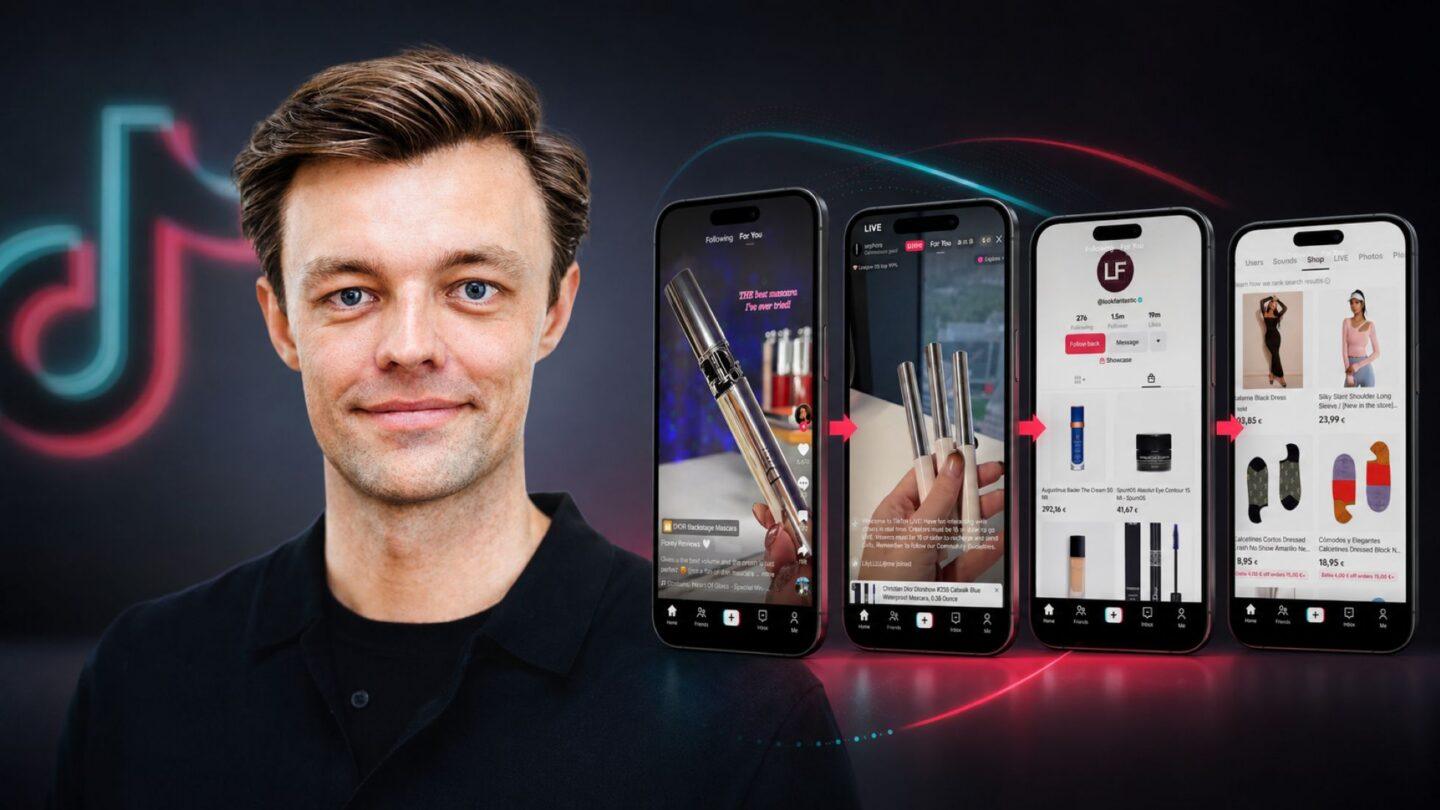
TikTok Shop will operate across several formats. The first will be short videos in the “For You” feed with embedded product links. After clicking, users will see a product card and will be able to complete the purchase without leaving the app.
The second format will be live shopping – real-time sales livestreams. Sellers and brands will be able to present products, answer questions, and conduct sales in real time.
The third element will be the Shop tab. Products will be selected by a recommendation engine, also within specific categories. A user entering fashion, electronics, or cosmetics sections will see offers tailored to their interests and behavior.
“This is somewhat different from traditional marketplaces. We do have categorization, but what is displayed at any given moment is driven by an algorithm,” explains Adam Zaorski.
Good to know
What the Polish e-commerce market looks like
E-commerce platforms have become one of the key mechanisms in Poland for goods distribution, price comparison, and building customer relationships. According to the Gemius E-commerce in Poland 2025 report, 78% of internet users declare that they shop online, 77% purchase from Polish online stores, and 41% also buy from foreign websites.
However, when measured against total retail sales, the share of e-commerce is lower than its importance in everyday consumer behavior. Data from the Polish Chamber of Commerce (KIG), based on Statistics Poland (GUS), shows that in 2024 e-commerce accounted for 8.9% of total retail sales in Poland, up from 8.7% a year earlier. In 2025, KIG estimates this share rose to around 9.1%, with e-commerce turnover approaching PLN 92 billion (approximately EUR 21.4 billion).
Marketplaces play the most important role today, as they concentrate demand, consumer attention, logistics, payments, and advertising. In the Gemius report, Allegro remained the most frequently indicated shopping platform. Its usage was declared by 88% of online consumers. It was followed by OLX (35%), Temu (20%), Amazon (19%), Zalando (15%), and AliExpress (15%).
The role of platforms extends beyond sales alone. For Polish companies, they are a channel to reach millions of customers, but also a source of price and commission pressure. For consumers, they mean greater choice, delivery convenience, easier price comparison, and lower prices. The OECD, in a 2026 study analyzing the Polish market, examines marketplaces precisely through the lens of competition and the market power of the largest platforms.
How to make money on TikTok? Affiliate program launches
Another format will be a storefront visible on a brand’s or seller’s profile. If a company operates an account on TikTok, its products will be directly accessible from its profile. A similar mechanism will apply to creators participating in the affiliate program.
Affiliate marketing will be one of the key sales tools. A creator who registers on TikTok Shop as an affiliate will be able to promote sellers’ products and earn a commission on sales generated through their content. Partnerships will be labelled accordingly, with communications localized for the Polish market.
“If a user buys a product from a creator’s video, the creator receives a commission,” notes a TikTok representative.
TikTok will not impose commission rates for affiliates on sellers. Technically, the range will span from 1% to 80%, with the exact rate determined by the brand or seller. The platform will only recommend commission levels depending on the category, as different market segments operate with different margin structures.
Access to the affiliate program will not be fully open. Creators must be at least 18 years old and complete a registration process. The minimum threshold is 1,500 followers.
“We want as many creators as possible to have the opportunity to monetize, but at the same time we want to ensure that profiles are active and managed in a professional way,” comments Adam Zaorski.
The operational side of TikTok Shop
From a seller’s perspective, the operational hub will be the Seller Center. This is where businesses will create accounts, add products, manage sales, and oversee their assortment. Products can be uploaded manually or via integrations. TikTok is planning connections with popular platforms and integrators, including WooCommerce, BigCommerce, BaseLinker, Apilo, and Sky-Shop.
“The seller sets up the Seller Center, which is essentially the control center of TikTok Shop. Products must be there, but they can be added manually or via integration,” noted Adam Zaorski.
Integrations will cover both product catalogues and order fulfilment. If an order is placed via TikTok Shop, the seller will not need to process it separately, provided their sales system is integrated with the platform.
A prerequisite for participating in the Polish TikTok Shop will be a business registered in Poland. The platform will accept sole proprietorships, limited liability companies, and joint-stock companies. Sellers will undergo KYB and KYC procedures, meaning business and identity verification.
Polish sellers will also be able to expand relatively easily to other European markets where TikTok Shop is available. The Sell Across Europe feature will allow them to list products across multiple markets, using automated translation of product descriptions, currency conversion, and even tools for translating text embedded in product images.
“A seller uploads products once and, with a few clicks, can list them across all European markets where TikTok Shop operates,” the TikTok representative explained.
TikTok Shop partners
In Poland, TikTok is working with InPost and DPD on logistics. For cross-border sales under the Sell Across Europe model, GLS will also be used. For payments, users will be able to choose cards, Apple Pay, Google Pay, and BLIK.
“InPost is a favorite brand among Polish consumers and a logistics market leader, so it is no surprise that we are becoming a natural partner for any new player seeking to establish itself in Polish e-commerce. This market is constantly evolving, which is exactly what makes the industry so exciting. TikTok Shop’s entry into Poland is a clear signal that the e-commerce ecosystem is maturing and offering consumers more and more options. New sales channels mean new opportunities for shoppers, and that is exactly the direction we support. We are rooting for TikTok Shop and are glad to be part of this change,” commented Rafał Brzoska, CEO and founder of InPost Group, on TikTok Shop’s entry into the Polish market.
Magdalena Kubisa, Business Development Director at BLIK, noted that Poland is currently one of Europe’s most advanced e-commerce markets in terms of mobile technology. Consumers have become accustomed to payment methods that are almost invisible – fast, intuitive, and completed within seconds.
“For a global platform such as TikTok Shop, launching with BLIK integrated from day one is a strong signal to Polish consumers. It shows a deep understanding of local habits and immediately removes barriers in the purchasing process,” said Magdalena Kubis.
TikTok Shop and the brands launching on the platform
Among the companies that have already joined TikTok Shop are Modivo, L’Oréal, Carpatree, beBIO Cosmetics, Eveline Cosmetics, and Everybody London.
“Entering the live shopping space is a new direction for our marketing activities, which we see as an opportunity to showcase the quality of our products to as many new customers as possible,” says Łukasz Traczyk, Director of Alternative Sales Channels at Modivo.
Małgorzata Misiura, Chief Digital & Marketing Officer at L’Oréal Poland & Baltic HUB, emphasizes that the partnership with TikTok Shop is intended to support the social transformation of commerce.
“We are pleased to co-create a new era of commerce together with TikTok Shop and the brands of our Consumer Products Division, placing consumers at the centre of every digital interaction,” says Misiura.
“We have long been eagerly awaiting the launch of TikTok Shop in Poland. For us, it is a huge opportunity, which is why we began preparations well before its official entry into the Polish market,” comments Jakub Chmielniak, owner of Carpatree.
Positive sentiment towards TikTok is also expressed by Karina Fiedczyk, Head of Digital Marketing, E-commerce & PR at beBIO Cosmetics, Wojciech Kasprzycki, authorized representative for communications and e-commerce at Eveline Cosmetics, and Jowita Ślusarz, Founder & CEO of Everybody London.
Sellers under supervision
After launch, the platform will monitor products, categories, service quality, shipping times, and compliance with terms and conditions. Sellers will be assessed using an internal metric, the Shop Health Score, which will be visible both to TikTok and to the sellers themselves.
“The goal is not to penalize sellers. We want to work with them and help them develop so that services are delivered at the highest possible level,” adds Adam Zaorski of TikTok.
The June 15 launch will be a gradual rollout. The feature may not appear for all users immediately, but TikTok expects access to expand over the course of several days or weeks.
“This will be a rollout. Technically, it may not appear for everyone from day one, but we do not have a policy of throttling the product. It will refresh and expand progressively,” Zaorski notes.


Key Takeaways
- TikTok Shop is set to launch in Poland on June 15 as a fully operational shopping service integrated directly into the app. This means users will be able to discover products through short videos, live streams, brand profiles, or the Shop tab, and then complete purchases without being redirected to external online stores. Poland is intended to be part of a broader European expansion that also includes the Netherlands, Belgium, and Austria. TikTok treats the project as a strategic initiative rather than a pilot feature. However, the rollout will be gradual, meaning access may be enabled for users in stages.
- For sellers and creators, TikTok Shop represents a new monetization model, but also a need to adapt to platform rules. Sellers will use the Seller Center, integrations with e-commerce tools, and logistics and payment solutions such as InPost, DPD, BLIK, Apple Pay, and Google Pay. The platform will generate revenue through commissions and advertising, with a reduced commission rate of 2% in Poland for the first 90 days. Affiliate marketing will play an important role: creators with at least 1,500 followers will be able to promote products and earn commissions on sales, with rates determined by the sellers themselves.
- The new platform does not necessarily pose an immediate threat to the largest players in Polish e-commerce such as Allegro, Amazon, or OLX, but it may reshape shopping behavior in selected categories. Experts cited in the text point primarily to fashion, beauty, electronics, lifestyle products, and impulse purchases. TikTok Shop is designed to work differently from traditional marketplaces. It will not rely solely on deliberate product searches, but on discovery through content, creator recommendations, and algorithmic distribution. This could shift part of advertising budgets toward sales measured directly within the app.