

This article is a part of Poland Unpacked. Weekly intelligence for decision-makers
Following the referendum in Kraków, speculation has begun over who might be next. There have also been announcements of further recall referendums.
“For city mayors, the most dangerous combination is two things: incompetence and a political backdrop,” says Łukasz Pawłowski, president of the Nationwide Research Group.
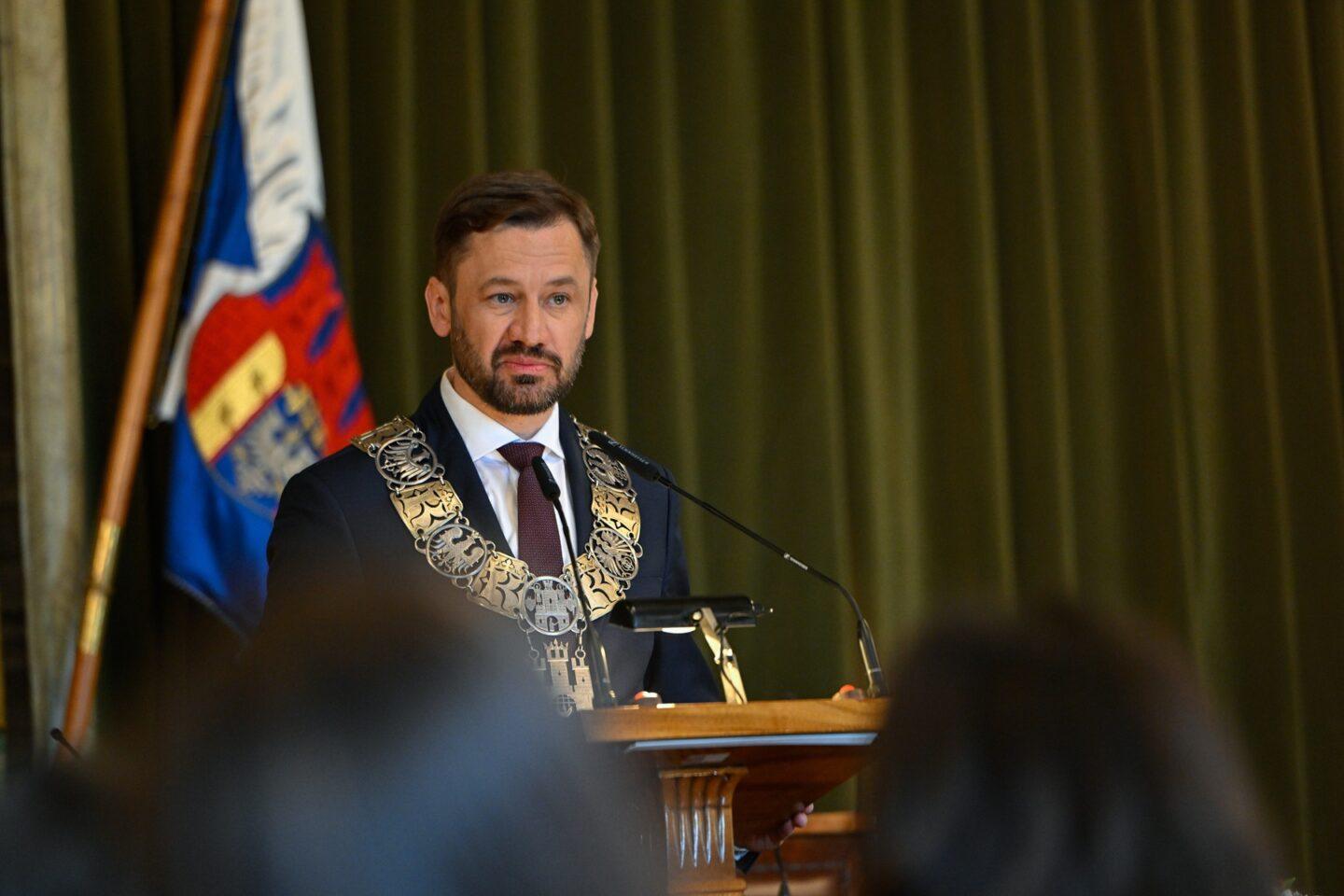
After just two years in office as Mayor of Kraków, Aleksander Miszalski is being removed by residents through a referendum. Turnout reached 29.99%, exceeding the validity threshold of 26.98%.
Kraków’s opposition and many residents had been calling for change, criticizing the outgoing mayor for, among other things, introducing the Clean Transport Zone, which bars vehicles that do not meet emissions standards from entering an area covering 60% of the city. He was also accused of appointing political allies to public-sector positions and presiding over the city’s growing debt burden.
Kraków referendum: Miszalski ousted
After losing the vote, Aleksander Miszalski thanked Kraków residents for taking part in the referendum and for the opportunity to serve as mayor over the past two years. Earlier, however, he had encouraged residents not to participate in the referendum, hoping turnout would remain below the threshold required for the result to be valid.
The margin in favor of his removal was overwhelming. A total of 171,581 residents voted to recall Aleksander Miszalski, while 3,631 voted against his removal.
Łukasz Pawłowski, president of the Nationwide Research Group, points to several political factors that contributed to Miszalski’s defeat. His firm conducted the exit poll during the Kraków referendum.
“For city mayors, the most dangerous combination is two things: some form of incompetence and a political backdrop. If a politician is associated with Civic Coalition (KO), that alone is enough motivation for some voters of Law and Justice (PiS), Confederation, and Grzegorz Braun’s movement to turn out for a referendum.
Also read: A motley crew of extremes: Who are Grzegorz Braun’s people?
In 2024, we predicted that this local-government term would see a wave of referendums, for several reasons. One is the high turnout in parliamentary and presidential elections, combined with low turnout in local elections, which results in relatively low referendum thresholds. Wherever a KO politician is in power, the prospect of showing Donald Tusk a yellow card is an attractive one. As long as Donald Tusk remains prime minister, KO mayors are fair game. Tusk himself cannot be removed through a referendum, but voters can derive satisfaction from removing a city mayor associated with him,” says Pawłowski.
According to the head of the Nationwide Research Group, Civic Coalition cannot afford to underestimate the united forces of the right.
“KO should recognize that even if the distribution of seats in parliament works in its favor, the right commands a different kind of majority. There are more voters supporting PiS, Confederation, and Braun’s movement. They helped Karol Nawrocki win last year, and they mobilized again in Kraków,” the expert says.
The first candidates emerge
Within hours of the vote ending, the names of the first contenders for Kraków’s mayoralty began to surface. Among the first to announce his candidacy was Bartosz Bocheńczak, secretary of the New Hope party, a Confederation activist, and former campaign manager for Sławomir Mentzen’s presidential bid.
“If nothing unexpected happens and the government-appointed commissioner calls the election, I will run. I want to address the issues that led residents to dispense with the outgoing mayor’s services. First and foremost, there is the Clean Transport Zone, which I would be delighted to abolish. There is also widespread cronyism in municipally owned companies and institutions linked to local government. Kraków’s debt is growing at an alarming pace, and I would like to bring it under control,” says Bocheńczak.
Marian Banaś, the former president of the Supreme Audit Office (NIK) and a finance minister in a Law and Justice (PiS) government, has also declared his intention to run. In recent years, Banaś has been at odds with his former party.
Unofficial reports suggest that the left-wing Together party (Razem) will field its own candidate in the Kraków mayoral election. The expected nominee is Aleksandra Owca, a city councilor and co-chair of the party.
PiS awaits Civic Coalition’s next move
Law and Justice (PiS) has yet to make a decision on its candidate. According to Łukasz Kmita, a PiS member of parliament from Kraków and the candidate who lost to Miszalski in the 2024 mayoral election, the party is waiting for an opportunity to launch a counteroffensive.
“We are waiting to see whom Donald Tusk and the voivode appoint as commissioner. If it is not the city secretary, who is a non-partisan civil servant, it would be a scandal. Kraków residents have spoken out against Civic Coalition (KO), and any attempt to impose a party-affiliated commissioner would be a slap in the face to the city’s residents.
Our candidate – or the candidate we choose to endorse – will be someone capable of reaching the second round and then winning the election. The other issue is the person Donald Tusk selects as KO’s candidate for mayor of Kraków. We will not reveal our candidate before KO does. We will tailor our strategy to our opponent’s moves in order to be more effective and achieve success,” says MP Łukasz Kmita.
According to the PiS politician, the party is currently considering five potential candidates.
“One of them is a highly respected professor with no formal party affiliation who could appeal to a broad cross-section of society. Another is an effective local-government politician and the deputy chairman of the City Council, Michał Dwernicki. The group also includes someone who has served both Poland’s national security interests and the Małopolska region (Kraków being it’s capital – ed.) and has an outstanding résumé. If one of the coalition’s MPs were to leave the governing camp, that person could potentially become a candidate we would support.
We are not short of talent. Quite the opposite,” Kmita concludes.
Gibała delays decision
Łukasz Gibała, an opposition city councilor in Kraków, says he will wait until the end of the long June holiday weekend (until 7 June – ed.) before deciding whether to enter the race. In 2024, he lost to Miszalski in the second round by just 5,434 votes.
“Following the referendum in which Kraków residents decided to remove the incumbent mayor, I have received many questions regarding my participation in the upcoming election.
A decision to run for office is a decision to take responsibility for the city and for the future of its residents. I will only decide to stand as a candidate if I am confident that, together with my team of experts, I can meet that challenge.
I will be available to speak with you after the long weekend,” Łukasz Gibała wrote in a statement provided to our editorial team.
Coalition partners without names – for now
What will the governing coalition parties do next? Sejm Marshal and New Left leader Włodzimierz Czarzasty announced that the party’s Kraków structures will select its candidate or candidates locally.
Poland 2050 is considering fielding Paweł Śliz, a Kraków MP and head of the parliamentary caucus. However, no final decision has been made.
No decision has been reached within Civic Coalition (KO), with which outgoing mayor Aleksander Miszalski is affiliated. Names circulating in KO’s internal “candidate market” include Senator Monika Piątkowska and Bogdan Klich, head of the Polish embassy in Washington, who recently denied that such a move would be possible. Prime Minister Donald Tusk has not publicly commented on the outcome of the Kraków referendum.
Łukasz Pawłowski of the Nationwide Research Group does not foresee success for either the Razem (a left-wing party led by Adrian Zandberg – ed.) candidate or a potential PiS nominee.
“In Kraków, a PiS candidate will not win in any case; the party is likely not to field one at all. Razem faces a problem. Its voters tend to be policy-driven, and their turnout in Kraków was higher than that of New Left voters. However, they voted in a tactical alliance with right-wing voters, which could be damaging in a nationwide context. For liberal voters, this looks like cooperation with PiS,” says Pawłowski.
More cities ahead?
The current local government term will last until spring 2029. Could more recall referendums be expected before then? The president of the Nationwide Research Group believes this is likely.
“In politics, one case can quickly turn into a series,” says Łukasz Pawłowski. He notes that Kraków is not the first major city where a mayor has been recalled. In May last year, residents of Zabrze voted to remove Mayor Agnieszka Rupniewska, who had held office for only one year. She was replaced by Kamil Żbikowski, who had unsuccessfully run for the post the year before.
“In both cities, the mayors were associated with Civic Coalition (KO) and were serving their first term. Each such referendum further mobilizes local opposition in other cities.
Several cities come to mind where the mayor is from KO or is associated with KO: Rzeszów, Lublin, Białystok, Wrocław, Gliwice, and Kielce. However, a key condition is the presence of a viable candidate who could win an election triggered by a referendum. That is why we will not see referendums in Poznań or Łódź, because in those cities the leading challengers come from the same political environment,” says Łukasz Pawłowski.
After Kraków, Rzeszów next?
In Rzeszów, a push to launch a referendum initiative was announced already a day after the Kraków vote. Local councilor Jacek Strojny said he will submit a motion to the City Council to hold a referendum on the recall of Mayor Konrad Fijołek.
Also read: From periphery to power hub: How Rzeszów moved to the center of Europe’s eastern shift
In Gdańsk, the idea of a referendum has also been circulating in discussions within the local opposition for some time. However, Mayor Aleksandra Dulkiewicz and her associates are more deeply embedded in the city’s institutional structure.
“The recall of Mayor Miszalski is a second yellow card, and ultimately a red card for Civic Coalition (KO). Gdańsk and Kraków share many similarities: alleged cronyism in municipal companies and institutions, fare increases in public transport, and higher parking fees.
Kraków sets an example and provides motivation, but the failure to recall the city council also shows that full success is only possible with strong organization and tireless work by referendum supporters on the Motława River (the river in Gdańsk – ed.),” says Andrzej Skiba, a Gdańsk city councilor from Law and Justice (PiS).
“We are observing the situation in Kraków and drawing conclusions,” he adds.
“It would have to be a grassroots effort”
Similar signals are emerging in Gdynia. Criticism of Mayor Aleksandra Kosiorek – who succeeded Wojciech Szczurek after his 26-year tenure – is spreading.
Jakub Ubych, deputy chair of the City Council and head of the Samorządność group (a political formation linked to former mayor Szczurek), admits that after the Kraków referendum he has received questions about a similar initiative in Gdynia. He acknowledges that “among residents, an emotional response is growing, suggesting that city authorities should be on their guard.” However, he stresses that “this would only be the beginning of a long process.”
“On social media, in parallel with events in Kraków, the word ‘referendum’ appeared frequently. This may indicate that this sentiment among residents could grow to a significant level. It would have to be a grassroots initiative, demonstrating dissatisfaction across different districts, which is already becoming visible. This confirms that these are not isolated emotions of the municipal opposition, but sentiments shared by residents as well.
Together with my political environment, we are highly critical of the current administration – it is chaos, a lack of vision, and an investment slowdown. The saddest part is that the word ‘referendum’ is being used in the centenary year of Gdynia. It is clear that the current authorities do not appreciate how important this moment is for residents,” says Ubych.
In Wrocław, there have already been two attempts to recall Mayor Jacek Sutryk. Neither resulted in a referendum. Right-wing politicians are now suggesting on social media that another attempt may be forthcoming.


Key Takeaways
- Political dynamics behind recall efforts. Łukasz Pawłowski of the Nationwide Research Group argues that attempts to remove local officials linked to Civic Coalition (KO) effectively serve as a way to “show a yellow card” to Donald Tusk. Due to low turnout in local elections, referendum thresholds are also relatively low. For KO, a key challenge is the numerical advantage of voters supporting right-wing parties.
- Early candidates in the Kraków mayoral race. Several names have already emerged in the race for Kraków’s mayor. Former Supreme Audit Office (NIK) head Marian Banaś and Bartosz Bocheńczak of the Confederation have declared their intention to run. The Razem party may field its co-leader and Kraków city councilor Aleksandra Owca. The New Left also intends to nominate a candidate, while Poland 2050 is considering the candidacy of MP Paweł Śliz. No decisions have yet been made by Civic Coalition (KO) or Law and Justice (PiS). Both are weighing several options, with PiS waiting for KO to make its move first.
- Potential wave of referendums in other cities. According to Łukasz Pawłowski, referendums could also be initiated in other cities governed by KO-affiliated mayors, including Rzeszów, Lublin, Białystok, Wrocław, Gliwice, and Kielce. In Rzeszów, a referendum initiative has already been announced. Wrocław has already seen several unsuccessful attempts to recall its mayor, though right-wing politicians are now signaling another possible effort. Meanwhile, similar referendum discussions are being heard in both Gdańsk and Gdynia.