

This article is a part of Poland Unpacked. Weekly intelligence for decision-makers
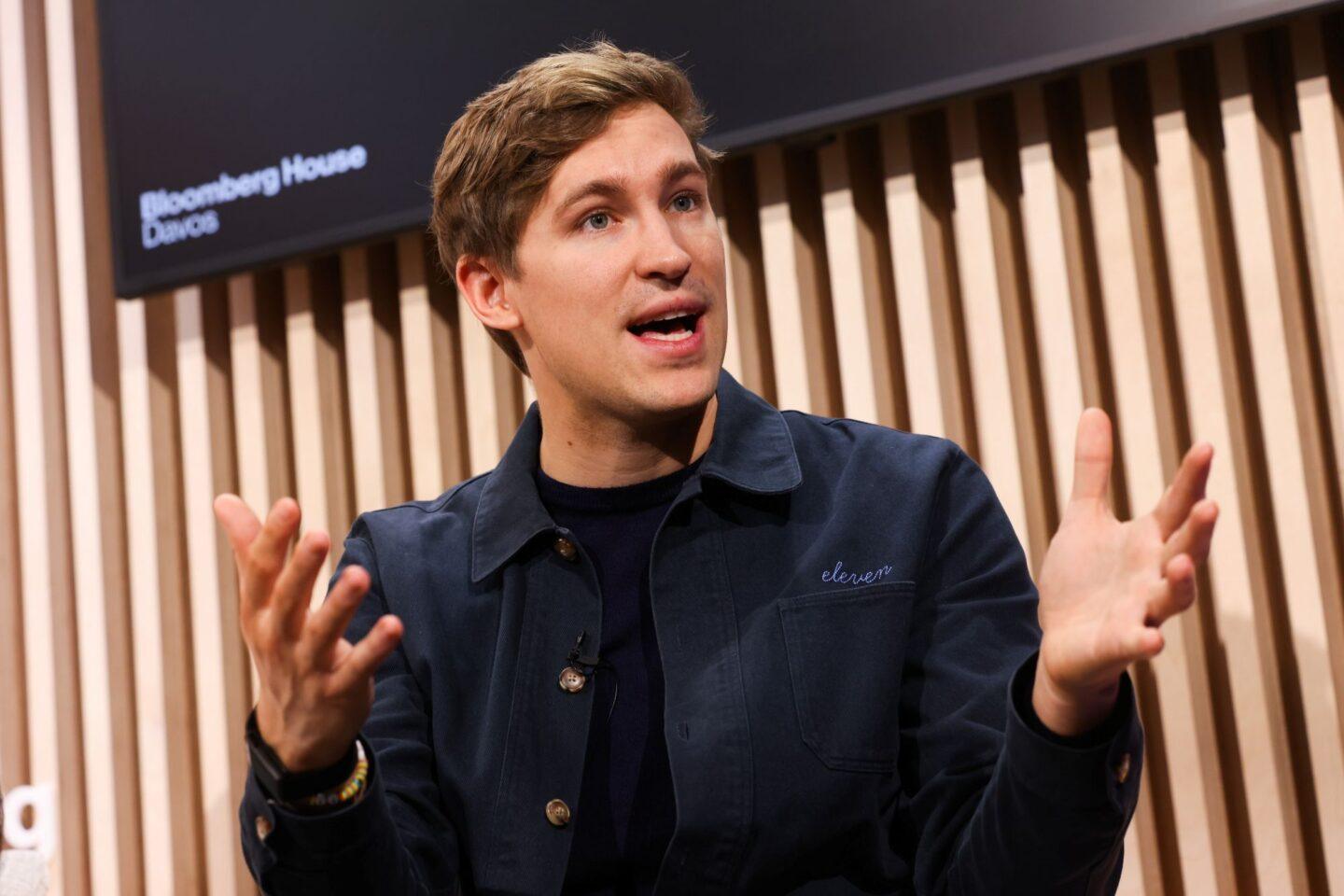
ElevenLabs wants artificial intelligence to stop sounding like a machine. During a presentation at ElevenSummit in Warsaw, Mati Staniszewski unveiled a preview of the upcoming v4 model, designed to speak not only more fluently, but also with emotion, intent, accent, whispering, and even singing.
For the founder of one of the world’s most prominent AI companies, the stakes are no longer limited to generating synthetic speech itself, but to building a communication layer for the entire economy.
“You can build an intelligent system, but if your AI sounds robotic, there will be no trust in it,” Staniszewski said at the Teatr Wielki in Warsaw during ElevenSummit.
In his vision, voice is set to become the default interface for artificial intelligence: from customer service and flight bookings to healthcare, education, and tourism. And he has concrete evidence to support that claim.
ElevenLabs bets on a new AI model
ElevenLabs, one of the world’s most recognizable companies in the field of generative audio, is preparing a new text-to-speech model, labelled v4. During his keynote, Mati Staniszewski presented a preview described as an “exclusive preview” – the first public demonstration of sample outputs that, in his view, signal the next stage in the evolution of synthetic voice.
“This model has not been released yet. This is an exclusive showcase. We are presenting its samples to anyone for the first time,” the ElevenLabs co-founder told the audience from the stage.
Moments later, attendees heard voices engaged in a dialogue about Warsaw – a city described as “both old and new at the same time,” rich in history yet “never standing still.” The demonstration showcased the capabilities of the new speech engine: shifting accents, whispering, emotional expression, and even singing.
“These are voices at a completely new level. You can control them. You can evoke emotions that were previously out of reach. From whispering to singing – the quality will continue to improve, but even now it is clear how extraordinary voice can become,” Staniszewski argued.
ElevenLabs: how a company grew out of Warsaw
Mati Staniszewski recalled that when his company was founded in 2022, most of the industry was focused on “solving intelligence.” ElevenLabs took a different view: the bottleneck would be communication. Natural human communication, the company argued, would be critical to unlocking the vast benefits of AI – breaking language barriers, making information and ideas more accessible, and creating entirely new ways of interacting with technology.
For that reason, ElevenLabs aims to be more than a supplier of high-quality voices for films, advertising, or audiobooks. It wants to build a communication layer for businesses, public administration, and consumers alike. That is the direction guiding the development of the company’s fourth-generation model.
Where ElevenLabs is headed
Mati Staniszewski said the company’s ambition is to build AI that communicates at a human level across every channel of daily life.
During the presentation, ElevenLabs showcased not only its upcoming v4 model, but also a new dubbing system, D2. Staniszewski recalled that one of the early inspirations for the company came from Polish-dubbed films, where “every voice, every character and every emotion sounds the same.” D2 is designed to address precisely that problem.
“D2 solves one of the biggest challenges in traditional AI dubbing: flat expression,” the ElevenLabs founder said.
Instead of generating speech solely from a transcript, the model is designed to use the original audio. Because it can perceive the original emotion and performance, it is able to transfer them into a new language.
Staniszewski linked this development to ElevenLabs’ broader product architecture. The company is building a platform that includes tools for creators, voice agents, and an API (application programming interface – a method enabling different software systems to communicate).
ElevenLabs Creative is positioned as a production suite for content creation: designing “brand voices,” localizing materials across image, video, and audio, and building repeatable workflows. ElevenLabs Agents, in turn, is intended as an environment for creating conversational experiences across customer service, sales, technical support, healthcare, tourism, and education. The company says its agents already handle millions of interactions daily.
“One platform means one coherent, seamless brand experience at every customer touchpoint – from marketing that sparks interest, to a sales agent, to a support agent that resolves a problem,” Staniszewski said.
He also demonstrated concrete use cases. In one example, he interacted with a travel assistant planning a one-day visit to Warsaw. The agent suggested an itinerary, recognized a photo of the National Theatre, helped select a performance, and then adapted recommendations based on prior preferences, calendar availability, and the number of friends joining the trip.
The Polish company partners with the Greek government to boost tourism
Mati Staniszewski stressed that the tourism assistant demo was not merely a conceptual showcase.
“We signed a partnership with the Greek government to build voice agents for tourism,” the entrepreneur said.
In his view, such solutions could reshape how citizens, customers, and patients access services. He also outlined other commercial use cases. In lead qualification, an agent can respond instantly before a potential customer loses interest. In healthcare, it can remind patients to take medication, schedule appointments, conduct post-discharge follow-ups, and communicate in the patient’s own language. In telecommunications, it can support real-time conversations and translation, while in education it can enable dialogue with a digital instructor.
“We are entering a golden era of the customer. This future is not as distant as it may seem,” Staniszewski said.
The list of partners he cited was meant to show that ElevenLabs is no longer confined to laboratories and demos. He referred to collaborations with Deutsche Telekom, MasterClass, and Poland’s National Health Fund (NFZ). At the same time, he clearly sought to anchor the ElevenLabs story in a Polish context, noting that he and his co-founder grew up near the venue of the presentation, met as teenagers, and spent years studying, working, competing, and traveling together.
Poland as the foundation of ElevenLabs
“We have probably spent too much time together. Fortunately, time is on our side, and we are still best friends,” Mati Staniszewski joked.
He spoke about a country that has undergone an “extraordinary transformation,” becoming a trillion-dollar economy and a home to engineers building some of the world’s most important technologies.
“Growing up in that environment gave us the ambition and the skills to keep moving forward and to build something here. The ambition is there. Technology is advancing. And there is still a tremendous amount left to build,” Staniszewski said.
Good to know
ElevenLabs: Poland’s biggest startup success story
ElevenLabs is one of Poland’s greatest technology success stories. The company grew from a small startup that raised a USD 2 million seed round in 2023. The funding came from Credo Ventures and a group of Polish angel investors.
By June 2023, the company had secured a further USD 19 million in funding. London became its headquarters. The round was co-led by American investors Nat Friedman, Daniel Gross, and Andreessen Horowitz, with participation from Credo Ventures, Concept Ventures, SV Angel, and angel investors including Mike Krieger, Brendan Iribe, and Mustafa Suleyman.
In January 2024, ElevenLabs raised another USD 80 million from Andreessen Horowitz, Nat Friedman, and Daniel Gross. Additional investors included Sequoia Capital, Smash Capital, SV Angel, BroadLight Capital, and Credo Ventures.
A year later, the company completed a USD 180 million funding round. It was co-led by a16z and ICONIQ Growth, with participation from investors including New Enterprise Associates (NEA), WiL, Valor Capital Group, Endeavor Catalyst, Lunate, and strategic investors such as Deutsche Telekom, LG Technology Ventures, HubSpot Ventures, NTT DOCOMO Ventures, and RingCentral Ventures. Following that round, ElevenLabs was valued at US$3.3 billion (approximately EUR 3.0 billion).
In February this year, the company closed another funding round at a record valuation of USD 11 billion (approximately EUR 10.2 billion). It raised USD 500 million (around EUR 460 million) from Sequoia Capital. Both a16z and ICONIQ increased their commitments, while new investors included Lightspeed Venture Partners, Evantic Capital, and BOND.
ElevenLabs also continues to attract smaller investors, including well-known figures from the entertainment industry. In early May, the company announced investments from actors Jamie Foxx and Eva Longoria, as well as Hwang Dong-hyuk, the creator of the hit television series Squid Game.
Polish president on ElevenLabs
The ElevenSummit conference was opened by Karol Nawrocki, the president of Poland. In his remarks, he referred not only to the achievements of the Polish economy but also to his own experience with ElevenLabs. He presented the company as a symbol of a new phase in Poland’s technological development. In his view, the firm founded by Mati Staniszewski and Piotr Dąbkowski is not merely a global business success, but proof that Poland is moving beyond being solely a consumer of breakthrough technologies.
“Today, Poland is ready not only to consume new technologies from around the world,” Nawrocki said.
According to the president, companies such as ElevenLabs demonstrate that “we are ready to create new technologies and take part in the technological revolution.” He went so far as to describe the company as “a case study of the Republic of Poland” – a story of “dynamic development, intellectual strength, and entrepreneurial spirit” that, in his view, captures the essence of Poland’s transformation over the past 35 years.
Nawrocki also recalled that, during his tenure as president of the Institute of National Remembrance (IPN), he was among the first institutional users of ElevenLabs’ technology, which helped “restore the voices” of Polish historical heroes.
“Thank you for bringing together the past and the future,” the president said.
At the same time, he sought to place ElevenLabs within the broader debate about the risks associated with artificial intelligence. As he emphasized, he does not fear the dangers of AI when it comes to ElevenLabs and other responsible Polish technology companies, because “nothing will ever surpass human creativity.”


Key Takeaways
- ElevenLabs aims to move beyond its reputation as a company primarily associated with synthetic speech generation. From Mati Staniszewski’s presentation, it is clear that the company is building a broader communication layer for artificial intelligence. Voice is intended to become the natural interface for services, business, public administration, education, healthcare, and tourism. The challenge is not merely to ensure that AI provides accurate answers, but also that it sounds credible, emotional, and human. Robotic communication can undermine trust in technology, even when the underlying intelligence is highly advanced.
- ElevenLabs’ new models, including the upcoming v4 text-to-speech system and the D2 dubbing model, are designed to mark the next stage in the evolution of generative audio. V4 is expected to offer greater control over voice, emotion, accent, whispering, and singing. D2, meanwhile, seeks to address the problem of flat AI dubbing by using the original audio rather than relying solely on a transcript. This allows the model to transfer both emotion and performance into another language. ElevenLabs is not developing a single tool, but an integrated platform encompassing content creation, localization, voice agents, and APIs.
- Mati Staniszewski framed the ElevenLabs story within Poland’s broader economic and technological transformation. The company is presented as an example of a Polish success story in the global AI industry, a message reinforced by remarks from Karol Nawrocki. ElevenLabs is intended to symbolize a country that not only adopts new technologies but also creates them. At the same time, the company is seeking to demonstrate the practical value of its solutions through partnerships and real-world applications across tourism, healthcare, telecommunications, education, and customer service.