

This article is a part of Poland Unpacked. Weekly intelligence for decision-makers
One year after announcing a strategy aimed at generating PLN 560 million (EUR 130 million) in profit, the external environment is not making life easy for the Pracuj Group. Its founder discusses a billion-zloty budget, a new approach to acquisitions, and a painful correction in valuations. He also reveals the company’s AI plans and the biggest threat facing a leader in job portals and HR software.
“To become a leading European HR tech platform” – this is the goal guiding Pracuj Group, founded in 2000. The company intends to achieve it under its 2025–2030 strategy. Over this period, it plans to increase revenue by three-quarters to PLN 1.4 billion (EUR 326 million) and adjusted EBITDA by more than half to around PLN 560 million (EUR 130 million).
Plans are one thing; market reality is another. And companies’ cautious approach to recruitment – particularly in Germany – has affected the Polish group’s targets. One year after announcing the strategy, it turns out that reaching PLN 1 billion (EUR 232 million) in sales in 2027 and PLN 1.4 billion (EUR 326 million) in 2030 may prove challenging. In 2025, revenue rose by 5% to PLN 811 million (EUR 189 million).
Nevertheless, the goal of generating PLN 400 million (EUR 93 million) and PLN 560 million (EUR 130 million) in EBITDA remains intact. Improved efficiency is expected to drive higher margins, which already exceed 40%. First-quarter 2026 results were in line with market expectations.
The company is not only facing an unfavorable macroeconomic environment, but also valuation pressure – similar to other HR businesses and subscription-based software (SaaS) providers.
In its initial public offering (IPO) ahead of its debut on the Warsaw Stock Exchange in December 2021, the maximum share price was set at PLN 82 (EUR 19). The final offering price was PLN 74 (EUR 17), resulting in a market capitalization exceeding PLN 5 billion (EUR 1.16 billion).
For most of its time on the stock exchange, shares of the Pracuj Group traded in the PLN 50–70 (EUR 12–16) range. Only briefly, immediately after the debut, did they approach PLN 80 (EUR 19). At present, the share price is close to PLN 50 (EUR 12), implying a valuation of around PLN 3.3 billion (EUR 767 million), although in March it fell below PLN 40 (EUR 9). A consolation for shareholders is the recommended dividend for 2025 of PLN 3 (EUR 0.70) per share – up 43% year on year.
Roughly three-quarters of the group’s business comes from recruitment services. However, their share is expected to gradually decline in favor of HR software. Geographically, Poland remains the key market (over 70% of revenue), anchored by the Pracuj.pl platform and the fast-growing Kadromierz. Ukraine accounts for less than 10% of sales, mainly through the Robota.ua portal, where the company has operated since 2006. The remaining share is generated in Germany, where the group operates softgarden, acquired in 2022 for approximately EUR 118 million.
 Interactive chart
 “I never give up”
Mariusz Bartodziej: In your private and professional life, do you prefer to have everything planned out, or do you leave plenty of room for spontaneity?
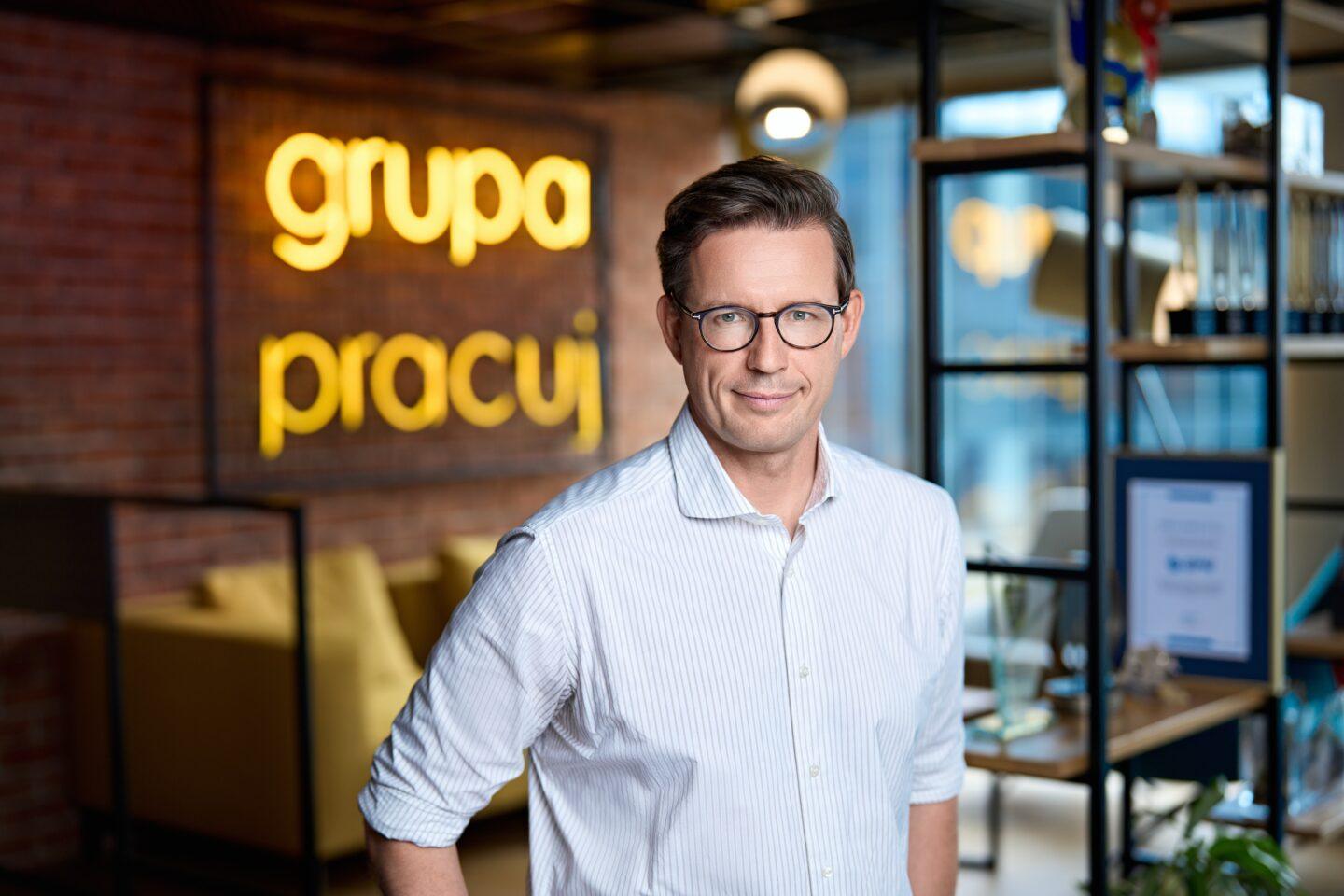
Przemysław Gacek, CEO and co-founder of Pracuj Group: In business, if something is within my control, I prefer it to be well organized and under control. In other matters, I rely more on trusted people and give them a high degree of autonomy.
I don’t have a tendency to look over people’s shoulders; I try to give my team space. The scale of Pracuj Group means that interfering in day-to-day operations would be inefficient.
In my private life, however, I am much more hands-on. Those activities are usually much less complex, so it is easier for me to plan them.
And how do you usually react when a plan falls apart, even partially?
When it is worth reacting quickly, I do so. Otherwise, I prefer to dig into the issue and understand it better – to give myself time to gather information and analyze it.
Jim Collins, from whom I have learned a great deal, emphasizes that data is key. Everything can be communicated in different ways – like the glass that is half empty for a pessimist and half full for an optimist. For me, it is simply 50% filled with water.
I make decisions only based on concrete information. Not always immediately, because I have learned in business that haste is a bad adviser. And I do not always react – sometimes inaction is a deliberate decision.
And why are you asking?
If adjusted EBITDA margins are maintained above the strategic target of 40%, the market situation has nevertheless tested the ambitious assumptions of double-digit revenue growth. What will you do about it – focus entirely on improving efficiency, or also try to increase sales momentum?
We always fight for the full package. We will not give up just because the external environment is not initially conducive to achieving the revenue target. We maintain that we will “deliver” over PLN 400 million (EUR 93 million) in adjusted EBITDA in 2027 and at least PLN 560 million (EUR 130 million) in 2030 – organically, meaning excluding any potential acquisitions. And will we also reach PLN 1 billion (EUR 232 million) and PLN 1.4 billion (EUR 326 million) in revenue, respectively? We will certainly try. We are growing quickly in Ukraine and seeing signs of recovery in Poland, so we believe – and we act.
I never give up, neither in business nor in sport. Three years ago, together with my team, I won the world championship in sailing. During the five-day race, we spent about 20 hours on the water. The title was decided in the final 2–3 minutes. We overtook our last rival 100 meters before the finish line.
Explainer
Entrepreneur from the very beginning of his career
Quitting corporate life to build one’s own business is an idea increasingly appealing to Polish managers. For Przemysław Gacek, however, working in his own company was the first step in his career (internships aside). A graduate of the University of Warsaw – and later also of London Business School – he founded the Pracuj Group in 2000.
There were five co-founders, but only he (alongside Maciej Noga, who serves as chairman of the supervisory board) remains involved in the company. He has served continuously as CEO for more than 26 years and is also its largest shareholder, holding a 52% stake worth approximately PLN 1.7 billion (EUR 395 million) at the current share price.
Przemysław Gacek’s effectiveness as an entrepreneur is evidenced not only by the success of the Pracuj Group – a leader among job portals in Poland and Ukraine with European ambitions. In 2023, he won the 21st edition of the EY Entrepreneur of the Year award, and 18 years earlier he triumphed in the New Business category. In 2018, he also received the Polish Business Roundtable award in the Vision and Innovation category.
He is also a highly active technology investor. For more than a decade, he has co-created the Hedgehog Fund and has been involved in startups as a business angel through the Hesta Investments family office. His portfolio includes several so-called unicorns – startups valued at at least USD 1 billion – including DocPlanner, operating in Poland under the ZnanyLekarz brand, and the Ukrainian foreign-language learning platform Preply.
What’s new in AI and a shift in the approach to acquisitions
In the 2025–2030 strategy, you have adopted a wide range of metrics – from financial indicators, through the growing importance of HR software sales, to a higher share of job postings targeting blue- and pink-collar workers. Which of these goals do you personally treat as priorities?
The market primarily judges us on revenue and margin; these are the main drivers of a company’s valuation. For me, however, particularly important are, among others, the further growth of e-commerce channels and HR software sales. In both areas, we are growing very dynamically.
There are, however, indicators where we can do little or virtually nothing. We would like to strengthen our position as the leader in job listings in the Polish white-collar segment [office and knowledge workers – ed.], increasing their number by 10% annually. That is difficult when domestic companies are reluctant to invest. You cannot draw water from an empty well.
In Ukraine, we plan to move away from the freemium model [free job postings – ed.] after the war ends. I hope this happens by 2030 and that reconstruction begins, but we have no influence over this.
Almost all our peers across Europe are seeing revenue declines, in most cases double-digit. Poland and Spain are performing best – two of the fastest-growing large EU economies. We are doing a good job, and others are still looking at us. Double-digit growth will take time, but we have already raised expectations from “low” to “high single-digit” revenue growth.
Interactive chart What new initiatives can you announce after one year that are intended to support the achievement of your strategic goals? Most of the momentum in the market today is in artificial intelligence.
We are preparing a number of changes precisely in this area. AI is already significantly helping us, among other things, in matching job offers with candidates, and helping employers quickly create high-quality job ads. We want to improve effectiveness in our existing areas of operation. In addition, we are preparing the agentification of our platforms and internal processes, as well as the rollout of a conversational search engine within our service.
We are taking a multi-track approach to AI deployment and remain open to external perspectives. Recently, we joined the Bison Fellowship program, which brings together outstanding Polish university students and pupils. They will work on projects addressing specific business challenges. We hope some of these will translate into real-world implementations.
And beyond that?
We have increased our stake in highly successful Ukrainian companies. As a result, an even larger share of their profits will flow to us. These businesses are already growing rapidly and increasing their contribution to the group’s results. We still see strong growth potential, especially after the war ends.
In addition, we have slightly adjusted our approach to acquisitions. We are now more open to smaller businesses that can selectively strengthen us in terms of product offering, talent, or customer base. However, we remain cautious. We are waiting for the correction in private-market valuations to catch up with what is already visible in public markets – a shift we have felt painfully ourselves.
What do you mean by that?
This year our valuation – taking into account the peak and trough of the share price – h as been cut in half. What has changed in our company? Only that we are larger and more efficient. Yet a large portion of investors assumed that the development of AI would bury HR and SaaS companies [providers of subscription-based software – ed.].
In my view, that will not be the case. Fortunately, the market is slowly starting to recognize this and adjust its thinking. With our experience and leadership position, we are best placed to benefit from this shift.
A large portion of investors assumed that the development of AI would bury HR and SaaS companies. In my view, that will not be the case.
Selective approach to M&A and a EUR 250 million budget
A year ago, you signaled readiness for further international acquisitions, particularly in the DACH region (German-speaking countries). Was it primarily high valuations that prevented you from completing even a single deal?
That is one of two reasons. We are now valued at 7–8 times annual EBITDA, rather than 12–13 times. We have no influence over that. Meanwhile, private company owners are still operating in last year’s reality – and they are entitled to do so. However, we are not willing to pay non-market prices, because SaaS business valuations have fallen by around 40% over the past year on average.
The second reason relates to the opportunities created by the development of artificial intelligence. We are considering some acquisitions specifically in terms of expanding our product offering. If we are expected to pay EUR 10 million for a solution that we could attempt to build ourselves in six months using AI, the choice is straightforward. Overall, we have become much more selective in our M&A approach.
After one year since announcing the strategy, Pracuj Group is in an even stronger financial position. What size acquisition budget are we talking about?
If a good opportunity arises, we can comfortably increase leverage to three times EBITDA. That would translate into roughly EUR 250 million (over PLN 1 billion at the current exchange rate – ed.).
However, this does not necessarily mean we will spend that amount. Especially since there are not many companies of a scale that would justify such valuations. We are seeing various projects, including from Poland. I cannot go into details, because competition does not sleep.
Large language models? “Extremely expensive”
Let’s return to internal changes in the use of artificial intelligence. In 2025, the group’s sales of new AI-based products increased by 24% to PLN 33 million (EUR 7.7 million), raising their share to more than 4%. What comes next?
It will definitely continue to grow. AI already significantly helps us, among other things, in effectively matching candidates with employers. At Pracuj.pl, we consistently have well over 80,000 active job listings. That is a lot. If we treat our platform like a store, we want to avoid a situation where a customer has to walk through an entire hypermarket to find a single product. They should be able to find it immediately upon entering.
Everyone today boasts about using large language models (LLMs). What no one says openly is that they are extremely expensive. It is easy to burn through an entire annual budget in a single quarter. It is therefore not surprising that, apparently, as many as 90% of US companies use Chinese open-source solutions [open-source models – ed.], because they are incomparably cheaper than American ones.
We are at an interesting stage of market development. Investors are beginning to expect visible revenue growth from AI. To achieve that, some companies can afford to burn cash. But in 2–3 years, the market will ask about return on investment. For some, that may become a problem.
And what about the Pracuj Group?
We are still experimenting, so the costs remain relatively low. We are developing many solutions in-house; we have been building competencies in big data and AI for over a decade. We closely monitor our artificial intelligence spending. We are mindful of the risk of rapid price increases and try not to become dependent on a single vendor.
Recently, the CFO of an American company told me that he has a six-person team dedicated solely to managing LLM-related expenses. The sums have already become so large that someone had to start controlling the budget.
Do you want to be a pioneer in the industry in terms of AI adoption, or rather an efficient fast follower?
I do not know whether we will always be first, but in this area we cannot afford to lag behind. At the same time, we always ask ourselves whether the market is ready for a given solution.
How artificial intelligence is shaping the labor market
Advances in AI are strongly affecting the labor market, especially in IT and particularly among entry-level employees. Does the ability to use new tools now matter more than seniority?
Seniority still matters, because companies today focus on efficiency. They therefore prefer employees who are already proven – either by the company itself or by previous employers. In every organization, however, there will be three groups of people.
Which ones?
The first are so-called early adopters, who immediately and independently embrace new tools. We also have no shortage of AI enthusiasts, and we make them ambassadors who share their experience with others. The second group of employees will have no problem using new solutions, at least to a basic extent. The third group will resist change. And it is precisely these employees who may be replaced by new, younger people for whom this may already be a natural work environment.
In some sectors, the use of artificial intelligence is already a priority, while in others it is still far away. On average, the term “AI” currently appears in 4–5% of job postings. That is still low. It is difficult to predict how quickly this share will change. Artificial intelligence will eliminate many jobs, but at the same time it will create new ones. The World Economic Forum estimates that by 2030 there will be 92 million jobs eliminated and 170 million created. On balance, we will therefore be globally in positive territory. We will see how this distribution plays out geographically.
What kind of people do you need on your team, given the rapidly changing market environment and the group’s ambitious goals?
For about two years now, we have maintained employment at around 1,100 people, and yet we continue to increase revenue. Over the next two years, we will grow sales by several dozen percent without significant recruitment. This is possible because we prioritize increasing employee efficiency, including through the use of AI.
I highly value our experienced team – I believe it is the best in our segment in the world. However, when it comes to new hires, we are primarily looking for “AI-native” individuals: people who use AI-based tools on a daily basis. That is why we place great hopes in the Bison Fellowship program. We are scouting talent among young people who have a fundamentally different way of thinking.
And layoffs as a result of AI-driven automation?
I am far from that approach. In 2020, just after the outbreak of the COVID-19 pandemic, our American investor tried to convince us that we should cut headcount because a crisis was coming. I explained that in the US companies can lay off 20–30% of staff overnight and rehire them two months later, but in Europe we have a different labor market. Moreover, based on experience from previous crises, I decided I wanted to continue working with people who had already proven themselves. Where would I find them again once conditions improved?
What are the key characteristics in today’s labor market?
Openness, curiosity, agility, creativity, the ability to ask difficult questions, and to accept feedback. This is a very important and highly relevant topic. We already know that excessive use of social media – and smartphones in general – dulls people’s thinking. That is why I am pleased that access to them among children is finally being restricted.
A similar dynamic applies to the use of AI chat tools. More and more people will lose their capacity for critical thinking, limiting themselves to accepting as fact whatever artificial intelligence suggests. Access to knowledge is widespread, but one still needs to know how to use it.
We are primarily looking for “AI-native” individuals – people who use AI-based tools on a daily basis.
Time to raise the retirement age, not shorten the work week
Are you following the ongoing pilot of reduced working hours in Poland?
No, not at all. Should I be?
It has mostly involved public-sector entities, so it probably is not necessary from your perspective. But it raises the question of whether your clients are exploring such a possibility, and whether there is room for a similar test at Pracuj Group.
We have not considered it and do not plan to. I belong to a generation that remembers their parents working six days a week. First, they gained free Saturdays, and later all Saturdays. If we continue this trend, we could already be moving toward a four-day work week. Ultimately, however, it all comes down to company efficiency.
If employees were willing to accept a reduction in pay to four-fifths – because that is how the issue should be framed – then fine. Otherwise, Poland cannot afford it. Demographics are unforgiving, and no government wants to address the topic of raising the retirement age, although it will certainly be necessary.
In Germany, we have many part-time workers. However, the German economy is at a different stage of development, and in any case it is not currently performing better than the Polish one.
Sustained confidence in German business
How strongly are you keeping your fingers crossed for a quick and strong recovery in Germany?
Germany is our key trading partner, so everyone in Poland should be hoping for that, because it is in our interest. The situation is difficult. It is easy to sail when the wind is at your back. But when it is blowing in your face, you need to maneuver a lot to stay on course.
For some sectors – such as technology, defense, or healthcare – the current global situation has no material impact. But Germany is an industrial economy, and it is strongly feeling the effects of high energy prices, as well as being displaced in various areas by cheaper competition.
A year ago, we could still speak of success in our German business. Today, in our key segment of software sales, we are performing reasonably well. We also offer a multiposting service there, for job ad republishing. We had assumed that its share in results would gradually decline. However, the current stagnation in the German labor market has made this process faster than we expected.
I am asking about Germany because you personally took responsibility for the EUR 118 million acquisition of softgarden. With operating margins in the low teens and revenue growth in the low single digits, the company is clearly falling short of your current expectations for acquired businesses. When will this “star asset” shine and become a growth engine for the group?
I continue to believe in the potential of the DACH region, the rationale behind the softgarden acquisition, and our ability to consolidate smaller HR software players. We have already proven in Poland – by successfully integrating HRlink with eRecruiter – that we are capable of doing this. We can repeat this in German-speaking markets.
We already saw at the end of 2025 that the German labor market was deteriorating. However, we did not sit idle. The share of software in revenues increased from roughly 45% to 75%. Without favorable tailwinds – namely growth in the German economy – it will be difficult to return to double-digit growth in softgarden’s sales.
Confidence in high margins and readiness for an “apocalypse”
How long can a business of your scale – still growing – maintain an adjusted EBITDA margin above 40%? That is a level detached from the realities of most businesses.
At first glance, it is high. In the job listings segment, many companies globally achieve profitability above 50%, and among Western European private companies, 60% is standard. They have maintained such levels for a long time, so I believe we can do the same.
Our group-level margin is somewhat lower due to diversification between job portals and software, where profitability is not as high. However, the latter business has a different advantage – it is highly scalable and more resilient to cyclical fluctuations.
What do you therefore see as the biggest risks for the group over the next few years and beyond, and how are you preparing for them?
We have spent a lot of time thinking about this over the past year. Today, I would point to the risk of how AI development will affect the number of job postings. The Economist devoted a cover story to this topic in May, titled “The jobs apocalypse.”
However, there does not necessarily have to be any labor market apocalypse. History shows that despite technological progress, we do not work less. We become more efficient, so we do more. This is consistent with the so-called Jevons paradox.
We cannot fight macroeconomic factors. But we are better prepared for them than others.
In what way?
Our strength is people. The Polish economy stands out in Europe thanks to the entrepreneurial nature of its society. We still have the drive, which cannot necessarily be said about, for example, Western Europe. And that is exactly what I see in my team. We have known each other for years, we remain motivated, and we consistently execute the plans we set.
In addition, Pracuj Group is a “founder-driven” company. I run it with people I trust, with whom I want to work, and who are genuinely committed. Bringing in managers who come for a few years at most and then move on does not work. I take a different approach to managing a business.
History shows that despite technological progress, we do not actually work less. We become more efficient, so we do more.
More enjoyment in sport than in business
Do business successes give you as much satisfaction as sporting ones? Or is it sailing – which you have been practicing for much shorter – already bringing you greater fulfillment?
Malcolm Gladwell argues in Outliers that it takes 10,000 hours of practice to reach expert level in any field. I recently calculated that I have already spent more than 50,000 hours in business, and only around 1,000 hours in sailing. So in the first area, I have already done a great deal, while in the second I am only just beginning.
In the company, I am no longer involved in day-to-day operational management. My work mainly consists of attracting the best employees, motivating the team, and setting strategic directions. The results are therefore long-term – I do not see them day to day. That gives satisfaction, but I feel it less frequently.
And sport?
In sailing, I enjoy how much I am learning. Moreover, my role there is completely different. When we are sailing, I have to stay fully in the present moment. You cannot let your mind drift even for a second. I experienced this during the recent long weekend. A moment of inattention was enough to result in a loss of control and damage to the bowsprit. The consequences of every action are immediate.
For me, sport is a great break from everyday business life and a motivation to stay physically fit. Competition at this level requires proper preparation and full focus. Before stepping onto the boat, I leave my phone on shore. It is the most effective digital detox for me.


Key Takeaways
- Fighting for the full potential outlined in the strategy. The strategy adopted a year ago is intended to lead Pracuj Group, owner of Pracuj.pl among others, to PLN 1 billion (EUR 232 million) in revenue and PLN 400 million (EUR 93 million) in adjusted EBITDA in 2027, and respectively PLN 1.4 billion (EUR 326 million) and PLN 560 million (EUR 130 million) in 2030. The labor market environment, particularly in Germany, is making it harder to achieve the revenue target, but the company is not abandoning it. It also has ways to improve efficiency. “We always fight for the full package,” says Przemysław Gacek, CEO and co-founder of Pracuj Group.
- Acquisitions worth PLN 1 billion? We’ll see. M&A is expected to be a growth driver that could even deliver higher results for the company. The budget available for this purpose is around EUR 250 million (over PLN 1 billion at current exchange rates). Pracuj Group does not necessarily plan to spend the full amount, as it is unwilling to overpay for private companies whose valuation corrections have yet to catch up with public markets. It has also changed its acquisition strategy, increasingly considering small, targeted add-ons. At the same time, it is more cautious about product companies if it believes it could build similar solutions itself using artificial intelligence.
- Risk of an “apocalypse,” strength in people. Although estimates of job destruction and creation driven by AI vary, a potential labor market “apocalypse” is seen as the main risk for Pracuj Group. Its founder argues, however, that such an outcome is not inevitable, as historically technological progress has increased demand for labor rather than reduced it. He also assures that the company is better prepared than competitors for macroeconomic headwinds. “Our strength is people. The Polish economy stands out in Europe thanks to the entrepreneurial character of its society,” says Przemysław Gacek.