

This article is a part of Poland Unpacked. Weekly intelligence for decision-makers
Read the full issue
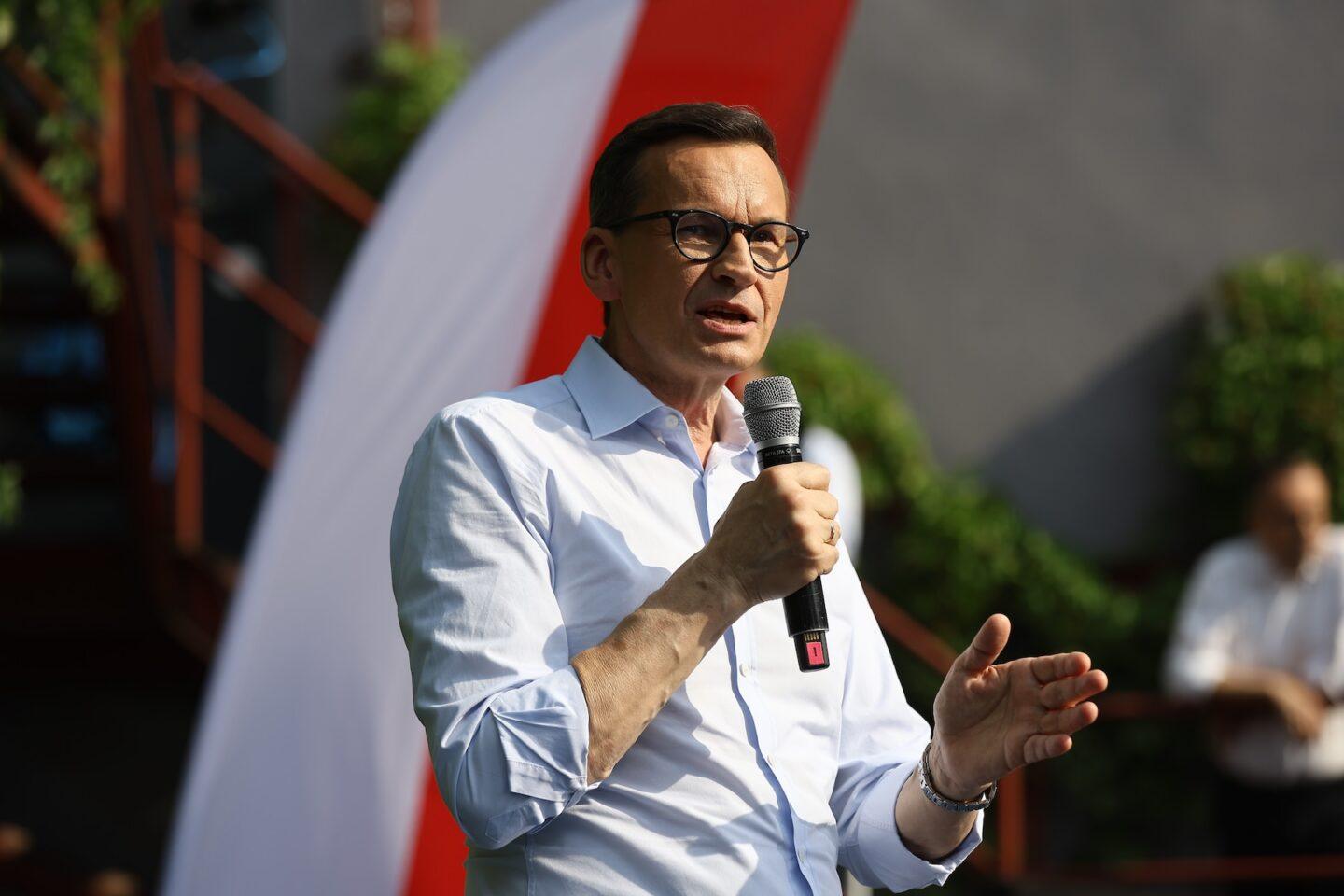
It was the last Friday of July, the temperature was well above 30°C (86°F), and there was a barbecue—a recipe for the perfect summer afternoon. The haze of a midsummer heatwave hung over Warsaw's Praga district, where a large barbecue hosted by Mateusz Morawiecki brought together supporters of his new political initiative.
"Mateusz, Mateusz"
The former prime minister, now leading a new movement on Poland's political scene, took on the role of both host and star attraction. Chants of "Mateusz, Mateusz" accompanied nearly every one of his public appearances throughout the afternoon. Morawiecki, for his part, made no attempt to hide his satisfaction with the event.
"To say I am pleased would be an understatement—I am delighted," Morawiecki told reporters. "We have brought together a remarkable number of young people from across the country, from both smaller communities and major metropolitan areas. Employers, employees, and entrepreneurs from different generations are all here. It is wonderful that we have managed to gather such a broad and diverse group."
The Rozwój Plus leader delivered the opening address to a crowd of more than 1,000 participants. The former prime minister thanked the audience for turning out in such numbers, describing them as "people driven by boundless ambition." Throughout his speech, Morawiecki repeatedly stressed the importance of courage in a rapidly changing world.
"If your belief in Poland, in our moral values, in the future, and in the Polish people has brought you here today, then you are in the right place. Rozwój Plus is the right place for you. We have embarked on a new path, and we will follow it with confidence and determination," he said.
Sausages, a Friday dispensation, and the politics of migration and demographics
Rozwój Plus offered guests more than an ample spread of traditional Polish barbecue fare. To accommodate the menu, a special dispensation was granted for the occasion, exempting practicing Catholics from the customary Friday abstinence from meat.
Attendees also received two newly published reports prepared by the association, focusing on migration and demographics. Speaking from the outdoor stage, Morawiecki argued that both issues would be central to Poland's future.
"Migration is not the answer to demographic decline. It is a phenomenon against which a country must either defend itself or one that it must know how to use," the former prime minister said.
The two themes also dominated the panel discussions held throughout the day, featuring Rozwój Plus politicians alongside academics, policy experts, and journalists.
While the policy discussions offered substantial food for thought, it was the festival-like atmosphere that stood out. Alongside the seemingly endless supply of grilled meat, there was an inflatable castle for children, table tennis, and even the opportunity to play chess with Garry Kasparov, who appeared as the event's special guest.
Reaching beyond the traditional right
The composition of the audience deserves particular attention. It contrasted sharply with the large Law and Justice (PiS) gathering in Katowice earlier this year, which ended with separate events organized by rival factions within the party. As at most PiS conventions, the Katowice crowd consisted largely of local party activists and an older base of supporters.
The atmosphere at Mała Warszawa, the venue in Warsaw's Praga district, was noticeably different. Alongside young conservatives, many of them closer to the Confederation Liberty and Independence (Konfederacja) than PiS, there were also figures associated with the left-wing opposition, including members and sympathizers of Razem, as well as journalists and public intellectuals from left-leaning circles. The clearest expression of that outreach was a panel devoted entirely to a left-wing vision of Poland's development, featuring former Razem MP Paulina Matysiak alongside commentators Marcin Giełzak and Jan Oleszczuk-Zygmuntowski.
That diversity highlighted what appears to be a key distinction between PiS and the emerging Rozwój Plus movement. Rather than relying solely on the traditional conservative electorate, Mateusz Morawiecki and his allies seem intent on forging less obvious alliances—appealing to voters who may not be drawn to Law and Justice but are receptive to a center-right platform centered on economic development and investment. It is far too early to judge whether the strategy will succeed, but the sight of people from markedly different political backgrounds engaging in conversation was, in itself, one of the event's notable achievements.
The gathering also drew representatives of a civic campaign seeking a referendum on the dismissal of Warsaw Mayor Rafał Trzaskowski. Although formally non-partisan, the initiative emerged from circles broadly sympathetic to the political right and critical of Poland's governing coalition.
Morawiecki: "On October 15, we begin a great march"
The movement's opposition to Poland's governing coalition was also clearly on display. While the event lacked the anti-government bookstalls and unflattering collages of Prime Minister Donald Tusk that have become familiar features of some Law and Justice conventions, Tusk nevertheless came under sustained attack from his predecessor.
"We have to fight for a better system. The system of Tusk is a system of idleness, cynicism, and deceit," Morawiecki declared from the stage, drawing enthusiastic applause from the audience.
The next chapter in that political offensive is set to be a "Great March", announced for October 15, the anniversary of Poland's 2023 parliamentary election.
"On October 15, we begin a great march, and we will carry that march through to victory, because Rozwój Plus plus Poland equals success," Morawiecki told the crowd.
What exactly Morawiecki has in mind remains unclear. Is he seeking to replicate the large-scale marches organized by Civic Platform ahead of the 2023 election? Or could the election anniversary mark the formal transformation of Rozwój Plus from an association into a political party? The details have yet to emerge. What is clear, however, is that the strong turnout has given the former prime minister renewed political momentum.
Józefaciuk: stepping outside the "bubble"
The relaxed summer atmosphere—combined with a distinctly technocratic flavor and lengthy policy discussions—attracted many supporters of Morawiecki. There were also a few unexpected faces. Among those attending the picnic was Marcin Józefaciuk, a former MP for the Civic Coalition, who now sits as an independent.
"I'm here in a private capacity because I like to know what's happening across the political spectrum and try not to lock myself inside my own bubble. I've previously attended events organized by Confederation and the launch of the New Left's election campaign for the same reason. Today, my main objective is to take part in the panel on demographics. I want to raise the issue of what I see as the systemic discrimination of men in family courts, as well as workplace safety, given that the overwhelming majority of fatal workplace accidents involve men," Józefaciuk told XYZ.
The independent lawmaker said he hoped politicians could work pragmatically in Poland's interest, regardless of party affiliation. He declined, however, to say whether he planned to cooperate with Rozwój Plus or any other political grouping.
"As an independent MP, I'm open to joining parliamentary groups or working with people looking for support. Opportunities for joint initiatives will certainly arise, particularly in areas that matter to me, such as education and men's issues. It's clear that we're beginning to cooperate beyond day-to-day politics and across party divides," he said.
Although the event focused primarily on discussions about Poland's future and on bringing together both old acquaintances and new supporters, the proverbial elephant in the room remained the recent split between PiS headquarters on Nowogrodzka Street and the Rozwój Plus camp—a division that lingered over the gathering throughout the day.
Piotr Müller: the language of political debate matters
Piotr Müller, the former government spokesman and now a Member of the European Parliament, believes that Law and Justice is getting closer to its more hardline former ally, Sovereign Poland (Suwerenna Polska). Speaking to XYZ, he argued that those trends have become increasingly entrenched.
"Instead of drawing on its 25-year legacy—a blend of conservatism, social solidarity, free-market economics, Eurorealism, and strong transatlantic ties—the party is beginning to embrace a rhetoric that rejects dialogue in favor of ever greater radicalism, both in language and in action. That does not mean we rule out working with PiS in the future, even in what I regard as its diminished current form. But we want to be honest about the differences between us. The language of political debate matters enormously. Overly radical rhetoric can gradually pull a political program into places it was never intended to go," Müller said.
The MEP also stressed that, despite the differences, Rozwój Plus and PiS continue to share important elements of their political heritage.
"...but we still share common ground with PiS"
"As the Rozwój Plus association, we are also opposed to an excessively far-reaching EU climate policy and the ETS system, which undermine our competitiveness. At the same time, we understand the challenges Poland faces in its energy transition and recognize that it must be carried out at the right pace, while protecting our national interests. Meanwhile, radical slogans are reshaping the party's political agenda and provoking extreme reactions," the MEP said.
Like other MEPs elected from the Law and Justice (PiS) lists, Müller remains a member of the European Conservatives and Reformists (ECR) group. He did not rule out changes in the future, but argued that Rozwój Plus's membership of the ECR—which includes, among others, the party of Italian Prime Minister Giorgia Meloni—would be a natural fit.
"That decision still lies ahead of us, but ideologically the ECR is currently the group that best reflects our position. It is a sensible formation at the centre of the European right: pragmatic on economic issues, opposed to further federalisation, and committed to combating illegal migration. Today, this political group is a much better fit for us than it is for some politicians within Law and Justice. It is worth remembering that not long ago Patryk Jaki was encouraging PiS to join the Patriots for Europe group, which includes allies of Viktor Orbán," Müller noted.
The next steps for Rozwój Plus
The event's strong turnout, the opportunity to demonstrate the movement's support base, and its outreach to non-party circles will undoubtedly give Morawiecki and his faction momentum as they begin operating independently. It should not be forgotten, however, that Rozwój Plus politicians still face the formal issue of ending their membership in PiS. Judging by informal conversations behind the scenes, the question is not whether this will happen, but when.
As time passes after the launch event, political reality will demand the more prosaic work of building organizational structures and developing the foundations of a political programme. For now, it remains difficult to say exactly what Rozwój Plus intends to become over the longer term. One thing is clear, however: it does not want to be another PiS—even if the two movements emerge from a similar ideological foundation.
What does appear certain is that Rozwój Plus politicians plan to take their message on the road across Poland. All of XYZ's interlocutors agreed on that point.
Rozwój Plus to take its message across Poland
"Travel and direct contact with voters are in our DNA. In recent years, every member of our association has criss-crossed Poland, promoting various initiatives. As Rozwój Plus, we will reach cities, towns, and villages across the country. The coming August and the harvest festival season provide an excellent opportunity for meetings, and we will certainly do a great deal of important work in this area," Krzysztof Szczucki told XYZ.
Szczucki's announcement was also confirmed by Mateusz Morawiecki and Piotr Müller.
"We are planning further trips, although we have not yet finalized the schedule. Today's gathering is the first event organized in response to the difficult political circumstances that have emerged. A detailed plan for our local activities is still being developed," the former prime minister said.
The former government spokesman struck a similar note.
The Sejm held its final sitting of July before the traditional August recess. Regardless of whether Rozwój Plus also takes a summer break, Morawiecki's movement faces a number of serious challenges ahead. Still, its first test of public appeal can be considered a success. Sunshine, heat, grilled sausages, and conversations about Poland proved to be a compelling recipe for a successful launch.
The harder part will come once the barbecue supplies run out and the initial excitement fades. That, however, is a story for another barbecue.


Key takeaways
- The launch of the Rozwój Plus association brought together more than 1,000 people from a range of political backgrounds in Warsaw. The participants included not only supporters of the right, but also representatives of the left and independent politicians. This points to an attempt to build a broader political base around Mateusz Morawiecki and move beyond the movement's traditional electorate.
- The new formation is clearly distancing itself from the more radical course pursued by the current leadership of Law and Justice (PiS). The former prime minister's allies have openly criticized the radicalization of their former political camp and are positioning themselves as a pragmatic force within the centre-right of Europe. In light of these declarations, the formal departure of Rozwój Plus structures from Jarosław Kaczyński's party appears to be only a matter of time.
- The association's leaders have announced an intensive nationwide tour in the coming weeks, during the summer holiday period. The movement now faces the challenge of building a solid policy platform once the initial enthusiasm surrounding its launch begins to fade.