

This article is a part of Poland Unpacked. Weekly intelligence for decision-makers
Rozwój Plus is slowly showing its hand. Mateusz Morawiecki’s policy proposals so far point to a platform that is broadly aligned with the political line of Law and Justice (PiS). There are, however, some clear differences.
The dust has begun to settle after the new political movement led by Mateusz Morawiecki went its own way. Following a turbulent political summer, politicians are preparing to return to parliamentary life in September – and, with it, to the pre-election campaign.
A battle for the same voters
Early polling shows Rozwój Plus (Development Plus) winning enough support in most surveys to edge past the electoral threshold. Most analysts and polling firms also indicate that the movement’s newly assembled voter base consists overwhelmingly of former Law and Justice (PiS) supporters. This could, of course, change over time, depending on how electoral lists are drawn up and on specific political developments.
To broaden its voter base, Rozwój Plus would have to address the needs of more than just former PiS supporters. The first outlines of Morawiecki’s party platform, however, suggest that the goal is not to offer a new policy proposition on the right, but rather to put a better “package” around ideas that have long been part of the broader conservative camp.
At Rozwój Plus’s inaugural barbecue in late July, there was no shortage of discussion on demographic, economic and purely political issues. Several weeks after the event, none of the ideas raised had broken through into the public debate. As Rozwój Plus politicians explained at the time, that was not their main objective. The “development” camp said it would unveil elements of its platform gradually, with the full package to be presented on October 15. A party convention is planned for the third anniversary of the parliamentary elections.
In recent weeks, we have heard mainly about two new ideas put forward by Mateusz Morawiecki’s political camp. Significantly, both concern issues that Law and Justice had been talking about even before the party split.
Bidding for the middle-class wallet
Mateusz Morawiecki and other Rozwój Plus politicians criticized a recent proposal by Prime Minister Donald Tusk and Finance and Economy Minister Andrzej Domański that includes changes to the income-tax thresholds for PIT taxpayers.
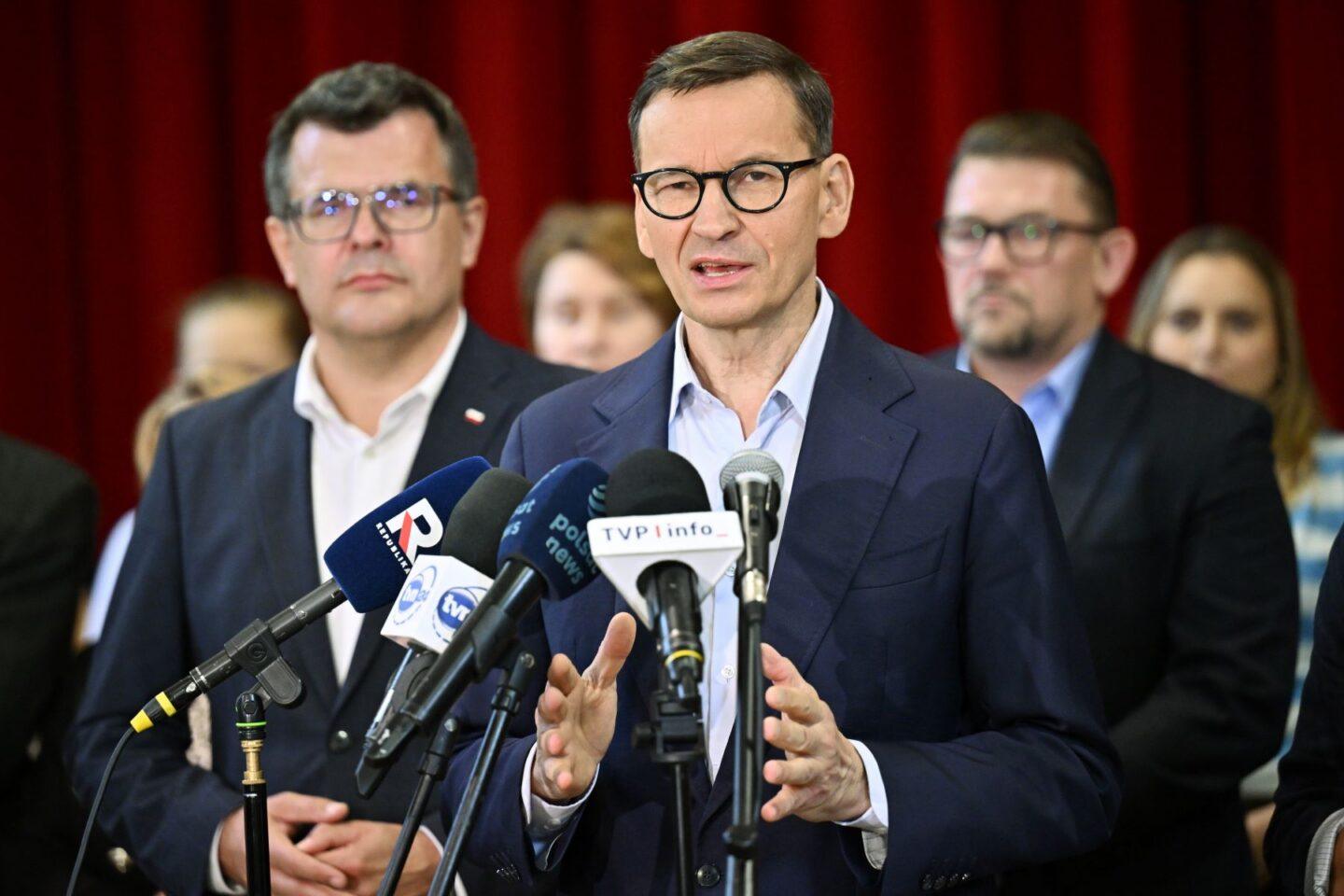
“They are hitting Polish flat-rate taxpayers, small and medium-sized businesses, and the Polish middle class – those who, by getting richer, make others richer because they raise their employees’ wages,” the former prime minister said at a press conference.
In response to the government’s proposal, Rozwój Plus presented its own tax-reform plan. Among other measures, the former prime minister’s allies propose raising the second income-tax threshold from the current PLN 120,000 (about EUR 28,000) to PLN 200,000 (about EUR 47,000), cutting the tax on Polish bonds held by domestic investors from 19% to 9.5%, and introducing an Estonian-style version of Poland’s capital-gains tax (known as the Belka tax, named after the finance minister of the time). Under such a system, the tax would be paid only when profits are realized, rather than when funds are reinvested.
Mateusz Morawiecki’s movement also proposed extending for another two years the PIT exemption for people under 26 who enter the labor market and decide to have a child. Rozwój Plus politicians argue that their proposals could be offset by tightening VAT collection, restoring the so-called excise-tax roadmap and increasing revenue from corporate income tax (CIT).
Rozwój Plus bids higher than PiS
The proposal to raise the second income-tax threshold to PLN 200,000 (about EUR 47,000) outstrips a recent offer from Law and Justice (PiS) announced by Przemysław Czarnek (potential PM if PiS wins). At a recent press conference, PiS’s candidate for prime minister said that, if the party returned to power next year, the second tax threshold would be raised to PLN 180,000 (about EUR 42,000) a year.
“We were preparing comprehensive solutions for Poles, an ambitious vision for development in the near future. And we will deliver it,” Czarnek said in June.
According to estimates by economist Artur Krawczyk published by XYZ, the PiS proposal would cost the state budget around PLN 20 billion (about EUR 4.7 billion). We were not, however, told how PiS intended to make up for the resulting shortfall in government revenues.
Both examples of tax reform, aimed primarily at the relatively well-off middle class working on employment contracts, say a great deal about the political ambitions of the former party colleagues. Both PiS and Rozwój Plus are trying to win over the votes of an increasingly well-paid electorate that is feeling the effects of frozen tax thresholds. There is plenty at stake: year after year, the number of taxpayers falling into the second tax bracket continues to grow.
It is clear, however, that PiS and Rozwój Plus are competing for the same voters with much the same narrative. The details may differ, but the essence remains unchanged.
Migration: similar solutions, different rhetoric
There are also more similarities than differences when it comes to migration. Against the backdrop of the recent migration crisis in Ceuta, Rozwój Plus presented its own proposal for tightening controls over the inflow of people arriving in Poland.
“First, we propose an individual immigrant account. All information concerning the legality of a person’s stay, the legality of their employment, the taxes they pay in Poland, their social-security contributions, and whether or not they have fallen foul of Polish law will be contained in this individual immigrant account,” Mateusz Morawiecki said.
A points-based system modeled on those used in countries including Australia would also be introduced. The former prime minister also called for immediate deportations under a so-called “deportation alert”, to be carried out by a dedicated “deportation service”. Critics have linked Morawiecki’s proposal to America’s Immigration and Customs Enforcement (ICE), which came under particular scrutiny at the beginning of the year after one of its officers shot and killed a Minneapolis resident.
“Not multiculturalism, as Angela Merkel called it, but total, brutal assimilation. There is no multiculturalism here. We are protecting national cohesion and the identity of Poles,” Morawiecki argued forcefully.
We know the hard-line rhetoric on immigration well from Poland’s public debate. One does not have to look far to find near-identical proposals from Law and Justice. In early August, PiS proposed introducing a system to record lawbreaking by foreigners. Violations of the law would trigger deportation proceedings.
There are essentially no differences between Rozwój Plus and PiS on this issue. It should be noted, however, that PiS has gone even further in its anti-immigration rhetoric, including by calling for non-working Ukrainians to be deported across Poland’s eastern border – a position voiced, among others, by MEP Tobiasz Bocheński. Mateusz Morawiecki’s group has not taken a position on the large presence of Ukrainians in Poland.
Rozwój Plus has ideas on demographics...
The clearest programmatic differences emerge on demographics – although they concern the level of detail rather than the overall direction. Rozwój Plus proposes paying PLN 3,600 (about EUR 840) a month per child until the age of three. The benefit would replace the 800 Plus child allowance during the child’s first three years. Once the child turns three, the parents would again receive PLN 800 (about EUR 190) a month. Morawiecki’s movement also proposes redirecting part of the pension contribution into the parents’ account under a so-called family pension contribution.
Beyond tax measures, the proposals include making part-time work easier, evening childcare at on-duty preschools, and a procreation voucher to cover infertility treatment.
So far, PiS has offered no new demographic proposals.
...But plenty remains unknown
These, however, are the only areas in which Rozwój Plus has so far been more explicit than Jarosław Kaczyński’s party.
We still do not know what the new grouping has in mind on healthcare, agriculture or defense. In other areas – including energy, climate policy, its stance toward President Nawrocki and its assessment of the achievements of the United Right between 2015 and 2023 – the two formations are speaking with virtually one voice. Not to mention the ritual criticism of the governing camp, which remains the strongest bond between the former party colleagues.
The first weeks of the two formations’ separate political lives suggest that their differences are more tactical and personal than strategic or ideological.
Waiting for the fall program offensive
Rozwój Plus is currently polling just above the electoral threshold (5%), with 5.6% of voters saying they would support the movement. PiS, meanwhile, has fallen below 20% in the average of recent polls.
Both polling numbers and policy pledges may still change. Against this backdrop, the October Rozwój Plus congress will be worth watching. The new party is expected to be formally established there, along with a new political identity for Mateusz Morawiecki’s camp.
For now, however, some commentators’ hopes that Rozwój Plus would reach beyond the traditional right-wing electorate and offer fresh policy ideas appear to be fading.


Key Takeaways
- According to the latest polls, most of Mateusz Morawiecki’s new movement’s electorate has come from Law and Justice (PiS). The first outlines of its platform, unveiled gradually since the inaugural barbecue in July, point to a repackaging of ideas already familiar from the broader conservative camp. The difference is mainly in how they are presented.
- On key tax and migration proposals, Rozwój Plus and PiS differ mainly in the details, not in their overall direction. Both formations have responded to the government’s proposal to change PIT thresholds with offers aimed at the same group of voters, although Rozwój Plus’s proposal to raise the second threshold to PLN 200,000 (about EUR 47,000) is more generous than PiS’s earlier proposal of PLN 180,000 (about EUR 42,000). A similar convergence can be seen in migration policy, where both parties propose tighter controls and accelerated deportations, with one notable difference: PiS has gone further by explicitly calling for the deportation of Ukrainians who are not working.
- Demographic policy is currently the only area where the two parties show a more pronounced programmatic divergence. Rozwój Plus has put forward specific measures, such as a higher child benefit until a child turns three and a family pension contribution, while PiS has presented no new proposals in this area. Both camps, however, are likely to intensify their policy offerings as the fall political season gets underway.