

This article is a part of Poland Unpacked. Weekly intelligence for decision-makers
The privately owned Polish ammunition manufacturer, which sells its products under the PFA brand, wants to produce components in Poland. It is in talks with investment funds about raising the capital it needs. It must also secure long-term contracts. To that end, it is holding talks with the Ministry of National Defense.
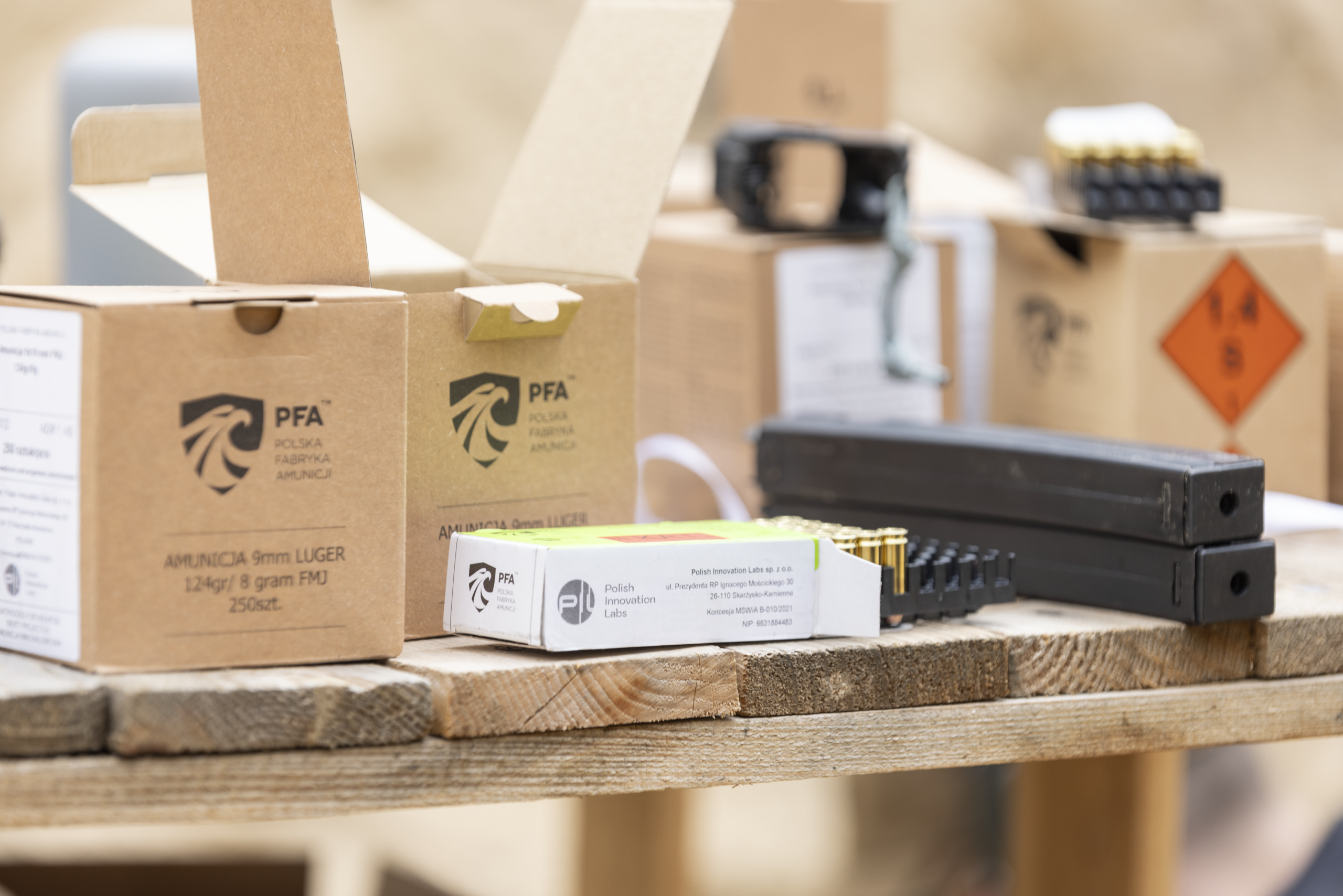
Polish Innovation Labs (PIL), an ammunition manufacturer operating under the PFA Polska Fabryka Amunicji brand, has production capacity of 6 million rounds of small-caliber ammunition a month. However, it is currently using only part of that capacity.
Where the orders are
The company currently sells 1.5–2 million rounds a month. It operates primarily in the civilian and public-sector markets and entered the military segment this year. The civilian market includes specialist firearms and ammunition retailers and shooting ranges. The public-sector market covers tenders for services overseen by, among others, the Ministry of the Interior and Administration and the Ministry of Finance: the Police, Border Guard (SG), Prison Guard Service (SW), National Revenue Administration (KAS) and Railway Protection Guard (SOK).
“In these tenders, we are the only Polish manufacturer and successfully compete with Polish distributors of foreign brands such as Sellier & Bellot and Fiocchi, which are owned by the world’s largest players in this segment of the ammunition market. Recently, we have supplied more than 3 million rounds in total to services overseen by the Ministry of the Interior and Administration and the Ministry of Finance,” says Maciej Sabat, a management board member.
The company sees the greatest potential, however, in the military. It is participating in more than a dozen procurement procedures and expects some of them to be concluded later this year.
“That is where the large volumes and high contract values are, which would allow us to scale the company quickly,” says Grzegorz Kubica, deputy CEO.
According to PIL estimates, Poland’s civilian market for small-caliber ammunition may be worth at least PLN 200 million (EUR 46.2 million), the public-sector market around PLN 50 million (EUR 11.6 million), and the military market at least PLN 350 million (EUR 80.9 million).
PLN 150 million in investment
The company’s investment plan envisages increasing production to 10 million rounds a month and launching its own domestic production of cartridge cases and bullets for 9 mm and 5.56 mm ammunition. Polish Innovation Labs has begun talks with private funds and the Chrobry Fund state fund, and estimates the planned investment at around PLN 150 million (EUR 34.7 million).
“First, we want to increase working capital by PLN 15 million (EUR 3.5 million) so that we can make full use of our current ammunition-loading capacity,” says Grzegorz Kubica.
The company has not yet decided whether it will raise capital from a private fund, a state-backed fund or through the stock exchange. Its decision will depend on the availability of financing and how quickly it can be secured.
If it obtains the funding, utilization of its current ammunition-production capacity could rise sharply within a dozen or so months. What it needs above all are contracts, which the company is currently working to secure.
Maciej Sabat (left) and Grzegorz Kubica of Polish Innovation Labs are betting on local content, understood not merely as having a Polish headquarters and Polish ownership, but above all as maximizing domestic production. Photo: XYZ
The weakest link: components
Building up in-house component production will take longer. Yet PIL representatives say it is essential. A significant share of components currently used in Poland comes from abroad. Deliveries from within the EU take around two to three weeks, while shipments from outside the bloc take four to five weeks. Goods subject to special regulations require specialized transport companies and additional procedures.
“We want to shorten that lead time by starting component production in Poland,” says Maciej Sabat.
Recently, delivery times have lengthened by around a week and a half because of the conflict in the Gulf, while transport costs have risen.
The machinery needed to manufacture the components itself must be ordered around a year in advance, and PIL’s entire project could take about two years.
“I thought there was more local content in this market,” says Grzegorz Kubica.
Poland first, then foreign markets
The company wants to expand exports, but first plans to strengthen its position in Poland and make deeper inroads into the military segment. It has already completed its first ammunition delivery to the Swedish police through a foreign contractor.
One of the products it is developing is reduced-ricochet ammunition. It is intended especially for services operating in environments where an accidental ricochet could have serious consequences. The company also runs educational initiatives at shooting ranges.
PIL representatives say Poland’s certification requirements for civilian ammunition are less stringent than those in some other European countries. The company therefore conducts its own daily quality checks on every production line in its ballistic laboratory. The laboratory can also test ammunition made by other companies against both civilian and military standards. PIL products are additionally sent to certification laboratories abroad.
A shared interest with the state
PIL does not want to compete with Mesko or other companies in the PGZ group, a state-owned company.
“We do not see ourselves as competitors. We would like to complement the state-owned companies,” says Grzegorz Kubica.
In his view, greater domestic ammunition-production capacity would make the state more resilient. The company wants to discuss a long-term contract with the Ministry of National Defense that would underpin a baseline level of production. Such an agreement would also be important for financing: in an industry where investments take years to pay back, predictable demand can matter just as much as capital.
Mesko has already expanded
Mesko has been steadily increasing its capacity in the small-caliber ammunition segment, particularly in 9x19 mm and 5.56x45 mm calibers. Thanks to upgrades to its production halls and investment in new machinery and equipment, the PGZ-owned company has reached production capacity of around 1 million rounds a day. That translates into potential annual output of about 250 million rounds.
“Our priority remains fulfilling orders from the Ministry of National Defense and meeting the needs of the Polish Armed Forces. Given the current security environment, we are focusing our production capacity primarily on military contracts. However, we do not discount the importance of other market segments, including civilian customers and formations overseen by the Ministry of the Interior and Administration,” Mesko’s press office says.
The company has not, however, disclosed any specific plans to increase sales to those services.
Mesko says the potential of Poland’s ammunition market remains significant and that it will continue to monitor changes in demand. It points not only to institutional demand, but also to the growing number of gun owners in Poland.
Bottlenecks
PIL has around 3,500 sq. m of warehouse and production space and seven external bunkers for explosives. The entire site is covered by licenses for trading, manufacturing and storage.
Machinery and tooling remain the main bottlenecks. Delivery of specialist equipment can take 12–16 months, and there are only a handful of manufacturers, mainly in Europe and the United States. Access to tooling is even more difficult.
“Only a few plants in Poland are capable of making such tools,” says Maciej Sabat.
Expert's perspective
The civilian market will grow
The growing number of gun owners is, of course, an important signal, but gun ownership alone does not create a shooting culture. What is needed are accessible shooting ranges, experienced instructors, clubs, training programs and an environment capable of introducing new users to shooting in a safe and responsible way.
This is where we see the greatest potential for the civilian market to develop. Shooting is growing largely from the bottom up. One person brings another to a range, someone takes their first training course, then starts practicing regularly, earns the necessary qualifications, joins a club or buys their own firearm. As the number of active shooters grows, so does demand for training, instructors, shooting ranges, firearms, equipment and, of course, ammunition – particularly in the most popular calibers, such as 9 × 19 mm, .22 LR and .223 Rem.
Our experience shows, however, that infrastructure is one of the most important conditions for further development. Through initiatives and partnerships connected with our community, around 100 shooting ranges have already received support. This demonstrates both the scale of interest and the potential in Poland. At the same time, we see how many initiatives run into administrative, legal or local barriers. That is why we believe the discussion about the civilian market should form part of a much broader conversation about national resilience.
We also look at this from the perspective of national security. Poland is investing enormous sums in modernizing its armed forces, but in parallel we should also develop citizens’ skills. Shooting ranges, clubs, instructors and training organizations create a form of capital that is built largely with private money and through years of personal commitment.
Our goal, therefore, is to create conditions in which responsible shooting can develop across the country: clear laws, predictable administration, more accessible infrastructure, professional training and high safety standards.
If we achieve these goals, growth in the number of firearms users and in demand for ammunition will be a natural consequence of the development of the entire community. The point is not to sell more ammunition. The point is for more Poles to know how to handle firearms safely and responsibly, to have places where they can train and to be able to develop their skills systematically.


How did it start?
Just a few years ago, ammunition production in Poland was not a sector that attracted investors. The war in Ukraine, rising defense spending and the rebuilding of Europe’s industrial capacity have changed that picture.
“My involvement in small-caliber ammunition production began in 2019. The idea of ammunition loading itself emerged sometime around the turn of 2016 and 2017,” says Maciej Sabat, a member of the company’s management board.
At the time, defense companies had problems even obtaining basic banking services, and vetting procedures took a long time. In 2025, investors Rubicon Partners ASI and the Elephant Rock Family Foundation acquired stakes in the company. They were attracted by its existing infrastructure, team and what they saw as the market’s underestimated potential.
“Maciej has enormous technological and technical expertise. He is also a shooter himself and knows how to load this ammunition. He is someone who knows exactly what he is talking about,” says Grzegorz Kubica, deputy CEO of Polish Innovation Labs.
Barriers: administration, know-how and time
Ammunition production requires more than capital, a factory hall and machinery. Before that, a company must prepare documentation, procedures, infrastructure and security systems.
“Obtaining a license is really only the final stage of a long preparation process,” says Maciej Sabat.
There are also permits, production plans, a quality-assessment system and authorizations for storage. According to company representatives, an inexperienced operator may need two to four years to complete the licensing procedures. It must then still import and commission the production line, train staff and implement quality control.
Know-how is just as important.
“Loading ammunition in small batches is completely different from producing it in large volumes. The knowledge often cannot be found in the literature, and many things come from experience or from learning through your own mistakes,” says Maciej Sabat.
Before the revenue comes in
The financing challenge is particularly acute in this business. A company has to bear investment and operating costs long before it reaches an adequate scale of revenue.
“Financing is a major challenge. For a start, banks are only beginning to learn how to finance defense-related companies,” says Grzegorz Kubica.
The problem is even greater when it comes to working capital. Polish Innovation Labs operates in a model in which components must be purchased in advance.
“When you place an order, you have to pay 100% of the component’s value upfront. Otherwise, no one will manufacture and ship the component needed for ammunition loading,” the deputy CEO continues.
Only then does the process of delivery, production, storage and sale begin.
“From the moment we spend one zloty until that zloty comes back to us, around four months pass,” says Grzegorz Kubica.
As sales grow, that means working capital must be increased continuously.
Good to know
The four components of a 9 mm cartridge
- Bullet. The metal projectile that leaves the barrel when fired and travels toward the target. In a typical 9 mm cartridge, it most often consists of a lead core surrounded by a copper jacket, known as a Full Metal Jacket (FMJ), although versions using other materials and shapes also exist, such as hollow-point bullets with a cavity in the tip.
- Cartridge case. The metal “body” of the cartridge, usually made of brass, an alloy of copper and zinc, and less commonly of steel or nickel-plated metal. The case holds all the components together: the bullet is seated at the front, the propellant is contained inside, and the primer sits at the rear in the case head. It also seals the chamber during firing, preventing gases from escaping backward.
- Primer. A small metal cap in the base of the cartridge case, filled with an impact-sensitive priming compound. When the firing pin strikes the primer, it ignites, and the resulting flame passes through a small hole in the case head and ignites the propellant.
- Propellant charge. Smokeless powder, for example a double-base propellant, in the form of fine granules contained inside the cartridge case. Once ignited by the primer, it burns rapidly, generating high gas pressure that drives the bullet out of the barrel.


Key Takeaways
- Poland has ammunition-production capacity, but it still lacks a sufficiently strong domestic supply chain. The problem is not limited to the ability to load ammunition itself. Access to components, specialist machinery and tooling remains a significant constraint. Dependence on foreign supplies lengthens lead times, raises costs and makes it harder to ramp up production quickly when demand surges.
- In the ammunition industry, capital is needed long before revenue arrives. Expanding production requires simultaneous investment in machinery and infrastructure, as well as substantial working capital because components must be financed upfront. For a private manufacturer, therefore, a predictable order book is just as important as access to PLN 150 million (EUR 34.7 million) in financing. A long-term contract with the state could make both financing and decisions to expand capacity easier.
- Local content could become one of the key pillars of resilience in Poland’s defense sector. Polish Innovation Labs’ plan shows that reducing dependence on foreign suppliers does not necessarily mean state-owned companies must build an entire industry from scratch. A private manufacturer can complement PGZ’s existing capabilities while gradually relocating successive parts of the supply chain to Poland.