

This article is a part of Poland Unpacked. Weekly intelligence for decision-makers
A group of Polish entrepreneurs will invest in the development of a fleet of BWRX-300 small modular reactors (SMRs) in Poland. They will back the project being developed by Michał Sołowow’s Synthos Green Energy (SGE).
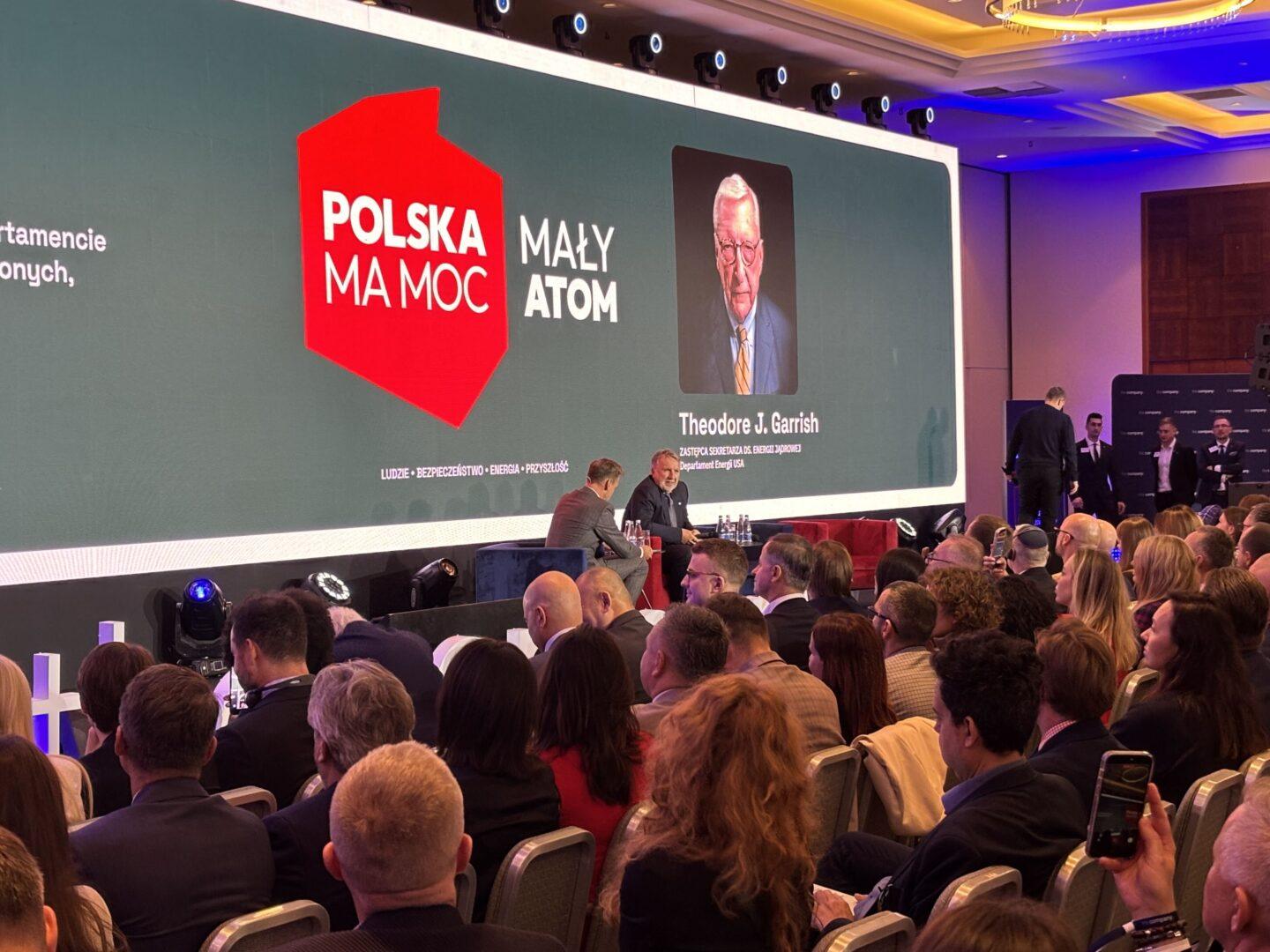
“I am no longer fighting for SMRs alone. From today, I will be doing it as part of a larger group,” the businessman announced during the Polska ma MOC conference organised by The Company.
The investors include Rafał Brzoska, founder and chief executive of InPost; Dariusz Gałęzewski, co-founder of Oshee; Krzysztof Pawiński, chief executive and one of the owners of Maspex, together with his daughter Marta Pawińska; Mati Staniszewski, co-founder and chief executive of ElevenLabs; ElevenLabs co-founder Piotr Dąbkowski; Michał Wypychewicz, head of Koronea Family Office and associated with ZPUE; Dominik Doliński, a partner in Oshee; Michał Brański, co-owner of WP Holding; and Bruno Wejchert, a partner at Strike Capital.
The announcement confirms earlier reporting by XYZ. As we reported on Wednesday morning, Michał Sołowow had invited new Polish investors to join his company’s project, with some of them deciding to invest directly in Synthos Green Energy.
The Polish entrepreneurs are expected to invest a total of around PLN 500m in Synthos Green Energy. Foreign investors will also participate. According to SGE, the company has secured PLN 1.35bn in equity commitments from foreign investors.
“We are in the middle of a funding round. So far, we have raised around EUR 400m. The only investor I can disclose is GE Vernova, which is contributing around EUR 100m,” Michał Sołowow said at the conference.
Synthos has been betting on SMRs for years
Michał Sołowow has for years ranked among Poland’s wealthiest people and was one of the first Polish entrepreneurs to bet on small modular reactor technology. Synthos began pursuing the idea as early as 2017, when the technology was at a much earlier stage of development.
Today, Synthos Green Energy, founded by Sołowow, is the exclusive regional partner responsible for developing BWRX-300 reactors in several European markets. The BWRX-300 is a 300 MWe small modular reactor developed by GE Vernova Hitachi Nuclear Energy. In September 2026, SGE, US-based GE Vernova, Japan’s Hitachi and South Korea’s Samsung C&T signed an agreement aimed at deploying SMRs in Europe.
Synthos is not merely a customer buying ready-made reactors. Sołowow has said that the company co-financed the development of the technology, covering 17% of the costs.
Why does Synthos need other entrepreneurs?
For the Polish entrepreneurs joining the SGE project, the investment may offer not only a share in the potential profits from the development of nuclear energy, but also an opportunity to help build energy infrastructure for their own businesses.
For Synthos, the new investors mean additional capital and stronger backing for the project both in Poland and abroad. They may also inject fresh momentum into a project that has for some time been stuck in negotiations between two major partners.
In Poland, SGE plans to build BWRX-300 units together with Orlen through OSGE, a joint venture established in 2022. According to the company, OSGE is currently focused on three locations where the first 14 SMR units could be built.
However, as XYZ has previously reported, the project has encountered turbulence. The first agreement between Synthos and Orlen was signed in 2021, under the Law and Justice government and while Daniel Obajtek was chief executive of Orlen. According to information obtained by XYZ, changes in Poland’s political environment and in Orlen’s ownership oversight became one of the factors contributing to prolonged negotiations over the final shape of the partnership. Officially, however, both sides have pointed primarily to business issues.
Good to know
SMRs are meant to broaden access to nuclear power
In SMRs, or small modular reactors, energy is generated in much the same way as in large nuclear reactors: through the controlled fission of atomic nuclei. The difference lies in their power output, design and the way the plants are built.
The International Atomic Energy Agency classifies reactors with an electrical output of up to 300 MW per module as SMRs. By comparison, modern large-scale nuclear reactors typically have capacities exceeding 1,000 MW. A smaller nuclear plant can, however, consist of several modules brought online sequentially.
The BWRX-300 technology being developed by GE Vernova Hitachi Nuclear Energy is a 300 MW small modular reactor. It was designed on the basis of operational experience and innovations in boiling-water reactor technology.
The small modular reactor market remains at an early stage of development. According to the World Nuclear Association, two small nuclear reactors are currently operating worldwide, in Russia and China. Another five units are under construction, while many more projects remain at the design and preparation stage. One of the most advanced is the BWRX-300 project being built in Canada.
During Wednesday’s conference, Sołowow announced not only that Polish entrepreneurs would join the investment, but also that SGE had reached an agreement with Orlen on the project.
What were SGE and Orlen negotiating?
In July, XYZ reported that, according to our sources at Orlen, one of the main unresolved issues was the definition of the “general partner”, which the two sides understood differently. The Ministry of State Assets was reportedly expecting Orlen to resolve the matter by the end of 2026.
In September 2026, Energy Minister Miłosz Motyka told TVP Info that work was underway on the final ownership structure and a new agreement. Poland’s Internal Security Agency was said to have raised objections to the ownership model agreed under the previous United Right government.
At the end of September, Orlen chief executive Ireneusz Fąfara told Bloomberg that progress had been made in the prolonged negotiations with SGE. He said an agreement could be reached by the end of the year and that discussions were down to “two or three key issues”.
“Our positions on these issues differ. I believe that with goodwill on both sides, we will reach an agreement,” Fąfara said at the time.
According to unofficial information, Orlen could sign the final agreement with SGE as early as mid-October. Talks are also reportedly continuing over the potential entry of the Polish Development Fund into the project. Energy Minister Miłosz Motyka spoke about this possibility in August 2026.


Key Takeaways
- Michał Sołowow is broadening the capital base behind Synthos Green Energy. A group of prominent Polish entrepreneurs is set to join the SMR project and invest around PLN 500m in the company. They include Rafał Brzoska, Dariusz Gałęzewski, Krzysztof Pawiński, Mati Staniszewski and Michał Wypychewicz. For SGE, this means additional capital and stronger partners for developing projects in Poland and abroad.
- SGE is developing its Polish project together with Orlen through the OSGE joint venture. Negotiations between the partners are still ongoing following political changes in Poland and management reshuffles at Orlen. The talks are said to focus on business issues, with decisions expected before the end of 2026.
- SGE wants to develop SMRs beyond Poland as well. The company is the exclusive regional partner responsible for developing BWRX-300 reactors in several other European markets. It is working with GE Vernova, Hitachi and Samsung C&T and is pursuing projects in several European countries.