

This article is a part of Poland Unpacked. Weekly intelligence for decision-makers
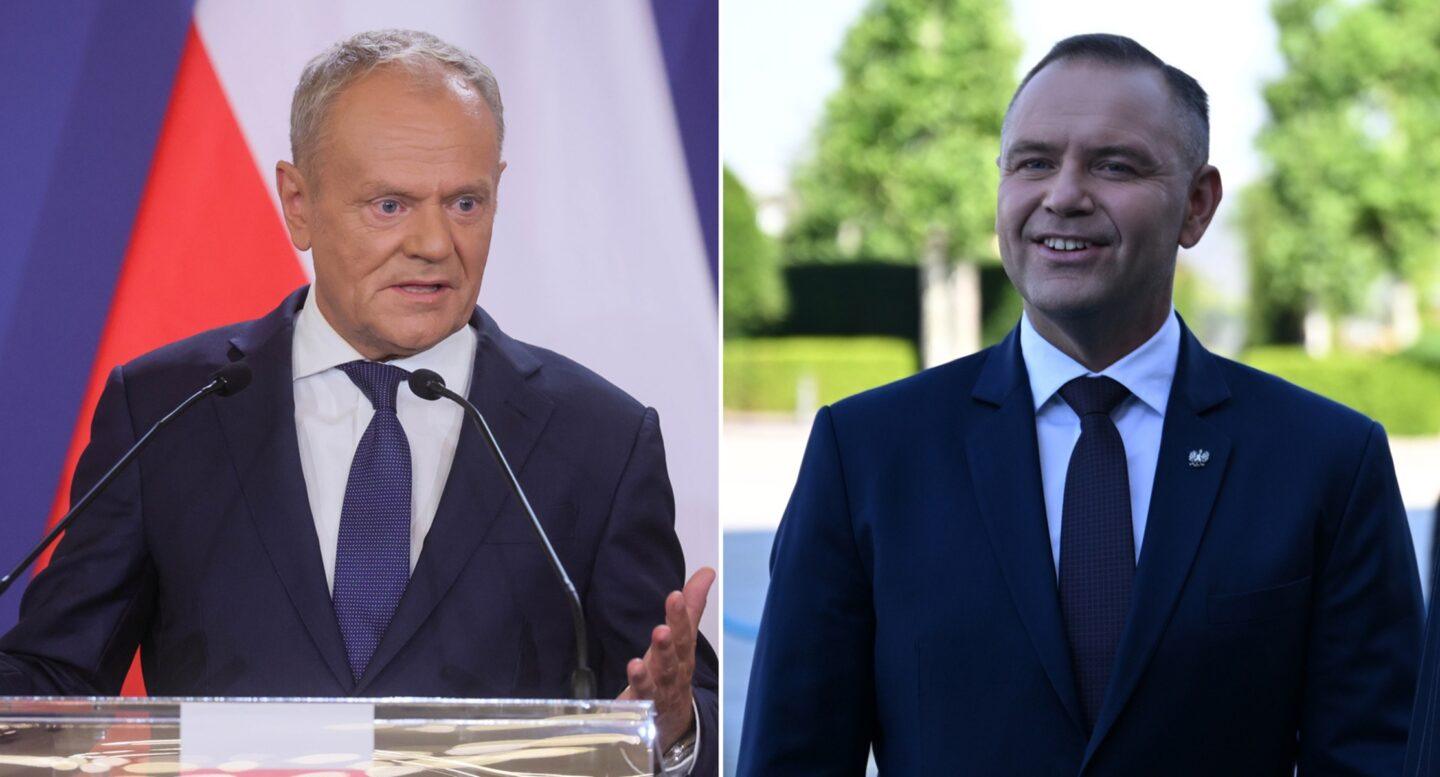
The conflict between a president and prime minister from opposing political camps is unusually intense today. Experts argue, however, that the problem stems not only from constitutional arrangements but also from growing polarization. And tensions caused by cohabitation are far from unique to Poland.
Rafał Trzaskowski wins the presidential election, but after the next parliamentary vote Law and Justice (PiS) returns to power. Przemysław Czarnek forms a government in which the environment ministry is to be headed by a politician unacceptable to Civic Coalition (KO). Trzaskowski refuses to sign the nomination.
Or Karol Nawrocki delays entrusting Donald Tusk with the task of forming a government after the next parliamentary election. He argues that he will make a decision only once the candidate for prime minister proves that he will properly safeguard Poland’s interests.
This is, of course, political fiction — in Poland. Similar situations have, however, recently occurred in Czechia and Slovakia. The examples of Poland’s southern neighbors show how far a conflict can go when the president and government come from opposing political camps.
A difficult word beginning with “c”
Cohabitation is a period in which the president and prime minister come from different political camps. In the history of Poland’s Third Republic, this has hardly been exceptional.
Since the Constitution was adopted in 1997, Poland has experienced cohabitation:
- in 1997–2001, when Aleksander Kwaśniewski was president and the AWS-UW coalition was in government;
- at the end of 2005, when Kwaśniewski briefly served alongside the newly appointed Law and Justice government of Kazimierz Marcinkiewicz;
- in 2007–2010, when President Lech Kaczyński served alongside Donald Tusk’s first government;
- in 2015, when Andrzej Duda spent several months as president while Ewa Kopacz’s Civic Platform–Polish People’s Party coalition remained in government;
- since December 13, 2023, when Donald Tusk’s government was sworn in. Initially, the head of state was Andrzej Duda, who came from Law and Justice. He was later succeeded by Karol Nawrocki, whose presidential candidacy had been backed by PiS.
Altogether, that amounts to nearly 11.5 years of cohabitation since 1997.
Jacek Haman: “We have a president acting like a third chamber”
“This cohabitation is genuinely going worse than in the past. If you look, for example, at veto statistics, they are completely different,” says Jacek Haman, a sociologist at the University of Warsaw and member of the Stefan Batory Foundation’s Electoral Experts Team.
He notes that former presidents - Andrzej Duda, Lech Wałęsa and Aleksander Kwaśniewski - also used the veto while serving alongside governments from opposing political camps.
“President Nawrocki is many times more active. You could say that while his predecessors would occasionally ‘bite’ an opposing government with a well-aimed veto, they generally did not question the parliamentary majority’s right to make law. Now we genuinely have a president acting as a ‘third chamber’,” Haman argues.
Polish-style cohabitation can paralyze the state
According to the Batory Foundation expert, the current conflict between the president and prime minister could become dangerous for the functioning of the state.
One problem, he says, is the disappearance of areas of cross-party agreement. He points to policy towards Russia and Ukraine as an example. In his view, cooperation should also extend to a substantial part of foreign policy. The dispute between the prime minister and president over ambassadorial appointments shows, however, that such agreement is lacking.
“Politicians are increasingly willing to sacrifice the common good for immediate, short-term gains in the current exchange of blows,” Haman says.
He sees the most concrete threat in the possibility of blocking legislation and, as a consequence, obstructing changes to state institutions, above all the justice system.
From a broader perspective, he argues, the erosion of political customs that once helped contain the intensity of conflict is equally damaging.
Paweł Musiałek: polarization is also part of the problem
“The character of today’s cohabitation between Donald Tusk and Karol Nawrocki is not solely the consequence of constitutional provisions that push the president and prime minister into political conflict when they come from different political environments,” says Paweł Musiałek, a political scientist at the Kraków University of Economics and president of the Jagiellonian Club.
In his view, another important source of tension is Poland’s very high level of political polarization, also recorded in international studies, including V-Dem.
“On the one hand, we have an enormous degree of polarization within our own country. On the other, this conflict is being fueled by the sense that we are taking part in a global contest between liberals and a right-wing international, which adds even more fuel to polarization,” Musiałek argues.
“In the current situation, we simply would not have joined NATO or the European Union”
The political scientist believes the current intensity of political conflict limits the state’s ability to pursue long-term policy.
“In a situation where the political atmosphere is like this and both sides fundamentally distrust each other, no agreement is possible. That means governing becomes limited to administration. It is impossible to implement any strategy that goes beyond simply administering the state,” Musiałek says.
In his view, constant political warfare reduces the effectiveness of the state and absorbs a significant share of politicians’ energy.
“Today, we are completely deprived of the ability to implement any long-term strategy requiring broader consensus. I am certain that, under current conditions, the consensus of the 1990s that led us into the European Union and NATO would be impossible. In today’s situation, we simply would not have joined NATO or the European Union,” the Kraków-based political scientist says.
Negative selection into politics
Musiałek also points to the consequences that increasingly fierce political competition has for political parties themselves and for people considering a career in public life.
“Politicians know that losing power no longer means merely spending some time in opposition. It may even mean court proceedings and the loss of personal security. That often leaves no time for thinking about the state,” says the president of the Jagiellonian Club.
In his view, this model of politics discourages some people from entering public life.
“What remains are people who made a bet on a political career in the past and became cogs in a machine that feeds these hardcore emotions,” Musiałek says.
This is not only a Polish problem
Conflicts linked to cohabitation are not unique to Poland. Czechia is currently dealing with similar tensions, while Slovakia experienced them earlier.
“The president is directly elected by citizens, which gives the office a strong democratic mandate, but the system remains parliamentary-cabinet based. The prime minister is accountable to parliament and heads the government,” explains Łukasz Lewkowicz, a Slovakia expert at the Institute of Central Europe and Maria Curie-Skłodowska University in Lublin.
A similar constitutional structure exists in the Czech Republic. The presidents of Poland, Czechia and Slovakia are directly elected, have appointment powers, play a defined role in foreign policy and formally serve as commanders-in-chief of the armed forces. The extent of their real power, however, differs.
Czech and Slovak presidents have weaker vetoes
There are important differences between the constitutional arrangements in Poland, the Czech Republic and Slovakia.
“Each system is slightly different. The Polish president has a very powerful weapon in the form of a veto that is difficult to override throughout the entire term. Overriding a presidential veto in Czechia or Slovakia is straightforward because a majority in the assembly is sufficient,” says Maciej Ruczaj, a political scientist at the Prague Centre for Transatlantic Relations, former Polish ambassador to Bratislava and former director of the Polish Institute in Prague.
He notes that in Czechia and Slovakia, the head of state can become particularly important when a new government is being formed or when changes are made to its composition.
“What is interesting is that all three constitutions say more or less the same thing: that ‘the president appoints the prime minister and ministers’. Yet constitutional lawyers and politicians draw different conclusions from this. In Poland, it has become accepted that the prime minister bears full responsibility for the composition of the government. In Czechia and Slovakia, however, there are cases — increasingly often in Czechia — where the president refuses to appoint particular people and gets their way,” Ruczaj says.
In his view, this stems from the president’s strong position at the moment a cabinet is being formed. At the same time, there is no unambiguous constitutional-court ruling defining the limits of this power.
Slovak-style cohabitation was difficult
Today, Slovak President Peter Pellegrini and Prime Minister Robert Fico come from politically close camps.
Lewkowicz recalls, however, the tense cohabitation of 2023–2024. It began after the 2023 parliamentary election, which returned Robert Fico to power. Zuzana Čaputová was president at the time.
“The relationship was particularly tense because the conflict was not only personal but also programmatic and constitutional,” Lewkowicz says.
Čaputová was associated with the liberal and pro-European political camp, while Fico, leader of SMER, returned to power on a platform critical of some institutions of the liberal state, the media and the previous policy towards Ukraine.
“Robert Fico’s campaign against Zuzana Čaputová was itself very aggressive — SMER referred to her, among other things, as an ‘American agent’. Criticism from the coalition also targeted the president’s family, which ultimately contributed to her decision not to seek re-election,” Lewkowicz recalls.
How the Slovak president blocked a ministerial candidate
After SMER’s election victory, Robert Fico began assembling a government. Rudolf Huliak of the Slovak National Party (SNS) was proposed as environment minister. President Zuzana Čaputová refused to appoint him, arguing that he did not provide sufficient guarantees that he would manage the ministry properly.
“Article 111 of the Slovak constitution says that the president, on the prime minister’s proposal, appoints and dismisses the other members of the government. And that is precisely where the interpretive problem arises: does ‘appoints’ mean an obligation to automatically appoint the person proposed by the prime minister, or does the president have room to refuse in exceptional circumstances? In Huliak’s case, Čaputová adopted the second interpretation,” Lewkowicz says.
The presidential office pointed, among other things, to Huliak’s statements on climate change and environmental organizations. Čaputová argued that appointing him could threaten the proper functioning of the ministry.
Fico ultimately accepted the president’s decision and Huliak did not become environment minister.
Slovak constitutional lawyers were not unanimous in their assessment, however. Some noted that during the negotiations Fico was not yet formally prime minister and that submitting the candidacy therefore amounted to political consultation rather than a formal nomination.
“Čaputová had constitutional arguments for refusing Huliak, but her interpretation was not beyond dispute. The disagreement was precisely about how far presidential discretion extends when ministers are appointed. It is a very good example of the difference between a formal power and constitutional practice,” Lewkowicz says.
Czech-style cohabitation
Difficult cohabitation in Czechia began in autumn 2025 with Andrej Babiš’s return to power. His government now operates alongside President Petr Pavel, who had defeated Babiš in the second round of the presidential election two years earlier.
The two politicians differ significantly on issues including foreign policy. Petr Pavel represents an unequivocally pro-Atlantic, pro-EU and pro-Ukrainian position. Babiš returned to power after promising, among other things, to limit some forms of support for Ukraine and put greater emphasis on Czech national interests.
During one of the debates ahead of the 2023 presidential election, Babiš said Czechia should not send troops to help Poland or the Baltic states in the event of an attack. He later withdrew the statement.
After the parliamentary election, Petr Pavel made Babiš’s appointment as prime minister conditional on him presenting a way to resolve his conflict of interest connected with the Agrofert holding company.
Another source of conflict was the nomination of Filip Turek as environment minister. Pavel raised objections after Czech media disclosed controversial remarks by Turek, including racist, sexist and homophobic posts and references to Nazi symbolism.
Ultimately, Turek did not take over the environment ministry.
Tensions between the president and prime minister have also emerged in foreign policy, including disputes over who should represent Czechia internationally and to what extent.
What would cohabitation between Macron and Le Pen look like?
“Of course, we can ask whether today’s level of polarization requires a clearer answer to the question of who actually decides and where the center of sovereignty lies,” Ruczaj says.
The former Polish ambassador to Bratislava notes that the constitutions of countries in the region were drafted at a time when more emphasis was placed on consensus and on balancing different centers of power.
“I would not draw conclusions from this about a ‘lower level of political culture’. We do not know what a hypothetical cohabitation between Macron and Le Pen as prime minister would look like. In most of Western Europe, either such a confrontation cannot happen because heads of state perform purely ceremonial roles, or there simply has not yet been cohabitation between representatives of the two sides of today’s political and ideological divide,” Ruczaj observes.


Key Takeaways
- The problems associated with cohabitation are not unique to Poland. Similar tensions are currently visible in Czechia, while in 2023–2024 they were particularly pronounced in Slovakia.
- The Polish president has a stronger veto than the presidents of Czechia and Slovakia, but in those countries the head of state can still effectively influence the composition of the government. Cases in which presidents refused to accept particular ministerial candidates illustrate this.
- Experts argue that today’s tensions stem both from constitutional arrangements and from a high level of polarization. Jacek Haman sees the possibility of legislative paralysis as one of the most serious risks. Paweł Musiałek, meanwhile, argues that the lack of political agreement makes it harder for the state to pursue long-term strategy.