

This article is a part of Poland Unpacked. Weekly intelligence for decision-makers
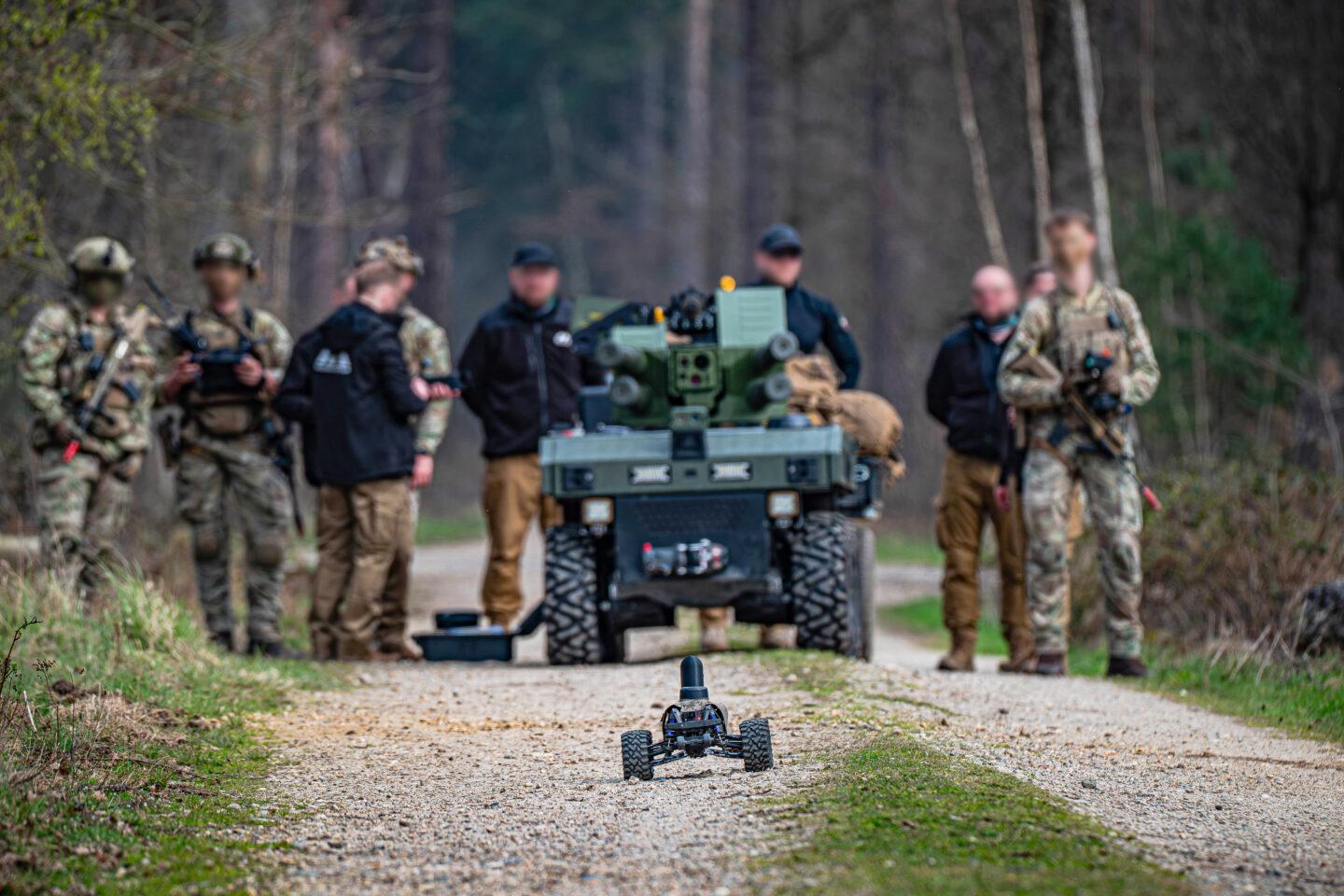
Macro-System has begun producing the first series of its Universal Ground Carrier (UNL), an unmanned platform on which the company has developed, among other systems, the reconnaissance and combat GOBLIN. This marks the project’s transition from development and testing to serial production. At the same time, the company says it is testing its supply chain and its ability to rapidly scale production in the event of larger orders.
Production is to rely on a network of Polish suppliers and partners, which currently includes more than 60 companies. Macro-System retains the key technological and integration capabilities, while its network of partners gives it the ability to scale production quickly.
Macro-System’s path towards unmanned ground vehicles began with flying machines. The company was experimenting with them as early as the beginning of the 2000s, when military drones were a far less obvious solution than they are today. It developed its first designs and presented them to the military. The response, however, was hardly encouraging.
“At the time, we were told that it was very interesting, but completely useless for the military,” recalls Mateusz Ciepliński, chief executive of Macro-System.
A few years later, it became clear that both technology and military requirements were developing in a direction the experts had not expected. Aerial drones began playing an increasingly important role in the armed forces, and the company decided to look for another niche. Around 2012–2013, it turned to unmanned vehicles operating on the ground.
As Ciepliński puts it, at the time “everyone was flying, nobody was driving”. This time, the company decided to pursue the project consistently, regardless of how long the market might take to mature.
Today, ground drones are becoming one of the directions in which modern armed forces are developing. Experience from the war in Ukraine has shown that their uses are not limited to combat. They can deliver ammunition and supplies, evacuate wounded soldiers, conduct reconnaissance or perform tasks in areas where sending personnel would involve particularly high risks.
Macro-System is building its family of vehicles around precisely this versatility.
“Our philosophy is to build vehicles that are universal. We start by making a very good vehicle, a very good carrier, and further development depends on users’ feedback and needs, as well as the pace of technological change,” says the Macro-System chief executive.
This approach defines the company’s development strategy: rather than designing a separate robot from scratch for each task, Macro-System is developing a common platform that can be fitted with modules tailored to specific requirements.
One vehicle, multiple roles
The basis of Macro-System’s larger systems is the UNL, or Universal Ground Carrier. It is a six-wheel electric vehicle weighing around 830 kg. It can carry 500 kg of cargo, with another 500 kg on an additional trailer. According to the manufacturer, it can also tow vehicles weighing up to around six tonnes.
Its maximum speed is 30 km/h, while a 27 kWh battery is designed to provide up to 20 hours of operation. Each wheel is powered by an independent electric motor, allowing the vehicle, among other things, to turn almost on the spot.
Above all, however, the company is focusing on the platform’s modularity. The UNL can transport supplies, equipment or wounded soldiers, but it can also be fitted with surveillance systems, communications equipment or weapons. During military trials, the company first tested a combat and reconnaissance configuration before adapting the vehicle for transport duties.
“We changed it from a combat-reconnaissance configuration to a supply configuration in half an hour. It took half an hour to remove the weapons module and install the cargo module,” Ciepliński says.
The same platform is the basis for GOBLIN, a reconnaissance and combat version of the unmanned vehicle. It can be equipped with the ZMU-05 remotely controlled weapon station developed by Arex, a company belonging to WB Group.
According to Macro-System’s materials, the module can carry machine guns ranging from 5.56 mm to 12.7 mm. The system can conduct surveillance and fire both during the day and at night.
Macro-System envisages two soldiers operating GOBLIN. One drives the vehicle and positions it appropriately, while the other controls the weapon system. This arrangement allows the vehicle to fire while moving.
“We once had a great many discussions about why it should not be operated by one person. But reality has confirmed that this is the right concept,” Ciepliński says.
He adds that the solution has been tested with military personnel.
Good to know
Ground drones as a market
Ground drones remain a much smaller market than unmanned aerial vehicles, but the war in Ukraine has clearly accelerated their development and adoption. Estimates of the global market vary substantially depending on methodology.
Reports covering military UGVs [unmanned ground vehicles — ed.] alone currently put the market at around USD 2–3bn a year and forecast several-fold growth over the next decade. Broader studies that also include civilian and law-enforcement applications project that the global market could grow from around USD 9bn in 2025 to more than USD 43bn in 2034.
Ukraine has become the most important testing ground for the technology. According to KSE Institute, Brave1 and Defence Builder, the value of Ukraine’s unmanned ground vehicle market increased from USD 43m in 2024 to USD 252m in 2025, a rise of 488%. Logistics platforms account for more than 60% of the market.
By mid-2026, the Ukrainian armed forces were already carrying out more than 10,000 UGV missions a month, while contracts for more than 22,000 such vehicles had been signed for 2026 as a whole.
Ukraine’s experience suggests that, for now, the greatest value of ground drones is not in replacing troops in direct assaults. They perform best when taking over the most dangerous and repetitive tasks.
They deliver ammunition, food and water to positions, evacuate wounded personnel, transport equipment, conduct reconnaissance, lay or clear mines and carry electronic-warfare systems.
Their importance is growing as extensive “kill zones” monitored by aerial drones emerge along the front. In such an environment, every journey by car or armored vehicle towards the front line risks detection and attack by FPV drones [First Person View — drones whose operators usually control them using a live video feed from an onboard camera — ed.].
A small, relatively inexpensive unmanned vehicle can perform a similar task without exposing a crew to danger.
That does not mean UGVs have already become the equivalent of “robotic infantry”. Analyses of wartime experience point to problems with communications and signal jamming, mobility through mud, trenches and devastated terrain, limited range and the need for constant operator supervision.
The next areas of development are therefore more resilient communications, autonomous navigation without GPS, more effective obstacle recognition and a gradual increase in vehicle autonomy.
Soldiers should be the ones testing the equipment
One principle is repeatedly emphasized at Macro-System: an unmanned vehicle cannot be developed solely by engineers sitting behind desks.
“Ambition and responsibility require us to keep improving our products. That is why the only effective way to develop them is to hand the vehicles over to end users and improve them based on their experience,” says the company’s chief executive.
The company therefore takes part in exercises, gives controllers to soldiers, observes how they use the equipment, then collects feedback and makes changes.
Macro-System is also testing this development model outside Poland. In April 2026, its systems took part in exercises conducted by the Belgian land forces. It was the first pilot of its kind in the Belgian army involving unmanned ground vehicles.
The machines took part in more than a dozen scenarios involving reconnaissance, logistics and evacuation, with operations conducted around the clock. GOBLIN, equipped with the ZMU-05 module and a 12.7 mm heavy machine gun, also performed night missions.
The vehicle also appeared during the Dzielny Dzik 26 exercise in north-eastern Poland, involving Polish, Lithuanian and French troops. Around 6,500 soldiers and several hundred vehicles took part in the maneuvers. GOBLIN performed reconnaissance and casualty evacuation tasks.
The company says its systems have also been tested on training grounds elsewhere in Europe, from France to Estonia, together with land forces and special-operations units.
Macro-System recently presented GOBLIN and GNOM in Belgium during the National Infantry Days (Journées Nationales de l'Infanterie). The event is intended to bring together different infantry units and the civilian sector, with demonstrations of modern equipment and combat systems as well as operations in urban environments.
Representatives of the Belgian, French, Dutch and German armed forces watched the demonstrations. Macro-System was one of two unmanned ground-system manufacturers taking part.
Ciepliński stresses that feedback from users quickly finds its way into subsequent versions of the system.
“The moment they give us feedback that they need something to work differently or need another function, we implement it immediately,” says the Macro-System chief executive.
In his view, more than a decade of development work, followed by successive trials and exercises, has contributed to the maturity of the systems.
Operators have limits too
Controlling a drone for many hours does not become easy simply because the operator is physically distant from the vehicle.
The company highlights a problem often overlooked in discussions about autonomy and new technology: for hours at a time, a person has to monitor screens, analyze camera feeds and the environment around the vehicle while simultaneously driving it or operating its weapons.
“The sensory load on an operator, whether of aerial or ground drones, is genuinely very high,” Ciepliński says.
He recalls tests during which live-fire exercises began at 8am and did not finish until around 1am. Such long operating periods require not only durable equipment, but also a properly designed workstation for the operator.
Development therefore also covers console ergonomics, the presentation of information and control systems. Even apparently minor changes can reduce fatigue during hours of continuous operation.
The company also trains users in configuring communications, because without a stable link even the most advanced vehicle becomes useless on the battlefield.
Ciepliński does not disclose details of the solutions used, but points to various ways of maintaining communications with the vehicle.
“From military communications and fiber-optic cable to Starlink and transmitters using civilian networks,” he says.
Operators are expected to be ready to switch communications methods depending on conditions and the threat posed by electronic warfare.
GNOM is designed to go where it is difficult to fly
The company’s second, much smaller system is GNOM, which Macro-System describes as “driving ammunition”. It is a small four-wheel vehicle measuring 557 mm in length and 397 mm in width.
With its warhead, it weighs around 8 kg and can reach speeds of up to 80 km/h. According to the manufacturer, its radio-control range is 500 metres and it can carry a payload of up to 2 kg.
GNOM’s concept differs from that of aerial loitering munitions. The vehicle is designed to use terrain, obstacles and buildings to reach places that are difficult to attack from above.
According to the manufacturer, it can move between trees, behind terrain obstacles and through urban areas. One envisaged use is attacking armored vehicles from underneath. Its small size is intended to make the system easier to conceal, while a soldier can carry it using special straps like a backpack.
GNOM does not, however, have to be used immediately as a weapon. Its cameras allow it to conduct reconnaissance and surveillance, and the vehicle can wait for a target.
The manufacturer has designed several types of warhead, including high-explosive fragmentation and shaped-charge versions, as well as a training variant without explosives. The system was also used during exercises in Belgium, where it performed reconnaissance and combat tasks.
GNOM has been in service with the Polish Armed Forces since 2025. A year later, together with GOBLIN, it received Defence24’s Security Eagle award in the Product Development category.
Macro-System stresses, however, that it does not regard its existing designs as finished products. New uses are expected to emerge from exercises and observations of the modern battlefield.
Ideas that began inspiring competitors
After more than a decade of development, the company can also use its platforms to test further applications.
As one example, Ciepliński points to using GOBLIN as a forward communications relay. The unmanned vehicle can be sent far away from a command post and connected to it by fiber-optic cable. If it is detected and destroyed, the loss would be incomparably smaller than losing a command post together with its personnel and equipment.
“Once we have GOBLIN, we can reconfigure it as a communications transmitter, send it 10 kilometres away from the command post over fiber. The cost of losing such a vehicle compared with the cost of losing a command post is on a completely different scale,” the Macro-System chief executive explains.
At the same time, the company acknowledges that it no longer wants to present every new concept publicly.
For years it published footage of tests and new applications for its systems, but says it noticed that some of its solutions were beginning to appear among other manufacturers as well.
“At some point, we stopped announcing further applications for our vehicles because we noticed that they were becoming a strong source of inspiration for other manufacturers. We want the years of investment in research and development to translate into a competitive advantage,” Ciepliński says.
At the same time, Macro-System is developing cooperation with component manufacturers and research institutions. In August, it signed an agreement with the Military University of Technology.
Joint work is to cover military robotics, unmanned ground platforms, autonomous systems, reconnaissance and the integration of vehicles with mission equipment and command systems. The objective is to shorten the path from research and testing to deployment by the military and other services.
After more than a decade, the situation therefore looks completely different from when the program began. Back then, the company had to explain why the military might need unmanned machines. Today, the question is rather which tasks should be handed over to them first.
“Fourteen years ago, we chose a direction that today fits the needs of the armed forces perfectly. We were developing this technology before demand for it became widespread,” Ciepliński says.
Ground drones are ceasing to be an exotic addition to unmanned aerial vehicles. They are becoming another tool for limiting soldiers’ presence in places where the risk is greatest.
Ground drones have significant potential
Polish Armaments Group (PGZ) also sees growing importance in unmanned ground systems.
In a comment to XYZ, PGZ notes that experience from the war in Ukraine has demonstrated that such platforms can take over some of the most dangerous tasks and reduce soldiers’ exposure to direct enemy action.
The group sees applications including reconnaissance, engineering operations, casualty evacuation and logistical support for troops close to the front line. Unmanned vehicles can also be armed and operate alongside crewed platforms.
PGZ stresses, however, that they are not intended to replace vehicles such as the Borsuk infantry fighting vehicle or Rosomak armored personnel carrier, but rather to complement existing capabilities.
PGZ is developing its own projects in this area, including the Sfora system and the Perun project previously pursued by Zakłady Mechaniczne Tarnów. The group says its objective is to build domestic capabilities covering the production, integration, development and servicing of unmanned ground systems.


Key Takeaways
- Macro-System sees its competitive advantage not only in technology, but also in more than a decade of experience developing unmanned ground vehicles. The company began working on them when the market was only starting to emerge. Today, it has platforms tested during exercises and together with military users in Poland and other NATO countries. According to the company, years of gathering feedback and rapidly implementing changes have contributed to the maturity of its systems.
- The core principle is to build universal platforms rather than a separate robot for every task. The Universal Ground Carrier (UNL) and the GOBLIN based on it can change configuration depending on the mission — from transporting supplies and evacuating wounded personnel to reconnaissance, weapons deployment and communications support. The company is therefore developing a platform that can be adapted to successive applications.
- The development of ground drones increasingly depends on integrating them into the military’s wider operating system. What matters is not only the vehicle’s performance, but also resilient and flexible communications, operator ergonomics, cooperation with command systems and the ability to integrate new sensors and modules. Development is being driven both by lessons from the modern battlefield and by practical feedback from soldiers using the equipment during exercises.