

This article is a part of Poland Unpacked. Weekly intelligence for decision-makers
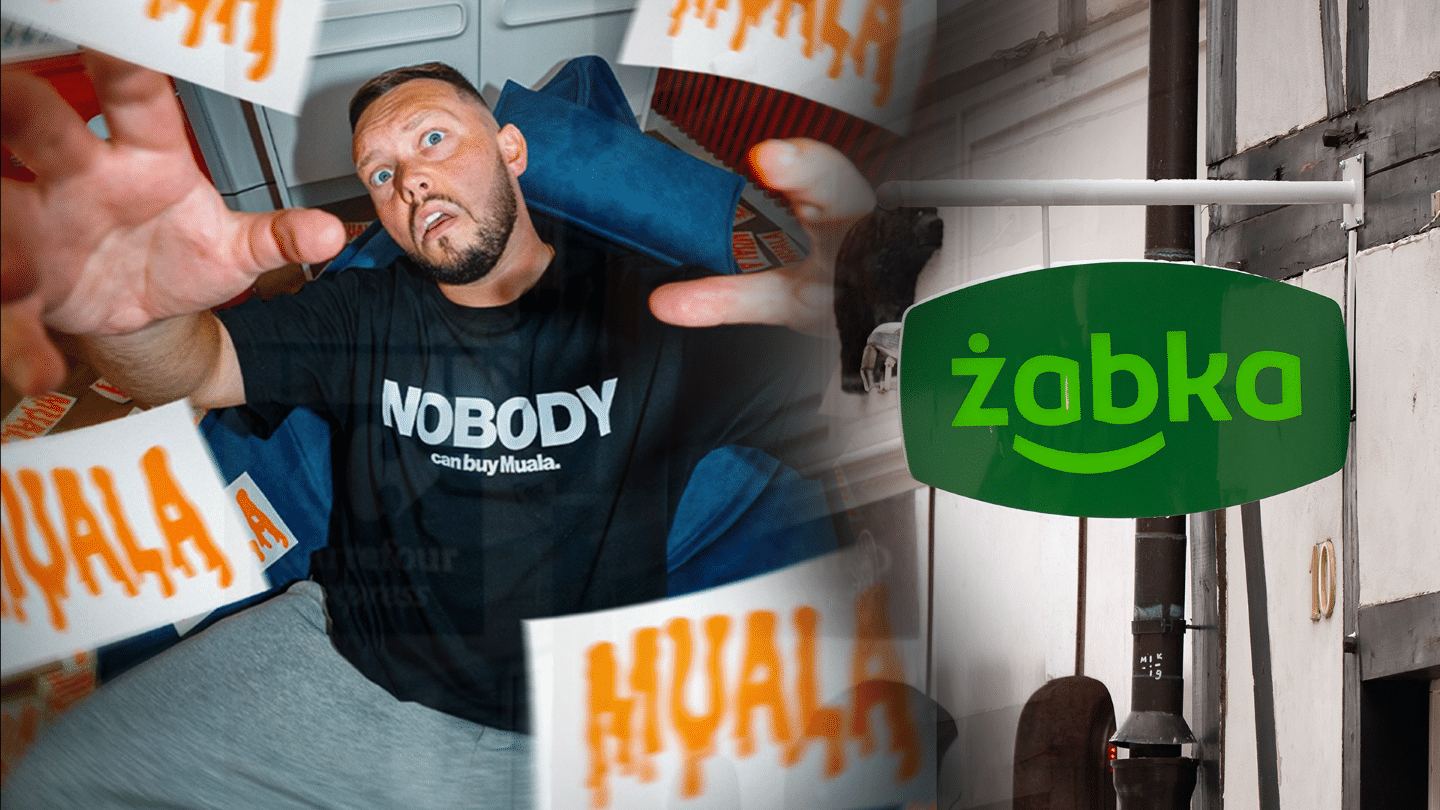
One positive review from Szymon “Książulo” Nyczke can bring crowds of customers to a restaurant. Now the Polish food influencer is building his MUALA brand, expanding from clothing into pizza sold at Żabka convenience stores. His videos attract millions of views, giving him enormous commercial potential. But turning that popularity into a sustainable business will depend on repeat customers and maintaining his credibility as a food reviewer.
Książulo began making videos as a teenager under the pseudonym KolorowyVlog. He later disappeared from YouTube, ran a small shop and eventually returned to the internet, first with short clips and then with longer food reviews. The formula remains simple: visit a restaurant, order food, show the price, taste it and decide whether it is worth the money.
We analyzed 953 videos published since the beginning of 2022, comprising 509 long-form videos and 444 Shorts. As of October 7, 2026, they had accumulated a combined 1.384 billion views: 876.1 million for long-form videos and 508 million for Shorts. Longer videos accounted for 53.4% of uploads but generated 63.3% of views. These figures represent total plays, however, not the number of unique viewers.
Half of his long-form videos attracted at least 1.61 million views. As many as 444 of the 509 uploads, or 87.2%, passed the one-million mark. Another 146 exceeded two million views, while 27 surpassed three million. The ten most popular videos accounted for just 3.8% of all views in the dataset. For Książulo, million-view videos are therefore the norm, although older uploads have naturally had more time to accumulate views.
Videos published between October 2025 and September 2026 had generated 400.2 million views by the measurement date, including 220.3 million for long-form content and 179.9 million for Shorts. Uploads from the preceding 12 months accumulated almost exactly the same number, at 399.4 million. What changed was the distribution: the share generated by Shorts increased from 37.6% to 44.9%.
In the table below, we divide each group’s total views by 12. This does not, however, represent the channel’s average monthly viewership during the corresponding period. A video published in 2023 could still attract views in 2026, while older content has had more time to accumulate them. These figures therefore cannot establish the channel’s audience growth rate or its creator’s average monthly earnings. That would require YouTube Analytics data showing actual monthly views and revenue.
 Interactive chart
 How much does the channel earn, and what do brands pay for?
Książulo can earn money both from advertisements served by YouTube and from partnerships with brands promoted in his videos. In the first case, YouTube sells advertising and shares the proceeds with the creator. In the second, the fee is determined by an agreement with the advertiser.
For long-form videos, creators receive 55% of net advertising revenue generated on the watch page, with payments processed through AdSense for YouTube. There is no fixed payment per view. Revenue depends on factors such as viewers’ countries, seasonality and whether an advertisement was actually displayed. Shorts operate differently: advertising revenue from ads shown between videos is pooled, with music licensing costs also covered from that pool. Creators receive 45% of the amount allocated to them.
For our simulation, we assumed net creator revenue of PLN 8.50 per 1,000 long-form views and PLN 0.50 per 1,000 Shorts views, after YouTube’s share. This produces estimated revenue of approximately PLN 7.70m from the videos analyzed: PLN 7.45m from long-form content and PLN 254,000 from Shorts. Videos published between October 2025 and September 2026 would account for around PLN 1.96m of that total.
These are not Książulo’s confirmed earnings. The assumed rates are not drawn from his account or an established market average. The view counts accumulated over several years, rather than within a single year, and we do not know when the channel began monetizing its content. Furthermore, publicly visible Shorts views are not equivalent to the number of plays eligible for revenue sharing. The estimates also exclude operating costs and taxes. What the model does demonstrate is the economic importance of longer videos: they generate almost 97% of calculated advertising revenue despite accounting for 63.3% of views.
Short-form content can nevertheless support the channel in other ways. Shorts can spread rapidly and reach people who have never watched Książulo before, effectively advertising the channel and encouraging viewers to explore longer videos. Available data, however, do not show how many viewers actually move between the two formats.
Brand partnerships provide another revenue stream. In June 2025, Książulo became an ambassador for Pepsi’s “Enjoy Summer Your Way” campaign. According to Wirtualne Media, the campaign covered television, digital advertising, outdoor media and events, with the creator visiting locations suggested by his fans. In March 2026, trade publication Press reported on another phase of the partnership, featuring the track “Kebs i… (muszę popić to)” (“Kebab and… I Need Something to Wash It Down”), produced with Pedro. Pepsi was therefore using Książulo’s popularity far beyond simply placing drinks in his videos.
Other partners included ZEN.COM and Polish cosmetics brand tołpa. In October 2025, ZEN.COM announced a partnership involving episodes filmed in Poland and abroad, demonstrating payments made while shopping and traveling. The campaign also offered 10% cashback at 23 food establishments. Tołpa, meanwhile, promoted its White On toothpastes through Książulo, along with a competition offering the chance to meet him and a discount code. The campaign website linked to an episode on his channel.
Książulo’s ability to influence purchasing decisions is evident in individual restaurants and food outlets. In November 2023, he and Maciej “Wojek” Wojas visited a small shop selling cream-filled pastry tubes at 50a Wolska Street in Warsaw. Following a positive review, queues formed outside the premises. More than six months later, the owner told Przegląd Sportowy Onet that the initial crowds had subsided but customer traffic remained strong. Interest therefore lasted well beyond the first few days after the video appeared.
A sudden influx of customers can also create problems. After Książulo featured the cafeteria at Warsaw’s Żoliborz district office in October 2024, its owner complained to Raport Warszawski about the overwhelming workload. In March 2025, the outlet reported that she had terminated her lease. That decision cannot be attributed solely to Książulo’s video. The case nevertheless illustrates that attracting customers does not automatically mean a business can cope with a dramatic increase in demand.
Interactive chart MUALA: from catchphrase to brand
For Książulo, “MUALA” originally meant exceptionally good food. The word later appeared on stickers he left at recommended restaurants, becoming a symbol of his approval. Building a brand around a memorable catchphrase is an established way to stick in consumers’ minds. In this case, however, it may all have begun with a spontaneous reaction to food, whose commercial potential was recognized only later.
MUALA also has legal protection. It is not a patent but a registered EU figurative trademark containing the word MUALA, owned by Szymon Nyczke (EUTM 018964785). The application was filed on December 18, 2023, and registration followed on May 6, 2024. The protection covers clothing and food service activities, including takeout, but does not automatically extend to pizza as a product. Książulo therefore secured rights to the brand before launching his clothing line.
The MUALA online store opened in June 2024, initially selling hoodies and T-shirts. The first batch reportedly sold out in around 20 minutes, after which preorders were introduced. By summer 2026, eight collections had appeared, mostly clothing. A pair of MUALA socks costs PLN 29, a MINIMUALA T-shirt PLN 125 and a BOX hoodie PLN 309. Product descriptions emphasize manufacturing in Poland and the use of 100% cotton. All three items are listed as sold out. Without knowing the size of the production runs, however, it is impossible to assess actual sales volumes.
Limited production runs also have a psychological effect. Customers who know that a previous collection sold out quickly have an incentive to follow announcements and avoid delaying purchases. Waiting may mean missing out on a preferred size or design. Each launch brings fans back to the brand, while scarcity can make the clothing more desirable. When Książulo gives items away to viewers, the gift carries additional value because the same product may not be available to buy whenever someone wants it.
For the business, smaller production runs mean less capital tied up in unsold clothing and a lower risk of markdowns or prolonged inventory storage. They do not eliminate warehousing or fulfillment costs, but they can reduce them. There is a trade-off, however. If demand exceeds supply, potential sales are lost. That does not necessarily mean lower profits, since increasing production would also involve additional costs and risks.
His own pizza, without his own factory
MUALA Pizza has entered the market in two varieties, Fat Peppa and Fat Cheese, both priced at PLN 24.99. According to Książulo, product development took more than a year. The team tested the dough, toppings, ingredient proportions, packaging and oven settings. The pizza is manufactured at a factory in Slovakia. Książulo says the facility was chosen because its technology could deliver the desired dough texture, despite the additional cost of transporting the product to Poland.
Książulo did not need to build a factory or open a chain of pizzerias. His contribution is the brand and the ability to reach millions of potential customers. The factory handles manufacturing, a business partner organizes product development and its launch, while Żabka provides distribution and prepares the pizza in its stores. This model allows the venture to use other companies’ infrastructure and limit its own capital expenditure. It also creates dependence on partners’ costs, reliability and quality standards.
Production must also be financed before sales revenue starts coming in. Ingredients, packaging, transportation and inventory all require working capital, while factories generally accept orders for specified production batches. We do not know MUALA’s minimum order quantities, who finances inventory or how the partners divide responsibility for unsold products. Without this information, it is impossible to establish how much capital the business requires or which party bears the greatest financial risk.
According to Książulo, the team calculated ingredient, manufacturing and logistics costs, as well as retail margins, and also looked for opportunities to lower the final price by reducing his own earnings. The PLN 24.99 paid by the customer therefore does not go entirely to the creator. It must cover taxes, manufacturing and distribution costs, and payments to the companies involved in selling the pizza. How much Książulo earns per unit depends on contractual terms that have not been disclosed.
Żabka provides stores, ovens and customer data
At PLN 24.99, the question is what customers receive for their money. A hot MUALA pizza purchased at Żabka can replace one ordered from a pizzeria. It is ready to eat within minutes, without customers having to bake it themselves or wait for delivery. Although the pizza arrives at the store frozen, the purchasing experience and convenience differ considerably from buying a frozen pizza at a discount supermarket. Customers are also paying for preparation and immediate availability. Comparing supermarket freezer prices alone therefore misses important differences between the products.
Żabka is what enables MUALA to compete for this type of purchase. In September 2026, the Polish convenience store chain opened its 13,000th location, having already equipped all its stores with food-service ovens. Książulo is therefore using an established infrastructure that can make his pizza an alternative to ordering from a pizzeria or buying a kebab or burger. Taste and price are not the only considerations: distance to the nearest store and waiting time also matter.
The size of Żabka’s network does not eliminate operational constraints at individual locations. The ovens are used for various products, while employees must serve other customers at the same time. Waiting times may increase when several orders arrive together. Książulo has also shown that selecting the correct oven program was an important part of developing the pizza, as incorrect settings affected the finished product. Żabka can distribute demand across thousands of outlets, but the quality of preparation and service ultimately depends on each individual store.
The chain also has access to data that YouTube statistics cannot provide. It can analyze sales by location, time of day and pizza variety, assess how customers respond to promotions and identify which products are bought together. Transactions linked to the Żappka loyalty app can also reveal whether customers return for another pizza.
According to Książulo, the partnership includes at least one year of exclusivity. This provides extensive distribution from the outset but limits opportunities to test sales through other retail chains. MUALA therefore benefits from thousands of stores, ovens and an established logistics network while depending on a partner that handles the final stage of preparation, processes transactions and collects customer data.
Interactive chart Behind the scenes: a businessman who knows how to monetize celebrity
The business operation behind MUALA involves Quality Prime, a company linked to Marcin Szczutkowski. This is not his first venture turning a well-known personality’s popularity into a mass-market consumer product. He previously helped develop Vabun perfumes associated with Radosław Majdan and TurboGrosik Energy Drink featuring Polish footballer Kamil Grosicki, which entered Żabka stores in 2018. Szczutkowski therefore understands both the mechanics of building celebrity brands and the process of bringing products into major retail chains.
Another major project was his collaboration with influencer Budda. Szczutkowski was behind the DOZE drinks brand and later became one of the producers of the film Budda. Dzieciak ’98. The subsequent legal troubles of Kamil Labudda, known as Budda, did not directly concern this venture but involved, among other matters, online lotteries, VAT settlements and financial flows. Quality Prime continues to feature DOZE in its portfolio as an example of a brand developed with an influencer.
Szczutkowski’s main business venture today is Quality Prime. Corporate records identify him as the company’s ultimate beneficial owner, while its sole shareholder is Estonia-based Qualitative Investments OÜ. Quality Prime handles the entire process of developing fast-moving consumer goods (FMCG), from initial concepts, brand strategy and product formulation to contract manufacturing, logistics, retail distribution and marketing.
Its portfolio includes Bungee Tea, Bandita pizza associated with Patryk Bandurski, Smashy Twins Style croissants, Corny Baby ice cream associated with Young Leosia and Kacper Błoński, Bambi’s Banger! drinks and Bambiszonki snacks. These products have been distributed through retailers including Żabka and Dino. The company therefore operates across several categories, from drinks and snacks to ice cream and pizza.
The business model follows a similar pattern in each case. Influencers contribute their recognition, audiences and the potential for demand from the moment a product launches. Quality Prime handles product development, relationships with manufacturers, logistics, packaging design and negotiations with retail chains. Książulo therefore does not need to establish a food company from scratch.
Making money without losing credibility
Publicity may persuade customers to try MUALA pizza, but repeat purchases will determine whether demand lasts. In 2025, Żabka sold more than 16.5 million pizzas, averaging over 45,000 a day. If MUALA captured 10% of that volume, it would mean sales of 1.65 million pizzas and approximately PLN 41.2m in consumer spending at PLN 24.99 per pizza.
As of October 7, 2026, Książulo’s video titled “Czy sprzedałem się Żabce?” (“Have I Sold Out to Żabka?”) had attracted 36,537 comments, more than any other video in the analyzed dataset. That was almost 15 times the median number of comments on the 92 long-form videos published in 2026, and more than the combined 33,626 comments generated by his previous 20 uploads, including Shorts. The scale of the reaction, however, does not tell us how many viewers will actually turn away from Książulo or stop watching his channel.
In July 2026, Książulo addressed a paid partnership with Popeyes dating back to 2023. He acknowledged producing a promotional video before deciding that advertising restaurants was incompatible with the direction he wanted his channel to take. In the case of MUALA pizza, he emphasizes that he is selling his own product through Żabka. From a business perspective, this is an important distinction, although some viewers may still see him as a food reviewer earning money from promoting food.
In April 2026, he rated pizza from Żabka more highly than pizza served at a restaurant in Wrocław. We do not know when the MUALA partnership was agreed, so that earlier review cannot be characterized as advertising. Nevertheless, the creator’s commercial relationships matter when assessing his independence, particularly when he reviews products sold by partners or their competitors. Given that work on the pizza lasted more than a year, it is reasonable to ask when Żabka was selected as the distribution partner.
Żabka’s own reputation adds another dimension. In a report published by Kanał Zero, franchisees described problems involving debt, excessive workloads and disputes with the chain. A Żabka representative defended the profitability of its franchise model and said that most franchisees had no outstanding debts to the company.
The coming months will offer a clearer picture of the controversy’s actual consequences through viewing figures, sponsor interest and repeat pizza purchases. Comparisons of video performance should, however, use identical periods after publication, and any decline in views should not automatically be attributed to the Żabka partnership. With a median of 1.61 million views, even a hypothetical 10–20% decline would leave Książulo with a substantial audience and significant earning potential. Revenue also depends on advertising rates and contractual terms, meaning it would not necessarily fall in proportion to viewership.


Key Takeaways
- Książulo’s audience generates substantial commercial potential, but his actual earnings remain unknown. The 953 videos analyzed accumulated a combined 1.384 billion views. Under our assumed advertising rates, they would have generated approximately PLN 7.70m, with nearly 97% attributable to long-form videos. This is a simulation, not a verified estimate of the creator’s earnings. It excludes brand partnerships and product sales.
- MUALA uses an asset-light business model built around external partners. The brand relies on a third-party factory, a business development partner and Żabka’s retail infrastructure. This reduces its own investment requirements but creates dependence on other companies. With pizza prepared in-store, customers receive a ready-to-eat meal for PLN 24.99, positioning MUALA as a potential alternative to traditional pizzeria orders.
- Repeat purchases and credibility will determine the business’s long-term prospects. A rapid sellout of the initial product batch may demonstrate interest, but sustained demand requires loyal customers. At the same time, Książulo must preserve the credibility that helped him build both his audience and his business.