

This article is a part of Poland Unpacked. Weekly intelligence for decision-makers
Poland's capital market is full of paradoxes. The benchmark WIG index keeps setting records, rising by 34% this year after a 47% surge in 2025, while the number of brokerage accounts has exceeded 3 million. Yet the stock market's capitalization remains a modest 31% of GDP, fewer than 450,000 retail investors are active, and large privately owned companies rarely choose to go public.
We speak with Tomasz Bardziłowski, CEO of the Warsaw Stock Exchange (GPW), about how to overcome these challenges, the potential impact of Poland's new Personal Investment Accounts (OKI), Europe's shortage of long-term capital, and the obstacles preventing businesses from listing their shares. We also discuss lessons from the ZondaCrypto scandal.
Grzegorz Nawacki, XYZ: We're speaking an hour after you replaced the stock exchange's bell. I'm wondering why, since the old one can hardly have worn out – there have been relatively few IPOs in recent years.
Tomasz Bardziłowski, CEO of the Warsaw Stock Exchange: The new bell made its debut as part of the Warsaw Stock Exchange's 35th anniversary celebrations. We decided the anniversary, coinciding with record highs for the WIG index, was a good occasion.
The previous bell served us for more than ten years and welcomed over 100 companies to the exchange. And it's not retiring – we've donated it to the Warsaw School of Economics.
We hope the new bell will announce the next hundred IPOs much sooner.
Who's who
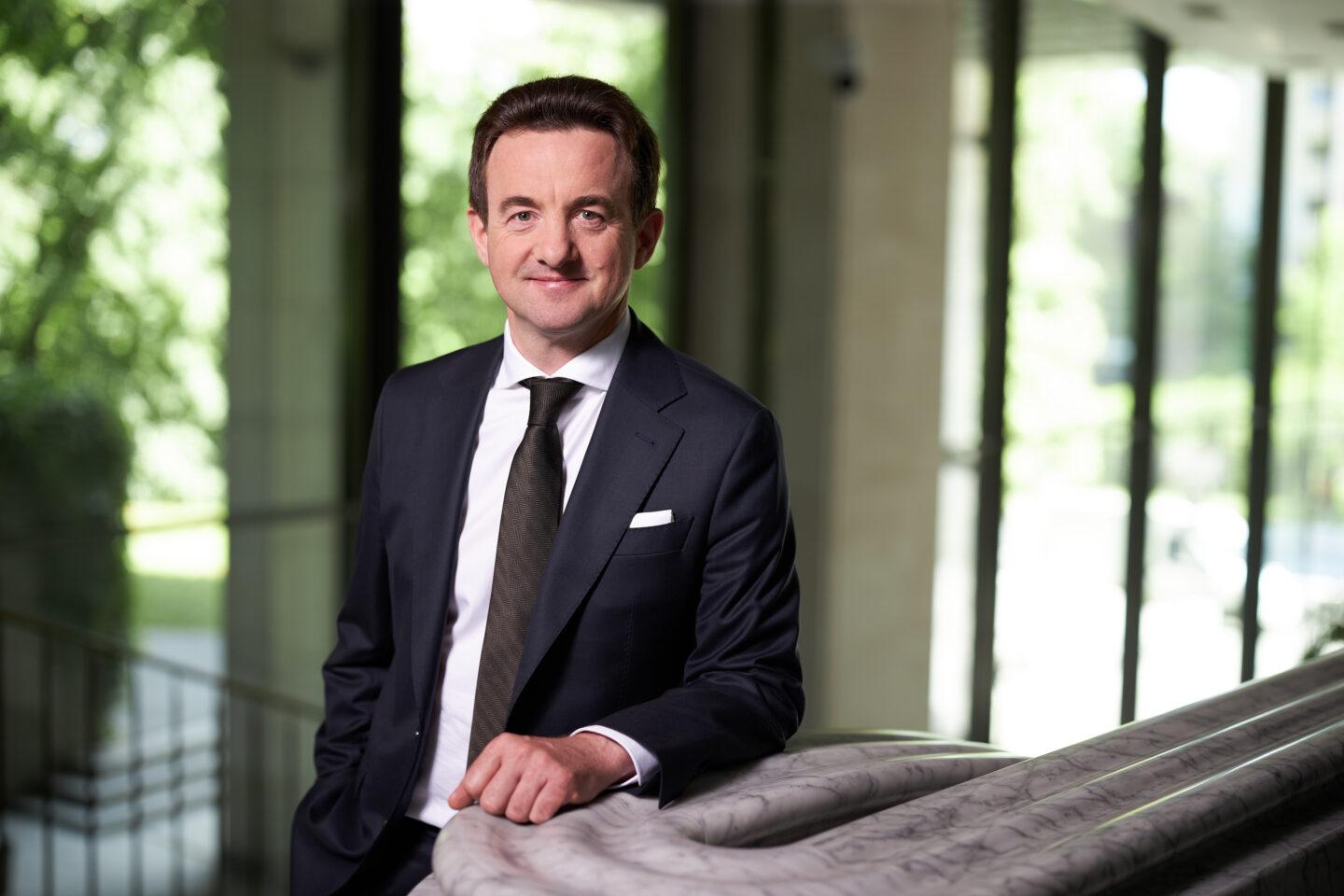
Tomasz Bardziłowski
Tomasz Bardziłowski has served as CEO of the Warsaw Stock Exchange (GPW) since March 2024.
He has nearly 30 years of experience in capital markets and has held senior positions at Credit Suisse, UniCredit, and IPOPEMA Securities.
He has repeatedly been recognized as one of Poland's leading equity analysts. A graduate of the Warsaw School of Economics (SGH), he also holds the Chartered Financial Analyst (CFA) designation.
Looking at the statistics, this year appears to mark a turning point, with more companies going public than in previous years.
We've already had ten debuts on the Main Market. Importantly, for the first time in a decade, more companies have joined the exchange than have left it.
We're also very pleased that the free float has increased to 53%, compared with less than 50% four years ago.
Secondary offerings are becoming more common as well. Since the beginning of the year, there have been 35 transactions involving capital raising and share sales, totaling almost PLN 20 billion. That's as much as in all of 2025.
The Warsaw Stock Exchange was once a symbol of Poland's successful economic transformation. Today, we want it to become a symbol of an innovative economy.
We're already seeing this shift. Companies in sectors such as space technology, biotechnology, and quantum computing have been particularly active in raising capital this year.
Ten IPOs in a year is hardly an overwhelming number. Why are Polish companies reluctant to go public?
Contrary to popular belief, the problem isn't a shortage of companies. It's a shortage of institutional capital willing to invest in smaller businesses.
During our visits to cities across Poland, we met dozens of companies interested in listing, but most were looking to raise between PLN 20 million and PLN 100 million.
The investment fund ecosystem has become increasingly consolidated, leaving relatively few smaller funds investing in smaller companies.
It's easier to execute one PLN 1 billion transaction than a dozen smaller deals worth PLN 50 million each.
This is a structural problem across Europe.
GPW isn't responsible for the lack of a single European capital market. But are you doing anything yourselves to encourage more companies to list in Warsaw?
We're promoting the Warsaw Stock Exchange in every way we can.
Whenever I meet entrepreneurs, I encourage them to consider raising capital through the stock market.
Among other initiatives, we're expanding the GPW IPO Academy program. Its third edition is already underway, and the first two produced more than 60 graduates.
The first company from the program has already gone public, and others are announcing plans to do so.
Perhaps the stock exchange is simply losing out to private equity and venture capital funds, which have developed considerably in Poland. They offer capital without all the regulatory obligations associated with being listed.
Polish private equity funds face the same problem as the stock exchange: insufficient domestic capital.
The difference is that private equity funds offer management support alongside financing, but in return they typically expect a majority stake and control of the business.
The stock exchange allows companies to raise growth capital or sell a stake while enabling founders to retain control.
We see investment funds as partners.
Most IPOs over the past decade have involved private equity-backed companies. Now we're looking forward to more listings from venture capital funds.
We're developing NewConnect, our alternative market, as a bridge between the VC ecosystem and the Main Market.
We've introduced a fast-track listing procedure on NewConnect for companies with venture capital investors among their shareholders.
The ecosystem created by PFR Ventures includes hundreds of businesses whose VC investors are now approaching the end of their investment cycles.
We want those companies to look to us for their next stage of development.
That's a significant change. Just a few years ago, it was reasonable to ask why we needed NewConnect at all.
I don't want to sound entirely negative. The WIG index keeps breaking records – it's up more than 36% this year after a 47% surge last year. At the beginning of 2026, many argued that the rally had run out of steam, yet Warsaw has been one of the strongest-performing markets this year. Are we finally seeing the genuine structural strength of Poland's capital market, or are rising indices simply masking deeper problems?
I speak regularly with international investors, and they often tell me that Poland has a strong, highly liquid market, interesting companies, and excellent infrastructure.
We've already closed the double-digit valuation gap that separated us from other emerging markets.
However, Polish stocks still trade at a discount of almost 30% compared with developed markets.
So can we be confident that the bull market will continue?
Earnings-based valuation multiples may be close to their historical averages, but corporate profits are at record highs, while price-to-book ratios are reaching their peaks.
For the rally to continue, companies will need to maintain or even increase their return on equity (ROE).
That could be difficult, because ROE is already very high for most large companies.
For the stock exchange to sustain its growth, it needs new investors and new listed companies.
For now, some companies are disappearing from the exchange. Żabka, for example, was delisted following its acquisition by a Canadian investor.
Buyouts and delistings are a natural part of the market cycle.
When a company moves from the growth stage to maturity, certain processes can sometimes be carried out more easily in private markets.
I also see this as an important function of capital markets.
Such transactions allow minority shareholders to realize gains and receive a takeover premium. They can then reinvest the proceeds in the market.
Some argue that the regulatory burden of being a publicly traded company is so great that listing simply isn't worthwhile. One entrepreneur told me he had to establish a team of several employees dedicated exclusively to reporting.
Yes, across Europe we're seeing growing reflection on the costs of regulation, compliance, and ESG requirements.
Today, ESG reporting is no longer mandatory for smaller companies, which the market has welcomed with relief.
Large investors still expect such disclosures, but for smaller issuers the costs were enormous.
Did you know there was a huge crash at GPW headquarters a week before the new bell was unveiled?
Hmm, no...
That was the sound of a huge weight being lifted off the CEO's shoulders when the new trading system worked. What does this achievement mean for the market in practical terms?
We certainly breathed a sigh of relief after the successful launch of GPW WATS on October 5.
That sense of relief came gradually over the first four days, when the old UTP system remained fully operational as a fallback.
On October 9, we finally retired it.
UTP no longer met today's requirements. Its supplier, NYSE Euronext, had itself replaced the technology with a newer solution five years earlier.
Above all, GPW WATS gives us a completely new level of performance.
Its processing capacity is currently five times greater than that of the previous system, and we can increase it up to twentyfold without significant additional investment.
We experienced the limitations of the old system after President Trump's tariff announcements in April last year, when an enormous surge in orders forced us to suspend trading for an hour.
With GPW WATS, that particular risk no longer exists.
We now have a much more efficient trading system and are ready to accommodate new investors.
On the very first day, we connected our first new exchange member – the broker Patria, which had been waiting specifically for the new system.
Does that mean you expect trading volumes on GPW to increase?
Yes. I'm convinced the new system will encourage more brokers to join the exchange.
More brokers mean more investors, which should translate into higher trading volumes.
Critics argued that GPW spent PLN 173 million developing its own trading system instead of buying an established licensed solution from an international supplier. The project was also delayed. Your predecessor made the decision to build it. Would you have made the same choice?
I inherited the project in 2024, and over the following 24 months, our team brought it to a successful conclusion, resolving more than 7,000 reported issues and errors along the way.
There are several compelling strategic arguments for having our own system.
First, flexibility in developing new products.
We're already working on introducing mini futures, for example, which are contracts with lower margin requirements.
Second, technological sovereignty and independence from external suppliers.
Third, having our own trading technology puts GPW in a different league internationally.
It opens the door to acquisition discussions and deeper technology-based cooperation with other markets.
So if the decision had been yours, you would still have chosen GPW WATS rather than buying an existing system?
Yes, but I would certainly have approached the project differently.
We completely changed the way it was managed.
When I joined the management board, it was essentially an external project, developed outside GPW's organizational structures by a team in Łódź and foreign contractors.
In that form, it wasn't meeting the objectives it should have.
For example, the focus was on creating the fastest trading system in the world rather than one that met GPW customers' needs.
We changed that radically.
Ultimately, the project was delivered by an internal GPW team led by Sławomir Panasiuk, the vice president responsible for this area.
That represented a major improvement in project management.
Without these changes, including personnel changes, the system might eventually have been completed, but we wouldn't have developed the internal expertise in Warsaw needed to manage it effectively.
I also wouldn't have sought financing from the National Centre for Research and Development (NCBR).
GPW received PLN 24 million in funding for the project.
Regardless of the NCBR's requirements, a company like GPW, with PLN 400 million on its balance sheet, shouldn't be taking innovation funding away from startups.
Three million brokerage accounts, but few active investors
Let's look at the stock exchange from the other side: investors. In theory, the situation looks promising. Poland has more than 3 million brokerage accounts. But your data show that only 444,000 were active in the first half of the year.
Foreign investors currently dominate trading on GPW, accounting for 73% of turnover.
Domestic retail investors generate just 13%.
I often get the impression that international investors have more faith in the growth of Polish companies than Poles themselves do.
Why don't Poles invest in stocks?
Historically, Poles have preferred to keep their money in bank deposits or invest in real estate.
That may have made sense given rising property prices and the tax treatment of different investments.
Rental income was taxed more favorably than capital gains from shares or dividends.
The introduction of Personal Investment Accounts (OKI) will largely eliminate that disparity.
OKI accounts provide a complete exemption from capital gains and dividend taxes on investments of up to PLN 100,000 per person, or PLN 200,000 for a married couple.
But will OKI really stimulate the stock market? If people simply move money they're already investing into these accounts, there won't be much of an additional boost.
Research by Professor Katarzyna Sekścińska of the University of Warsaw, commissioned jointly by GPW and PKO BP, shows that 64% of existing investors intend to use OKI accounts, as do 27% of people who don't currently invest.
Most importantly, as many as 60% of respondents said they would deposit new money rather than simply transfer their existing savings.
We're seeing particularly strong interest among people aged 18–24.
In that age group, 64% consider the solution attractive.
This creates an opportunity for a new generation of investors to enter the market.
You say GPW's main problem isn't a shortage of good companies but a shortage of capital, particularly domestic capital. Polish investment fund managers aren't attracting much money into equity funds either.
That's a painful fact.
Polish investment funds hold just 13% of their assets in domestic equities, the lowest proportion in Europe.
Fixed-income funds dominate, reflecting the way investment products are distributed through banks.
We want to change that, partly through OKI accounts, whose tax incentives have been designed to encourage equity investment.
At the same time, GPW is strongly supporting the development of exchange-traded funds. Doesn't that take business away from traditional investment fund managers?
If we didn't offer ETFs on GPW, Polish investors would simply buy American ETFs through foreign investment apps.
Our goal for this year is to have 50 ETFs listed in Warsaw, and we're already close to achieving it.
In the first half of the year, Poles invested more than PLN 5 billion in ETFs.
Only 17% of that money went through GPW, and just 10% was invested in Polish assets.
Thanks to OKI, I'm convinced the share of investments in ETFs based on Polish assets will increase.
That means more Polish capital will remain in Poland.
Cryptocurrency, regulation, and market access
More than 30,000 people lost money after buying cryptocurrencies through ZondaCrypto. Isn't it a blow to the stock exchange that so many people preferred to invest there?
Interest in cryptocurrencies has many causes.
But it may also be partly the result of overregulation in traditional capital markets and what I call the paradox of MiFID questionnaires.
To buy shares on the stock exchange, investors must complete a complicated assessment and demonstrate that they've already invested in the past.
Otherwise, the system may block them.
As a result, young people have been turning to places where access is immediate and barriers are minimal.
We're discussing ways to make these requirements more flexible with the Polish Financial Supervision Authority (KNF).
Some are calling for cryptocurrency exchanges to be banned. But perhaps GPW should launch one of its own instead?
We don't plan to establish a cryptocurrency exchange in the traditional sense.
Instead, we offer investors access to this market through regulated instruments, including a bitcoin ETF and digital assets.
This approach eliminates the risks associated with platform insolvency or hacking attacks, leaving investors exposed to investment risk.
Rather than operating a conventional cryptocurrency exchange, our new strategy will focus on developing blockchain technology and asset tokenization in cooperation with Poland's Central Securities Depository (KDPW).
A more integrated European capital market
Speaking of the financial regulator, there have been growing calls to create a single European capital market. EU finance ministers have reached some initial agreements, prompting alarmist comments from the political right that Poland is losing oversight of GPW. Is that happening?
Nothing of the sort is happening.
In October, the Council of the European Union adopted measures that allow greater integration of European capital markets under the Savings and Investments Union while preserving national supervisory powers where justified by the size and characteristics of local markets.
We believe this is the right direction.
Europe needs a stronger capital market, but its strength should be built primarily on well-developed national markets.
As far as Poland's supervisory arrangements are concerned, nothing changes.
Stock exchanges operating in several EU member states may voluntarily opt for pan-European supervision.
But GPW is, and will remain, under the exclusive supervision of the Polish Financial Supervision Authority.
GPW's market capitalization amounts to around 31% of GDP. In a recent XYZ analysis, we noted that this is a record level for Warsaw, but still far below Germany's 50%, France's 100%, and Sweden's nearly 200%. Why is Poland catching up with Western Europe so slowly?
I was very pleased to read that analysis.
We present similar figures to investors.
The gap between Poland and Western European markets demonstrates just how much growth potential our capital market still has.
Over the past two decades, Poland's economic growth was driven by exports and relatively cheap labor.
Polish wages are no longer low. Relative to productivity, they're now around the European average.
If wages are to continue rising, we need to increase productivity.
That requires greater investment and more innovation, and both depend on a strong capital market.
As Mario Draghi rightly pointed out in his report, the main problem across Europe is a dramatic shortage of long-term capital.
European pension funds manage approximately USD 5 trillion, compared with USD 50 trillion in the United States.
What is your target for GPW?
Our ambition is to increase the ratio of stock market capitalization to GDP from around 30% today to 50% by 2030.
To achieve that, the market needs approximately PLN 250 billion in new domestic capital, or PLN 50 billion annually.
According to Ministry of Finance estimates, the OKI program alone should provide around PLN 5 billion a year, accounting for 10% of that requirement.
The remaining gap must be filled by institutional investors, particularly Employee Capital Plans (PPK) and domestic investment funds (TFI).
Without increasing their investment in Polish equities, accelerating the development of the market simply won't be possible.
Sweden remains our benchmark.
Its stock market capitalization reaches around 170% of GDP, partly thanks to its strong pension system.
Connecting Central Europe's stock exchanges
A few years ago, there was an idea for the Warsaw Stock Exchange to acquire the Vienna Stock Exchange. Your predecessor instead bought the Armenian Stock Exchange. Do you see potential for further consolidation?
We're not thinking about consolidation through ownership. We're focusing on connecting markets operationally.
We've signed a memorandum of cooperation with seven exchanges across Central and Eastern Europe.
We're working on integrating clearinghouses and central securities depositories so that a Polish investor can easily buy shares in Zagreb or Bucharest, while Croatian and Romanian investors can just as easily invest in Polish companies.
That's much easier and offers greater potential than acquiring other stock exchanges.
Almost two years have passed since the memorandum was signed. When will we see results?
We expect the first tangible results at the beginning of next year.
We're working on a joint regional ETF covering companies from Central and Eastern Europe and will be looking for a partner to develop the product.
Foreign providers are also launching ETFs based on our indices on the exchanges in Zagreb, Ljubljana, and Bucharest.
We want more such ETFs to debut on Europe's major exchanges next year.
Starting next year, Poland will be classified as a developed market by S&P. Is that necessarily good news? Won't it mean losing the attention of investors who focus on emerging markets?
We've met S&P's criteria, and our market maturity and economic performance have been recognized.
Of course, that's welcome, but I don't expect a particularly significant effect.
The impact would be much greater if MSCI decided to reclassify Poland as a developed market.
We want to be ready for that within three to five years.
At our current market capitalization, inclusion in MSCI Developed would reduce the number of Polish companies in the main index from 16 to just eight.
That's why our priority is to build a larger base of big, liquid companies first, ensuring that an upgrade doesn't restrict capital flows to medium-sized issuers.
Does Poland's position among the G20 economies mean anything for GPW?
It matters a great deal, because perceptions and international attention play an important role in investment decisions.
Poland is attracting considerable attention globally, and people are speaking positively about our economy. That helps us enormously.
At meetings with investors, conversations often begin with congratulations on Poland's economic achievements – for being one of the fastest-growing economies and the sixth-largest economy in the European Union.
Financing Poland's next economic transformation
Poland faces enormous economic projects: the energy transition, defense investment, and the development of innovation and AI. Where can GPW play a role?
In all of them.
In energy, our Catalyst debt securities market and green bonds will play a crucial role.
We're introducing a market-maker requirement for bonds to improve liquidity.
Corporate bonds could also become more popular thanks to OKI accounts.
In defense and space technologies, we expect further IPOs from dual-use companies.
And in deep tech, we already have Europe's first publicly listed quantum computing companies, alongside a dynamic biotechnology sector.
For most of your professional life, you were an analyst evaluating companies and their management teams. What rating would analyst Tomasz Bardziłowski give CEO Tomasz Bardziłowski?
The market is evaluating me every day. Since my first day at our headquarters on Książęca Street, GPW's share price has risen from PLN 37 to more than PLN 100. We've also paid dividends during that period.
Many new foreign investors have joined our shareholder base. They compare GPW with exchanges around the world, rather than looking solely at its historical valuations.
Analysts have a natural tendency to look backward and evaluate companies through the lens of historical ratios. Sometimes they find it difficult to accept that structural change can justify a higher valuation.
Much of the work we've done at GPW over the past few years is only now beginning to produce more tangible benefits.
We've addressed our technological debt, reorganized matters involving subsidiaries, and successfully delivered the extremely challenging project of implementing a new trading system.
That phase is now largely behind us. We're entering a period of building and development.
We want to focus on growing the capital market and pursuing projects that can genuinely increase GPW's importance.
So, speaking as an analyst, I'd say this: give it a little more time.
I'd like to finish the processes we've started and see their full effects reflected in the development of the market and the value of the Warsaw Stock Exchange.


Key Takeaways
- Poland's biggest capital market problem is a shortage of domestic investment capital, not a lack of companies interested in listing. According to GPW's CEO, the market particularly lacks funds willing to finance smaller businesses seeking PLN 20–100 million. The exchange aims to increase its market capitalization from around 30% of GDP to 50% by 2030. Achieving that target will require approximately PLN 250 billion in new capital, primarily from investment funds, Employee Capital Plans (PPK), and household savings.
- GPW wants to keep more Polish savings invested domestically while strengthening ties between Central and Eastern European stock exchanges. Personal Investment Accounts (OKI), a broader range of ETFs, and easier access to shares listed across the region are central to this strategy. One of the first concrete results of cooperation among seven regional exchanges is expected to be a joint ETF covering Central and Eastern European companies, which GPW is already working to develop.
- The launch of GPW WATS marks the beginning of a new development phase for the Warsaw Stock Exchange. The new trading system offers five times the processing capacity of its predecessor, with substantial room for further expansion. It should make it easier to connect new brokers and introduce products such as mini futures. Owning its technology is also expected to strengthen GPW's independence, support cooperation with other exchanges, and help Warsaw compete in a higher tier of European capital markets.