

This article is a part of Poland Unpacked. Weekly intelligence for decision-makers
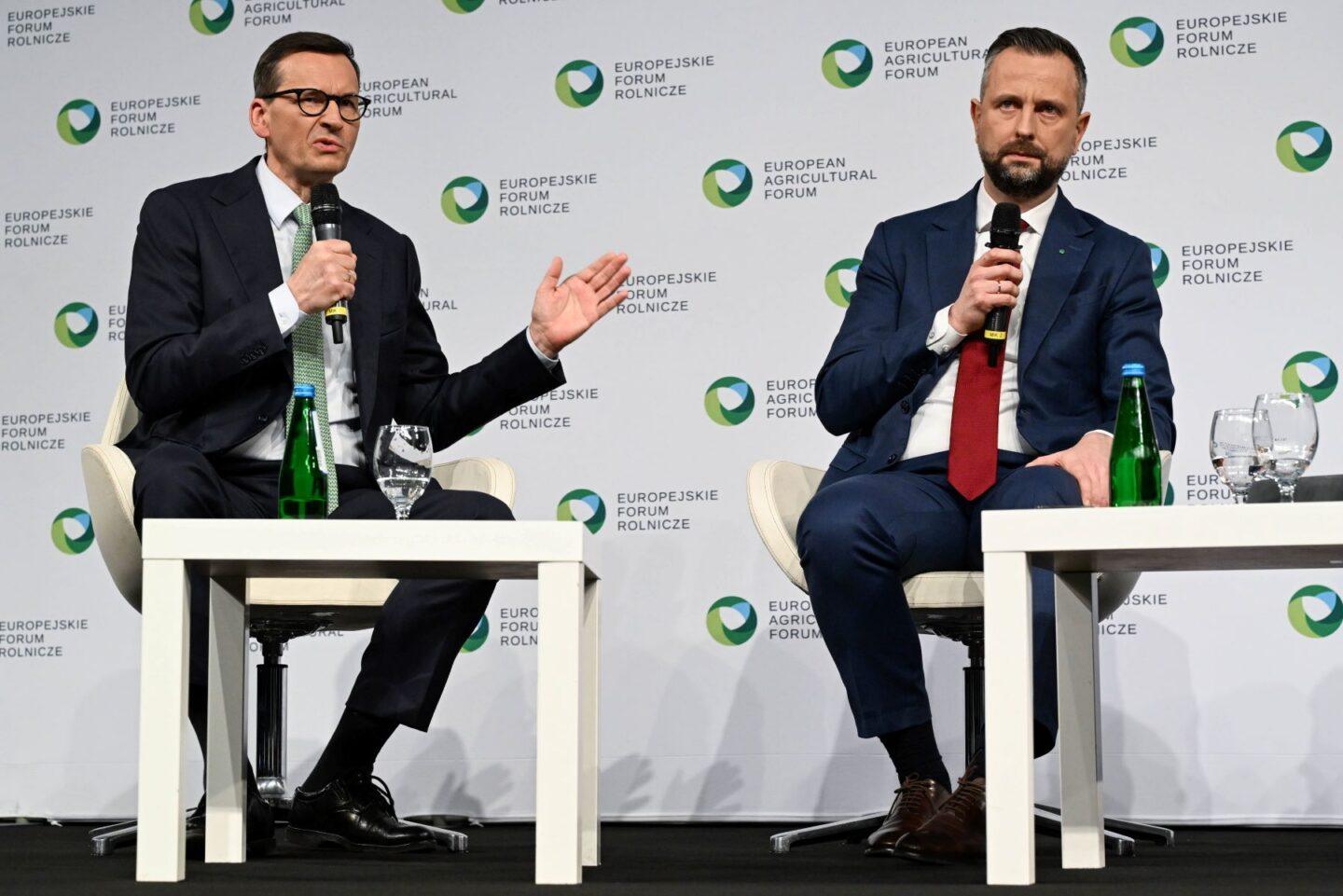
April Fools’ Day – entirely in earnest – brought an unexpected debate between Mateusz Morawiecki and Władysław Kosiniak-Kamysz. The exchange was serious, if relatively calm. The two clashed over defense procurement and the European Union. More important, however, is the backdrop: the debate served clear political objectives for both sides.
At the start of the week, there was no indication that senior figures from government and opposition would face off. Yet on Tuesday, March 31, news broke that former prime minister Mateusz Morawiecki would debate Deputy Prime Minister and defense minister Władysław Kosiniak-Kamysz. The occasion was the European Agricultural Forum in Jasionka near Rzeszów. According to Gazeta Wyborcza daily, the idea had been in the works for some time but kept from public view.
Morawiecki’s penchant for debating opponents
For the former prime minister, debating across the aisle is nothing new. Last September, he faced Adrian Zandberg, leader of the left-wing Razem party.
Soon after, in October, Morawiecki took part in a one-on-one discussion with Katarzyna Pełczyńska-Nałęcz, then minister of funds and regional policy and now head of Poland 2050. Those debates – in Dąbrowa Górnicza and Krynica-Zdrój – were widely covered in our pages.
Kosiniak-Kamysz returns to debates
As defense minister and leader of the Polish People’s Party (PSL), Kosiniak-Kamysz appears less often in debates with political opponents. An exception came in August, when he met Sławomir Mentzen, leader of New Hope. Mentzen had been hosting “Beer with Mentzen” events, inviting rivals as well. At a meeting in Kraków, the PSL leader revealed he had been offered the premiership in 2023 in a proposed PiS–PSL coalition.
Few expected political bombshells in Podkarpacie. Yet the broader political context is revealing. Jarosław Kaczyński, while calling for party unity, has made clear that Morawiecki will no longer play first fiddle in the PiS camp.
A strong Kosiniak, a weak PSL – and Morawiecki’s remote duel with Czarnek
Przemysław Czarnek has been anointed as the party’s candidate for prime minister, representing a sharper rightward turn. Morawiecki has not left PiS, but is pushing his own agenda focused largely on economic development. He avoids open criticism of party leadership – though there is little sign of warmth.
As reported by XYZ, Morawiecki is also running his own series of voter meetings, independent of tours by Czarnek or Kaczyński. He is effectively pursuing a parallel political and communications strategy.
At first glance, PSL’s situation seems less dynamic. Kosiniak-Kamysz’s leadership is secure, as shown by his recent re-election as party head. Yet PSL itself hovers around the electoral threshold. A solo run in 2027—despite strong local structures—would carry significant risk. From a political standpoint, reinforcing his position within the governing coalition is therefore key, including through debates with opponents.
Morawiecki grows skeptical of the US
The exchange offers several noteworthy takeaways, particularly in the context of the 2027 elections.
On Wednesday morning, The Guardian published an interview with US President Donald Trump in which he expressed serious doubts about continued US participation in NATO. The debate moderator, Piotr Witwicki of Interia, opened with this issue—and Morawiecki’s response was striking. He placed the US alliance only third among Poland’s security pillars, behind the Polish military and regional forces.
“If anyone still believes that Article 5 of the Washington Treaty truly works like a musketeer principle… I would prefer to take you out of that comfort zone. There is no such automatism,” Morawiecki said.
This is surprising. PiS—including Morawiecki—has consistently prioritized ties with the United States, particularly under Trump.
At the same time, both participants agreed on Poland’s key alliance directions.
Cross-party consensus on regional alliances
“Sweden, Finland, the Baltic states in the north, and Turkey and Romania in the south… This is a shared strategy of the Polish state, regardless of political background,” said Kosiniak-Kamysz.
Defense investment, however, proved divisive. The current defense minister criticized his predecessor Mariusz Błaszczak for “blind” procurement—buying equipment without armaments or industrial offsets.
Morawiecki pushed back, arguing that the early phase of the war in Ukraine required rapid purchases, particularly when – he claimed – France and Germany were keen to resume trade with Russia on previous terms.
“Anyone involved in the Ukraine war will tell you this wasn’t yet the drone phase. We had to introduce heavy equipment into the Polish army quickly, supplemented by purchases from the US and Korea. I have no intention of apologizing,” he said.
A ritual dispute over sovereignty
Did Morawiecki’s criticism of the US translate into a softer stance on the EU? Quite the opposite. In his narrative, the EU constrains Polish sovereignty.
“Poles have finally begun to understand that the European Union is no benevolent aunt—that they want to take advantage of us,” he said.
He also took indirect aim at Germany, citing investments in Polish ports (including Gdańsk, Świnoujście and Szczecin) that have boosted revenues from customs duties, VAT and excise.
“We took that money from Rostock, Hamburg, Rotterdam and Amsterdam. That hurts them,” he argued, casting Western partners as competitors.
Morawiecki also criticized conditionality mechanisms tied to EU funds such as the Recovery Plan and SAFE. Kosiniak-Kamysz rejected this line of argument.
“No one will take this money away, because the EU knows it must rearm. As for sovereignty, in my view the real threat comes from the Russian Federation—not our Western alliances,” he countered.
A bone of contention: whose allies are more pro-Russian?
Unsurprisingly, Viktor Orbán’s Hungary became another flashpoint. Kosiniak-Kamysz attacked PiS for its alliance with Budapest, citing its pro-Putin stance and obstruction of support for Ukraine.
Morawiecki countered by pointing to early-war attempts by France’s president and Germany’s chancellor—Donald Tusk’s allies in the European People’s Party—to return quickly to “business as usual” with Vladimir Putin. He distanced himself from Orbán’s pro-Russian views, while offering a partial defense.
“During my time as prime minister, Orbán never blocked any sanctions package,” he said.
That is incorrect. In November 2023—while Morawiecki was still in office—Hungary blocked the 12th sanctions package against Russia, including measures targeting nuclear energy. The package was adopted more than a month later.
Support for PSL’s “SAFE 0%” and Tusk compared to Gomułka
Despite disagreements, the debate remained relatively calm. Both politicians supported scrapping term limits for local government officials. More notably, Morawiecki declared support for PSL’s SAFE 0% proposal.
“I will vote in favor—this is our first point of agreement. I’m glad Prime Minister Kosiniak-Kamysz has begun speaking positively about the president’s proposal,” he said.
The most telling remarks came at the end. While the discussion touched on fuel subsidies for farmers, Morawiecki portrayed PSL as politically dependent on Donald Tusk.
“With you, people voted for PSL and got Tusk instead. A bit like January 1947: ‘The ballot box is a magic box—you put in Mikołajczyk, and Gomułka comes out.’ Why do I say this? Because if you had real agency in this coalition, you would have done at least what I did as agriculture minister—subsidies when prices slump,” he said.
Explainer
Władysław Gomułka
Władysław Gomułka is one of those figures who manages to be both a communist true believer and, at certain moments, a symbol of resistance to Soviet control — which tells you a lot about how complicated Polish politics under communism actually was.
A lifelong communist who had fought the Nazis underground during the war, Gomułka led Poland in the immediate postwar years but was purged from power in 1948 for being too independent-minded and insufficiently loyal to Moscow — he even spent time under house arrest during the Stalinist terror of the early 1950s.
Then, in 1956, after Stalin's death triggered political earthquakes across the Eastern Bloc, he was brought back as First Secretary of the Polish United Workers' Party (PZPR): here was a man the Soviets had punished, which felt like a credential. There were real reforms, a loosening of the worst Stalinist rigidities, and a degree of cultural thaw.
But Gomułka's reformist reputation curdled over time — by the 1960s he had become rigid, authoritarian, and out of touch — and his rule ended in disgrace in December 1970, when workers on the Baltic Coast went on strike over food price rises and security forces opened fire, killing dozens.
Kosiniak-Kamysz did not respond.
Conclusions: a political win-win?
There is a reason to recall those remarks before drawing conclusions. Morawiecki routinely attacks the government. Yet among coalition parties, PSL is ideologically closest to him. He is therefore trying to drive a wedge between PSL and Civic Platform. Paradoxically, this also benefits Kosiniak-Kamysz, who strengthens his standing within the coalition while projecting a degree of independence from the prime minister. Though PSL already punches above its weight, its leader skillfully frames conciliation as an asset—particularly ahead of future political alignments.
Meanwhile, Morawiecki—according to media reports—plans to establish an association bringing together several dozen loyal MPs. He is clearly preparing for multiple post-election scenarios. One debate does not allow for sweeping conclusions. But the mere fact of this public exchange with a PSL deputy prime minister sends a signal to PiS leadership: Morawiecki still matters, can engage opponents, and can find common ground on selected issues.
This is also part of his rivalry with the Przemysław Czarnek faction. There is no direct attack on the prime-ministerial nominee, but Morawiecki is clearly working to maintain his political relevance.
The simplest conclusion may also be the most enduring: the debate itself strengthens both Morawiecki within PiS and Kosiniak-Kamysz within the governing coalition. A rare case—at least temporarily—of a political win-win.


Key Takeaways
- The debate served both participants’ political interests. Morawiecki demonstrated independence from party rivals and sought to weaken coalition cohesion. The deputy prime minister used the platform to project assertiveness within the government.
- Mateusz Morawiecki questioned the automatic nature of US security guarantees within NATO. He prioritizes the development of Poland’s armed forces and regional cooperation over ties with Washington. Władysław Kosiniak-Kamysz agreed on the importance of regional alliances but sharply criticized previous arms purchases as chaotic and lacking technology transfer.
- A clear fault line concerns relations with the EU and the diagnosis of threats. Morawiecki portrays EU institutions as limiting Polish sovereignty and competing with Polish ports for revenue. The PSL leader rejects this entirely, identifying Russia as the primary threat and condemning Hungary’s policy.