

This article is a part of Poland Unpacked. Weekly intelligence for decision-makers
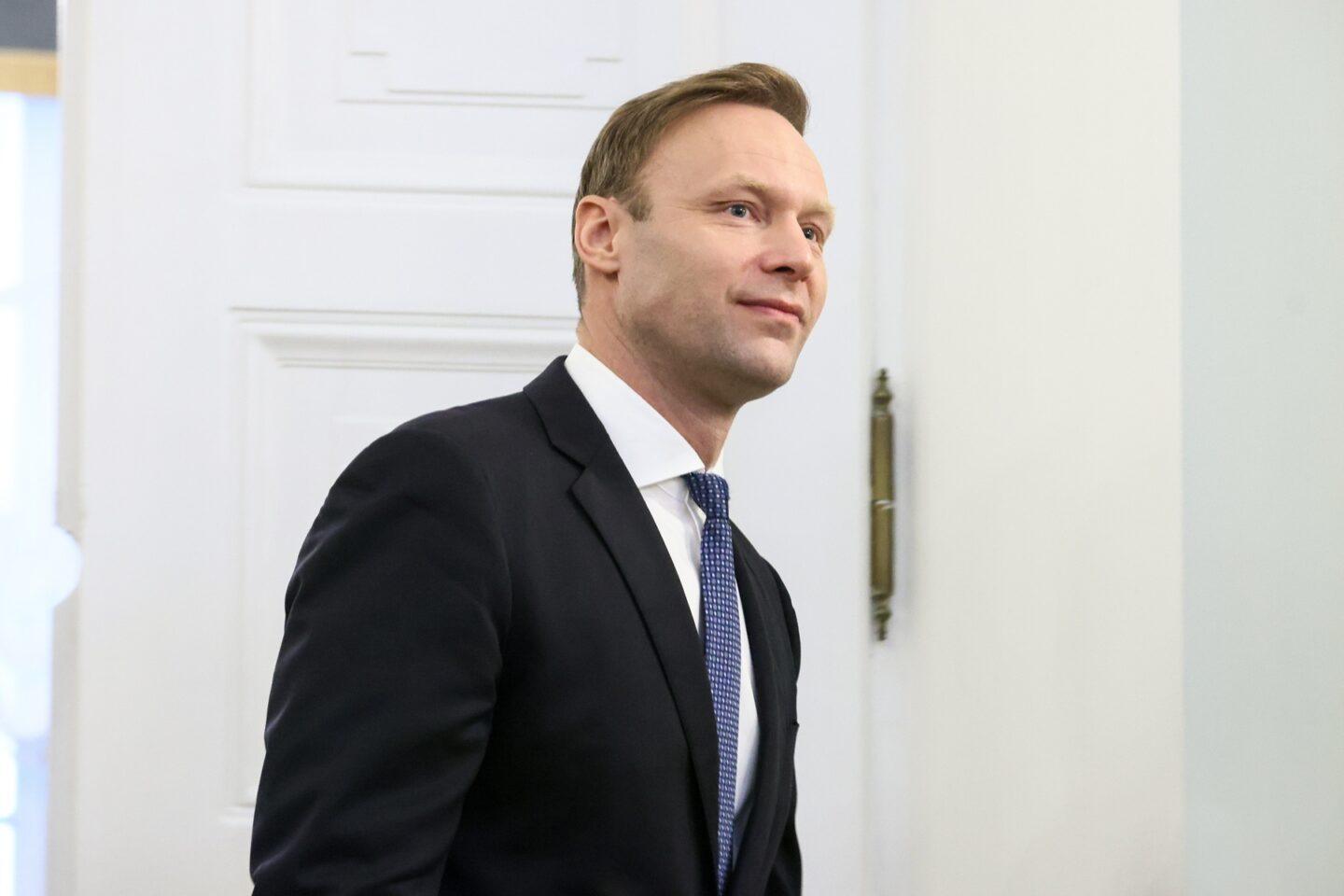
– “This system of mutual blocking benefits the political parties involved in the conflict,” says Marcin Mastalerek, former head of the chancellery of President Andrzej Duda, explaining his referendum initiative in an interview with XYZ.
It is not only President Karol Nawrocki who is planning referendums. After less than a year outside the top tier of politics, Marcin Mastalerek is returning with a proposal for a constitutional referendum. On Constitution Day, May 3rd, in an article published by Wirtualna Polska, he announced the launch of a referendum initiative in which he intends to ask Poles about the country’s system of governance.
He wants to ask whether Poland should adopt a presidential system, in which the president has greater influence over governing the country, or a chancellor-style system, in which the government is the central executive authority and the president plays mainly a representative role.
Under Mastalerek’s proposal, the referendum would be held alongside next year’s parliamentary elections. In his conversation with XYZ, the politician admits that the list of questions may be longer. He also says he is working with partners on the initiative.
Referendum alongside parliamentary elections
Rafał Mrowicki, XYZ: What does the former head of the chancellery of the previous president do today, nine months after that presidency ended?
Marcin Mastalerek: I divide my life between Washington and Warsaw. My family is here in Poland, but my wife and children did not want to move. The United States is my main place of work and income. I run a consulting firm there. I cooperate with conservative think tanks. I also publish in American media. Thanks to President Duda, I got to know the closest circle around President Trump, and later I visited the United States many times. It is experience worth making use of.
And after almost a year out of politics, you want to launch a referendum initiative.
I already have experience in this area. At the age of 24, I pushed through parliament a civic initiative restoring tax relief for students. A dozen or so years ago, collecting 100,000 signatures seemed almost impossible. As a member of the Law and Justice youth organization, I gathered a group of young people from various student and non-partisan organizations. Of course, Donald Tusk’s government at the time handled it in its own way. Our initiative, along with the signatures, was put in the freezer.
Many people are reaching out to me. I have a broad network of contacts from my political and business activity. My experience from the United States will certainly help. I was there even as a presidential minister.
You will probably remember April 2024. President Duda was heavily criticized for meeting Donald Trump at Trump Tower during the American election campaign. That was the meeting after which the author of the Nixon article pointed out that it was President Duda who convinced President Trump to unblock USD 60 billion in aid for Ukraine [by Republicans – ed.] [Bob Woodward, the American journalist who, together with Carl Bernstein, uncovered the Watergate scandal – ed.].
Who's who
Marcin Mastalerek
A long-time associate of President Andrzej Duda and head of his chancellery from 2023 to 2025. Between 2011 and 2015, he was a Law and Justice (PiS) member of parliament, head of the PiS Youth Forum from 2011 to 2014, and the party’s spokesperson from 2014 to 2015. After one term in the Sejm, he also served as a director at Orlen and as vice president of the Ekstraklasa football league.
Conflict sharper than before the change of president
Why are you launching this initiative now? In your Wirtualna Polska article, you argue that the conflict between the two centres of executive power is becoming destructive. Yet it did not begin on August 6 last year.
I have often said that “timing is everything.” Today is the right moment for such an initiative. I discussed it with President Andrzej Duda at the end of his term. I had a sense that this conflict would intensify, and that is exactly what happened. It is sharper than during the period when Andrzej Duda was president and Donald Tusk was prime minister simultaneously – and that was already a very sharp conflict. I fear that after the 2027 elections it will become even worse, regardless of who wins.
I had a sense that this conflict would intensify, and that is exactly what happened. It is sharper than during the period when Andrzej Duda was president and Donald Tusk was prime minister simultaneously – and that was already a very sharp conflict.
Why?
With a fragmented political landscape, forming a government could become a problem. There may be a struggle of all against all. This may be a better moment to force politicians to seriously consider such an initiative than in 2017, when President Duda put forward a similar idea.
Mr. Mastalerek: as a right-wing voter, I have grievances
The referendum did not take place then.
I advised President Duda when he put forward the proposal for a constitutional referendum on the 100th anniversary of independence. At the time, Law and Justice (PiS) also held a majority in the Senate. If Jarosław Kaczyński had not blocked President Duda’s idea, many issues would have been settled by now. The president wanted Poles to decide whether more power should be held by the president or the government. Our constitution will turn 30 next year. It is not some kind of Holy Grail, but a solution adopted eight years after 1989 that has proven not to work. Prime Minister Tusk says that it is the people who are bad and the constitution that is good, which sounds like a rather peculiar form of self-criticism.
Am I naive? No. I believe politicians will only be forced to act through public enthusiasm. That is exactly what President Bronisław Komorowski did with the referendum proposed by Paweł Kukiz [a rock star-turned anti-establishment politician – ed.]. The decision to launch the referendum initiative was prompted by his defeat in the first round of the presidential election.
This system of mutual blocking benefits the political parties involved in the political dispute. Next year, ahead of the elections, Prime Minister Donald Tusk will be held accountable for his “100 commitments.” He will argue that he failed to deliver them because of the president. On the other hand, the president has a strong public mandate. People expect him to act, but he does not have the tools to do so. Poland and its citizens lose as a result. As a right-wing voter, I have strong grievances.
“Mr. Kaczyński blocked an attempt to discuss reforms”
Do you mean within your original political camp?
After 2015, during the years of Law and Justice (PiS) government, I was not involved, because as a “reward” for co-running the campaign I was cut from electoral lists. During that time I advised the president, but I did not take responsibility for PiS policy. I have grievances against Chairman Kaczyński for dealing with everything in Poland except implementing reforms. When President Duda wanted to introduce reforms and give a voice to the people, Chairman Kaczyński was not interested.
At the age of 19, I joined the PiS youth organization in Szczecin in north-western Poland. It was a party that wanted to achieve great things. It wanted a Fourth Republic and a fair state. At that time, even a coalition with Civic Platform (PO) was possible. I have strong grievances that in 2015–2023 Chairman Kaczyński did not want grand projects beyond social programs such as 500 Plus child benefit. He had an independent parliamentary majority and a president from his own camp, and yet he blocked an attempt at a serious discussion about reforms. Perhaps Chairman Kaczyński is simply accustomed to how things are.
Names of collaborators
Are you launching this project with a ready list of questions?
On May 3, I symbolically announced the launch of an initiative to build a committee. I am in contact with many local government officials. This part of the project will be handled by Marcin Witko – the mayor of Tomaszów Mazowiecki, who worked closely with President Duda for many years. Responsibility for cooperation with businesses and industry organizations within the committee will be held by Mariusz Rusiecki [a former social adviser to President Andrzej Duda, local government official, and manager – ed.], while contacts with academic and student communities will be handled by Mateusz Kuliński [Student Rights Ombudsman and PiS district councilor in Warsaw’s Wola district – ed.].
We are convinced that citizens should be asked about the constitution in force. The 1997 Constitution was adopted in a referendum with a turnout of 43 percent. That is a low level of democratic mandate. Today, significantly more people participate in elections.
Poles should be asked what system they believe the country should have: a chancellor system, a presidential system, or the current model.
Criticism of term limits in local government
So that makes two issues. Is there a third?
Poles should also be asked about the reform under which Law and Justice (PiS) blocked local government officials from running for office after two terms. The issue of term limits will certainly come up. In 2029, the first local elections will be held in which officials who have served two terms under the restriction will no longer be able to run.
Party politicians say that more democracy must be introduced in local government to counter “networks of influence.” If I were being cynical, I would ask whether political parties should not also introduce term limits for their leaders.
So the current constitution, the system of government, and term limits. Anything else?
We will also talk with entrepreneurs and their representative organizations. We are considering whether to ask about issues that politicians across all parties are afraid to address. Business owners are increasingly vocal in saying that Polish companies pay high taxes in Poland, while their competitors operating in the same market pay significantly less.
We will consider whether to frame a question on this issue. Politicians will not do it on their own. Some fear European corporations, others are wary of American ones. No one is thinking about Polish companies. If anything is to change in this area, it will only happen if citizens force politicians to act.
“For many Poles, this system has advantages”
Running business operations in the United States, are you not concerned about how American business might react to such an idea?
I am not concerned. One thing I learned in the United States is that they respect only those who have their own opinion. I can assure you they do not respect those who merely try to flatter others. Good relationships should be used to advance one’s own interests.
What I see in Poland is that some people try to ingratiate themselves with officials in Brussels, while others are preoccupied with what will be said in America.
Four questions. Is that a closed list?
No – and that is precisely why we are giving ourselves time until the autumn. I am open to input from different circles.
When I first thought about this initiative, I was convinced we should ask only about a presidential and a chancellor system. However, President Marcin Witko pointed out that it may also be worth asking about a light modification of the current system, or including such an option within the question on a chancellor or presidential model.
For many Poles, the current system has its advantages. Some are concerned about placing full responsibility on one side and would prefer to preserve a balance. I am not closed to that idea.
Andrzej Duda as support?
Do you want to involve former President Andrzej Duda in this initiative?
We will want to talk with former President Andrzej Duda. I spoke with him at the end of his term. He believed it was a good idea. I am trying to explain to the right side of the political spectrum, to Law and Justice, and through the media I am also trying to reach Chairman Kaczyński, that they need Andrzej Duda and his international and state experience. I will try to involve Andrzej Duda despite his current activities, because today he is fulfilling himself outside politics. We will want to benefit from his advice.
Are you not concerned that this initiative could evoke clear associations? You, although outside PiS for over a decade, are still associated with the right wing of the political scene and with President Duda. Could this be a limitation?
No. President Duda is entirely outside politics. If I had such concerns, I would not be doing business, and earlier I would not have been vice president of the Ekstraklasa. Different people engage in different matters. In the United States, this is normal. If I have any concern, it is that in Poland we have created a situation in which people who have achieved success do not enter politics. I would prefer politics to be made up of independent individuals with experience, rather than people dependent on the party leader’s pen and lacking autonomy outside politics. These are today the biggest problem of Polish politics. Working in the Ekstraklasa, I have repeatedly demonstrated that it does not matter to me whether someone holds left-wing or right-wing views.
And are you not concerned about suggestions that this initiative could be seen as supporting President Karol Nawrocki in building a presidential system?
No. I co-participated with President Duda in presenting the idea of a referendum for the centenary of independence in 2017. At that time, I neither knew President Nawrocki nor suspected he would become president. He probably did not suspect it himself either. We do not know how people would vote in such a referendum, or which system they would choose. I am, however, pleased that President Nawrocki, like President Duda, sees the shortcomings of the current constitution.
We do not know who will win in 2027. It will likely depend on the final stage of the campaign, but also on which lists and electoral blocs politicians run on. A good example of the importance of the electoral system and lists is the 2019 election. Law and Justice secured an outright majority in the Sejm under proportional representation and the D’Hondt method.
Two centers of executive power
PiS lost the Senate in the same campaign.
In that same election, Civic Coalition (KO) won the Senate. That is how divided Poland is. You represent an editorial team focused mainly on economic issues. Can any Polish entrepreneur imagine running a company the way Polish politics functions – without clear accountability and with constant mutual blocking?
Businesses do not want an unstable and unpredictable reality.
In my view, that instability already exists today. Democracy means that the other side has a chance to win elections – and that is obvious. A separation of power into two executive centers essentially does not exist outside our part of Europe. Either the Western world does not understand our “brilliant” system adopted after 1989, or something is wrong with us. I would bet on the latter.
Mr. Mastalerek critically on PiS 2023 referendum
How do you intend to run a referendum campaign so that – if the referendum were to take place – it does not end up like the referendum proposed earlier by President Komorowski, or the one held alongside the most recent parliamentary elections?
Step by step. We focus on well-formulated questions that we want to consult with various stakeholders. Then we will collect 500,000 signatures, and afterwards we will try to persuade parliament to organize the referendum. At this stage, there is no point in discussing campaign tactics when the referendum itself has not yet been secured.
Do you know why the 2023 referendum failed? Because it served the ruling party in pursuing its electoral goals. Our referendum proposal is fundamentally different. It is not meant to help any party, and it is difficult for parties to accept because it gives the voice back to citizens. It addresses real Polish problems. The questions from the PiS-organized referendum? With all due respect, please spare me from ridiculing them.
By the autumn, before starting the signature collection, do you want to prepare a closed list of questions?
We intend to consult these questions until the autumn, and then organize an event where we will present them.
Presidential Council for a New Constitution
How do you assess President Nawrocki’s attempts to work toward a new constitution? He announced such plans already on August 6, when he took office, and on Sunday, May 3, he presented the composition of a council tasked with preparing a draft new constitution.
I very much welcome the fact that the president is speaking about the constitution. President Duda did it, and Chairman Kaczyński also did it when his brother was president. Let us remember that in 2009–2010, Chairman Kaczyński, together with former Deputy Prime Minister Przemysław Gosiewski, prepared a draft constitution for Law and Justice, which significantly strengthened the role of the president. However, when Chairman Kaczyński later held power, nothing came of it. That is why I am pleased that the president is taking action. Today, he is the most powerful politician in Poland and has a strong mandate.
Can such a composition of the presidential council prepare a constitutional draft that would be acceptable?
My diagnosis is simple: only citizens can change the constitution by forcing politicians to do so. I do not believe that any political camp will push through a new constitution, because the other side would not accept it. I am pleased with the president’s diagnosis, but I believe that only a referendum can lead to constitutional change through social pressure. It is meant to be a form of leverage.
I do not believe that any political camp will push through a new constitution, because the other side would not accept it.
Public pressure
But citizens will not write a new constitution on their own, and it will not be adopted without the involvement of politicians.
Of course. The point is to decide the direction in which it should be written. If, with high turnout, Poles clearly indicated that they support either a presidential or a chancellor system, the president would have the tools to move precisely in that direction.
And how do you assess the composition of the council?
I have not seen it in full [before this interview – ed.]. I noticed that Marek Jurek [a prominent Polish right-wing conservative politician, known for serving as Marshal of the Sejm from 2005 to 2007, leading the Right of the Republic party after leaving PiS, and advocating strict Catholic values like opposition to abortion – ed.] is expected to be among its members. He is an outstanding figure. It is good that there are people there who have been able to say “no” to Chairman Kaczyński.
Alongside him are also, among others, Professor Ryszard Piotrowski, Julia Przyłębska…
Professor Piotrowski is a non-political figure who has his own views, and that is very good. I am not talking about any hostility. I believe that first there should be a citizen decision on the direction of change, and only then should experts work out the details. I am not afraid of people’s judgment. In politics, there is no need to remain in it for its own sake. At the age of 31, I first proved to Chairman Kaczyński that if I do not like something – or someone, and that person was Jacek Kurski – I will pursue my ambitions elsewhere.
Mr. Mastalerek’s political ambitions: “I have already fulfilled myself”
What are your personal ambitions connected with the referendum initiative? Is this meant to be your return to high-level politics, or an attempt to find a new role after next year’s elections?
I am not thinking about that at all. I fulfilled myself as a member of parliament at the age of 26, which is quite early. Later, I could have become a minister, and I did become one – just a bit later.
Before 2015, Chairman Kaczyński asked me what kind of minister I would like to be. I was a member of parliament at the time and I replied that I did not want to be any kind of minister, because his assistant would have more influence in this country than any minister. Chairman Kaczyński laughed.
I can guarantee that one does not need to be a member of parliament to have influence on politics. I know this better than most.
Factional tensions in PiS
How do you assess the current situation in Law and Justice (PiS), where factional disputes are becoming increasingly vocal?
What is happening in Law and Justice is the result of the party’s long-standing operating model under Chairman Kaczyński, and of building the party as his personal property. It is a party stripped of people who could stand up to him. At one point, there was even an attempt to push out Mateusz Morawiecki, who resisted.
To be honest, I do not like this party today. I joined a different party, and I could not be active in it in its current form. If, in 2003, I had wanted to join the League of Polish Families of Roman Giertych, I would have joined that party, not Lech Kaczyński’s party.
Mr. Czarnek compared to LPR under Giertych [Liga Polskich Rodzin (LPR) was a far-right Polish nationalist and Catholic political party founded in 2001, with Roman Giertych as its prominent leader, serving as president from 2006–2007 and later as deputy prime minister and education minister in the PiS government- ed.]
What do you think about Law and Justice’s candidate for prime minister?
Minister Przemysław Czarnek, who was one of the least popular politicians in this government, would have fit perfectly into the League of Polish Families in those times. A broad right-wing formation should have people like Professor Czarnek, but as a radical wing that never actually comes to power. If a party wants to be a 40-percent movement, it must have a radical wing, but that wing cannot dictate what the entire party looks like. I cannot imagine that in the times of President Lech Kaczyński, Minister Czarnek would have been a candidate for prime minister or played any significant role. I do not like that.
I also did not like the so-called “Lex Czarnek.” I was one of the people who convinced President Duda to veto it. Minister Czarnek has still not apologized for that law, which was meant to give officials the right to decide on children. That had nothing to do with either conservatism, liberalism, or freedom.
Are you rooting for Mateusz Morawiecki?
I am watching what is happening around Mateusz Morawiecki. His rivals are trying to get Chairman Kaczyński to expel him from the party. It is not that he is doing something wrong. Rather, others are trying to do something to him, and he is defending himself.
I understand why, as prime minister, he accepted many things imposed by Chairman Kaczyński. He wanted to be prime minister and believed that holding the office was worth compromises. He wanted to do good things, and the price of staying in office was also endorsing actions he would not have supported on his own. I understand that, and I am watching him closely.


Key Takeaways
- Mr. Mastalerek is critical of Law and Justice’s choice of Przemysław Czarnek as a potential prime ministerial candidate. In his view, Mr. Czarnek is too radical a politician and should not play a leading role in the party. He argues that today’s PiS differs significantly from the party he once joined, and resembles the former League of Polish Families (LPR). He also says he understands Mateusz Morawiecki’s position as he defends himself against a competing faction..
- Marcin Mastalerek believes that the current system, in which a president and a government originating from different political camps are locked in mutual confrontation, is dysfunctional. In the view of the former head of President Andrzej Duda’s chancellery, relations between Prime Minister Donald Tusk and President Karol Nawrocki are even more tense than during the previous presidency. Mastalerek also argues that the current constitution requires changes, and that citizens should set the direction of those changes through a referendum.
- In addition to the question of a presidential versus chancellor system, Mr. Mastalerek would also like to ask whether Poles are satisfied with the current constitutional model. Among the topics that could be included in a referendum are the constitution itself, term limits in local government, and the taxation of foreign companies that pay lower taxes than Polish firms competing in the same market. The list of questions is to be finalized by the autumn, when it will be presented at a dedicated event. Mr. Mastalerek is working with Marcin Witko, mayor of Tomaszów Mazowiecki; Mariusz Rusiecki, former adviser to President Andrzej Duda; and Mateusz Kuliński, the Student Rights Ombudsman. They will need to collect at least 500,000 signatures within 60 days of registering the referendum committee.