

This article is a part of Poland Unpacked. Weekly intelligence for decision-makers
After a series of votes in recent years – parliamentary elections in 2023, local and European elections in 2024, and the presidential election in 2025 – Poland will hold no nationwide elections in 2026. Yet political tranquility is unlikely.
The past year was marked by intense political tensions between the government and the opposition, whose candidate won the presidential election and has become not only an active participant but also one of the leading players in this ongoing conflict.
Presidential and Prime Ministerial addresses. A preview of continued tensions
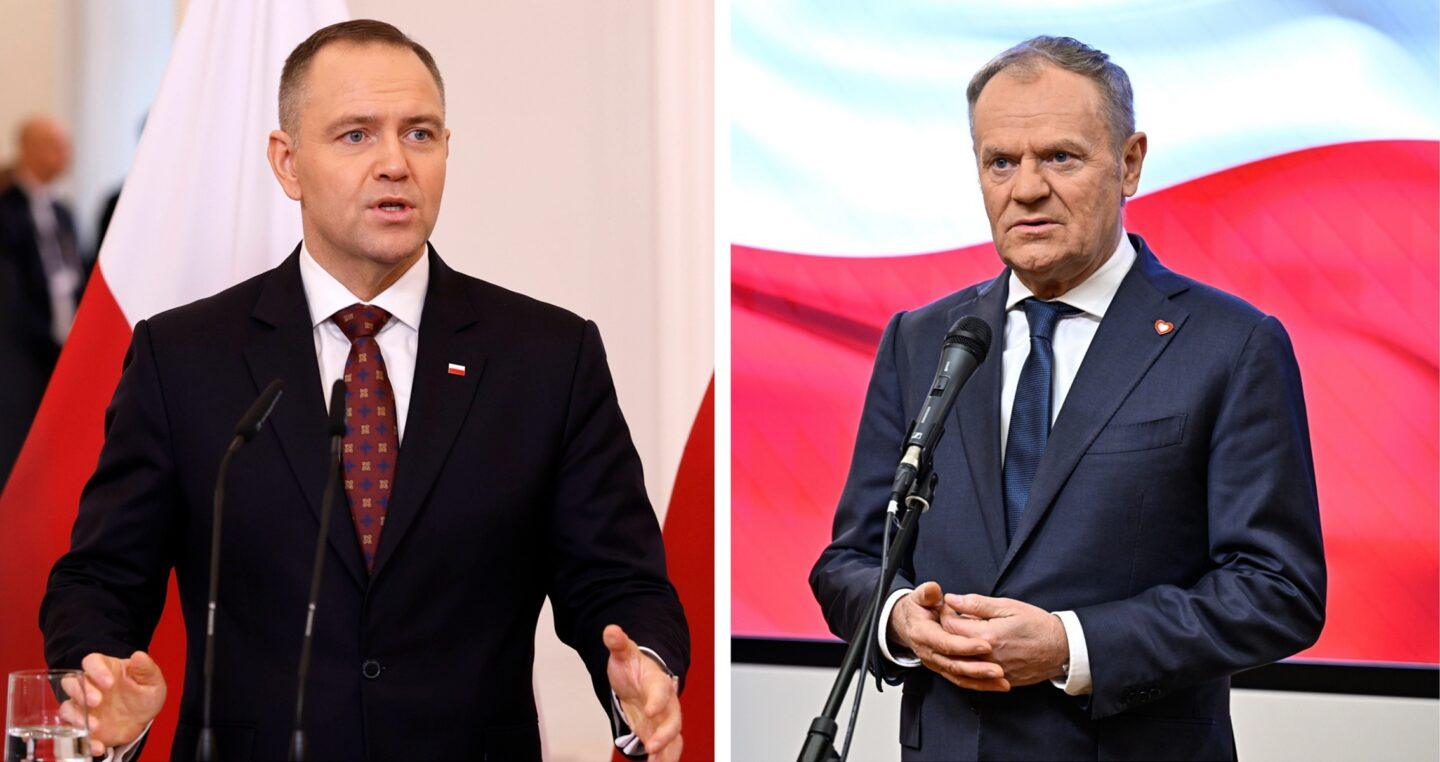
Both the president and the prime minister did not shy away from taking shots at one another in their New Year’s addresses. President Karol Nawrocki, speaking on New Year’s Eve, opened with remarks on patriotism and national security. He also touched on Poland’s invitation to the G20 summit and on his relationship with U.S. President Donald Trump.
The President on elections: Change is needed
Turning more directly to domestic politics, President Nawrocki described last year’s presidential election as a message from Poles to Donald Tusk’s government.
“In the past year, Poles made their choice clear: they are dissatisfied with the status quo. They signaled unmistakably that the state’s affairs are not moving in the right direction, that change is needed, and that citizens’ voices must once again be decisive. You have pointed the way forward,” President Karol Nawrocki said in his address.
The president once again framed his electoral victory as a political turning point. Mr. Nawrocki is playing an increasingly prominent role on the right and could become the patron of alliances being formed in anticipation of the 2027 parliamentary elections. Right-wing politicians are increasingly discussing the need for a right-wing Senate pact, with many positioning President Nawrocki as a potential sponsor of such an agreement.
In its dealings with the government, it is hard to expect the president to ease off. The first months of his presidency have shown that the change in the presidential palace has not made implementing government plans easier. President Nawrocki vetoed 20 bills in five months, and his team has signaled further vetoes – such as on the law regarding the status of a “closest person,” which the government adopted just before the end of the year.
“Liberum Veto – weakness and defeat”
Prime Minister Donald Tusk did not spare sharp words for the president and the opposition. In his New Year’s address, he opened by highlighting low inflation, repairing relations with Europe, securing funds from the National Recovery Plan, and encouraging the return of Poles from abroad.
Turning to lessons from history, he quickly moved to delivering pointed criticism of the president and the opposition.
“We know what gives us strength and success, and what brings weakness and defeat. A strong army – security and victory. Lawlessness and liberum veto – weakness and defeat. Respect for the law, equality, freedom, tolerance – our Polish values are development and power. Corruption, oligarchy, political patronage – these are decay and collapse," Prime Minister Tusk said in his New Year’s address.
By invoking liberum veto, he was alluding to the president’s frequent vetoes of government legislation, likening him to the Polish nobility of the 18th century who wielded this right, which was ultimately abolished by the Constitution of 3 May 1791.
The prime minister also vowed to “crack down on criminals of all kinds – whether a hooligan king, a drug dealer, a corrupt politician, or a Russian militant.” The remarks naturally evoked associations both with the fan-based circles connected to President Nawrocki and with accountability for the previous Law and Justice (PiS) governments. Just before the end of the year, new indictments emerged, this time linked to the visa scandal involving, among others, a former deputy foreign minister in the PiS administration.
Explainer
The visa scandal
The visa scandal was a major political corruption affair that erupted in 2023, involving allegations that Polish consulates were selling work visas to migrants, primarily from Asia and Africa, in exchange for bribes.
Whistleblowers, including consular staff, came forward with evidence of the scheme. There were allegations that tens of thousands of visas may have been issued improperly, and that the corruption reached beyond just low-level consular officials.
The scandal broke during the PiS (Law and Justice) government and became a major political issue heading into the October 2023 elections. Deputy Foreign Minister Piotr Wawrzyk was forced to resign. The opposition used it to attack the government's competence and integrity, particularly ironic since PiS had built its brand partly on being tough on immigration and corruption.
The scandal damaged PiS’s credibility on migration issues - a core part of their political identity - and contributed to their electoral defeat in October 2023.
Beyond corruption, the scandal raised serious questions about who was entering Poland and the EU. If visa approvals were based on bribes rather than legitimate checks, it potentially created security vulnerabilities. There were concerns about human trafficking connections and whether organized crime was involved in the visa-selling networks.
Coalition changes: Elections within Polska 2050
Donald Tusk’s party, the Civic Coalition (KO), is facing internal elections. The prime minister can likely rest assured about his own position; any changes are expected mainly at lower levels of the party hierarchy.
In the first days of 2026 – marking the first leadership shuffle since the current government took office – the coalition will see a change in its leadership lineup. On January 10, the first round of party elections will be held within Polska 2050. Six candidates are running: Paulina Hennig-Kloska, Joanna Mucha, Rafał Kasprzyk, Katarzyna Pełczyńska-Nałęcz, Ryszard Petru, and Bartosz Romowicz.
Just before the end of 2025, MEP Michał Kobosko withdrew from the race to succeed Szymon Hołownia.
Polska 2050: Stakes in the party election
Approximately 800 ordinary members of Polska 2050 – out of a total party membership of around 1,500–1,600 – will be eligible to vote. If none of the six candidates secures the required support, a second round of voting will take place on January 12.
The party founded by Szymon Hołownia – former TV host and journalist – currently has very low ratings, making it unlikely to surpass the electoral threshold in next year’s national elections. It still maintains a parliamentary club of more than 30 members, which remains a significant force in the Sejm.
The new party leader will join the coalition leadership alongside Donald Tusk, Włodzimierz Czarzasty, and Władysław Kosiniak-Kamysz. They could influence coalition dynamics and give the party – and its role in government – a new character.
Not only Polska 2050 but also the New Left and the Polish People’s Party (PSL) face the challenge of improving their poll standings. Among the smaller coalition partners, the New Left most consistently surpasses the electoral threshold. PSL currently polls as low as Polska 2050, but it benefits from a large network of local activists. The personal ratings of Deputy Prime Minister Kosiniak-Kamysz, who enjoys strong public trust, could also serve as an asset.
The situation on the right
Within Law and Justice (PiS) party elections were held last year. In each case, the position of the long-standing leader remained unchallenged. In 2026, Jarosław Kaczyński’s party will face several challenges.
The first is escalating internal conflicts. Tensions within PiS are growing month by month, and it is becoming increasingly difficult for Mr. Kaczyński to contain disputes. Party factions are clashing publicly, a trend that was particularly visible in the final weeks of 2025 between the camps of Mateusz Morawiecki and Jacek Sasin. If PiS hopes to return to power in 2027, these internal struggles will not make the path easier.
The second challenge is the intensifying competition to PiS’s right. A year ago, the main threat on the far-right was the Confederation Liberty and Independence party, led by Sławomir Mentzen and Krzysztof Bosak.
Since the presidential election, Grzegorz Braun and the Confederation of the Polish Crown have been gaining ground, increasingly approaching 10 percent in the polls. Former PiS voters are more frequently shifting to Mr. Braun’s camp. The open question remains whether Mr. Braun can translate these current ratings into a lasting political base.
Third challenge – accountability. The ruling coalition has increasingly little time to hold its predecessors to account. In his first interview of the year with Gość Niedzielny, President Nawrocki accused the government of focusing primarily on political reckoning. At the same time, those in power may feel pressure from voters who expect tangible results from such investigations. By the end of 2025, further moves in this area became visible. In December alone, the Attorney General informed the Sejm Speaker of charges against, among others, Mateusz Morawiecki and Mariusz Błaszczak.
Explainer
Gość Niedzielny (Sunday Guest)
Gość Niedzielny (Sunday Guest) is Poland’s largest Catholic weekly magazine - a publication that sits at the intersection of faith, culture, and social commentary from a Catholic perspective.
The most advanced investigation concerns the Government Strategic Reserves Agency and involves individuals connected to Mr. Morawiecki; sixteen people have already been charged. Late in the year, parliament stripped Zbigniew Ziobro – a former justice minister and a divisive figure in Polish politics – of his immunity. The prosecution intends to press charges against him for the mismanagement of the Justice Fund. The former justice minister – like his former deputy Marcin Romanowski – is currently abroad, evading authorities.
Room for a new party?
Next year, 2027, will effectively be a permanent election campaign ahead of the parliamentary vote. 2026, by contrast, may serve as a period of pre-election testing. Some parties are already framing their actions as part of the lead-up to autumn 2027.
Włodzimierz Czarzasty, for example, stated this after being re-elected in December as leader of the New Left. For him, the challenge is not only maintaining the current coalition after the next elections but also competing with the Razem (Together) party for dominance on the left of the political spectrum.
The pre-election year will not yet reveal the full configuration in which the main parties will approach next year’s vote. It may, however, be an opportune moment to begin building a new political movement aimed at the 2027 elections.
One-third of Poles want a new party
At the end of November, Onet (a major Polish portal and news outlet) published the results of a survey conducted by SW Research. It showed that 32.1 percent of Poles hope for the emergence of a new party that could alter the balance of power on the Polish political scene ahead of the next elections.
By contrast, 42.8 percent of respondents were opposed, yet roughly one-third of Poles continue to express hope for a new political movement.
In the second half of 2025, a new political party called Nowa Polska (New Poland) was founded by senators with a local government background: Zygmunt Frankiewicz, Wadim Tyszkiewicz, and Andrzej Dziuba. The party has not yet registered measurable support in polls. At the end of the year, Nowa Fala (New Wave) was registered by Joanna Senyszyn, a long-serving leftist parliamentarian who previously ran in the presidential election.


Key Takeaways
- In his New Year’s address, President Karol Nawrocki stated plainly that he aims to pursue a change of government in Poland. 2026 may mark the next stage of these efforts in the context of the upcoming parliamentary elections.
- Prime Minister Donald Tusk shows no intention of yielding to the president. He also promises to continue holding the previous PiS governments to account.
- Polska 2050 will hold internal elections in January to choose a successor to Szymon Hołownia, with six candidates competing for leadership. On the right, moves to build a Senate pact ahead of the next elections are expected. 2026 may also provide an opportune moment to launch new political movements in preparation for next year’s vote.