

This article is a part of Poland Unpacked. Weekly intelligence for decision-makers
Strażnik, an app developed in Lublin in south-east Poland, combines publicly available data to warn users about potential threats. Its creator stresses that it is no substitute for Poland’s official emergency alert system. But during a Russian attack on Ukraine, the app incorrectly displayed a drone on the Polish side of the border. What are government agencies doing, and how are they responding to the project?
Strażnik was not developed by the military, Poland’s Government Security Center (RCB) or a major technology company. It is the work of Piotr Kukier, a resident of Lublin who develops the app on his own, in his spare time. He is not a professional programmer and uses generative artificial intelligence to develop his projects. Strażnik is available on Android, iPhones and through a web browser.
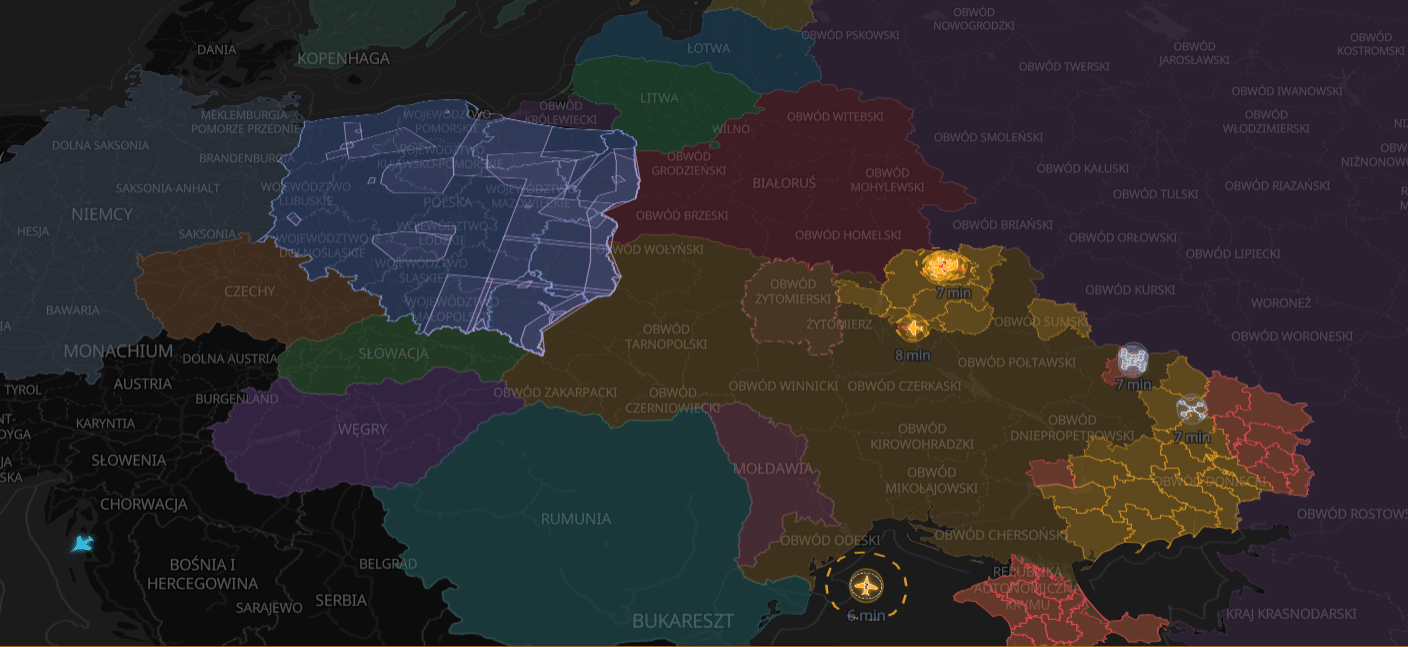
The idea came from a personal experience. Kukier told the media that early on July 30, air-raid sirens sounded in Lublin, but he failed to hear them despite having his windows open. He only learned about the alert later. That same day, he reportedly created the first prototype of his own “siren on a phone.” Over time, the simple notification mechanism evolved into a tool showing aerial activity over Poland and neighboring countries.
The project is gaining popularity. Responding to questions from XYZ on September 25, Kukier said public GitHub statistics showed more than 67,000 downloads of successive Strażnik releases. He cautioned that this was not the number of users, since the same person might download multiple updates. The latest release had attracted approximately 4,500 downloads at the time. According to its creator, the iPhone version ranked first among free utilities in Poland’s App Store on September 23. Preparations are underway to publish the app on Google Play.
Combining multiple sources into a single warning
Strażnik is not a radar system and does not independently monitor Polish airspace. Instead, it aggregates information from publicly available sources. The project documentation lists, among others, the Ukrainian OSINT aggregator Neptun, ADS-B aircraft-tracking data, airspace restriction notices published by the Polish Air Navigation Services Agency (PANSA), RCB alerts and media reports.
Good to know
Neptun
Neptun is a Ukrainian data aggregator that provides a free, interactive map for round-the-clock monitoring of aerial threats in near real time. It does not use military radar. Instead, an AI algorithm analyzes information every five seconds from Ukraine’s official alert system and 69 verified Telegram channels, including communications from the Ukrainian Air Force, the Armed Forces of Ukraine and regional observers.
The system automatically geolocates and displays the approximate positions and flight directions of Russian Shahed drones, missiles, guided aerial bombs and aircraft, giving civilians a rapid overview of the situation in Ukrainian airspace.
Strażnik assigns points to individual pieces of information and aggregates them for each Polish province. The mechanism is intended to reduce the risk of triggering an alarm based on a single signal. In current versions, a red alert also requires additional confirmation, such as an official RCB instruction to seek shelter or information about an attacking aircraft or drone approaching Poland near the border.
Kukier acknowledges the limitations of the system.
“Strażnik does not have access to all the information available to the authorities. It helps people understand the situation, but it does not replace RCB alerts, sirens or announcements from the relevant institutions,” he told XYZ.
The same disclaimer appears in the application’s documentation. Strażnik describes itself as an “unofficial supplementary source” and is not affiliated with the RCB, the Regional Warning System (RSO), PANSA or any other government institution.
Government agencies: official warnings must come first
The RCB is aware of the project. In its response to XYZ, the agency said it was analyzing possibilities for using similar ideas in the future. It acknowledged that the emergence of such tools demonstrates considerable public interest in security and a need for rapid access to information. However, it also emphasized the importance of verification.
“When it comes to information about threats, we recommend that official communications from public authorities, services and institutions responsible for monitoring the relevant type of threat remain the primary point of reference. These include RCB alerts, the Regional Warning System and emergency sirens,” the RCB stated.
The agency also noted that users should know where the information presented by an app comes from, how it is verified and whether the application clearly distinguishes official data from its own analysis and forecasts.
Poland’s Ministry of the Interior and Administration has adopted a more reserved position.
“The state’s role is to continuously improve the official, reliable and secure civilian warning system. We do not evaluate commercial products. The Ministry of the Interior and Administration is undertaking its own initiatives concerning public warnings and alerts. Since mid-2024, we have been working to establish a Warning and Alert System (SOiA). Development of the SOiA application is possible thanks to funding from the National Recovery and Resilience Plan. Further financing will be provided through the government’s Civil Protection and Civil Defense Program,” the ministry stated.
Poland is developing its own warning system
The Interior Ministry is coordinating the project with the Ministry of National Defense and the RCB, while the State Fire Service is also involved. The authorities are analyzing, among other things, how RCB alerts should be used and when warnings about potential aerial attacks should be triggered.
At the same time, preparations are underway to introduce cell broadcast technology, allowing warnings to be sent directly to phones located within a designated geographic area.
“The Ministry of the Interior and Administration and the RCB are the lead institutions developing new ways of informing the public about threats. The Defense Ministry cooperates with them as one element of the system,” the Defense Ministry’s press office told XYZ.
PANSA did not respond to XYZ’s questions about Strażnik.
Kukier acknowledges that neither the RCB, PANSA, the Interior Ministry nor local governments have contacted him about the application. He says he is open to cooperation with public institutions, although he has not decided to transfer exclusive ownership of the project to anyone. Any potential collaboration or licensing arrangement would require separate negotiations.
Strażnik remains a one-person project developed outside normal working hours. Users can voluntarily support its development. Kukier says the application will remain free, without advertising or user tracking.
Expert: a supplementary tool, not an official warning system
Marcel Rutkowski, an analyst at the Security Observatory, notes that Strażnik is part of a broader trend of privately developed tools supporting civilian protection and crisis management. In his view, such initiatives demonstrate grassroots engagement with security issues but must be approached cautiously.
“Private solutions such as Strażnik can only serve as supplementary tools. They cannot become the basis of the official public warning system,” Rutkowski emphasizes.
He also warns of information chaos. During a crisis, uncoordinated messages from multiple channels may make it more difficult to assess the situation, facilitate disinformation and undermine trust in official warnings.
The risk of error becomes reality
When XYZ submitted questions to Strażnik’s creator and government institutions, the possibility of the app displaying incorrect information was still largely a hypothetical risk. Just days later, it became reality.
On September 28, during another Russian attack on Ukraine, the RCB sent an alert to people in Poland’s Lublin province. A Russian drone was operating near the Polish border. At around 5 p.m., screenshots from Strażnik began circulating on social media, suggesting that the unmanned aircraft had crossed into Polish airspace. Some users presented the image as evidence of an airspace violation.
The claim was false. Poland’s Defense Ministry reported that the Russian drone had struck on the Ukrainian side of the border, approximately two kilometers from the Dorohusk border crossing, without entering Polish airspace.
The incident was examined by fact-checking organization Demagog. According to its analysis, Strażnik indicated a location uncertainty of approximately four kilometers. For an object located around two kilometers from the border, that margin was crucial.
A rapid fix
Kukier acknowledged that the application had incorrectly visualized the object’s location. He explained that the drone had remained over Ukraine throughout the incident and announced a correction.
“The object information panel accurately displayed what the source reported. The scoring and alert mechanisms also use the reported position, never the visual representation. The misleading shift of the icon therefore could not have increased the alert level. No warning was triggered or missed as a result,” the creator explained.
At the same time, he accepted responsibility for the error.
“People look at the map and have every right to expect that it will not show them something the data does not confirm,” Kukier said.
He removed the position-prediction feature that same day.
“The marker now appears exactly where the object was reported, together with an uncertainty circle and its flight path. Near the border, the app also provides a numerical distance so users do not have to judge it visually,” he explained.
Kukier said he had also added a test checking the actual function responsible for drawing the marker. The previous test had covered only part of the process, which was why it failed to detect the error.
The need for a reliable source of information
The incident exposed another problem. Even when an application displays disclaimers and uncertainty estimates, some of that context may disappear when users take screenshots. The image of a marker appearing on the Polish side of the border circulated online as standalone “evidence,” generating further false claims.
“I understand the need for information about threats. I respect and admire Strażnik’s creator for his initiative. At the same time, I am concerned that the application may contain further errors that only become apparent during similar crises. Nor can I be sure that a solution developed with AI by someone who is not a professional programmer is adequately protected against interference by APT groups [advanced persistent threats, often state-sponsored cyberespionage groups – editor’s note]. All of this could cause unnecessary panic and fuel conspiracy theories. The state has experts who could review the application for consistency and security. Perhaps it should consider offering such support,” says Marcin Kostecki, editor-in-chief of Demagog.
He also highlights something the creator himself acknowledges: the application will always show approximate rather than precise locations of objects.
“That is why Piotr Kukier directs users to official channels, including RCB alerts. The problem is that, as the app creator’s own experience shows, RCB alerts and warning sirens are not enough for people. They do not provide precise information about threats, they occur relatively frequently, and people are beginning to ignore them,” Kostecki says.
He acknowledges that, apart from the RCB, it is difficult to identify a single official source responsible for communicating threats.
“Usually, the Operational Command of the Armed Forces is the first to issue information, followed by the Defense Ministry and then prosecutors’ offices. At the same time, the Interior Ministry and police issue their own statements, as do other institutions, such as Poland’s Cyber Defense Forces and NASK, through the Polish Press Agency or the Ministry of Digital Affairs.
“I think it would be worthwhile to establish a single channel publishing threat-related communications at predictable intervals. That would help not only individual citizens but also the media and the state as a whole, which needs to maintain consistency in its communications,” the Demagog editor-in-chief suggests.


Key Takeaways
- Strażnik responds to a genuine demand for rapid information about security threats. The application’s growing popularity suggests that users want more detailed and timely warnings than those provided through conventional channels. Developed independently, without institutional backing, the project addresses an information gap that is particularly significant in regions near Poland’s borders.
- The application is not part of Poland’s official warning system and does not have access to all government security data. The RCB, Interior Ministry and Strażnik’s creator all emphasize that official alerts, emergency sirens and communications from the relevant authorities must remain the primary sources of information during a threat. Private tools can only supplement that system.
- The September 28 error demonstrated that the risk of misinformation is real. An incorrect visualization of a Russian drone’s position circulated on social media as supposed evidence of a violation of Polish airspace. The case illustrates how the responsibility for presenting uncertain information increases as an application becomes more popular, particularly when its output can be shared without the context needed to interpret it accurately.