

This article is a part of Poland Unpacked. Weekly intelligence for decision-makers
Philippe Meunier, vice-president of the Auvergne–Rhône-Alpes region, visited Warsaw with a delegation of 15 companies to discuss cooperation in nuclear energy and other industrial sectors.
In a debate on the role of regions in Europe’s reindustrialization, the message was unequivocal: without active government involvement and protection against unfair competition, Europe will not rebuild its position.
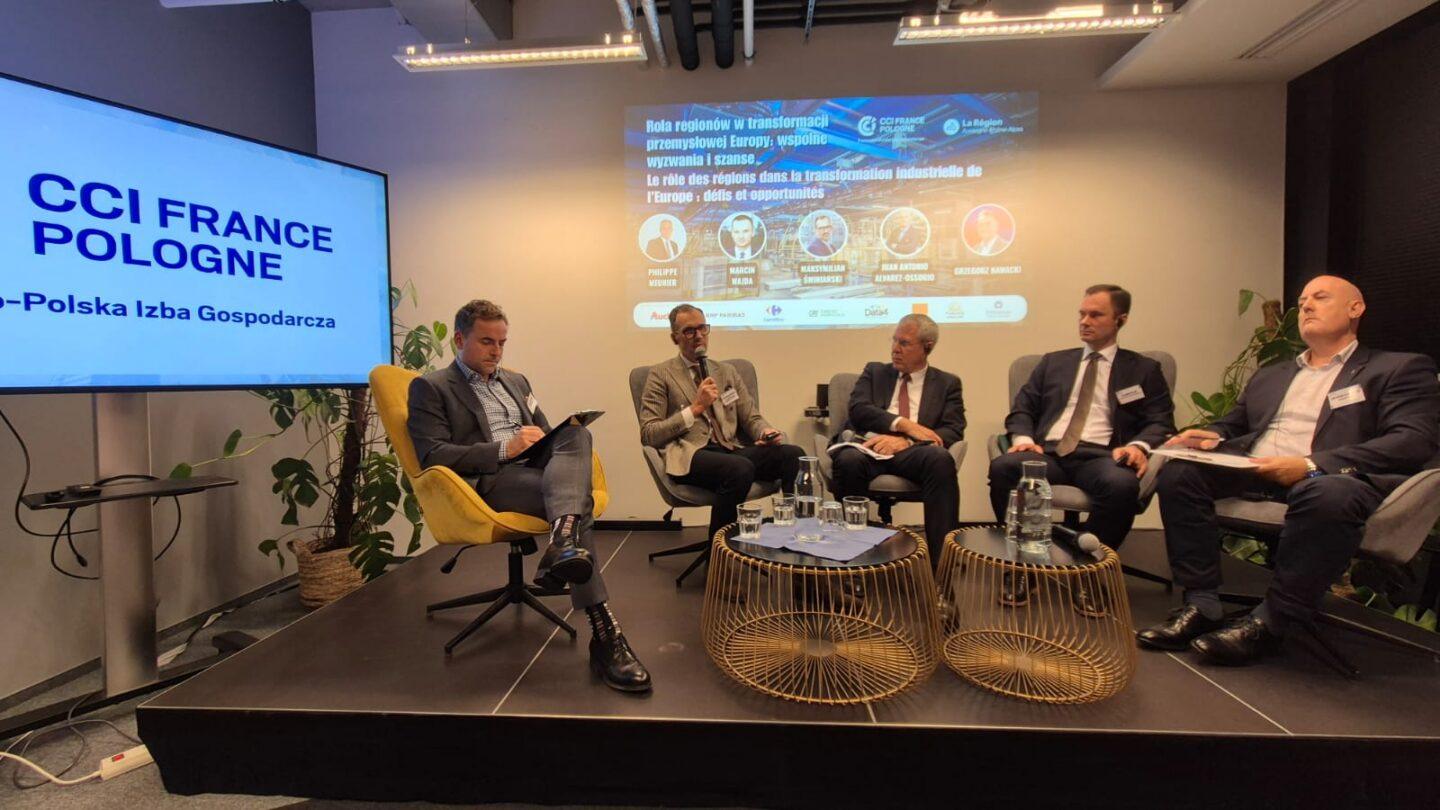
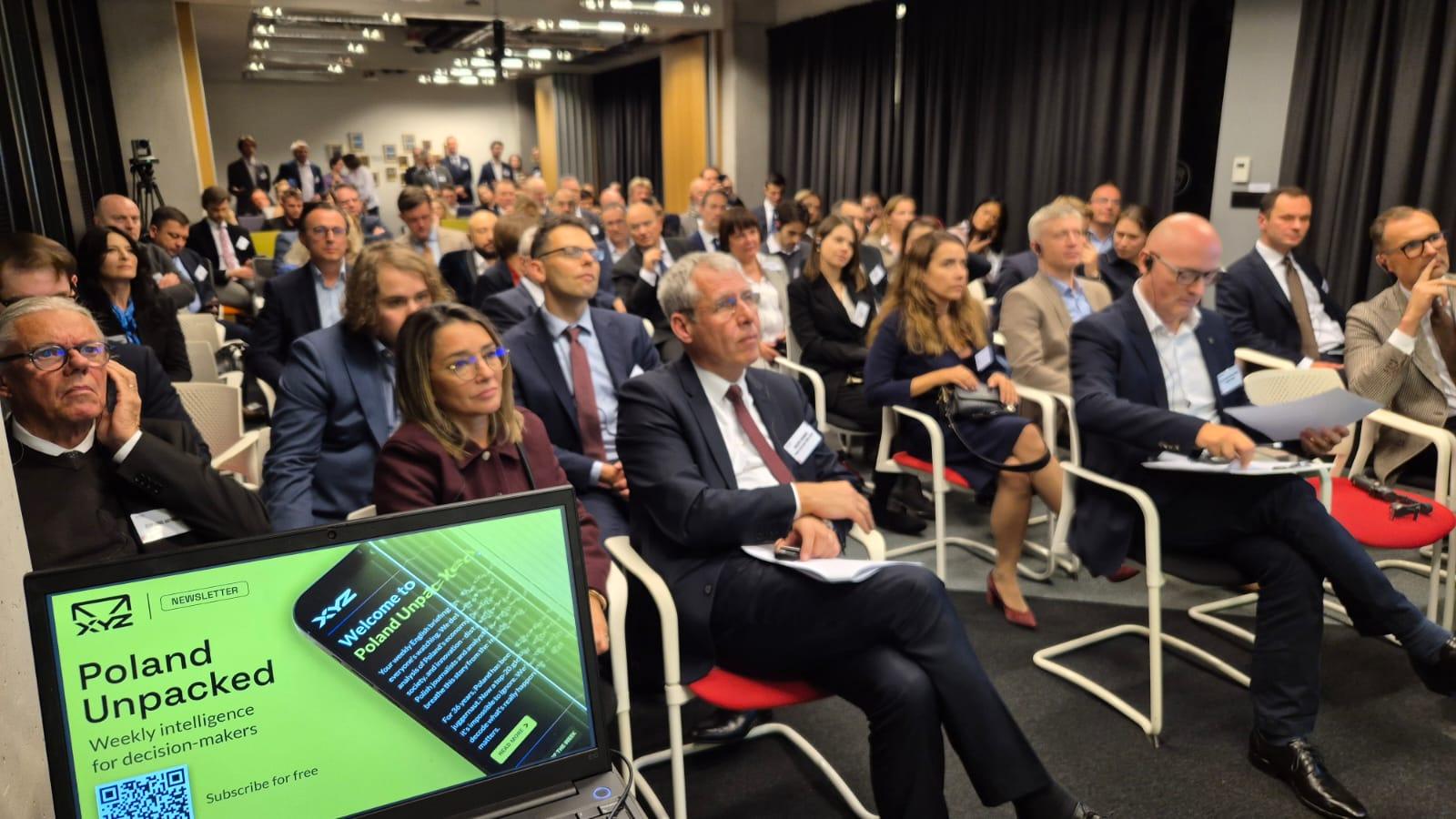
The discussion on what determines the success of regions, moderated on December 4, 2025, by Grzegorz Nawacki, editor-in-chief of XYZ.pl, brought together nearly 100 participants – representatives of member companies and invited partners of the French Chamber of Commerce and Industry in Poland.
EUR 1 billion to reclaim economic sovereignty
Auvergne–Rhône-Alpes, France’s leading industrial region, has launched a €1 billion fund dedicated to reindustrialization and the recovery of economic sovereignty. During a visit to Warsaw on December 4, Philippe Meunier, the region’s vice-president, stressed that Auvergne–Rhône-Alpes comprises 12 départements which, if they were a country, would rank 12th in the European Union.
“Success is first and foremost about regional policy. If a region is pro-business, as ours is, and supports industry and nuclear power, it delivers results. If it opposes these sectors, business will not develop,” Meunier said during a debate organized by the French-Polish Chamber of Commerce.
In an interview with XYZ.pl, the vice-president left no doubt that the state also has a role to play in creating development opportunities for weaker regions with a less advanced industrial base.
“One option is interregional projects, which make it possible to leverage potential strengths and offset shortcomings. But it is the state’s responsibility to provide the initial impetus and set the framework for such initiatives. The difficulty is that beyond a certain level of investment, regions start to become competitors,” Meunier noted.
The region, home to 14 nuclear reactors – the largest nuclear fleet in France – and set to add two new EPR units (European Pressurized Reactors), employs more than 50,000 people in the nuclear sector alone. Auvergne–Rhône-Alpes is also a leader in other industries, including chemicals, aerospace (manufacturing components for Airbus aircraft and Rafale fighter jets), luxury goods (Hermès products), and mountain tourism.
EUR 600 million for industrial modernization
The region has invested EUR 600 million in upgrading the machinery and equipment of industrial companies and allocated a further EUR 200 million to research and development. The funds are directed to firms in key sectors: energy, mobility, aerospace, health care, chemicals, and agriculture.
“This is a matter of budgetary choices and making support for companies a priority,” Vice-President Meunier explained.
The region also supports exports by small and medium-sized enterprises and invests in vocational education to ensure that businesses have access to a skilled workforce. Meunier noted that the region works with clearly defined partners: within Europe (including Poland), across the Francophone world, and in what he described as the “wider world” – the United States (Pennsylvania and Texas), China, Japan, and South Korea.
Mazovian Voivodeship: 23% of Poland’s GDP and an industrial base to match its French counterpart
Dr. Marcin Wajda, director of the Department of Regional Development and European Funds at the Marshal’s Office of the Mazovian Voivodeship, highlighted the region’s distinctive profile, which combines a powerful services hub – Warsaw – with areas of significant industrial potential.
Located in central Poland, Mazovian Voivodeship (Mazowieckie) generates 23% of Poland’s GDP and, in terms of industrial employment, matches the Auvergne–Rhône-Alpes region. Where is Mazowieckie placing its bets? On support for the petrochemical, food-processing, and energy industries. The region is a member of the European Chemical Regions Network (ECRN) and carries out export promotion through the Mazovian Regional Development Agency.
“Industry is an opportunity for regional Mazowieckie areas, beyond the Warsaw metropolitan area. That is why the regional authorities are taking a range of measures, including international cooperation and export support,” Wajda said.
Under cohesion policy, Mazowieckie has EUR 2 billion in European funds at its disposal. This year, the region allocated EUR 65 million to support innovation in enterprises and research and development, as well as EUR 25 million to reduce energy costs for companies.
Michelin: The world’s largest plant employs 5,000 people
Juan Antonio Alvarez-Ossorio, president of Michelin Polska and managing director of the Olsztyn plant, stressed that the facility’s operational stability depends on four key factors: access to a skilled workforce; well-developed infrastructure (roads, energy, and access to inputs such as nitrogen); an efficient services sector; and simplified administrative procedures.
“Our plant in Olsztyn, north-eastern Poland, employs 5,000 people and is the largest Michelin facility in the world – though few people realize this. Access to skilled workers and the ability to retrain employees from industries that are being phased out are of fundamental importance to us,” Alvarez-Ossorio said.
The company has been operating in Poland for 30 years, having acquired the Stomil Olsztyn plant, which had already been producing tires for three decades. Michelin, a CAC 40-listed company, underscores the importance of proximity to customers, access to raw materials, and the geographic diversification of production.
Polfa Tarchomin: 200 years of history and an investment in Europe’s security
Maksymilian Świniarski, chief executive of Polfa Tarchomin, recalled that the company has more than 200 years of history. Founded in 1823 as a chemical enterprise and later transformed into a pharmaceutical manufacturer, it employed more than 3,500 people in the 1980s and 1990s; today, the workforce numbers 900.
The company is Poland’s largest producer of active pharmaceutical ingredients (APIs), and 20 of its products are included on the European list of critical medicines. Świniarski emphasized that in the current geopolitical environment the company plays a strategic role: 80% of the APIs used in Europe now come from China, whereas 20–25 years ago the proportions were reversed.
“Our task is to build the security of our country and of Europe as a whole, not merely to create value for the owner. Seven out of ten hospitalized patients who require antibiotic therapy receive products from our plant in Warsaw,” Świniarski stressed.
Polfa Tarchomin is carrying out an EUR 150 million investment to build the largest production center for high-potency and oncology drugs in the region. The company owns 45 hectares of land in Warsaw and does not qualify for support from EU funds, as Warsaw is classified as a region that is too affluent.
“Politics must regain control over the economy”
At the heart of the debate was the future of European industry in the face of global shocks: the pandemic, the war in Ukraine, the energy crisis, and intensifying competition from China and the United States.
“From the pandemic, through the war in Ukraine, to the election of Donald Trump, we have been witnessing a shift in the paradigm of the global economic model. This forces us to rethink international trade and the need to regain sovereignty,” said Philippe Meunier.
The vice-president of the Auvergne–Rhône-Alpes region did not conceal the fact that Europe had, for years, placed its faith in unrestricted liberalism. China, by contrast, despite opening up to trade, remains a country with a centrally planned economy.
“I was recently in Shanghai and Beijing. The Chinese work model is ‘9-9-6’: working from 9 a.m. to 9 p.m., six days a week. In Shanghai, 80% of cars are electric, and all delivery scooters are electric – internal combustion engines have effectively disappeared. They are at the forefront because they work extremely hard,” Meunier recounted.
Market protection and environmental standards as competitive weapons
Meunier delivered a blunt critique of Europe’s failure to protect its market from unfair competition.
“When confronted with Chinese online sales platforms, France chose protection. I believe that was the right decision. Politics must regain authority and protect economic activity using all available means,” the vice-president stressed.
He also drew attention to uneven competitive conditions stemming from environmental regulations.
“Our companies are subject to stringent EU environmental standards, which raise production costs. At the same time, we import products that do not meet those standards. The EU must protect its borders and impose tariffs on goods from countries that pollute the planet,” he argued.
At the same time, Meunier emphasized that such protection must not apply to the EU’s internal market – “that would be the end of everything for us” – but should instead be directed outward, toward third countries.
Artificial intelligence as an opportunity, not a threat
The debate concluded with a discussion on artificial intelligence and its impact on the labor market. Philippe Meunier emphasized that technological progress should not be feared.
“Artificial intelligence is like any invention: it carries both risks and opportunities, much like nuclear energy. We can destroy countries, or we can produce energy. Let us not be afraid of the human mind and its intelligence,” he said.
He added that AI could increase the efficiency of public administration, translating into lower taxes for companies and greater overall economic competitiveness.


Key Takeaways
- Reindustrialization requires political leadership. Regional and national authorities must actively shape industrial policy, protect Europe from unfair external competition, and treat strategic sectors- such as energy, pharmaceuticals, and advanced manufacturing - as matters of economic sovereignty.
- Regions are becoming central actors in Europe’s economic security. From Auvergne–Rhône-Alpes to Mazovia, regions are deploying substantial funds, building industrial ecosystems, and using international partnerships to strengthen resilience, jobs, and competitiveness beyond major metropolitan centers.
- Strategic autonomy must go hand in hand with innovation. Nuclear energy, pharmaceuticals, and artificial intelligence are not risks to be avoided but tools to be leveraged - both to secure Europe’s supply chains and to improve productivity, public administration, and long-term growth.