

This article is a part of Poland Unpacked. Weekly intelligence for decision-makers
The government is taking another step toward implementing the idea of re-Polonizing the Polish economy. The principle that is set to guide the second half of Prime Minister Donald Tusk’s term is now gaining objective measurement criteria. The Ministry of State Assets has presented long-awaited rules for defining the “domesticity of entities.” Their adoption will be recommended for entities spending public funds.
The Ministry of State Assets (MAP) has unveiled the long-anticipated definition of local content, sought by Polish companies. Prioritizing domestic components in investment projects is set to become one of the pillars of the government’s economic policy in the second half of Prime Minister Donald Tusk’s term. The definition of local content is intended to provide objective metrics for tracking the government’s pledge to re-Polonize the economy, as well as ministerial commitments to favor domestic suppliers in multibillion-zloty investment projects.
Re-Polonization – based on giving priority to Polish firms within supply chains in infrastructure and energy investments – is one of the key tasks the government set itself following the cabinet reshuffle in the summer of 2025. Upon taking office, Wojciech Balczun, the minister of state assets, announced that a special team would prepare a definition of local content. In addition to the definition itself, it is also expected to develop “re-Polonization KPIs” (Key Performance Indicators, widely used tools in modern management). These indicators are intended to determine whether the assumed level of “localness” or “Polishness” in investments has been achieved.
Polish companies had been waiting for the definition of local content
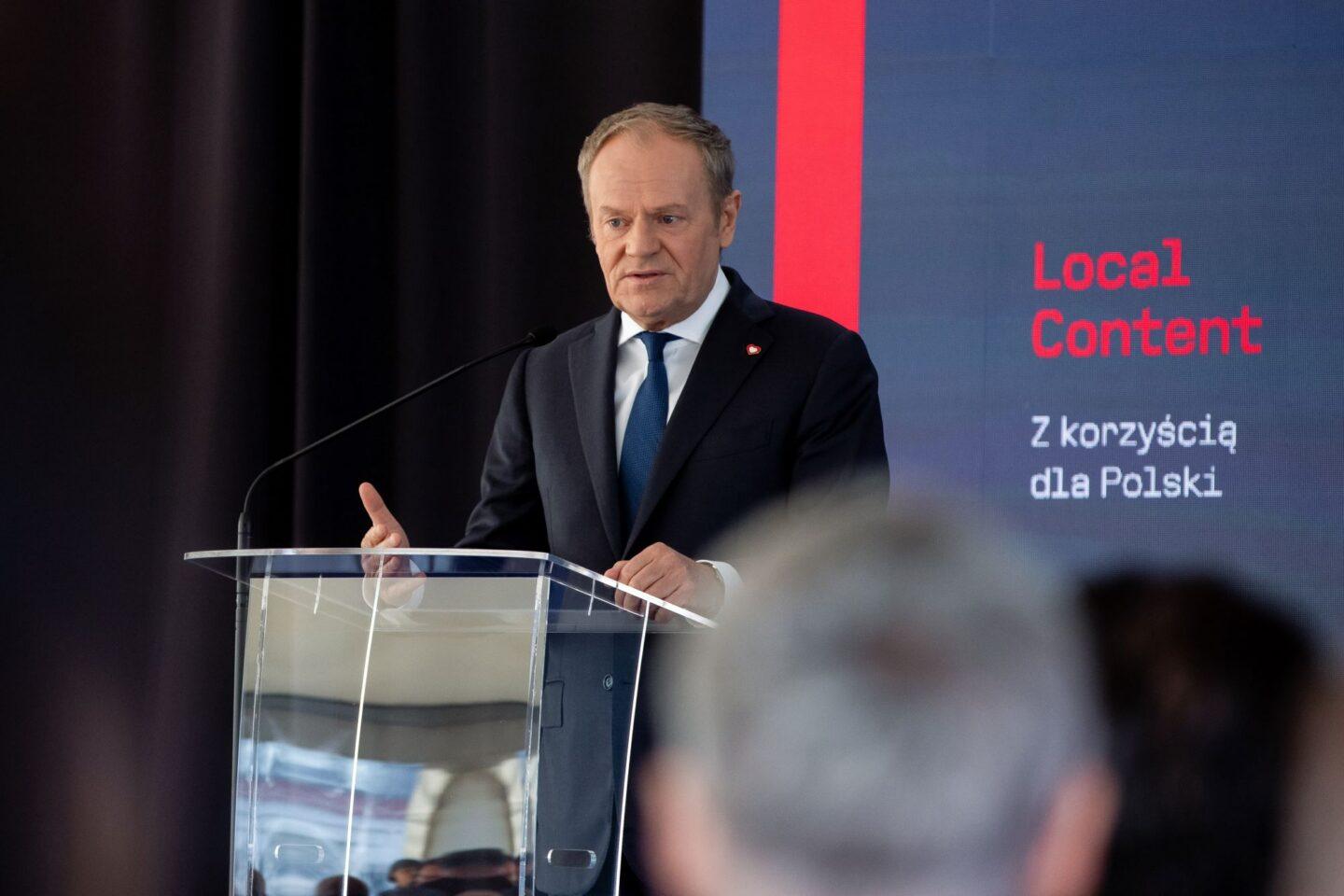
The announcement of the definition of local content, as well as the accompanying KPIs, had been highly anticipated by Poland’s industrial sector and service providers. Wojciech Balczun had already signaled at the end of 2025 that they would be presented. The Ministry of State Assets (MAP) announced that it adopted the definition of local content in February 2026 and had planned to present it in early March. That deadline was ultimately postponed to April. Donald Tusk and Wojciech Balczun presented what would be classified as domestic content, and clarified how companies operating in Poland – but belonging to international groups while paying taxes locally – should be treated. The conference was held at the headquarters of Apator, located near Toruń, a Polish company supplying measuring devices and systems such as electricity meters.
“Local content is a matter of sovereignty. It is about ensuring that decisions on what to produce are made in Poland. This is not straightforward, given that we belong to the EU. That is important for us, but we will do everything to implement the slogan ‘choose Polish.’ We will look for every available way to do so. No one will convince me that the EU can forbid us from intelligently favoring Polish companies,” Prime Minister Donald Tusk said during the conference.
Wherever possible, choose Polish
The premise of the plan is straightforward: entities spending public money are to prioritize companies operating in Poland. If a given product or service is not offered by a Polish company, the second choice should be European suppliers, followed by providers from countries that cooperate with the EU. This category includes primarily the United States, as well as Asian partners such as Japan and South Korea, and non-EU European countries like the United Kingdom and Norway.
“There are areas where a Polish product cannot replace a unique offering available only from a foreign company. But we must use every opportunity to choose Polish wherever it is possible. We must ensure that everyone internalizes this – white and red is better [the colors of the Polish flag – ed.]. From today, the idea of local content becomes our shared commitment. Foreign influence must not affect what we produce here. A politician who promotes foreign production at the expense of domestic industry is not a patriot – and that does happen. Yes, we will be egoists, in the sense of looking after our own interests,” said Donald Tusk.
Two weeks before the government’s announcement at Apator’s factory, Statistics Poland (GUS) launched a pilot program to measure local content. The measurement will cover both the contracting authority and contractors across three tiers of the supply chain. The pilot will begin in the energy sector. Under its assumptions, companies will report data related to domestic content directly to GUS. The measurement will include elements such as payroll costs, the value of goods and materials sold, services, and other company expenses.
Poland’s economy must change its development model
As Wojciech Balczun argued during the conference, the idea of prioritizing Polish companies is grounded in the belief that Poland needs a shift in its economic development model.
“This is a historic moment. In the autumn of last year, we discussed what should be most important for the government – not only for the second half of its term, but for years ahead. We are now at a point where the transformation phase of the Polish economy is coming to an end. We know what price we had to pay to become the economy we are today. We became a provider of cheap labor, a good market for our partners,” the minister of state assets said during the press conference dedicated to presenting the details of the government’s plan.
Local content in practice: what has the government announced?
There will be no hard statutory requirements mandating the selection of domestic suppliers whenever possible. The option of introducing such rules is constrained, among other things, by EU law, which guarantees all EU companies equal access to the market. Instead, the government is opting for policies and guidelines.
The Ministry of State Assets (MAP) is set to publish a code of best practices for local content. It was announced at the conference that this will happen “without delay,” although no specific date was given. Special requirements will apply to state-owned companies, which will be required to appoint local content officers. Management boards of state-controlled firms will be held accountable for how they implement the government’s re-Polonization policy.
“Recommendations for state-owned companies will be followed by KPIs for management boards. Soft recommendations alone will not be enough – we also need effective enforcement tools,” said Minister Balczun.
The ministry has also prepared a proposed criterion for assessing the “domesticity” of a company to be used in public procurement. The weighting of the criteria presented by MAP is as follows:
- 25% - whether the headquarters of the entity’s owner (beneficial owner) is located in Poland
- 25% - whether the entity’s main line of business is located in Poland
- 15% - whether the entity’s tax residency is in Poland
- 15% - whether more than 50% of employees of the entity pay taxes and social security contributions (ZUS) in Poland
- 10% - whether the entity is registered in Poland in the National Court Register (KRS) or Central Registration and Information on Business (CEIDG) and has conducted uninterrupted operations in Poland for three years
- 10% - whether more than 50% of the entity’s annual revenue is generated in Poland.
 Interactive chart
 Why these criteria?
The framework goes beyond a company’s registered office, taking into account where it actually conducts business, employs staff, and pays taxes. According to the government, this approach makes it possible to include firms that are part of foreign corporate groups but are genuinely active in Poland. At the same time, it is intended to ensure that the re-Polonization policy is not classified as protectionist or as being in breach of EU law.
As outlined by Minister Balczun at the conference – and reiterated by Finance and Economy Minister Andrzej Domański in an interview with XYZ – supporting the domestic component of supply chains is also one of the assumptions of the state procurement strategy adopted by the Council of Ministers at the end of March.
How it is being implemented
The government’s presentation of its detailed approach to local content took place during a conference marking the signing of an agreement between Enea and listed utility equipment manufacturer Apator. Enea is a company with more than a 52% stake held by the State Treasury and one of the four largest energy operators in Poland. Apator will supply the company with smart electricity meters. Under current regulations, 80% of the country is expected to have access to such meters by 2028. The contract, worth approximately PLN 300 million (around EUR 70 million), covers the delivery of roughly 750,000 devices.
“Enea will have PLN 100 billion (around EUR 23 billion) to spend over the next decade. We want as much of that as possible to be spent in Poland. Together with Apator, we are proof that it is possible to design and structure this in a way that keeps production in Poland,” said Grzegorz Kinelski, CEO of Enea.
The importance of state-owned companies working with local suppliers was also highlighted to XYZ by Grzegorz Lot, CEO of Tauron.
“If the areas in which we operate continue to develop, they will become a driving force for the economy. We are strongly interested in ensuring that local companies grow, and we are already supporting that development. Most of Tauron’s investments in the distribution segment are spent locally. We have adjusted our procurement methods to make it easier to cooperate with smaller firms. Long-term cooperation with a large partner is an incentive for them to invest and expand,” said Lot.
PKO Bank Polski CEO Szymon Midera also noted that the bank intends to actively participate in the program. The institution aims to demonstrate a model approach to financing that is also accessible to small and medium-sized enterprises, enabling them to participate in large-scale investment projects.
“We will promote a new investment financing model that will provide greater access to projects, especially for SMEs, as well as improved liquidity. This involves carefully phasing large investment projects and eliminating overlapping guarantees. To achieve this, we will use a proven escrow-account mechanism. This will increase SMEs’ ability to participate in major investment waves so they can build their competencies,” the PKO BP CEO told XYZ.
The government also appeals to local authorities
It will be relatively easy to encourage state-owned companies and public institutions to follow the rules proposed by the Ministry of State Assets (MAP), as the composition of their management boards depends on the ministry itself or other central government bodies. A more difficult challenge will be persuading local governments to choose Polish suppliers, especially if goods or services offered by domestic firms are more expensive.
“I would like to address local governments. The government has no direct influence over their decisions. However, we will effectively build a system for assessing who is implementing projects in line with local content principles. We will create a ranking of local governments. It cannot be the case that EU funds flow to municipalities that do not respect this principle. Of course, no one will force anyone to make economically irrational choices,” Prime Minister Tusk said.


Key Takeaways
- The ministry will present a code of best practices for local content, and managers of state-owned companies are to receive guidelines for implementing the government’s policy in this area. In companies with state ownership, local content officers are to be appointed.
- In the second half of its term, the government aims to prioritize the domestic component in investment projects. This is part of the “re-Polonization” agenda for the Polish economy, which Prime Minister Donald Tusk has long presented as a strategic priority. At a Wednesday press conference, the prime minister said the approach would be based on prioritizing Polish suppliers in investment projects. If that is not possible, the second choice would be European companies, followed by firms from countries maintaining friendly relations with the EU.
- Minister of State Assets Wojciech Balczun presented on Wednesday the definition of local content, understood as the domestic component in investment projects. The measurement of local content is expected to be taken into account in the allocation of public funds. The ministry proposed criteria for assessing the “domesticity of entities” applying for public procurement contracts. MAP identified the company’s registered office and whether its main line of business is located in Poland as the most important factors.