

This article is a part of Poland Unpacked. Weekly intelligence for decision-makers
Who's who
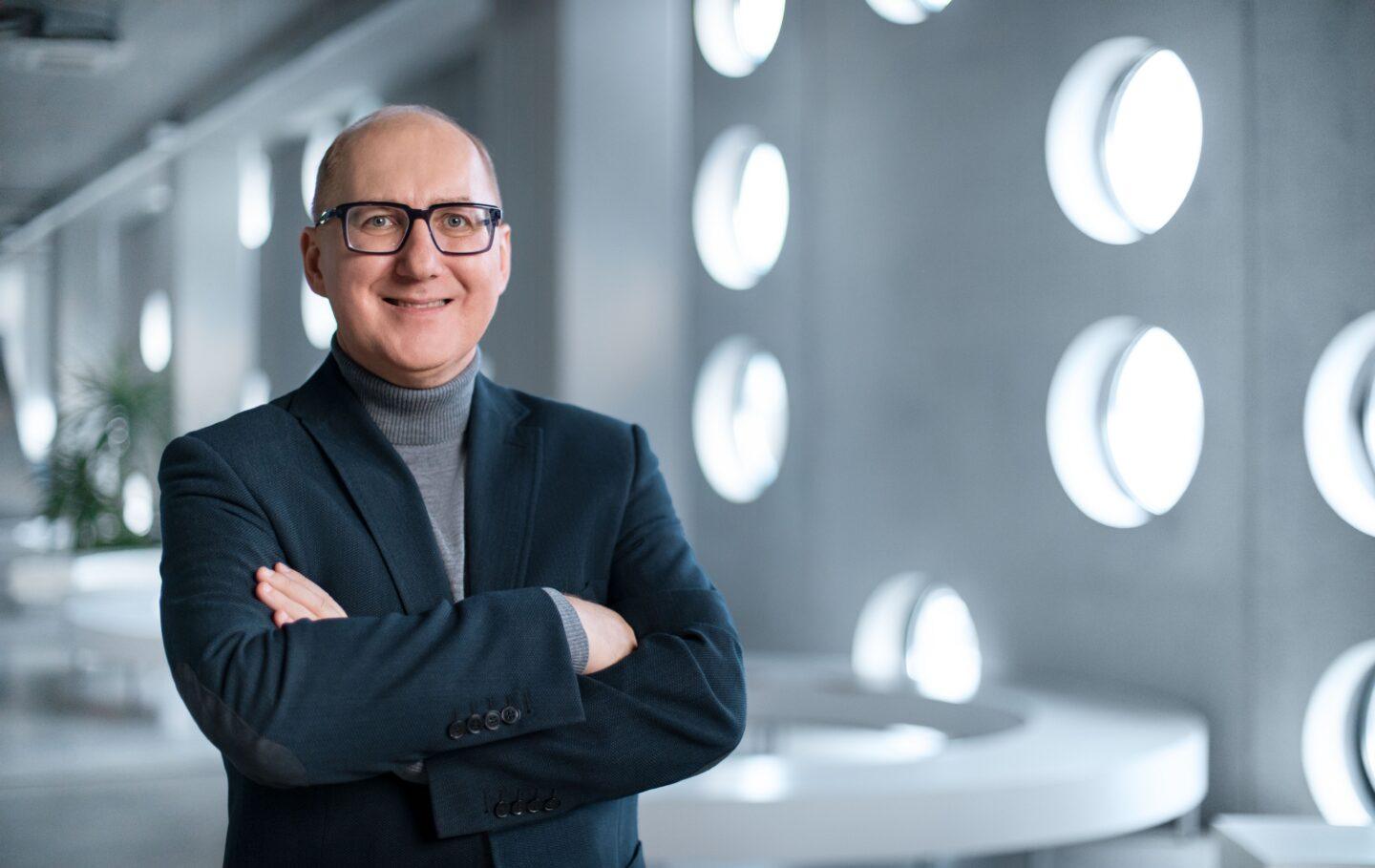
Prof. Arkadiusz Wójs
Rector of Wrocław University of Science and Technology for the 2020–2024 and 2024–2028 terms. A professor of physical sciences, his academic and professional career has been closely tied to the university, where he completed his studies and earned his PhD.
Since 2017, he has been a member of Academia Europaea. In 2019 he joined the Polish Academy of Sciences, becoming a full member in 2025.
He has held visiting positions at the National Research Council of Canada (master’s and doctoral fellowships), the University of Tennessee (postdoctoral fellowship in 1997–2000 and visiting professorship in 2001–2007), and the University of Cambridge (Marie Curie fellow, 2008–2010). He has lectured at universities around the world.
Prof Wójs’s main research interests lie in theoretical and computational solid-state physics. He is a co-author of six books and 187 major scientific papers.
Katarzyna Mokrzycka: Wrocław University of Science and Technology is seeking to host the so-called AI gigafactory investment. Together with the city, you have declared your interest and are actively promoting your bid. Are you also assembling the private component, which is supposed to finance as much as 65% of the entire project? Are you in talks with private capital that would like to join this investment in Wrocław?
Prof Arkadiusz Wójs, Rector of Wrocław University of Science and Technology: There are quite a few companies that support the idea of an AI gigafactory in Poland in general, and in Wrocław in particular. At this stage I cannot disclose any information about money, but the context is broader than the capabilities of investors from a single city or region. The investment costs run into the billions of zlotys, and that is only the beginning. One must also factor in operating costs, securing energy supplies, heat off-take and protection.
When thinking about an investment of this magnitude—an AI gigafactory—its construction in Poland should be supported by the entire Polish business community. Only then can we afford it. Only then can enough capital be mobilized for us, as a country, to build it.
A nationwide interest. Will business understand that?
Only such an arrangement would also generate a sufficiently large base of customers for the services and products produced by such a gigafactory, making the project economically viable. An investment valued at around PLN 12bn must make business sense. That means participation from all major companies, corporations and institutions already using artificial intelligence today: finance, insurance, defence, logistics, but also public administration, hospitals and other entities operating in public services.
If Polish business fragments and starts backing just one city, one location, at the expense of others, no AI gigafactory will be built in Poland. There would certainly be a funding shortfall, and the investment would lose its chance of paying for itself.
So in seeking to locate the investment in Wrocław, you believe it must be a nationwide project?
A 65% private-capital contribution is so substantial that consolidating only companies clustered around a given city or sympathetic to one centre will not suffice. This has to be a collective “whip-round” by Polish business as a whole.
Based on what you know today, is such a consortium actually coming together?
I do not know—and this is not something universities should be dealing with. This is a political matter, one that lies in the interest of the state. I do know that even the best intentions and a commitment of PLN 100m, in whatever currency, from a single investor in a single location…
I assume you are referring to Rafał Brzoska’s project in Kraków.
…and all the other declarations that appear in the media are insufficient relative to the financial needs of building a gigafactory.
Are you not concerned that such a consortium may simply not materialize in Poland? A few months ago, we wrote in XYZ that companies are not even being asked for their views, merely informed that they have been included in a consortium. That is more likely to discourage them than to prompt them to put money on the table.
I trust that the money will nevertheless be found. This is a technological imperative if Poland wants to continue developing. It is therefore also a national interest. The fact that we are not aware of something does not mean that discussions are not taking place. The issue is too important to be discussed openly in real time. I hope the government is dealing with it.
I believe that Wrocław University of Science and Technology—and Wrocław itself—offers the strongest competence centre, the broadest base of researchers and PhD candidates in artificial-intelligence development. We also have the best location in terms of security and the provision of electricity and heat off-take. But location is a secondary, more technical matter. What matters most is securing the funding for the project; only afterwards does the question of where it will be located come into play.
As the saying goes: you cut your cloth according to the energy you have
You raised two key issues—aside from financing—that are decisive in choosing a location: the pool of specialists and access to energy. Do you already have everything in place, or is it a matter of assembling enough scientists and securing energy supplies once Wrocław University of Science and Technology is selected?
We already have the people. We are the strongest scientific and research centre in artificial intelligence in Poland. Of course, it would be wonderful to have four times as many people, but even today this is the country’s leading hub. We have the largest computer-science faculty in Poland, employing the highest number of researchers, educating the most PhD candidates and producing the greatest volume of publications.
Artificial intelligence is a special kind of technology. For Wrocław University of Science and Technology, it is the foundation of our development strategy—the number-one priority research area. That is where we have the most students and where the largest funds are directed. Wrocław more broadly is one of the few strongest academic centres in the country. The University of Wrocław also has a powerful computer-science base. If, alongside the gigafactory project, we were to combine our academic resources, we would be unbeatable.
When it comes to energy, it is worth reversing the question and asking how large a gigafactory we can realistically build on Polish soil. Globally, projects of this kind are often accompanied by debates about creating additional, independent and massive energy sources. In Poland, that is unlikely. Our reality is that we must connect to the existing power system.
We have to accept that our gigafactory will not be large compared with facilities planned in China or the United States. Even so, it would still represent the greatest computing power ever built in Poland—and in this part of Europe. And Wrocław already has the energy resources to support that.
I am aware that we are not the only city competing for this investment. It may well be feasible elsewhere, too. But Wrocław offers the most.
This may sound like a strange question, but if you are already so strong, why do you need a gigafactory at all? You yourself have said that, regardless of location, various entities across the country would use it.
Because we have the greatest potential to contribute to the development of artificial intelligence in Poland. Our university does not pursue science as a hobby or on a niche scale. Our priority is to develop those areas in which we are competitive, and to do so at an international level.
That raises another question. Can a single Polish university—even with a gigafactory—realistically compete with powerful foreign research centres, especially in artificial intelligence? Would it not make sense to consider consolidating efforts around the gigafactory together with other universities?
Polish universities should begin talking seriously about some form of consolidation. In all key, priority areas, forces need to be joined. Our institutions are simply too small to compete internationally on their own.
We will certainly cooperate with other Wrocław-based universities in areas of shared interest. Beyond artificial intelligence, Wrocław is also very strong in space technologies. In that case, cooperation among as many as three universities is possible. Wrocław University of Science and Technology has its own specialisation—microsatellites—and we already work closely with many local start-ups in this field. On the other hand, the University of Environmental and Life Sciences has enormous potential in satellite-based Earth observation. And the University of Wrocław is active across all these areas.
Wrocław is also seeking to host the Polish headquarters of the European Space Agency’s Technology Centre. In my view, this makes excellent sense—not only because of the academic expertise in the space sector, but also thanks to the surrounding business and start-up ecosystem.
Is cooperation within a single city sufficient? Or would a regional approach deliver greater results? How do you see a model in which all the strong centres in southern Poland—say, Wrocław, Katowice, Kraków and Rzeszów—jointly compete to host an AI gigafactory, while also combining forces as a research hub? Is that feasible?
Not only can I imagine such a model—I would be keen to be involved in it.
Cooperation among universities within a city and across a region are not mutually exclusive. Logistically, it is easier for researchers to work together within one city, of course. But Wrocław and Kraków are barely three hours apart by car; that is hardly a prohibitive distance. It is not uncommon for a researcher to hold positions at two universities. One of the winners of our Lem Scientific Award works simultaneously in Zurich and Basel. Distances like that pose no obstacle at all.
A technical university can reconcile forces that may seem contradictory
Leading universities in the United States, Europe, Japan or Australia—those employing the world’s top talent and hosting breakthrough research—are typically far broader in scope than their Polish counterparts. The norm is a wide academic ecosystem, as interdisciplinary as possible. I think of this as a federation of islands, united by a common banner, culture and commitment to excellence. What distinguishes these institutions globally is their ability to work together effectively. Medicine and engineering do not merely coexist at the same university; they influence one another, collaborate and develop joint research projects. Law coexists with the arts, while the space sector interacts with anthropology, sociology or ethics.
In Poland, we must try to replicate all the advantages that come with a large, comprehensive university. This is beginning to happen, but so far only in a handful of centres. Some universities already combine engineering, the humanities and medicine, and are attempting to create joint research projects. Institutions that are not yet doing so should build such models either through expansion—by adding new disciplines—or through cooperation with another university. What matters is combining research potential as often as possible within academic centres, thereby strengthening their international standing. This would finally unlock and unleash the potential of Polish scientists, innovators, researchers and inventors.
The future belongs to large research hubs. The era of isolated, narrowly profiled institutions is coming to an end. At Wrocław University of Science and Technology we have launched a Faculty of Medicine. Until recently this might have seemed surprising, but at a time when medical sciences are increasingly driven by artificial-intelligence algorithms, it is a natural next stage in the development of a technical university.
I also fully agree that large Polish universities should cooperate beyond the boundaries of a single city—for instance across southern Poland. For now, however, we tend to compete with one another more than we collaborate. Competition can be useful, as it forces greater effort. Yet constant rivalry for investment and research funding ultimately makes cooperation harder.
I am less familiar with the dynamics among comprehensive universities, but in the case of technical institutions the pattern is clear: Polish polytechnics seek allies in Europe in order to win local competition at home. Virtually every serious Polish university is now part of some European network. We belong to the Unite! European University Alliance. I readily admit that this is a powerful development lever, particularly for research. But the same logic could be applied to cooperation among Polish universities located in different cities. One could imagine, for example, an alliance of major Polish technical universities—AGH, Warsaw University of Technology and Wrocław University of Science and Technology—in a field where all are strong, such as artificial intelligence.
So far, nothing substantial has happened in this direction. If it did, it would be excellent. It may yet turn out that circumstances force such cooperation upon university leaders. If full mobilisation becomes necessary for an AI gigafactory to be built in Poland, the national interest may outweigh universities’ natural inclination to compete.
Would you be satisfied with such an outcome?
It would be wonderful.
A year ago, the rector of the Warsaw School of Economics said in an interview that mergers among universities are inevitable; otherwise many institutions will face closure. Demographic trends suggest that student numbers will continue to fall. Could this be an additional argument in favour of closer cooperation among universities?
I am convinced that universities should merge or be merged - but not because of demographics. Demography is not the key issue. Even if student numbers fall sharply in the near future, as now seems likely, that will not necessarily be detrimental to universities. The reason is simple: at Poland’s leading institutions, there are still too many students.
At Wrocław University of Science and Technology, we currently educate around 22,000 students. Although we have reduced this number from more than 30,000, our academics are still overburdened with teaching relative to research.
Are there too many students at Polish universities?
At the world’s leading universities, research staff are able to devote a much greater share of their time to research than to teaching. In Poland, we have not yet achieved that balance.
The teaching load on Polish researchers is noticeably heavier than at the foreign institutions we aspire to match in research terms. Too large a share of students in Poland not only fail to complete their studies, but begin them without any real intention of committing fully. As a result, teaching effort and other university resources are not used efficiently. Small comfort comes from the fact that, in this respect, Poland does not differ markedly from European averages.
At the same time, we are trying to live up to the ambitions awakened by Poland’s accession to the European Union. We are increasingly winning prestigious European Research Council (ERC) grants—funding that, only a few years ago, we did not receive at all. But competition for these grants is fierce at the international level. We also compete for visiting scholars, guest lectures, networks, prestige and awards. Everything we do at technical universities—what we research and publish—is assessed internationally. All of it must be benchmarked against global standards.
Yet the conditions under which Polish researchers work are not on a par with those in Europe, among other reasons because of excessive teaching loads. Low levels of research funding are one issue, but we must also start saying out loud that Polish academia is burdened with too much non-research work. Reducing student numbers somewhat would improve the quality of education and make universities more creative in scientific terms.
Are you saying that a lecturer’s biggest problem is having to teach?
What I am saying is that nothing bad will happen if there are slightly fewer students at universities—provided they are better supported. Reducing student numbers at Poland’s leading universities and technical institutions should actually benefit them, making them more competitive in research terms.
I would like political decisions in Poland to be shaped with this perspective in mind—to see an opportunity, rather than a threat, in declining student numbers. This would allow academics to devote more time and effort to translating their knowledge into concrete solutions for the economy, business and the state.
I still believe, however, that universities should strive to merge. There is simply a more important reason for consolidation than the risk of having too few students. As I have said, education and student development are stronger at multidisciplinary institutions. This increases the likelihood that graduates will emerge as decision-makers—creative, effective individuals. Young people prepared not only to perform tasks, but also to make decisions, shape processes and drive change. Their knowledge will determine the country’s development.
But for that to happen, an engineer specialising in electronics must, at some point, encounter both a humanist and a medical professional. They must understand their perspectives and be able to offer them something in return.
The capital represented by such a well-rounded cohort of young talent is today one of the strongest assets of Wrocław University of Science and Technology. It begins with student societies, continues through the doctoral school and early-career researchers—young PhDs—and culminates in young group leaders: habilitated doctors who supervise doctoral candidates while running their own research programmes.
How to support student inventions so they do not leave the country
I recently spoke with Jędrzej Kowalewski, the chief executive of Scanway, a Wrocław-based space-technology company. He said that he personally helps students financially when they want to test technologies or inventions abroad that they are developing at university, because academic institutions offer too little support. Everyone in Poland is happy to point to Iceye and its Polish roots, but the fact is that Rafał Modrzewski founded the company in Finland as a student, because there was no real chance of doing so in Poland. How can the model for supporting innovative ideas at the student stage be changed at technical universities, so that innovators do not leave for abroad?
We already have such mechanisms in place. Wrocław University of Science and Technology has a record-high budget for student activities compared with other universities, including support for young innovators working in student research clubs. The student government alone has PLN 2m a year at its disposal from the university’s budget. Over the course of the year, additional funds flow to various student events; faculties allocate resources to their own research clubs under internal policies; and financing also comes from companies cooperating with young inventors. For firms, student research clubs are a gold mine of talent—future creative employees.
In light of what you have said about conducting research for the needs of the economy, how do you assess ideas to increase universities’ mandatory engagement with business? This theme keeps returning in different forms. In 2025, for example, there was talk of forcing universities to produce more patents, as well as the possibility of obliging companies to finance joint research projects with academia.
The world’s leading economies are largely knowledge-based—that is, they rely on research, on creating new knowledge domestically and within their own ecosystems. That is why developing stronger interaction between Polish universities or research institutes and business is in the interest of the Polish economy.
That said, I am convinced that the role and responsibilities of different types of universities are not the same. A comprehensive university dominated by non-technical disciplines bears less responsibility for the ongoing transfer of knowledge to the economy. The role—and responsibility—of technical universities is greater. Polytechnics must think about transferring knowledge to the economy on a continuous basis, not only about entirely abstract problems. In my view, the responsibility of Polish technical universities for economic development is still being fulfilled inadequately.
At the same time, universities must be allowed to do big things. By “big things” I mean research that is not commissioned—work driven by a scientist’s own intellectual curiosity and fundamental questions. This, too, is a core mission of a university. A university is an oasis of free, creative thought, not a pool of qualified workers solving problems on demand. We must have the freedom to pursue grand ideas, even if no one is asking for them today. That is how breakthroughs, discoveries and progress are formed.
The difficulty, of course, is that whether something is truly “big” often becomes clear only years—or even decades—later.
And that is exactly how it should be. Not every research project must deliver results, especially quickly. What is often lost in public debate is that science has a social and civilisational duty to develop innovations not only for the economy as we know it today, but also for the economy we are only beginning to imagine—or cannot yet imagine at all. Nuclear fusion technology may one day give us virtually free electricity, just as the internet delivered almost free communication. That will transform the entire economy around us, and the role of universities is to shape new concepts for a changing world.
Patents will not change science
I still think that, to defend the argument that a university with fewer students and an unchanged academic staff has value and purpose—that it deserves to maintain its level of public funding and remain an “oasis of free, creative thought”—additional justification will be needed. The questions will inevitably be asked: how many inventions did Wrocław University of Science and Technology apply to patent last year? How many were commercialised? How many cooperation agreements were signed with companies?
At Wrocław University of Science and Technology we have been increasing our presence in the economy for several years now; this is part of our new strategy. Over the past decade, we have been granted nearly 900 patents in total—almost 90 a year. More important still, however, are our joint research projects with business partners, as well as research and expert work carried out at their request. And, of course, the competencies of our graduates, especially in key areas.
In those areas, I would like to see not just gradual improvement, but a genuine leap forward. Still, the top priority—fully consistent both with my diagnosis of the university’s condition and with state policy—remains not patenting, but academic excellence, particularly in the technical sciences.
You asked how I assess the idea of increasing subsidies for universities that focus on patents and cooperation with business. My assessment is that this is not a change that would materially alter our financial situation. Even if, as a result of better or worse evaluations, all our disciplines were to change category—which is entirely unrealistic—the total funding would shift by less than 5% of our overall budget. These are not sums that would radically change a university’s fortunes.
Far more important will be the outcome of the IDUB competition—Initiative for Excellence – Research University—and the size of the budget of the National Science Centre (NCN).
Should I read this as meaning that you are not particularly invested in this change, or that you are opposed to it?
What I am saying is that funding linked to patents within the university evaluation process would be a modest addition to our budget. Much larger funding streams for universities will continue to come from grants and European research programmes, such as those of the National Science Centre or Horizon Europe.
Different times, different tasks for universities
The Ministry of National Defence has recently announced plans to establish a Regional Defence Group in Lower Silesia. Will Wrocław University of Science and Technology be involved in this project as well? Is this even a role for a university?
I think there is no doubt at any Polish technical university today that engagement with the defence and armaments sector is a duty. Our strategy explicitly предусматри increased involvement in these areas. We have already established an interdisciplinary research centre focused on materials engineering, which may be relevant, for example, to the production of artillery ammunition. Another centre will soon be launched, one that will also develop our competencies in explosives.
Polish technical universities still do not play an adequate role—whether in the defence industry or in economic development more broadly. This limited engagement is also visible when compared with leading technical universities in Switzerland, Germany, France or the United States. That said, there is both the will and the momentum for change.
Abuses in academia: the elephant in the room
The last issue I would like to raise is a difficult one—for both of us. Please do not take my question personally; in an interview opening a new academic year, it simply has to be asked. 2025 was a challenging year for academia. The sector is dissatisfied with funding levels, pay and the management of research institutions. I agree that we need stronger knowledge transfer—only that will allow the Polish economy to move to a new level of development. But the more I write about science, the more concerned I become about stepping on a landmine. After some conversations, I receive anonymous emails about mobbing allegedly concealed by university authorities; the media report abuses by senior officials, opaque ties between rectors and business, overly expensive cars for university leadership, or personnel reshuffles linked to people in power. Shouldn’t Polish academia finally change its rules—open up, air itself out, revise its models, and sometimes remove the “rotten apples from the basket”?
Indeed, even at our best, largest universities there are reports of serious problems: nepotism, politicisation, activities bordering on corruption, mixing institutional interests with private ones, and so on. This damages not only the image of Polish academia—the worst part is that it blocks universities’ development prospects. Completely. The worst scenario is when, instead of tackling problems, university authorities sweep them under the rug.
Our own policies are transparent. I am not saying we have no problems—that would not be true. We employ 5,000 people. In an organisation of this size, it is impossible that improper behaviour never occurs. We receive reports of mistreatment at work, inappropriate relationships, sometimes unfair evaluations or favouritism—and we address them.
I have never heard one rector publicly criticise another. Do you think that would be an excessive reaction? Academia rightly demands more funding. But if it wants a social licence to do so, shouldn’t it be beyond reproach?
Academia does not have to be beyond reproach. It has to be normal—like in the rest of western Europe. Academic institutions should function much like banks or hospitals. But I agree that, objectively, they do not yet function as they should. Universities are not reforming quickly enough when it comes to management culture or the culture of professional relationships. Problems erupt in unexpected places—as we saw recently with cases of violence at art schools. It is as if not all decision-makers in Polish academia have come to terms with the fact that the old days of feudalism and professorial abuse are over—abuses that, not only in Poland, included exploiting young researchers and their work or blocking their careers.
As rectors, we do not usually comment publicly on reprehensible behaviour. But that does not mean we do not call it out, criticise it and push for change within appropriate, authorised forums.
So academia is changing - just too slowly?
Compared with the state of affairs decades ago, the change is very visible—but it is always too slow from the perspective and expectations of young researchers. Still, that tension is a good thing: it is a precondition for change and improvement. I have no doubt that relations at our universities are still not what young academics—many of whom have already experienced other universities around the world—know they could and should be.


Key Takeaways
- An AI Gigafactory as a national project - ideally in Wrocław. Prof. Arkadiusz Wójs, rector of Wrocław University of Science and Technology, argues that his institution and the city of Wrocław offer the best location for the investment, thanks to their research base and concentration of AI specialists. Such a costly project - around PLN 12bn - requires, however, that business looks beyond where the facility is ultimately built. Regardless of location, activities must be tightly integrated. Fragmentation of effort would make delivery impossible.
- University cooperation as a prerequisite for competitiveness. Universities should consolidate their capabilities locally, regionally, and nationally—for example, technical universities in southern Poland—to compete internationally. AI and space technologies are cited as prime examples. Competition between institutions can be a brake, Prof. Wójs argues, but a national interest—such as an AI gigafactory—can force cooperation. He also advocates greater interdisciplinarity: the university has launched a Medical Faculty, a move intended to enhance graduates’ appeal to business.
- Merging universities and shifting focus from teaching to research. An excessive number of students burdens academics with teaching, undermining research creativity, says Prof. Wójs. Reducing student numbers would improve quality—both of education and of universities’ contribution to Poland’s economic development. Technical universities must transfer knowledge to the economy while retaining the freedom to choose research topics. A change in the operating model, he argues, could enable polytechnics to be used more effectively in developing concrete solutions for the Polish economy.