

This article is a part of Poland Unpacked. Weekly intelligence for decision-makers
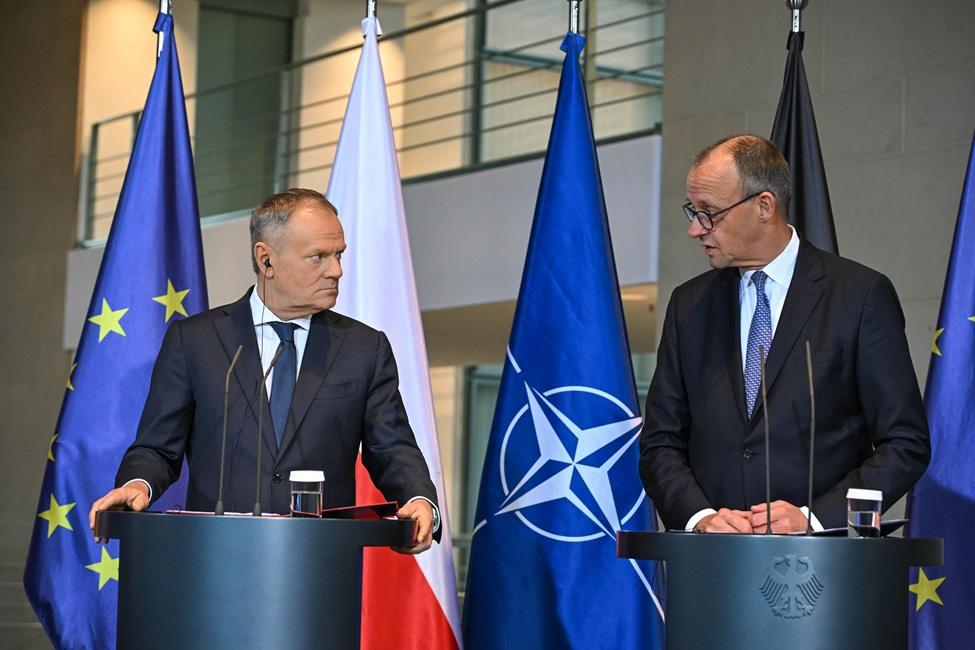
After last Monday’s meeting with Chancellor Friedrich Merz, Tusk hailed Polish-German cooperation on defending the EU’s eastern frontier as a “Copernican revolution” in European politics. Talks spanned security, infrastructure, and historical memory - a subject that remains acutely sensitive in Poland.
On the latter, Merz promised to speed up the restitution of cultural property looted during the war and pledged a monument to Polish victims of German occupation. The Bundestag backed the idea on Wednesday with a resolution calling for the memorial.
Questions about reparations inevitably arose. Last year, Berlin suggested EUR 200 million for surviving Polish victims - a sum that Warsaw viewed as largely symbolic. The underlying tension is clear: can Tusk turn words into leverage, or will this bold gesture fade into domestic theatrics?
Prime Minister Tusk to German Chancellor on reparations: “Time is running out”
Prime Minister Donald Tusk reminded Chancellor Friedrich Merz that when he raised the issue with his predecessor, Olaf Scholz, there were roughly 60,000 World War 2 survivors in Poland. Today, the Polish-German Reconciliation Foundation estimates around 50,000 remain who could claim compensation for German wartime crimes.
“Hurry up if you truly intend to make this gesture,” Tusk said in Berlin. “If we do not receive a swift and clear declaration, I will consider a decision next year for Poland to meet this need from its own resources. I will say no more on the matter.”
Tusk’s appeal to Germany sparks debate at home
Jan Grabiec, head of the Prime Minister’s Office, suggested that Chancellor Friedrich Merz did not receive Tusk’s appeal calmly. According to Grabiec, Merz saw the Polish prime minister’s remarks as an “undiplomatic jab.”
Reactions in Poland were sharply divided. President Karol Nawrocki, along with the leaders of Law and Justice (PiS) and the Confederation (Konfederacja), criticized Tusk’s comments.
Nawrocki argued that asking “a nation that suffered persecution” to pay reparations is “contrary to historical truth, logic, and any values,” and called on the prime minister to apologize. Jarosław Kaczyński, leader of PiS, suggested on X that any compensation considered by the Polish government should instead come from Germany.
At a press conference on Tuesday, government spokesman Adam Szłapka defended Tusk. He said the German chancellor “understood and appreciated” the prime minister’s words. Referring to Monday’s Berlin meeting, Szłapka noted that Tusk emphasized Germany’s reliance on a 1950s diplomatic act that waived reparations—“a decision made without the consent of the Polish people.” To this day, he said, Poland has received no compensation.
Will Tusk’s public pressure on Germany be effective? Experts agree that Germany should provide reparations to surviving Poles, but they differ on the form Tusk’s intervention should take.
Diplomacy for domestic purposes?
Prof. Anna Pacześniak, a political scientist and European affairs expert at the University of Wrocław, acknowledges that diplomacy cannot be divorced from domestic politics—“especially in Poland.” She notes that German media have observed Polish-German relations are, in some sense, hostage to events in both countries.
“Chancellor Merz also answers to someone, not just political parties but voters, including the Alternative for Germany (AfD). In Poland, Donald Tusk is speaking to Law and Justice and, to some extent, its supporters, as well as to the Confederation and its voters. What we are hearing from Germany is a reflection of Poland’s domestic political scene. Because these dynamics are now playing out openly, they inevitably influence bilateral relations,” says Pacześniak.
She adds that relations were also tense under Olaf Scholz, but that Merz and Tusk belong to the same European political family—the European People’s Party. “We are seeing the consequences of the United Right’s rule and of Tusk positioning himself as a supposedly pro-German politician, a stance he feels obliged to deny from time to time,” Pacześniak explains.
“An attempt to publicly embarrass a partner”
Prof. Anna Pacześniak sees the prime minister’s move as a rare diplomatic tactic: applying pressure by publicly embarrassing a counterpart.
“From my perspective as an observer of foreign policy, the prime minister resorted to an argument seldom used in diplomatic relations. This was not about reparations, as PiS claims, but about compensation for living victims of Nazism. It was an attempt to put a partner on the spot—someone who, on the international stage, presents themselves as a champion of values,” Pacześniak explains.
A crisis that hurts both sides
Such gestures in diplomacy rarely win praise. Janusz Reiter, Poland’s ambassador to Germany from 1990 to 1995, argues that publicly displaying toughness does not signal true strength. He sees Monday’s events as exposing a broader crisis in Polish-German relations.
“The question of compensation for victims requires urgent resolution. Of course, this is Germany’s obligation, which the German government acknowledges. This will not, however, heal Polish-German ties—it is about people for whom this support is crucial, both materially and morally. Unfortunately, the visit revealed the fragility of bilateral relations. The pressure on Polish leaders to demonstrate toughness to Germany is not a sign of strength. Polish-German relations are in crisis, to the detriment of both sides,” Reiter observes.
“Activate the mechanism as soon as possible”
Prof. Stanisław Żerko, a historian at the Western Institute in Poznań and the Naval Academy in Gdynia, offers a different perspective—though he has reservations about the Polish government’s handling of the issue.
“The only thing I take issue with in Prime Minister Tusk’s announcement is that he is merely considering this option. This mechanism should be activated immediately; I have written about this possibility before. It is also a pity that the prime minister did not clarify that these amounts would later be presented to Germany. Italy adopted a similar approach a few years ago,” Żerko notes.
Overall, the historian views Tusk’s gesture positively. He believes a public appeal could prompt Germany to reconsider its rigid stance.
“It was significant that these words were spoken in Berlin, in front of the chancellor, who appeared clearly unsettled. Yet the reactions of Poland’s right-wing opposition reinforce my view that, for them, the reparations issue is mainly a domestic political tool. It is also used to stoke anti-German sentiment. I am increasingly convinced that PiS is gripped by a kind of anti-German paranoia,” Żerko adds.
No chance for reparations. What next?
Prof. Stanisław Żerko points to the political narrative advanced by PiS on reparations. On 1 September 2022, PiS MP (later Deputy Foreign Minister and now MEP) Arkadiusz Mularczyk presented a report estimating Poland’s war losses at $850 billion. The report was circulated to foreign politicians, including in Germany, but no formal reparations claims followed.
“There can be no question of reparations; anyone demanding them either misunderstands the issue or is being disingenuous. That said, there is a German debt of compensation to Poland—real, ongoing, and unresolved. Polish-German reconciliation cannot proceed without addressing it. Of course, we are not talking about trillion-dollar sums; that is absurd. A compromise must be found, through constructive, friendly dialogue between the two countries,” Żerko explains.
The Bundestag test
The next Bundestag session could test the impact of Prime Minister Tusk’s public appeal. German MPs are set to debate pension policy—a discussion that may also touch on compensation for Poles who survived World War II.
But interpreting Chancellor Merz’s reactions is not straightforward. “We don’t even know what he heard when Tusk’s statement was being translated,” warns Prof. Anna Pacześniak of the University of Wrocław. “Speculation that Germany is brazenly withholding payment, or secretly pleased someone else will pay, is too simplistic. Diplomacy does not work that way.” Pacześniak sees a scenario in which Tusk could score a diplomatic win. “If Poland were to advance the payment, it could then present Germany with a bill. This is far smaller than the $850 billion estimated by MP Arkadiusz Mularczyk, and it would not close the reparations debate. Yet the move would put Chancellor Merz in an uncomfortable position and signal Poland’s resolve. We will only know the outcome after Friday’s Bundestag vote—perhaps, as the saying goes, ‘we will know them by their fruits.’ If the decision favors Poland, Tusk will have shown a firm stance and, within days, secured a result.”