

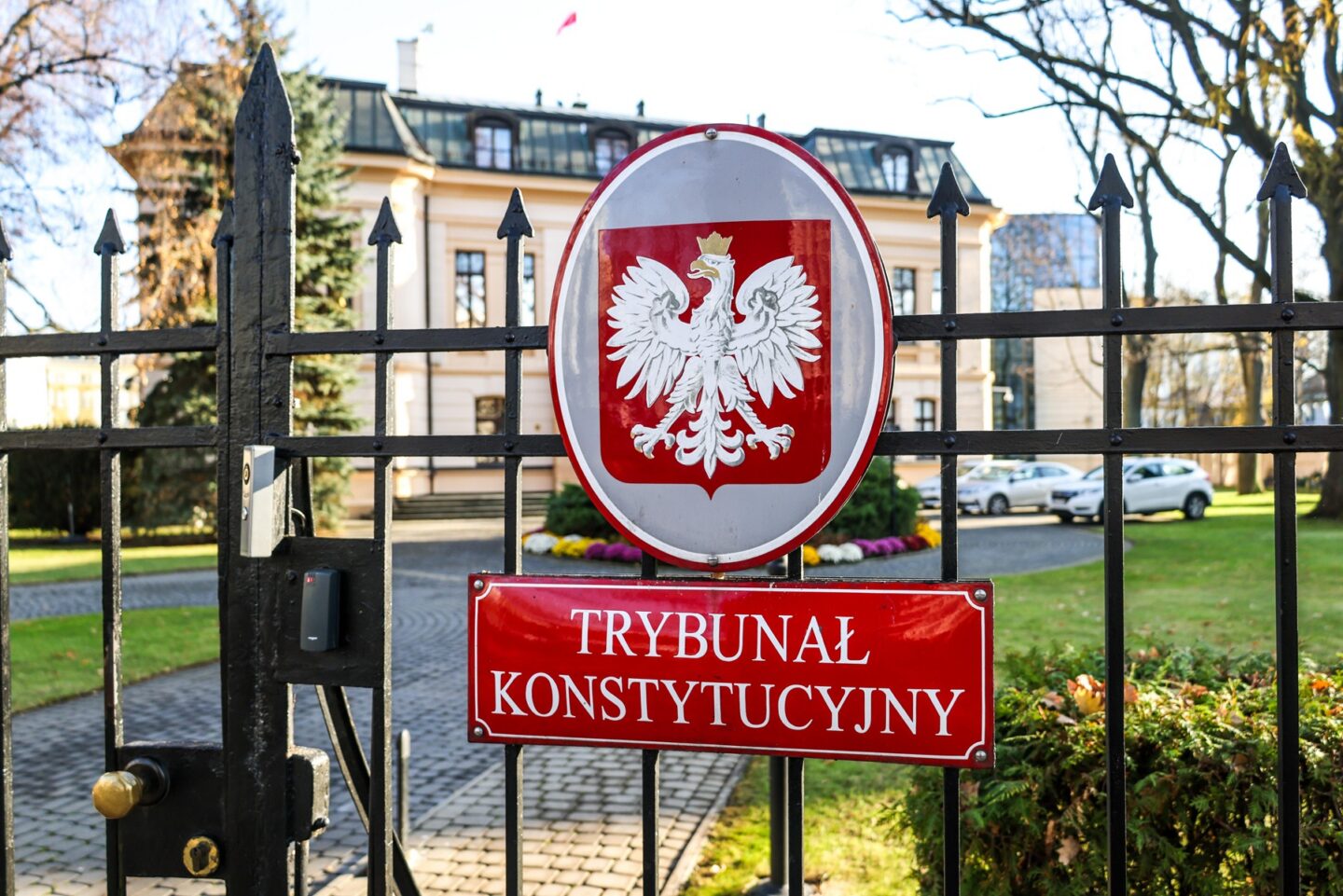
This article is a part of Poland Unpacked. Weekly intelligence for decision-makers
The decision opens the door to challenging rulings issued by the Polish body with the participation of so-called “stand-in judges” – individuals appointed to seats already lawfully filled. It may also mark a turning point, creating space for changes to the Constitutional Tribunal itself.
The Court of Justice of the European Union found that Poland’s Constitutional Tribunal, by failing to respect ECJ case law, breached several fundamental principles of EU law.
The ECJ also ruled that the Tribunal does not meet the standards of an independent and impartial court established by law. The reason lies in the improper appointment of three of its members as well as its president. The ruling refers to the so-called “stand-in judges” – members of the Constitutional Tribunal appointed under the Law and Justice (PiS) government to seats that had already been filled at the end of the 7th term of the Sejm (during the final phase of the PO–PSL administration) – as well as to the former president of the Tribunal, Julia Przyłębska.
The ECJ ruling on Poland’s Constitutional Tribunal
The Court of Justice of the European Union examined two judgments of Poland’s Constitutional Tribunal that, in its view, violated EU law. The first was the ruling of October 7th 2021. According to the ECJ, it breached the principle of effective judicial protection by denying national courts the authority to review the legality of judicial appointment procedures. At the time, the Constitutional Tribunal rejected the possibility of scrutinizing resolutions of the National Council of the Judiciary, which had recommended candidates for appointment and for adjudicating on defects in those procedures.
That judgment was issued in response to a question referred by then prime minister Mateusz Morawiecki. He had asked the Tribunal to provide a comprehensive ruling on the alleged conflict between norms of European law and Poland’s constitution.
The Constitutional Tribunal, then chaired by Julia Przyłębska, held that provisions of European law empowering national courts to disregard constitutional provisions or to adjudicate on the basis of repealed norms were incompatible with the Polish constitution. It also stated that EU treaties, as instruments of international law, take precedence over domestic law at the statutory level, but cannot override the constitution.
The Constitutional Tribunal refused to comply with an ECJ order
The second Constitutional Tribunal ruling challenged by the Court of Justice of the European Union was issued on July 14th 2021. The ECJ found that, in this case as well, the Tribunal had breached the principle of effective judicial protection. Poland’s Constitutional Tribunal refused to recognize the binding force of interim measures imposed by the ECJ concerning the structure and jurisdiction of the Polish courts, as well as procedural rules governing judicial proceedings.
At the time, the Tribunal declared a provision of the EU treaties unconstitutional. On the basis of that provision, the ECJ had ordered – by way of interim relief – the suspension of the Disciplinary Chamber of the Supreme Court pending a final judgment by the Luxembourg court. The ECJ subsequently imposed daily financial penalties on Poland for failing to comply with that order.
The ECJ ruling: What comes next?
What does the ECJ’s ruling mean in practice? According to Przemysław Rosati, president of Poland’s Supreme Bar Council, there is little room for ambiguity: Poland must comply with the judgment. Failure to do so could expose the country to financial penalties, which the Court of Justice may impose at the request of the European Commission.
In an interview with XYZ, Mr. Rosati stressed the importance of ensuring that, going forward, Polish state institutions refrain from adopting legal acts that violate the fundamental legal order of the European Union.
“Poland joined the European Union voluntarily, but that entails accepting the primacy of EU law as part of the domestic legal order. The Constitutional Tribunal therefore cannot engage in judicial activity that encroaches on matters reserved for the ECJ. Nor can it interpret the treaties – that is the purpose of preliminary-ruling proceedings before the ECJ. By the same token, the Tribunal cannot declare the Polish constitution to be superior to EU law. These are issues that can and should be addressed through case law that remains within the Constitutional Tribunal’s competences and objectives. If Poland’s constitutional court were to respect these boundaries, we would not be facing ECJ rulings such as today’s,” Mr. Rosati said.
In short, the Constitutional Tribunal cannot adjudicate on matters reserved to the ECJ, cannot interpret EU treaties, and cannot assert the primacy of the Polish constitution over EU law.
The status of “stand-in judges” called into question
Speaking to XYZ, Krzysztof Izdebski – a lawyer, civic activist, and member of the Civic Legislative Forum at the Stefan Batory Foundation – described the ECJ’s decision as expected and consistent with the earlier opinion of the Court’s advocate-general, Dean Spielmann.
Mr. Izdebski stressed that the ruling confirms both the defective status of the so-called stand-in judges and the lack of independence of Poland’s Constitutional Tribunal.
“Of particular interest is the issue of the appointment of former president Przyłębska, as the current president, Bogdan Święczkowski, was chosen in a similar manner. This may well be used to challenge his presidency as well – together, I hope, with the nomination of candidates to fill vacant seats on the Tribunal. This opens up room for action by the current government. I hope it will not become a pretext for subordinating the Tribunal to the present parliamentary majority. The ECJ ruling creates space to introduce changes to the Tribunal through individuals who may be appointed to it. They would be in a position to challenge the actions of the stand-in judges,” Mr. Izdebski said.
Rulings issued with the participation of stand-in judges may be challenged
In the lawyer’s view, the ECJ ruling provides a legal basis for challenging Constitutional Tribunal judgments issued with the participation of stand-in judges. Such rulings had already been questioned by parts of the legal community. In 2024, the current government adopted a resolution to stop publishing Tribunal judgments issued with the involvement of stand-in judges. Krzysztof Izdebski argues, however, that the authorities went too far by also refusing to publish those Tribunal rulings in which stand-in judges had not taken part.
“The ECJ ruling confirms that judgments issued with the participation of stand-in judges were rightly left unpublished, because they had no legal force. That said, I believe that where some of those rulings had a positive impact on citizens’ rights – for example in matters relating to pensions – they should not be annulled automatically. They should be re-examined by a properly constituted bench. In the fight for the rule of law, citizens’ rights must not be overlooked. Not everything the Tribunal has done over the past ten years was purely political. Much of it was, of course – but there were also many judgments which, precisely because they were not political, attracted little public attention,” says the Batory Foundation expert.
In his view, the appropriate bench should reassess the rulings. In the struggle to restore the rule of law, citizens’ rights should not be collateral damage.
At present, there is little prospect of a statutory solution to the stalemate surrounding the Constitutional Tribunal. Differences between Donald Tusk’s government and President Karol Nawrocki over the rule of law are too profound. More likely are extra-statutory measures, implemented through executive regulations. New appointments to the Tribunal can also be expected in 2026. Since the change of government in 2023, the current governing coalition has not put forward its own candidates. The numerical dominance of judges appointed under Law and Justice (PiS) and associated with the former authorities is, however, gradually eroding.
“A new phase in the struggle over the Tribunal is beginning,” Mr. Izdebski says. “I have a naïve hope that it will not move toward further politicization, because for the past ten years we – as citizens – have lacked an institution that protects our constitutional rights. This may be an opportunity to restore that Tribunal to the public.”
For a decade, he adds, citizens have effectively been without an institution tasked with safeguarding their constitutional rights.
“Addressed both to parliament and to the president”
The head of the Polish Bar argues that the ECJ ruling sends an important signal to Poland’s authorities – both to the governing coalition and to the president.
“With regard to the issue identified by the ECJ – the lack of independence and impartiality of the constitutional court, that is, our Constitutional Tribunal – stemming from the manner in which three judges were appointed in 2015, it is crucial not to repeat the same mistake. This message is addressed both to the Sejm – not to elect excess judges – and to the president – to administer the oath to judges elected by the Sejm. Under the Polish constitution, it is the Sejm that elects Constitutional Tribunal judges, while the president – on the basis of statute, not the constitution itself – administers their oath. Electing excess judges is an error, just as refusing to administer the oath is an error. Neither should be repeated,” says Przemysław Rosati.
As he notes, the ECJ’s judgment “also demonstrates how vital it is that judges of the Constitutional Tribunal are appointed correctly.”
“Whether one likes it or not, the ECJ’s ruling amounts to a very harsh assessment of the substantive competence of the Tribunal judges who participated in issuing the two judgments reviewed by the Court. The ECJ has crushed the substantive standard of the Constitutional Tribunal’s functioning over the past ten years. These are just two illustrative rulings in which the Tribunal attempted to re-engineer Poland’s legal order, including in relation to the country’s voluntary membership of the European Union,” Mr. Rosati emphasizes.
In his view, the judgment underscores that the crisis surrounding the Constitutional Tribunal is not merely procedural or political, but goes to the core of legal standards and institutional credibility
ECJ ruling on Poland’s Constitutional Tribunal: Reaction from the Justice Minister
Poland’s justice minister, Waldemar Żurek, commented on the ECJ’s ruling. Mr. Żurek declared that Poland is prepared to comply with the Court’s judgment.
In a video posted on the X platform, he said the ruling obliges Poland to change the current state of affairs.
“We warned those who, for years, have been dismantling the rule of law in Poland that this would have a direct impact on Polish citizens. If we have an institution that is a tribunal in name only and, in reality, an empty shell – as some lawyers describe it – then citizens are not afforded proper legal protection. This must change. Let us all sit down at the table and consider how to rebuild a tribunal that is compliant with the law,” Mr. Żurek said.
At a subsequent press briefing, he announced that vacancies on the Constitutional Tribunal would be filled in the near future. He conceded, however, that he does not expect cooperation from the president on any potential statutory changes.
The Prime Minister’s response to the ECJ ruling
Prime Minister Donald Tusk, speaking from Brussels, also weighed in on the ECJ’s judgment. He described the ruling as “a light at the end of the tunnel” for rebuilding the rule of law in Poland and announced consultations with coalition leaders on the next steps.
“It seems that from this point on, we will be able to start repairing the Constitutional Tribunal through the systematic replenishment of its membership, as terms there are gradually expiring. Once we reach a situation in the Tribunal – this ‘not-quite Tribunal’ -where it becomes possible, for example, to elect a president or chair in line with the rules, in accordance with the law and in a fair manner, that will be the moment when we can say the Tribunal is once again functioning properly,” PM Tusk said.
The Polish Constitutional Tribunal dispute
The turmoil surrounding Poland’s Constitutional Tribunal has persisted since 2015. At the end of the PO–PSL government’s term, five judges were appointed to the Tribunal, even though only three seats were becoming vacant. The outgoing authorities justified these “reserve” appointments as a precaution to prevent a situation in which the new parliament might fail to make timely selections, which would have disrupted the continuity of the five judges’ terms – effectively one-third of the Tribunal’s composition.
After the change of government, the new PiS-led majority also appointed judges to the “reserve” seats. President Andrzej Duda administered their oaths, and these individuals have since been referred to as stand-in judges. Judgments issued with their participation are now being challenged.
The appointment of Julia Przyłębska as president of the Tribunal also raised concerns. She was elected to the position with the votes of stand-in judges, despite the absence of the required resolution from the Assembly of Constitutional Tribunal Judges. In a similar fashion, Bogdan Święczkowski was appointed president in December 2024. Mr. Święczkowski previously served as head of the Internal Security Agency, national prosecutor, and deputy to Zbigniew Ziobro in the Ministry of Justice.


Key Takeaways
- The ECJ ruling concerned two judgments of Poland’s Constitutional Tribunal in which the Polish Tribunal had challenged earlier ECJ decisions. In these rulings, the Tribunal contested the order to suspend the Disciplinary Chamber of the Supreme Court and the order to review resolutions of the National Council of the Judiciary recommending judicial appointments.
- The ECJ found that the so-called stand-in judges were appointed to the Tribunal improperly. Irregularities were also identified in the appointment of the former Tribunal president, Julia Przyłębska. These issues stem from decisions made by the previous parliamentary majority. Under the PiS government, judges were appointed to seats that had already been filled.
- The ECJ decision opens the door to challenging Constitutional Tribunal rulings issued with the participation of stand-in judges.