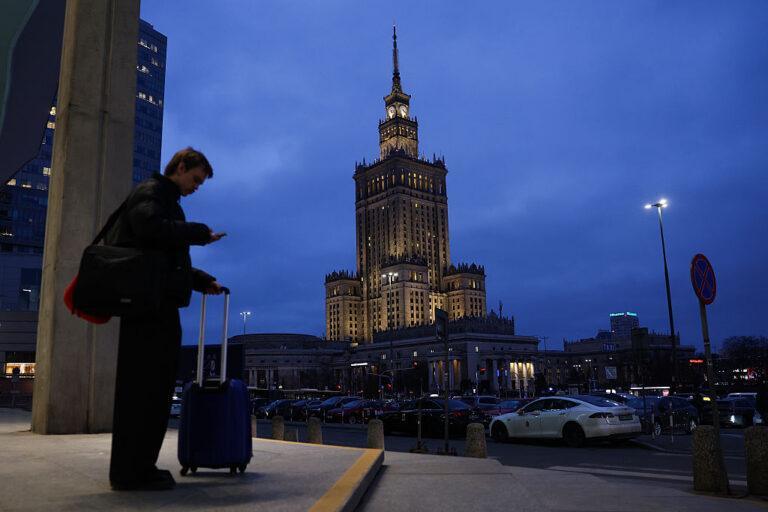
For some time now, Poles have been eagerly debating which country they will overtake next in terms of GDP per capita. Last week Spain became the latest benchmark for national ambition. According to projections by the International Monetary Fund (IMF) published last October, Poland is expected to surpass Spain in 2026 in GDP per capita measured at purchasing power parity (PPP).
The Monetary Policy Council (Rada Polityki Pieniężnej, RPP) has decided to lower interest rates by 25 basis points. The reference rate now stands at 3.75%.
Poland’s seasonally unadjusted real Gross Domestic Product (GDP) grew by 4% in the fourth quarter of 2025, outpacing the previous quarter’s 3.8% increase. Quarter-on-quarter, GDP rose by 1%. For the full year 2025, GDP expanded by 3.6%.
Poland may soon tap its gold reserves to fund defense spending at zero interest — an unconventional alternative to EU loans that could deliver quick cash but come with long-term costs and strategic trade-offs. The plan highlights the growing interplay between national finance and military strategy
Poland’s GDP grew by 4% year on year in the fourth quarter of 2025, according to Statistics Poland’s flash estimate. The chart makes the acceleration unmistakable. Growth reached 3.8% in the third quarter, 3.3% in the second, and 3.2% in the first. A year earlier – in the fourth quarter of 2024 – GDP expanded by 3.5% year on year.
The central government budget recorded a deficit of PLN 275.6 billion (EUR 64 bn) for 2025, the Ministry of Finance announced. Revenue amounted to PLN 594.6 billion (EUR 132 billion), while expenditures came in at PLN 870.2 billion (EUR 193 billion)
Fewer Polish households are struggling to “make ends meet,” according to consumer sentiment surveys by Statistics Poland (GUS). In the latest reading for February this year, the share of such households stood at 29 percent – a level that has held steady for several months. At the same time, a growing number of households are saving: as many as 61 percent of respondents declared that they were able to put money aside in February.
Retail sales measured at constant prices rose by 4.4% year on year in January 2026, according to Statistics Poland (GUS). This is a strong result, comfortably above the market consensus of 3.1%.
According to Poland’s Labor Force Survey (BAEL), the number of people in employment reached 17.346 million in the fourth quarter of 2025, data from Statistics Poland (GUS) show. That was slightly below the previous quarter, by 15,000, but 100,000 higher than a year earlier. In year-on-year terms, this translates into growth of 0.6%.
Public debt projection is not a forecast of an inevitable crisis but rather a mathematical exercise based on a “no-policy-change” assumption. In practice, this shifts the burden of adjustments onto the next parliamentary term. After 2027, Poland – regardless of the political option in power – will face the necessity of genuine fiscal consolidation.


 Marek Skawiński

 Michał Kulbacki