

This article is a part of Poland Unpacked. Weekly intelligence for decision-makers
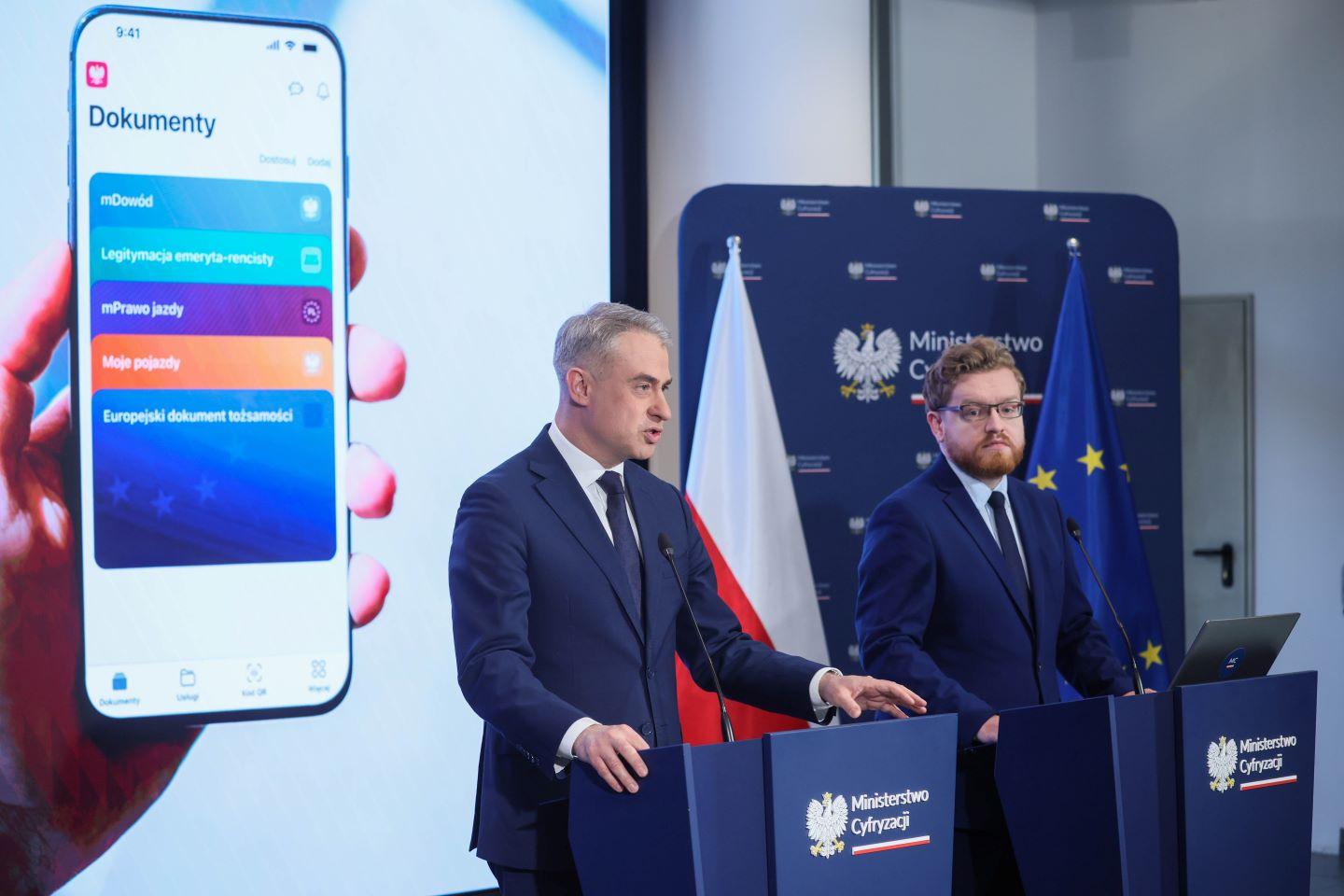
An ID card, driving licence, university e-diploma and, in future, many other documents are set to be added to the European digital wallet, which will become part of Poland’s mObywatel app. Among them is a new type of credential that is spreading rapidly across Polish universities this year: microcredentials, or digital certificates confirming newly acquired skills.
The first practical stage of work on the digital wallet in Poland has now begun. The Ministry of Digital Affairs and the Central IT Centre (COI) have launched a sandbox for the European Digital Identity Wallet. It is a free testing environment in which companies and institutions can check how their own systems will work with the future digital wallet. Citizens are due to begin testing it in December.
The European Digital Identity Wallet is to be integrated into the mObywatel ecosystem. Its key advantage will be that it can also be used outside Poland — all from a smartphone.
According to COI, the first tests focus mainly on digital identity confirmation and data verification. Ultimately, however, the wallet’s capabilities are intended to go much further. It will not only allow users to prove who they are, but also to digitally confirm their qualifications, education and other information required by an office, bank, university or employer anywhere in the EU.
Users will not have to show the entire document
The European Digital Identity Wallet, or EUDI Wallet, is being developed under new EU rules on digital identity. The aim is to make a document or credential issued in one member state usable in another.
Each EU country must develop its own solution in line with common standards. In Poland, the wallet is to become part of the mObywatel ecosystem. One important point for users: to use the European digital wallet, a conventional ID card will need to be replaced with one containing an electronic layer.
Identity confirmation is the most straightforward use of the new system. But there is an important difference compared with simply showing an ID card.
Users will be able to disclose only the information a particular service actually needs. For example, if someone has to prove they are of legal age, the system will not need to reveal their surname, document number or exact date of birth. A confirmation that the person meets the age requirement will be enough.
The same principle could apply to a driving licence or other authorization. COI calls this selective disclosure of identity attributes. Such a system is intended to improve the protection of personal data.
The new system also opens the door to applications far beyond dealing with public administration. The European Commission lists banking, signing contracts, travel, prescriptions, payments, mobile driving licences, university enrolment and presenting documents required when applying for a job.
For now, companies and institutions are doing the testing
The sandbox launched in September is intended to check whether the proposed solutions can work smoothly with the various technologies used by different services before the system is rolled out more widely.
Companies and institutions that identify customers or verify their data and entitlements can apply to join the sandbox. COI lists banking, insurance, telecommunications, transport, education, healthcare, retail and digital services.
Participants receive access to a demonstration version of the mObywatel Europa app. In the first phase, they mainly test sample identity data and an online verifier. They can check how the wallet would work with their own service, report errors and suggest changes before the solution moves into a production environment.
There is no publicly available list of sandbox participants. One of the first companies to announce that it had registered and begun testing is IDENTT, a Polish company specialising in digital identity verification.
Proof of acquired skills will also go digital
One particularly interesting new feature that, under Europe’s Digital Strategy, is expected to be added to the wallet is educational credentials — diplomas, academic degrees and various certificates.
This option could matter not only to individual users. It may prove especially important for the labour market.
Digitally verifiable qualifications stored in a single European system are particularly relevant given a new trend spreading across Polish universities: microcredentials. In Poland, these are still at an early stage, but are growing rapidly as a new way of acquiring often highly specialised professional skills.
Alongside multi-year degree programmes and postgraduate courses lasting several months, universities are beginning to offer courses focused on very narrow skill areas that can give workers an additional advantage in the labour market.
Each course lasts from several dozen hours to a few weeks, at most a dozen or so, and ends with a digital certificate — a microcredential — that the employee can present to an employer.
“This trend is growing at extraordinary speed in Poland. Around 50 different universities have already signed agreements with us. Many more are considering how to get started, but in general microcredentials are the future of education. You can already see it globally. In the US, skills-based hiring is developing rapidly, and microcredentials are being used for precisely that purpose,” says Michał Nowakowski of the Educational Research Institute (IBE), who leads a project introducing microcredentials at Polish universities on behalf of the Ministry of Development Funds and Regional Policy.
Unlike a multi-year degree programme, such a micro-course can be created quickly and focus on a very specific skill currently needed in the labour market.
E-diplomas will become mandatory from January
mObywatel is already beginning to collect information about education. Since June 30, 2026, universities have been able to issue electronic diplomas voluntarily, which graduates can access through the app.
They can download the diploma, diploma supplement and official copies, and allow the document’s authenticity to be checked using a QR code.
From January 1, 2027, universities will be required to issue new diplomas digitally as e-diplomas.
In future, much more information about qualifications could be included. For employees, this would mean being able to keep proof of professional qualifications, additional university courses and specialist training ending in microcredentials in a single digital environment.
Nowakowski says IBE intends to join the mObywatel Europa sandbox.
“I have just received the authorization needed to do so and we will definitely apply for the opportunity to test the microcertificate system,” he says.
New certificates are looking for a place in the digital wallet
For now, microcredentials are issued through several different systems. The Educational Research Institute is developing the public “Odznaka+” platform.
Some universities also use commercial tools for issuing digital documents, including solutions provided by DoxyChain. The company has already applied to participate in the wallet tests.
“Our goal is for a microcredential issued by a university to be transferred automatically to the recipient’s European Digital Identity Wallet as soon as support for such documents becomes available. That would give graduates permanent access to their credentials and allow them to share them easily with employers or other universities,” says Maciej Stopierzyński, chief executive of DoxyChain.
This is precisely the type of integration the company wants to test in COI’s sandbox.
A convenient solution for employers and HR
From the labour-market perspective, such a function could be much more important than simply storing additional documents on a phone.
Today, a candidate may attach a diploma, a dozen PDF certificates and course confirmations to a CV. A recruiter has no easy way to verify them immediately.
If doubts arise, the employer has to contact the university or training provider. With a rapidly growing supply of microcredentials, that would be extremely time-consuming and cumbersome.
A digital credential can work differently. It contains information that allows an employer to verify electronically who issued it and whether the document has been altered.
Stopierzyński believes that instant verification of qualifications by employers could become one of the main arguments in favour of digital credentials.
“Instead of waiting for a university to reply, an employer can verify a digital document literally at the moment the candidate’s application arrives,” says the DoxyChain chief executive.
As a result, the digital wallet within mObywatel could over time begin to resemble a verified digital professional file: a university diploma, documents confirming further education and microcredentials from continuing professional development.
One file that also works outside Poland
The EU concept also allows the digital wallet to work across borders.
A Pole applying for a job in Belgium or Germany would no longer necessarily have to send scans of documents, translate them into another language or confirm their qualifications with national authorities.
In principle, the European standard is intended to allow such credentials to be presented and verified digitally in any other member state.
The same would apply when enrolling at a foreign university, opening a bank account outside Poland or using services that require proof of a particular entitlement.
The finish line is not that far away
When will all these new functions become available? Soon, but not all at once.
COI says the capabilities of the digital wallet in mObywatel will be expanded gradually. Poland is also participating in the EU’s Aptitude project, which covers wallet applications in travel, transport and finance.
Poland is leading work on a mobile vehicle-registration document.
The European Union requires every member state to provide at least one European Digital Identity Wallet by the end of 2026.
The Ministry of Digital Affairs and COI say the digital wallet will join the mObywatel ecosystem in pilot form in December 2026. Only after the results of the pilot have been analysed will the wallet be permanently integrated into mObywatel and made available to all users.


Key Takeaways
- Poland has begun testing the European Digital Identity Wallet. The Ministry of Digital Affairs and COI have launched a sandbox in which companies and institutions can test integration of their systems with the future wallet. It is intended to work across the EU and, in Poland, will become part of the mObywatel ecosystem. A key new feature will be selective disclosure of data — for example, confirming that someone is of legal age without revealing their surname or date of birth.
- The wallet is intended to verify not only identity, but also qualifications and entitlements. In addition to ID cards and driving licences, it is expected to include e-diplomas and microcredentials — certificates confirming skills acquired through various courses. This market is only now beginning to develop in Poland. Institutions and companies are already testing new solutions. For the labour market, the change could be significant: employers will be able to verify qualifications instantly, including across borders.
- When will the new solutions arrive? The EU requires every member state to provide at least one such wallet by the end of 2026. In Poland, a pilot version is due to appear in mObywatel in December 2026. After the results are assessed, the solution is expected to be permanently rolled out to all users.