

This article is a part of Poland Unpacked. Weekly intelligence for decision-makers
Almost EUR 44 billion will flow to Poland from European funds earmarked for joint defense against the Russian threat. How much of that money will reach Poland’s defense industry - and what share will go to private firms? How was the list of 139 projects submitted to Brussels assembled? What does cooperation with Ukraine look like in practice? These are the questions addressed by Magdalena Sobkowiak-Czarnecka, the government’s plenipotentiary responsible for the SAFE program, who stresses that she is “not a one-month envoy.”
Good to know
SAFE
SAFE (Security Action for Europe) instrument is a new EU financial instrument that will support those member states that wish to invest in defence industrial production through common procurement, focusing on priority capabilities.
SAFE will finance urgent and large-scale investments in the European defence technological and industrial base (EDTIB). The aim is to boost production capacity, making sure defence equipment is available when needed, and to address existing capability gaps - ultimately strengthening the EU’s overall defence readiness.
Through SAFE the EU will provide up to EUR 150 billion that will be disbursed to interested member states upon demand, and on the basis of national plans. The disbursements will take the form of competitively priced long-maturity loans, to be repaid by the beneficiary member states.
Grzegorz Nawacki, Łukasz Maziewski (XYZ): Who is who in the SAFE program? You are the government’s plenipotentiary, but the application was submitted by the Ministry of Defense, and BGK is to serve as the operator. The Chancellery of the Prime Minister is not, as a rule, involved in defense policy. So what administrative apparatus do you actually have at your disposal to influence the implementation of SAFE?
Magdalena Sobkowiak, Government Plenipotentiary for the European Security Instrument (SAFE):
The application was signed by Prime Minister Władysław Kosiniak-Kamysz, and my team prepared it. Under the regulation appointing me, administrative support for the plenipotentiary is provided by the Ministry of National Defense. This means my team operates within the structures of that ministry. BGK will act as the financial operator.
SAFE, however, is a whole-of-government program. After I joined the project, we decided to expand the procurement list to include proposals submitted also by the Ministry of the Interior and Administration as well as the Ministry of Infrastructure.
Why include the Ministry of the Interior?
Because a key element is equipping the Border Guard. This naturally ties into the Eastern Shield project, which ranked high when we were shaping the SAFE portfolio. Beyond that, the Police submitted cyber-related projects that dovetail with the military cyber-security initiatives led by the Cyber Defense Component Command (DK WOC). These projects are closely aligned, and the cooperation is very tight.
Any other ministries involved?
The Ministry of Infrastructure put forward projects related to military mobility – adapting infrastructure so that troops and equipment can move quickly and safely. This includes selected road segments and additional rail tracks.
The Ministry of State Assets oversees the Polish Armaments Group (PGZ), one of the main beneficiaries of SAFE. Procurement is not handled solely by the Armament Agency; DK WOC has its own equivalents, and both the Ministry of Infrastructure and the Ministry of the Interior have their own procurement institutions as well.
Good to know
PGZ
Polska Grupa Zbrojeniowa (PGZ) is a capital group concentrating several dozen production plants, service facilities and research centers crucial for the Polish defence industry.
PGZ manufactures innovative systems and solutions used by the Armed Forces of the Republic of Poland and allied formations.
The Group’s offer: modern radiolocation and radar systems, rifles and optoelectronics, wheeled armoured transporters, barrel artillery, unmanned air systems and systems supporting battlefield management.
PGZ products are based on the Polish technological inventions and cooperation with global leaders in the defence sector. They are developed and produced under the supervision of experienced engineers, constructors and specialists.
And then there is the Ministry of Finance, which also took part in drafting the application.
Does the Finance Ministry influence what weapons systems we purchase?
It is about the sources of financing. The SAFE list includes projects previously funded from the state budget or the Armed Forces Support Fund as well as entirely new initiatives. Someone had to reconcile and balance all this – and that was the role of the Ministry of Finance.
What happens next with the Armed Forces Support Fund (FWSZ)?
What role will the FWSZ play in administering the program?
A decision will be taken within days on whether the FWSZ will serve as the financing vehicle for the projects, or whether a new fund will be created. The first option requires amending the Homeland Defense Act; the second calls for an entirely new piece of legislation and for placing the fund within BGK. The Ministry of Finance will play a significant role here.
Good to know
BGK
Bank Gospodarstwa Krajowego (BGK) is Poland’s state development bank and one of the government’s key financial levers for long-term economic policy. Established to support strategic investments, BGK operates outside the commercial banking sector, directing capital toward infrastructure, innovation and projects deemed essential for national development.
In recent years it has become an increasingly prominent co-investor alongside EU programmes, channelling public funds into venture capital, regional development and SME support. BGK often partners with institutions such as PFR Ventures to mobilise private capital, strengthen the domestic financial ecosystem and reduce investment gaps in areas where market financing remains scarce.
Good to know
FWSZ
Poland’s Armed Forces Support Fund (FWSZ) is not a conventional budget. It is a purpose-built, quasi-off-budget financing mechanism designed to undergird a rapid and large-scale modernization of the country’s armed forces.
Established under the aegis of the Ministry of Defence and administered by BGK, FWSZ draws on a mix of direct state budget transfers and debt financing (loans, bonds) to underwrite procurement, infrastructure and other defence-related capital expenditures
A proposal surfaced in the National Defense Committee to channel all SAFE funds into the FWSZ.
I am aware of those discussions, but I do not support that approach. SAFE also includes projects that were previously neither in the budget nor in the FWSZ. The General Staff shared that view. That is why the list includes, among other things, new drone programs, the purchase of MRTT aircraft for air-to-air refueling, and the strengthening of the Eastern Shield. These are initiatives whose implementation was accelerated by the events of the night of 9–10 September, when Russian drones flew over Poland.
Good to know
Eastern Shield
“Eastern Shield” (Tarcza Wschód) is a project planned for 2024-2028 to strengthen Poland's resilience to attacks and hybrid warfare. It was created in response to Russian aggression against Ukraine and draws on the experiences of that war, but it is a peaceful project: it aims to deter potential aggressors, protect soldiers and civilians, and, together with allies, demonstrate our readiness to defend our borders.
Over a length of roughly 700 kilometres, the plan envisages a “belt” of engineered defences and infrastructure, reaching up to 50 km inland, with the aim of deterring potential aggression, impeding hostile force movement, and giving Poland (and its allies) operational depth.
There is also the issue of the FWSZ itself. A recent audit by the Supreme Audit Office (NIK) found that…
…that the financing framework for the FWSZ could have been designed better. That is why I favor creating a new fund. But the final decision will be taken at the highest level.
MRTT aircraft are a critical investment for our Air Force. Will we buy them?
Yes, the purchase is included on the SAFE list. These are new projects, so the head of the Armament Agency must launch a full procurement procedure.
Good to know
Armament Agency (AU)
The Armament Agency is responsible for carrying out tasks that ensure the conditions necessary for the Armed Forces of the Republic of Poland to achieve the required operational capabilities.
In particular, the Armament Agency is responsible for activities related to defining equipment requirements for identified operational needs, initiating research and development work, and conducting procedures for acquiring military equipment and services for the Polish Armed Forces, including related construction investments.
It also oversees the quality of delivered products, prepares and supervises offset agreements, and manages intellectual property rights resulting from research and development efforts.
Why?
Because refinancing existing projects – those already in the budget or in the FWSZ – looks different; the full documentation is already there. For new projects, such as the MRTT aircraft or drones, we are currently presenting only the outline and the anticipated funding envelope.
And the heavy transport aircraft?
I'm sorry, but the project list is classified as “restricted.”
Why, given these are EU funds and transparency rules apply?
Each project will become public once its contract is signed, just like all current Ministry of Defense agreements. However, after consulting the National Security Bureau, we concluded that publishing the full list of 139 projects today – together with detailed descriptions – would in effect signal to Russia where our vulnerabilities lie and how we intend to close them.
Coordination as the key to SAFE
Let’s return to your role. What exactly are you responsible for?
Above all, for coordination. By 30 November, we had to prepare a full, complete and eligible procurement list – effectively, an investment plan. I am also responsible for talks with Ukraine regarding its participation in our segment of SAFE. In addition, I coordinate the drafting of the legislation that will establish the fund. A further element of the program is joint procurement with other European states – that is, seeking partners to buy the same systems. That, too, falls to me.
And each country pays from its own budget?
Of course. My objective is to persuade foreign partners to buy products from Poland’s defense industry. I will spend the coming months on a tour across Europe to refine procurement plans and bring about intergovernmental agreements or memoranda of understanding.
How many projects will be delivered under SAFE? How does the allocation mechanism work?
We have EUR 43.7bn at our disposal. Each member state declared the amount it expected to need. I can reveal one detail: the Commission did not expect to allocate the full EUR 150bn available for SAFE in the first round – but the funds were snapped up almost instantly.
In the summer, countries submitted only their financial needs, without concrete projects. In September, the Commission informed us that Poland could apply for EUR 43.7bn, and that triggered the full drafting process.
Who decided the shape of the list?
The Armed Forces – based on the Central Material Plans, the Technical Modernization Plan, and new operational needs, including those identified after the Russian drone attack during the night of 9–10 September.
My task was to verify that the projects met the eligibility criteria. Ultimately, we submitted to Brussels a list of 139 projects, described in considerable detail.
Eligibility for SAFE depends on several key conditions:
- each product must be delivered by the end of 2030,
- at least 65% of its components must be of European origin,
- the supplier must be based in the EU,
- and the project must contribute to supporting Ukraine.
And finally, there is the type of procurement contract: Single Procurement (the standard EU public procurement format), and after May 2026, its Common Procurement variant. We have also prepared a reserve list.
How large is it?
In total, we have projects worth around EUR 60bn, so the reserve amounts to more than EUR 15bn.
To what end?
The Commission has six weeks to raise questions or reject part of the submission. Thanks to the reserve list, we have additional projects ready to be slotted in immediately.
Who will get the money?
SAFE is a loan, not a grant – Is this mechanism advantageous for Poland? Germany did not apply at all.
Indeed, not every EU member state has joined the scheme; only 19 have. In Brussels, one often hears that Germany’s decision hinged on the fact that participation in SAFE effectively requires excluding American components, because the program does not cover purchases of US or South Korean equipment.
Under the previous Polish government, such purchases dominated. Today – after reviewing the initial allocation – 89% of the Ministry of Defense’s SAFE funding would remain in the Polish defense industry.
But is the mechanism beneficial for Poland?
Yes, it is a loan. But it is currently the best instrument available. Interest runs at around 3%. As Minister of Finance - Andrzej Domański - notes, this is the cheapest money on the market. Capital repayment begins only after ten years, and the entire schedule runs until 2070.
If we were not a frontline state facing a real, daily threat of military escalation, one could dissect the cost-benefit calculus more finely. We should also remember that part of the funds will refinance FWSZ contracts, which were themselves based on loans – now replaced by cheaper financing. From the state budget’s perspective, SAFE is advantageous.
The fact that 89% of the money will go to the Polish defense industry sounds excellent – fulfilling industry demands. But how much of that will go beyond the state-owned Polish Armaments Group (PGZ)?
At present, roughly half. Contrary to what is often assumed, not all funds will flow to PGZ. There are major private-sector players on the market, as well as smaller subcontractors.
My view is simple: if Poland is spending more on defense than any other EU country and will receive the largest share of SAFE funds, then we should have Europe’s best defense industry. If we fail to achieve that, it means something went wrong.
If Poland is spending more on defense than any other EU country and will receive the largest share of SAFE funds, then we should have Europe’s best defense industry. If we fail to achieve that, it means something went wrong
This instrument also reverses the previous procurement philosophy – the former government spent most of the money abroad. Now Deputy PM Kosiniak-Kamysz is reversing that logic. Even if the final figure ends up being 80%, it still represents a completely new philosophy – one that benefits Polish industry.
Is there a chance to streamline procurement mechanisms?
That is my next objective: improving cooperation between the military and industry. The armed forces must be able to test products. Current procedures are too slow and discourage innovation, which emerges from experimentation – including failed tests.
We need a program under which the military orders small batches, tests them on the range, and then procures the best solution. Without this, we will not build an innovative defense sector or a modern army.
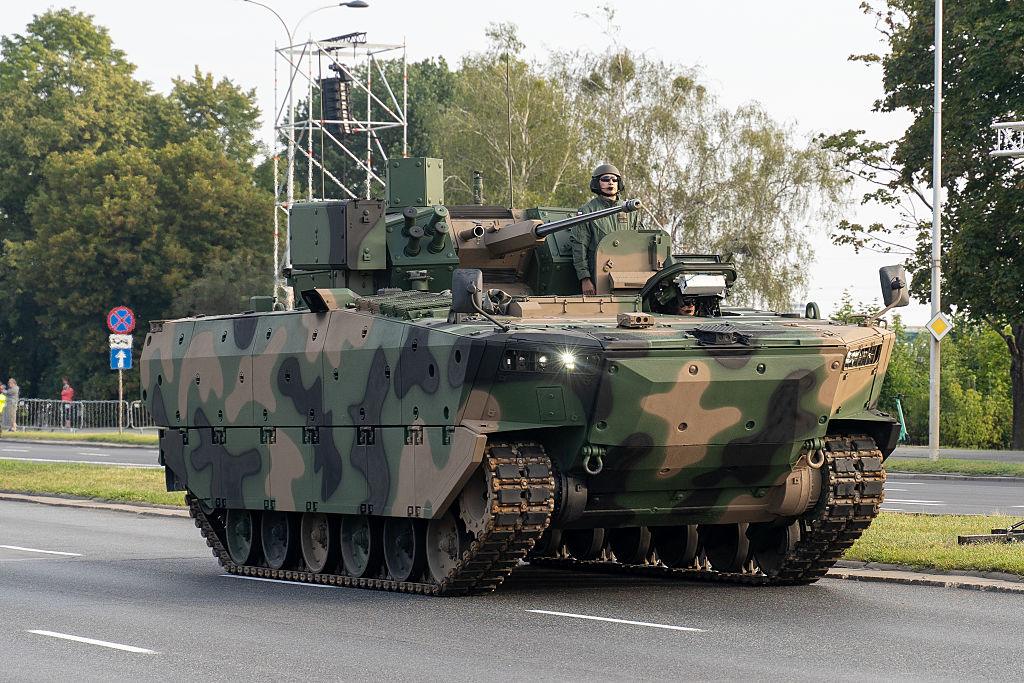
Consider the Borsuk infantry fighting vehicle – 12 to 13 years of design and testing. Meanwhile, the war in Ukraine has upended the global defense market. The Ukrainians can modify equipment in a week and field-test it immediately.
Good to know
Borsuk Infantry Fighting Vehicle
The Borsuk IFV, built on the Universal Modular Tracked Platform (UMPG), is equipped with a 30mm remote-controlled turret system. The crew consists of three soldiers: the commander, the weapon operator, and the driver.
The vehicle is intended to transport six soldiers to the battlefield while providing an appropriate level of protection, and to carry out tasks related to supporting infantry units using its onboard weapons.
The vehicle can engage enemy infantry, armored vehicles, aerial targets, and other objects employed by the adversary, in all weather conditions and at any time of day.
Features: high mobility and the ability to overcome terrain obstacles, including water obstacles by swimming. It can be operated in various climatic conditions. Its maximum speed on paved roads is 65 km/h, and 8 km/h in water. The combat weight in the baseline configuration is 28 metric tons.
Borsuk means badger.
The EU still has a long way to go.
Military equipment increasingly incorporates civilian components because they are available faster. Joint procurement is, in many respects, an experiment by the European Commission. In my view, it will function effectively only under SAFE-2. If Europe maintains its current momentum, cooperation between member states will deepen.
We also emphasize to the Commission that the defense market operates differently from the civilian one. Bilateral defense projects require intergovernmental agreements or memoranda, and countries protect their technologies. Systems sold domestically often differ from export versions.
What works in one country may not work in another – and it certainly does not operate like a single civilian market. We often hear: “If it works for Ukraine, let’s buy the same thing.” But it is not that simple.
State involvement is unavoidable
This raises several issues tied to the supply of military equipment – for instance, intellectual property rights. This has long been a challenge for business.
In joint ventures, certainly. No one is eager to share secrets. But SAFE contains a provision that effectively mandates joint purchases by at least two countries. In our case, a major export success is the Piorun missile system, for which many NATO countries are already queueing.
State involvement, however, is unavoidable – if only to streamline the negotiation process.
Let me return to how private firms can also benefit from SAFE. Is there any mechanism in the allocation of funds that naturally steers money their way? For instance, trade unions at PGZ wrote to the prime minister claiming that every PLN not spent with them “endangers national security.”
I fundamentally disagree with that view. If, amid a war just across our border and the highest defense spending in our history, a state-owned plant is still struggling, one must ask whether it is being managed properly.
If - amid a war just across our border and the highest defense spending in our history - a state-owned military plant is still struggling, one must ask whether it is being managed properly.
There was no ideological bias in selecting beneficiaries – the roughly 50/50 split emerged organically. The decisive voice always belongs to the Armed Forces, which define the equipment they require. No one interferes with the needs of the General Staff. If a project fails to meet the eligibility criteria, it simply does not make the list.
Are Polish private companies strong players in this market?
Yes. We have large, robust private-sector firms with capabilities that PGZ simply does not possess in certain domains.
Those PGZ capabilities themselves face criticism – namely, that partnerships with foreign contractors effectively reduce the state-owned group to a middleman rather than a manufacturer.
That is precisely why the rules require that 65% of components be of European origin. Many firms – particularly American ones – tried, at the eleventh hour, to argue that operating a plant in Poland should automatically qualify them under SAFE.
The number of lobbyists surprised me. I expected many – but some I hadn’t even heard of. But this is not about having a factory in Poland. What matters is who owns the company and what its governance structure looks like. That is how the 65% “European component” is calculated.
A second category concerns Design Authority. This posed difficulties especially for AI-related products. And more broadly, if we treat SAFE as a kind of “exercise”, it clearly reveals where Europe has deficits.
With cyber forces, we discovered that certain components simply must come from Asia.
‘Orka’ will not be funded through SAFE. But money will flow to ‘Safe Baltic’
Is this precisely why the Orka submarine program will not be financed through SAFE? Deputy PM Kosiniak-Kamysz mentioned it. Yet it was originally our idea to include a “maritime” component in SAFE.
Our list does include a maritime component. Orka did not make it for a very simple reason: it will not be ready by the third quarter of 2030 – and that is an absolute requirement for obtaining SAFE financing.
Good to know
Orka
The “Orka” program is a key, long-term modernization initiative of the Polish Navy, aimed at acquiring three new submarines to replace the ageing ORP Orzeł.
In November 2025, Poland selected Sweden (Saab Kockums) as its partner to deliver the A26 submarines, bringing an end to a lengthy negotiation and selection process that included other bidders from France, Germany, Italy, Spain, and South Korea.
The program also includes technology transfer, offset arrangements, and strategic industrial and military cooperation.
Orka means killer whale.
Leaving maritime issues aside: what about projects to expand ammunition production capacity? For example, 155 mm rounds. Is that covered by SAFE?
Yes, of course. First and foremost, we need to replenish the National Ammunition Reserve.
And is there room for private producers in this area?
Wherever no contracts have yet been signed and the agency has not launched procurement procedures, the choice of supplier is still ahead of us.
Previous major funding-and-modernization programs – such as the National Recovery Plan – had milestones that determined when payments were released. Does SAFE work the same way?
In the Recovery Plan, the milestones were rather distant from the projects themselves. Here, it is different.
When we decide something must be purchased, we have to demonstrate – for each of the 139 projects – what steps we have taken to encourage European partners to cooperate. Then comes the selection of the contractor, signing the contract, delivery of successive batches – in practice, these will constitute the milestones. At the outset, we will receive 15% of the allocated amount, and the rest as we complete subsequent stages.
That is why the 2030 deadline is so crucial: the European Commission will pay Poland the final tranche only after the final delivery – in the third quarter of 2030 – of the entire product. For this reason, as I mentioned, the Orka program will be financed outside SAFE.
“Aid to Ukraine was a European requirement”
You mentioned cooperation with Ukraine, which is a highly emotional issue. How does collaboration with Kyiv look in the context of SAFE?
The program’s framework explicitly defines three forms of cooperation.
First, purchases financed by SAFE that are then donated to Ukraine.
Second, joint procurement – Ukraine pays from its own budget, which it currently does not have, and the Member State pays from its own resources.
And third, direct purchases from Ukraine.
The fact that Ukraine will be part of Poland’s SAFE plan is simply a given – the European Commission requires it. Right now, we are working on defining our bilateral needs.
On one hand, Ukraine has submitted a specific list of products it wants us to provide. On the other, we have clearly outlined which of their technologies are of interest to us. I hope that this week a joint team – involving the Foreign Ministry, the State Assets Ministry, the Economic Development and Technology Ministry, and the Defense Ministry – will be formed so that we can establish a common position.
This provokes strong reactions. There are comments like: “We’ll borrow money only to buy weapons for the Ukrainians.”
There are several answers to that.
First, as Deputy PM Kosiniak-Kamysz says, the front line in Ukraine is also our line of defense. If we want to be safe, we need to support Ukraine.
As Deputy PM Kosiniak-Kamysz says, the front line in Ukraine is also our line of defense. If we want to be safe, we need to support Ukraine.
Second, from the very beginning, SAFE assumed that Member States would use these funds to help our eastern neighbors.
But let me dispel a misconception: it is not the case that all – or even half – of the money will go toward cooperation with Ukraine.
Bureaucracy slows armaments – is Poland pushing to ease the rules?
One of the arguments explaining why defense procurement progresses so slowly concerns bureaucracy: procurement procedures, permits, and so on. Does Poland plan to propose easing these rules?
Parallel to SAFE, there is another EU defense-oriented initiative – the Defense OMNIBUS. We launched it during the Polish EU Council Presidency. It introduces simplifications across multiple areas, including defense.
We have to remember that defense was never a core domain of the European Union. The prevailing assumption was that NATO is responsible for defense, while the EU deals with industrial issues and the single market.
That’s why SAFE – allocating EUR 150 billion to defense – is a revolution.
The program’s very existence is revolutionary and will reveal a great deal. We also have the EDIP grant scheme – financially more attractive because it provides grants, but its budget is only EUR 1.5 billion for the entire EU. On top of that come differences between Member States in how they spend funds. This is why SAFE is such a major success of the Polish Presidency. The entire process – from the concept to entry into force – took just over seventy days. That is an absolute record.
It also helped that the European Parliament was excluded from the decision-making process.
Finally, let’s talk about you…
To finish, let’s turn back to you. It’s quite a path: from the Government Plenipotentiary for the EU Presidency – coordinating the work of politicians and civil servants – to SAFE and military affairs.
I know what you’re getting at. When I took office, people kept saying it would be impossible to submit the SAFE application by 30 November. And yet? We did it. I read comments calling me a “one-month envoy”. I disagree.
Until 30 November, it was a race against time. We worked on 139 projects, all described in great detail. Our application exceeded 300 pages. We managed to finalize it, and now the European Commission has six weeks to assess it and come back with questions, if any. We can also replace projects if needed.
At the same time, work continues on the new SAFE Fund Act and its implementation. And that’s not all – we must prepare for negotiating and signing the loan agreement. Then: Ukraine, closing bilateral talks, arrangements with our European partners. We have until May for that. Afterward, we move into the coordination phase of the program itself – so there will be no shortage of work.
You mentioned that failing to “develop a strong defense industry” would be a kind of original sin. Where is the biggest risk that we might fall short?
We lack coordination between the armed forces, industry, and the government. This must be a two-way street. If a new idea emerges in business, the military needs to test it. But producers must also know what the armed forces expect.
Who's who
Magdalena Sobkowiak
Magdalena Sobkowiak-Czarnecka (b. 1984) brings experience in European affairs and strategic communication to her role as Government Plenipotentiary for the Instrument for Strengthening European Security, appointed in October 2025.
A graduate of global economics, she also holds postgraduate qualifications in diplomacy and completed doctoral studies at the Warsaw School of Economics. Her international credentials include training at Reuters in London, Harvard Kennedy School's Leadership Academy for Poland, and CEU Democracy Institute in Budapest. Recognised by the German Marshall Fund as a future European leader, she serves on the Programme Council of the Economic Forum in Karpacz and founded "Women in the Centre," a nationwide association promoting gender equality.
Her career spans both Brussels institutions and Polish media. From 2016-2018, she worked at the European Commission specialising in economic affairs, defence, and space policy.
Previously, she reported for Poland's major broadcasters - TVP and Polsat - covering US elections, terrorist attacks in Paris and Brussels, EU summits, and Brexit.
Between 2019-2023, she served as chief adviser to Władysław Kosiniak-Kamysz and managed his 2020 presidential campaign. She was appointed Deputy Minister for EU Affairs in January 2024 before assuming her current security-focused role, positioning her at the intersection of European integration and continental defence strategy.


Key Takeaways
- According to Minister Sobkowiak, a new, separate law establishing the Armed Forces Support Fund should be enacted.
- Magdalena Sobkowiak, responsible for allocating SAFE funds, asserts that between 80% and 90% of the nearly EUR 44 billion earmarked for Poland will flow to the domestic defense industry.
- One of the conditions for Poland securing the largest share of the European funding “cake” was a requirement to cooperate with Ukraine on defense matters.