

This article is a part of Poland Unpacked. Weekly intelligence for decision-makers
Who's who
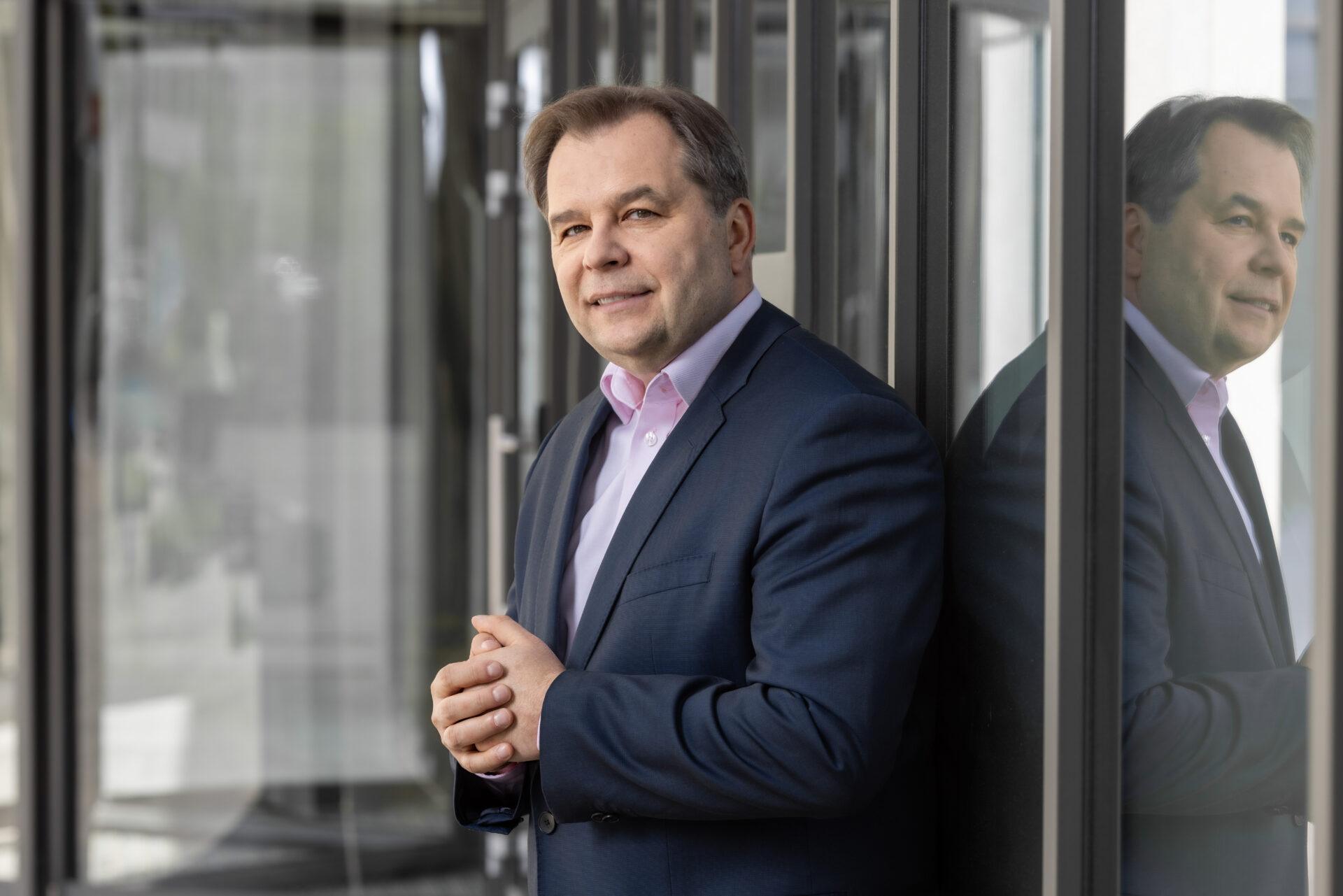
Sebastian Mikosz
A manager and economist, Mikosz served as CEO of LOT Polish Airlines from 2009 to 2011 and again from 2013 to 2015. He later headed Kenya Airways between 2017 and 2019 and served as a vice-president of the International Air Transport Association (IATA) from 2020 to 2022. He has been CEO of Poczta Polska since 2024.
Emilia Derewienko, Grzegorz Nawacki, XYZ: Does anyone still need a postal service? And can Poczta Polska survive—given its internal problems on the one hand and the steady decline in letter volumes on the other?
Sebastian Mikosz, CEO of Poczta Polska: The postal service is one of the most underestimated and neglected institutions of the Polish state. Its role has been overlooked for the past two decades. Other countries, however, have understood its importance. I say this with full conviction, because I myself did not appreciate it until I began working here.
The first step for us, as a management team, has been to say something that should be obvious: physical letters are disappearing. I was genuinely surprised that no one had stated this openly before. So our strategy begins with acknowledging that the service for which the Polish king founded the Post nearly 500 years ago is losing its raison d’être.
But all you need to do is look at our European neighbours—and beyond—to see how their postal operators have transformed. Then you look at us and ask why we are 15 years behind the changes that others have already made.
What did they do?
First, someone took the time to map out, strategically and honestly, the advantages that a postal operator still has. A postal service is one of the state’s most recognisable and trusted brands. Everyone knows what the Post does. That brand recognition - and the trust that comes with it - is an enormous asset.
Two physical factors add to this. The first is our nationwide footprint: we are present in every Polish municipality, and taxpayers paid for that network long ago. If we tried to draw up a business plan today to build such a network from scratch, it would never get off the ground.
We accept criticism and respond to it, but the fact remains: we are still a highly efficient logistics operator delivering 3.5 million letters a day. The problem is statistical and reputational. If 1% of those deliveries goes wrong, that’s 35,000 items. And that 1% drives our image in the media, because nobody writes posts saying they received their letter on time, as expected.
So yes - we have the capacity to reach every address in Poland, we have the branches, and we have the logistics to support them. Those are the pillars on which this company can stand. Other countries recognised the potential early on and asked themselves: if the traditional role of mail is shrinking, what new roles can our network take on? It is a strategic question - and one we address head-on in our transformation plan. We are not merely restructuring. We are not tinkering at the edges. We are reshaping the business as a whole.
We are not merely restructuring. We are not tinkering at the edges. We are reshaping the business as a whole.
Our head of IT said recently that we are “refurbishing the aircraft while it’s in flight.” My aviation background made me wince for a moment, but I still find the metaphor accurate. The plane is airborne, and it needs to be rebuilt.
This approach has only one drawback: no one has ever attempted it, so we cannot know whether the aircraft will crash.
But in fact everyone has attempted it - the Italians, the French, the Austrians, the Portuguese, the Belgians, the Swiss, the Greeks. Everyone except us.
You refer to the public image of Poczta Polska. How do you feel when you see, on social media, a member of the Council of Ministers mockingly complaining that “after an hour at the post office, only 15 people are left in the queue”?
Ask any politician how many postal workers we have, or whether there is a post office in every municipality in Poland. Ninety-nine per cent will not be able to answer. The simple truth is that very few people understand how the postal service actually works.
For years, Poczta Polska neglected its own public relations - and the State Treasury barely noticed the company at all. Other troubled firms were on the government’s radar; we were not. The reason I am here is not because of any deep expertise in postal operations, but because I have experience in restructuring organisations.
Only when the problems grew too large to ignore did someone finally realise: “My God, what do we do now?” Suddenly the company received a wave of attention. Within two and a half years it emerged that nearly 100 trade unions were active here and that we employ 60,000 people. And all the while, the government had tasked this institution with maintaining a dense nationwide branch network—and then failed to pay for that service for eight years.
The reason I am here is not because of any deep expertise in postal operations, but because I have experience in restructuring organisations.
You yourself say that letters will eventually become obsolete and that Poczta Polska cannot build its future on them alone. So what will it rely on? And what will the post office look like after the digital transformation?
The post office of the future must rest on a portfolio of services - not on a single service, as it has until now. We see several pillars on which the organisation can build and, ultimately, generate revenue. I am the CEO of a joint-stock company, which means that, in principle, I should be guided by the Commercial Companies Code. But I am also fully aware that Poczta Polska is a public institution—a component of the state’s resilience architecture—and therefore has a mission that goes beyond turning a profit.
Yes, we are expected to be financially self-sufficient. But on the owner’s side—and I have heard this from three consecutive ministers—no one expects us to pay dividends. This company is meant to perform several functions, both now and in future.
So what is your vision?
First of all, I do not expect physical letters to vanish entirely within the next decade. They will still exist, though our revenue from them will continue to fall. We can anticipate a decline of 6–7%, perhaps even 10% a year. This means that out of today’s 900 million letters, we may be left with around 200 million in five years. Our logistics will need to adapt accordingly.
We are already the designated e-delivery operator under existing legislation. We handle several million items a year through the e-Polecone system. Digital substitution is replacing physical correspondence; it is a business that requires far less infrastructure and is more profitable. The obligation to have and use an e-delivery box will expand gradually. From 1 January 2029, all public institutions will communicate exclusively through this channel. As an institution, we have a clearly defined mandate: to operate the entire electronic delivery system, including what is known as the hybrid service. After all, some people will not want an electronic mailbox - and no one will force them.
In such cases, we will print the digital message, deliver it physically, and the citizen will be able to hand us a paper response. We will scan it and “inject” it into the system. In short, we will be the bridge between the analogue and digital worlds, so this business will remain. This is also why we expect to remain the designated postal operator for the next ten years. When we spoke with the president of UKE, we agreed this is certainly the last such designation - because a decade from now, Poczta Polska will be in a very different place.
We also want to re-enter the courier market. Every modern postal operator has its own courier arm; we have Pocztex, but it is a minor player. Why? The reason is simple: neither the company nor its owner ever took this service seriously. The market moved on while we stood on the platform analysing the situation. Today we carry parcels using our letter network rather than a dedicated courier network - because we do not have the infrastructure for true courier operations.
Meanwhile, in my view, the Polish market is one of the most mature courier markets in Europe, perhaps in the world, in terms of competition. We want to return to this segment through our consolidation with Orlen Paczka. It is a project that should have begun long ago; had it started then, we might now be a player with a genuine voice - potentially even close to the podium.
I think the bar in the Polish courier market is extremely high. How do you stop the competition from accelerating?
So what are we supposed to do - nothing? The consolidation with Orlen Paczka will require an investment of around PLN 1.5-2 billion (EUR 375-473m). That is not an unmanageable figure.
Where will you find the money?
The state has not invested in the postal service for 20 years. It is time for that to change.
Are you already in talks?
Not only are we in talks - we have concrete proposals on the table, and the owner is fully aware of them. And this is not just about the courier business alone. We want to take part in the consolidation of the sector; if not with this operator, then with another. We are not going to grow organically, and there is no point pretending otherwise. It is better to merge, because the market is under extreme pressure on margins.
It is very similar to the telecom sector: there are simply too many operators. Each of them believes they can enter the market because they see growth. I see the rising valuations as well - my sector is expanding - but I do not see where anyone expects to find sustainable margins.
You’re talking about an alliance between two state-owned companies, while InPost—a private firm - has just signed a partnership with the British postal service. Can you imagine the state-owned Polish Post forming an alliance with a private player in our ecosystem?
I think it would make perfect sense. Why not? This is precisely the problem: state-owned companies are still treated as some sort of anomaly. In day-to-day operations, there is virtually nothing that sets us apart - aside from the fact that we must comply with certain public-procurement rules.
If we think about local content, whom should we prioritise? DHL? Deutsche Post?
For me, infrastructure availability is also key. Today, courier companies compete on price and quality. Customers do not care about infrastructure - sorting centres, machinery, logistics flows. All of that is invisible to them. In Poland, expectations are extraordinarily high; people are focused almost entirely on the last mile.
We, however, must look at the business fundamentals: do we really need to own every sorting centre and operate every truck ourselves? What matters is that the courier wears our sweatshirt, delivers on time, and ensures that the user experience is world-class.
You stress how important user experience has become. What needs to change at post offices today so that people standing in line view the institution more favourably?
Whether a customer faces fifteen people ahead of them in the queue is, above all, the result of a lack of digitalisation - not the fault of the branch itself. I visit post offices across Poland and, frankly, the men and women working there are my heroes. They operate in conditions that are often difficult and far below market standards.
Whether a customer faces fifteen people ahead of them in the queue is, above all, the result of a lack of digitalisation - not the fault of the branch itself. I visit post offices across Poland and, frankly, the men and women working there are my heroes. They operate in conditions that are often difficult and far below market standards.
We therefore need to change the way we work and deliver services, automating processes wherever possible. But today we are simply not ready for that. Our central IT system dates back to the year 2000. Many of our service windows still run on Windows 2007, a system that stopped receiving technical support in 2013. The technological collapse is so advanced that we cannot add new services even if we want to. We do not have cash registers; to introduce them now, we would either need to buy 40,000 devices or wait until we can install the software on a new central system. So we will make one big “leap” straight into the 21st century.
Soon, however, most tasks will also be handled by machines. We will shortly begin piloting letter machines—allowing customers to send and receive letters just as they do today with parcel lockers. Our aim is to create a system for registered letters that can later evolve into machines for small parcels. In fact, many small parcels are already smaller than letters, so the opportunity is there.
Once branches become automated, people will still visit post offices—but mainly to buy insurance, fill in a form, or carry out the kind of “counter” operation that requires human contact. And the difference for us is significant: a transaction like that brings in a commission of PLN 40 (EUR 10), rather than PLN 4 (EUR 1).
Please tell us more about the letter machines. Have you set a timeline for introducing them?
This project has been sitting on a shelf in the company for five or six years. And the shelves at Poczta Polska are full of studies and ideas that simply need to be picked up and implemented.
For now, our goal is straightforward: get the letter machines up and running. This is another challenge for our IT teams, because users will need to identify themselves - either through the mObywatel app (a Polish government app that lets citizens access digital IDs and official public services on their phone) or with an ID card. We are currently in the testing phase.
I expect we will be able to present the machine physically at the start of the year. We already have a prototype - it’s essentially a box with a tablet. Nothing rocket-scientific.
How much time are you giving yourselves for this “leap forward” in IT?
It is intended as a two- to three-year project, although some foundational systems can be implemented much faster. The paradigm for IT investment has changed: today, you don’t buy—you rent. So this will not take the form of traditional capex.
I believe significant progress could be made around 18 months after signing the contract. We remain, however, victims of a nightmarish public-procurement framework. In state- or Treasury-owned companies, competitors often exploit the rules to block one another. What should normally be a matter of months can drag on, though some procedures are surprisingly completed in weeks. It is, frankly, unbelievable.
The most fundamental shift is philosophical: we are no longer customising IT systems. Instead, we take the standard “box” and turn it on. If business processes need adjustment, we adapt the processes to the system. My goal is for the first visible improvements to reach customers as early as next year. We will have a new core system, a revamped online platform, and a finalised new mobile application.
What are some other potential obstacles?
At Poczta, scale is always a factor. For example, we currently have a tender for internet connectivity across 4,600 locations. There is no single provider in Poland that can handle the whole country, so consortia are formed. In these arrangements, one provider covers the entire network - and that provider sets a high price, while we have a fixed budget. Managing scale like this requires a broader perspective. Even just training staff takes six months, and only after that can implementation begin.
What could ideally be spread over five or six years must now be accomplished in five quarters. An organisation unused to any movement is suddenly confronted with constant stimuli, change, and high expectations. The truth is, if we had invested PLN 200 million (EUR 47m) a year in IT over the past decade, we would be in a very different place today.
Won’t they carry you out on a wheelbarrow [reference to trade unions' actions from 1990s]?
Let them try - I’m too heavy.
And how are relations with the trade unions now?
Important talks are ongoing, and a schedule of meetings has been set, though I have no personal ties.
Should it be that way?
We must not have short memories. When I arrived, a Solidarity [a major trade union in Poland] representative oversaw sales and operations as a board member and employee representative. Eighty percent of regional directors were also local union leaders, negotiating raises and appointments among themselves. The result? A loss of PLN 700 million (EUR 165m), no investments, no new products - complete stagnation.
Union members never wrote to me asking for IT investment or the development of KEP [courier, express and parcel services]. Instead, they were negotiating jubilee bonuses, communication bonuses, and awards. It is clear to me who created such a difficult situation.
Union members never wrote to me asking for IT investment or the development of courier, express and parcel services. Instead, they were negotiating jubilee bonuses, communication bonuses, and awards. It is clear to me who created such a difficult situation for the company.
Let’s not say that you are only criticizing. Poczta Polska is on the right track, and the financial loss for 2024 has been reduced. Do you also expect better results in 2025?
I wouldn’t go that far. Our goal is to stabilise the situation enough to demonstrate a clear trend -that the measures we are implementing are reducing the financial loss. I am less focused on the absolute numbers because we are on the eve of significant investments, which will actually increase the loss. I want the financial result to be just one element in how we evaluate progress.
And what about creating postal galleries, which you mentioned once?
The galleries are my idea - more about changing the post office’s image than generating revenue.
Step 100 kilometres outside Warsaw, and the perception is very different. There, the post office enjoys a far better reputation. You may compare it to the capital’s shopping malls, but when I meet the mayor in the town of Ruciane-Nida [north-eastern Poland, pop. approx. 4,000], the Polish Post Office is one of the main commercial hubs. No one scoffs at the fact that we sell wallets, books, candles, blessed candles, or cookbooks. In fact, our retail sales often outperform some traditional stores.
What is the reason for this?
First, Poland has undergone a historic transformation in retail quality. And we, as the postal service, simply have not travelled that road. Today, we have some of the best train stations, police stations - even gas stations - in Europe. Walk into a post office, and it feels like the late 1990s. It is striking that a state-owned company has not kept pace.
I want to rethink our retail approach, to streamline what sometimes seems internally inconsistent. For example: should we continue selling books, which have low margins and are complex to manage, and simultaneously offer products with higher margins that sell well?
Today, we have some of the best train stations, police stations - even gas stations - in Europe. And now you walk into a post office, and it feels like the late 1990s. It is striking that a state-owned company has not kept pace.
I visited a post office in a small town in south-east Poland, where they were selling mosquito-repellent creams and candles. A woman came in with four children and ended up buying half the display of colouring books. Sure, she could also shop at Empik [major Polish retail chain], but in smaller towns the nearest Empik can be dozens of kilometres away. In this context, our branches serve a broader purpose. Urban customers see the post office one way; small-town customers see it very differently.
It is obvious that state-owned companies are often poorly managed - that is the norm. But listening to what you describe, Poczta Polska may have been among the worst-managed over the years.
Let me be clear: the State Treasury, as owner, generally only took notice when a problem became unavoidable - and by then the scale of the problem had grown. I agree that the company was dramatically neglected. I have adopted the principle of not criticizing my predecessors - after all, I will be a predecessor myself one day - but I simply cannot understand how it got to this point.
Laying off staff is always difficult, politically and personally. Perhaps they avoided that. But to fail to invest in the courier network, in IT, or to buy vehicles for postmen? We are one of the country’s most important companies for cash transport - and we did not purchase a single armoured vehicle in eight years.
Also, we own phenomenal properties in city centres. My goal is not to make money - or lose it - but simply to make them self-sustaining. We have beautiful buildings across Poland, including the one in the very heart of Warsaw. Everywhere you go, these stunning post offices are dark and locked after 4 p.m. Often, employees occupy only 10% of the space. What about the rest?
I want city officials to feel like co-hosts of these buildings. Let’s create cultural and educational spaces, cafes - make something happen around these locations. Let people see that the post office is not dead.
Since we are talking about layoffs, how many employees have left Poczta Polska under the Voluntary Departure Program? And how many are likely to leave in 2026?
The Voluntary Departure Program saw 5,000 employees leave. The remainder of the reduction came through natural turnover, such as retirements. Today, total headcount stands at around 50,000. But departures alone are no longer a solution - I am now focusing more on productivity, even as turnover continues with people leaving and new employees arriving.
Next year, one of our challenges will be persuading postmen and counter staff not to retire. Their years of experience are invaluable, building trust in the postal service. At the same time, we need to modernise transport. Look at France or Switzerland: postmen there use tricycles or small electric vehicles. In Poland, ours are still riding bikes with side bags.
We will also reform how we work with couriers. Currently, most are employed on standard contracts, which is unusual for this market. That will change - but it is challenging.
On one hand, I would buy these vehicles and provide them to postmen. On the other, we would need workshops, maintenance, and a fleet-management system. It is a complex puzzle. I expect solutions to emerge by mid-next year, as they are closely linked to the budget. Implementing these measures is essential; without them, it will be impossible to reduce costs while improving operations.
What is the future of Bank Pocztowy?
The future of Bank Pocztowy is among the most challenging issues we face. On one hand, the bank is essential, playing a key role in distributing financial products through the postal network.
On the other hand, we know that without actively selling its products at post offices, the bank cannot grow. Historically, we have been fortunate to maintain an excellent relationship with PKO BP [state-owned bank, a major player in Poland] - the current president of PKO BP is a former president of Bank Pocztowy. Together with Szymon Midera and the PKO BP management board, we have agreed on the initial steps to take.
PKO BP has repeatedly stated that it is not interested in acquiring Bank Pocztowy and remains a minority shareholder. From my perspective, that is not a problem for two reasons. First, many of my predecessors focused on selling the bank rather than improving it. Selling a bank is a highly complex process. Second - and perhaps most importantly - we face a regulatory challenge: the bank is currently too small. Our priority must therefore be to develop it, expand its operations, and push it forward.
So when will a decision be made about a possible sale to PKO BP, if not now? Interest rates are falling, and in 2026 an increased CIT for banks will take effect. This seems unlikely to improve Bank Pocztowy’s results. Won’t the bank just get stuck again?
I see the role of Bank Pocztowy differently: improving financial performance, reducing costs, simplifying banking, and distributing products through an extensive network - a network that is itself a major advantage. My goal is to focus on this, and then approach the Polish Financial Supervision Authority and say: “We have improved results, PKO BP is on board, and we are aligned in our strategy.”
What happens after that - whether we sell or not - is a separate question. Look at Austria, France, Greece, or Portugal: almost all their postal operators have banks. The relevant question is not whether to have one, but how to manage it effectively.
So what should we wish for the Polish Post Office today?
When you go to an Italian post office, you can take care of many essential services in one place. I would love to create something similar here—a single location where you could buy an electricity subscription, a phone plan, an internet subscription, travel tickets, or insurance; pay your dog tax; and even obtain a permit to cut down a tree. Everything in one place. I came up with the idea of CUDO, which stands for Citizen Service Center [and literally means 'a real gem'] - though apparently someone else is already using the name.
I want us to offer these “useful services” alongside traditional postal, cash, and courier operations. In France, for example, postmen deliver prescription drugs because they have legal authority to do so, and they help with reimbursement forms and other administrative tasks. They are not social workers, but they leverage the trust they have in their communities. This is precisely what needs to happen in Poland. It is my wish - for myself, for the state, and for the Polish Post Office - that we transform in this way.


Key Takeaways
- Poczta Polska (Polish Post) is facing the need to completely change its operating model. Physical letters will disappear faster than anticipated, so the current core business is no longer a source of stable revenue. The postal service must rely on new services—from e-delivery to courier services—while modernizing its outdated technological infrastructure, which is currently hindering its development.
- The transformation of the postal service requires both huge investments and a change in mindset. For years, the company was neglected by the state, had no investment support, and operated on archaic IT systems, which made it impossible to implement new services. Now it has to make a “giant leap” into the 21st century in 18-36 months, which means pressure, scale of change, and the need for a complete reorganization of processes.
- The future of the postal service depends on consolidation and strengthening its position in the parcel market. Pocztex is currently too weak to compete on its own, so the natural direction is to join forces, e.g., with Orlen Paczka or another operator. Without seriously entering the CEP segment, the postal service has no chance of sustainable self-financing, and the market is so difficult that either a partner will emerge or Poczta Polska will be left behind.