

This article is a part of Poland Unpacked. Weekly intelligence for decision-makers
Although the expansion of Polish companies into other Central and Eastern European markets has become a natural direction of growth, banking stands out as a story of decades of missed opportunity.
More than 37 years after nine banks were spun off from the National Bank of Poland (NBP), opening the market to competition, domestic lenders largely failed to venture abroad. Today, only two — PKO BP and mBank — operate retail banks or branches outside Poland. At the end of 2025, it was 18 years since mBank launched in Czechia and Slovakia.
Competing with international groups
The beginnings were not easy. Both markets have long been dominated by banks owned by large international groups — much bigger than Poland’s mBank. Leaders remain banks controlled by Erste Group: Česká spořitelna in Czechia and Slovenská sporiteľňa in Slovakia. In Czechia, second place is held by ČSOB (owned by Belgium’s KBC), with Komerční banka (France’s Société Générale) third. In Slovakia, VÚB (owned by Italy’s Intesa Sanpaolo) is runner-up, with Tatra banka (Austria’s Raiffeisen) in third place.
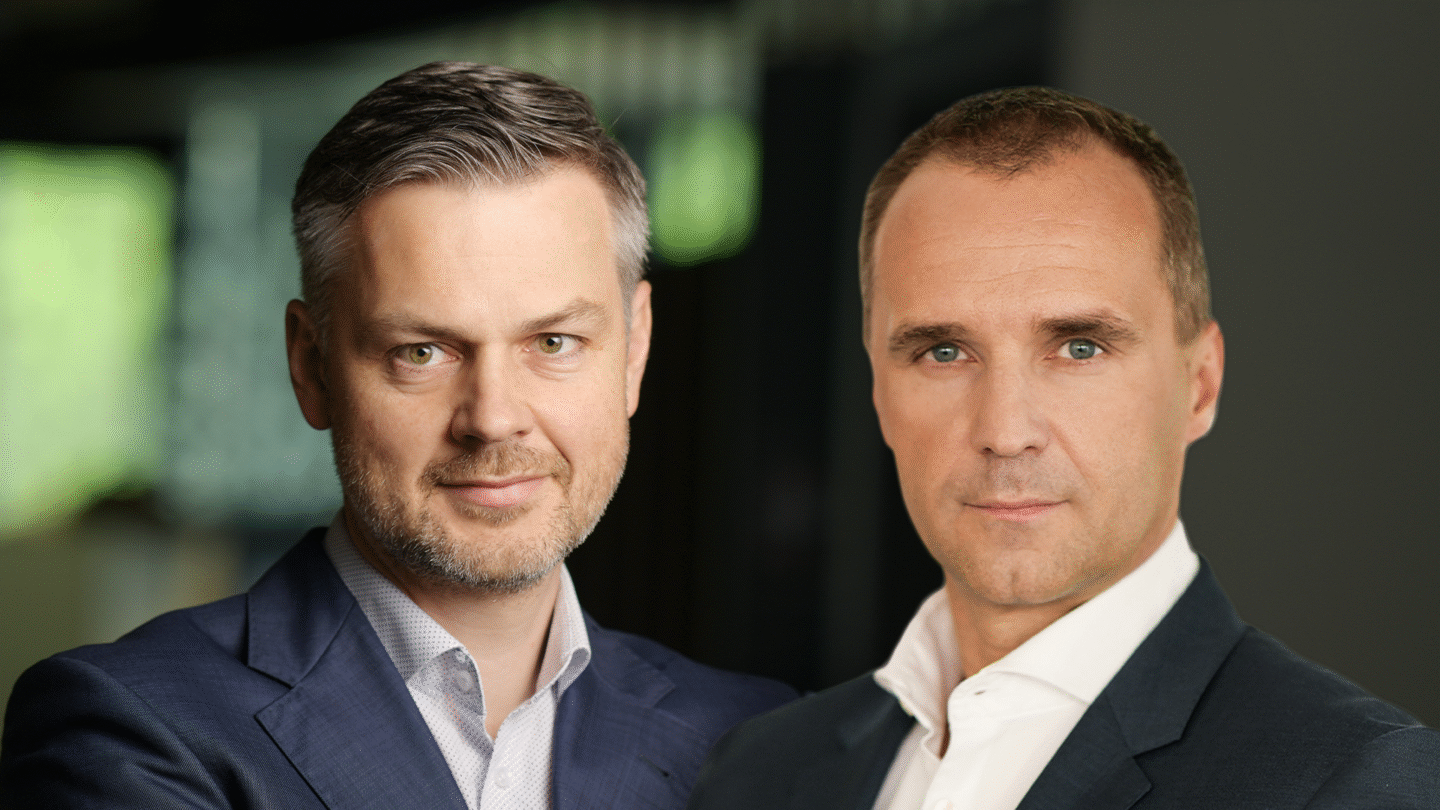
“We are talking about a kind of oligopoly. Historically, the three largest players in both markets held as much as 80% of market share; today that figure is somewhat lower. Even so, this makes market entry a significant challenge,” says Robert Chrištof, who has led mBank in Czechia since December 2024 and chairs the executive committee overseeing both the Czech and Slovak markets.
mBank nevertheless took on the challenge. When entering these markets, it sought to stand out with a distinctive customer proposition. It was the first to offer free accounts and services for retail clients, and it provided a user-friendly app. Press releases from that period highlight market-leading deposit rates and the most competitive pricing for loans. Today, Chrištof notes with some satisfaction that larger competitors have copied solutions pioneered by mBank’s Czech and Slovak operations — perhaps the highest form of recognition.
“We showed that you can offer high-quality digital banking without charging customers high fees. We set a trend that others followed,” he says.
Serving 10% of adult customers across both markets
Eighteen years after its debut, mBank is still not among the largest players in either market. Its share of sector assets does not exceed 4–5%. But it looks much stronger when measured by customer numbers. In Czechia and Slovakia combined, it serves 1.2 million customers — just under 10% of the adult population (13 million). That makes it one of the larger players in the retail segment.
“On average, each adult Czech and Slovak holds more than two bank accounts. That’s why all our efforts focus on increasing the activity of existing customers. We want to become their main bank, not just the one they use for higher interest rates. We intend to be our customers’ lifelong partner,”
Chrištof emphasizes.
 Interactive chart
 Currently, the bank has just over 700,000 active customers — those who transact regularly, make at least five card payments a month, and receive regular inflows to their accounts. Under mBank’s strategy through 2030, this number is to rise to at least one million. The vast majority of new customers are already active users. In 2025, mBank added 110,000 new customers across both markets, 75–80% of whom actively use its services.
“Eighteen years after launch, we are now a mid-sized bank that has proved it can succeed even in markets functioning as oligopolies. Over the strategy horizon, we want to double our market share in both lending and deposits,” Chrištof says.
A limited branch network by design
As in Poland, mBank has not built an extensive branch network in Czechia or Slovakia. It operates 28 locations in Czechia and about half that number in Slovakia. These come in three formats: traditional financial centers, lighter branches, and mKiosks (stands in shopping malls).
“Whether banks have 500 or 1,000 branches, we are still competing for two markets with a combined population of 16 million. Even without a large network, no one can beat us on accessibility, maturity, and speed of delivery of solutions,” says Chrištof.
“We are a leader in payments excellence. We were the first to introduce, for example, payments with smart rings; among the first to launch Google Pay and Apple Pay. We believe this matters in the battle for customers. We also see that such solutions increase spending value. In payments made with rings customers spend on average about one-third more than with cards,” adds Roman Fink, CEO of mBank Slovakia and chief financial officer on the joint Czech–Slovak executive committee.
Converting traditional customers to the app
The small branch network is a deliberate strategy. The bank encourages customers who visit branches to install the app and use it for everyday banking. Currently, 555,000 people use the app — almost half of all mBank customers in Czechia and Slovakia. At the end of 2022, the number of app users was about half that level.
Despite the ongoing shift toward remote channels, the bank does not plan to close all branches. Instead, the network’s structure will change: mBank will gradually move away from mall kiosks in favor of traditional branches.
“When customers come to discuss mortgages, they don’t want to be surrounded by crowds doing their shopping. A branch provides a much more comfortable environment,” Fink acknowledges.
Uncompetitive in mortgages…
This brings us to mBank’s lending business. At the end of September 2025, its loan portfolio in Czechia and Slovakia was worth PLN 10.2 billion (EUR 2.4bn), accounting for 13.2% of the parent group’s total loan book. Roughly two-thirds of this was in Czechia and one-third in Slovakia. Mortgages dominated, though growth has been modest: 4% year on year in Czechia and 1% in Slovakia.
Interactive chart “The mortgage market has seen intense competition for years, pushing margins sharply down. Average margins are now around 0.8–1 percentage point. That is challenging for us because, unlike our competitors, as a subsidiary of a Polish bank we must pay a 0.44% bank tax on this amount. As a result, we have essentially focused on granting mortgages mainly to our existing customers and have limited lending to new clients. We no longer treat mortgages as an acquisition product,”
explains Chrištof.
This issue was also highlighted by mBank CEO Cezary Kocik in an interview in August, where he spoke of unequal competition in Czechia and Slovakia.
“We have to pay the Polish bank tax on mortgages granted abroad. None of our competitors have to do this. That makes us highly uncompetitive. There is a lot of talk about Polish companies expanding abroad, but to do it effectively we need at least a level playing field in those markets,”
he said at the time.
…yet the mortgage portfolio is beginning to grow again
Despite these constraints, mBank’s executives argue that after years of slower growth, mortgage sales have picked up and are now showing strong momentum, though they do not disclose exact figures. Evidence of improvement can be seen in the stabilization of the mortgage portfolio’s value. For the first time in years, annual growth in these products has turned positive; quarterly growth has reached 4% in Czechia and 2% in Slovakia.
“If we want active customers, we cannot afford to lose them because we don’t offer mortgages,”
Fink says.
Double-digit growth in other loans
mBank has seen much stronger growth in non-mortgage lending — mainly personal loans and credit cards. Over the past year, the portfolio grew by 26% in Czechia and 25% in Slovakia.
Even so, these volumes remain smaller than mortgage lending and are unlikely to overtake it, given the large difference in average loan size and the gradual recovery in mortgage sales. Put simply, one mortgage is worth about 20 personal loans.
The bank notes that 70% of personal-loan sales go to its existing customer base. These are so-called pre-approved loans, which — thanks to detailed customer data — can be offered in the app with funds paid out within minutes. The remaining 30% is generated through intermediaries providing financial-advisory services.
“Many factors are driving acceleration here. Two and a half years ago, we shifted priorities, allocating more resources to this product instead of focusing so heavily on mortgages. Today, we stand out for fast application processes, availability in digital channels, and effective risk measurement — but not necessarily for price. We’re not the cheapest in the market; we’re comparable,” says Chrištof.
Resilient to falling interest rates
Fink argues that the bank’s strategy is delivering results. Revenues and net profit are growing at double-digit rates. According to mBank’s presentation, combined revenues from the two markets rose 16% year on year to PLN 158.4 million (EUR 38m), meaning that the Czech and Slovak businesses contribute about 5% of the group’s total income.
“For years, the Czech banking market was the most profitable in Central and Eastern Europe. Now it’s broadly comparable to Poland. Slovakia’s development has been somewhat slower,” the executive notes.
Banks are grappling with falling interest rates, and universal banks with broad retail and corporate offerings tend to cope better. mBank, however, remains focused exclusively on retail customers and small businesses — and does not intend to change that.
Executives point to the growing importance of fee income in a lower-rate environment. mBank has seen higher revenues from insurance products linked to loans, such as coverage protecting repayment in the event of job loss. In 2026, it plans to expand this insurance to cover a wider range of life events that could affect a borrower’s ability to service a mortgage.
“After years of very high interest rates, we’ve simply returned to normalization. We can cope because we are the most cost-efficient bank. Strong growth in personal lending also helps,”
says Fink.
Over the strategy horizon, mBank plans to broaden its offering to include investment products, though it has not specified whether this will involve mutual funds or access to securities. It wants to build a solution not currently available on the market and best suited to customer needs.
The bank does not plan to enter new segments such as private banking or large corporate services. Instead, it will focus on its strengths. Its executives still see substantial growth potential in both markets.
Expert's perspective
mBank in Czechia continues to outpace competitors in innovation
Although mBank is no longer the only bank offering online banking — this is now standard — it remains among those introducing digital innovations ahead of competitors. Whether these are incremental improvements or more significant steps, they are usually developed in cooperation with customers. The result is products that feel tailor-made — from earlier payment cards with favorable FX rates to newer accounts designed for small businesses.
Ultimately, mBank’s popularity is reflected in the numbers. According to archived reports, in 2008 it served 185,000 customers; last year that figure had risen to nearly 800,000. While it is unlikely that the bank will again launch something as groundbreaking as free accounts, I am convinced it will continue to surprise the market in the near future.


Key Takeaways
- mBank remains highly uncompetitive in the mortgage market because it must pay the Polish bank tax on loans granted abroad. Even so, it reports growing sales in this area. Much stronger improvements are evident in personal loans and credit cards. The bank also plans to introduce investment products and a new type of insurance.
- Eighteen years after entering Czechia and Slovakia, mBank has 1.2 million customers there — around 10% of the adult population. Its shares in the lending and deposit markets remain modest, but Robert Chrištof and Roman Fink, who lead the two businesses, say they aim to double them over the strategy horizon.
- For years, mBank differentiated itself through free services and payments innovations. It was the first to introduce, for example, payment rings — an area in which Czechia even outpaced Poland. Although it now has many imitators, it plans to intensify the fight for active customers. The goal is to increase their number from 700,000 to one million over the next five years.