

This article is a part of Poland Unpacked. Weekly intelligence for decision-makers
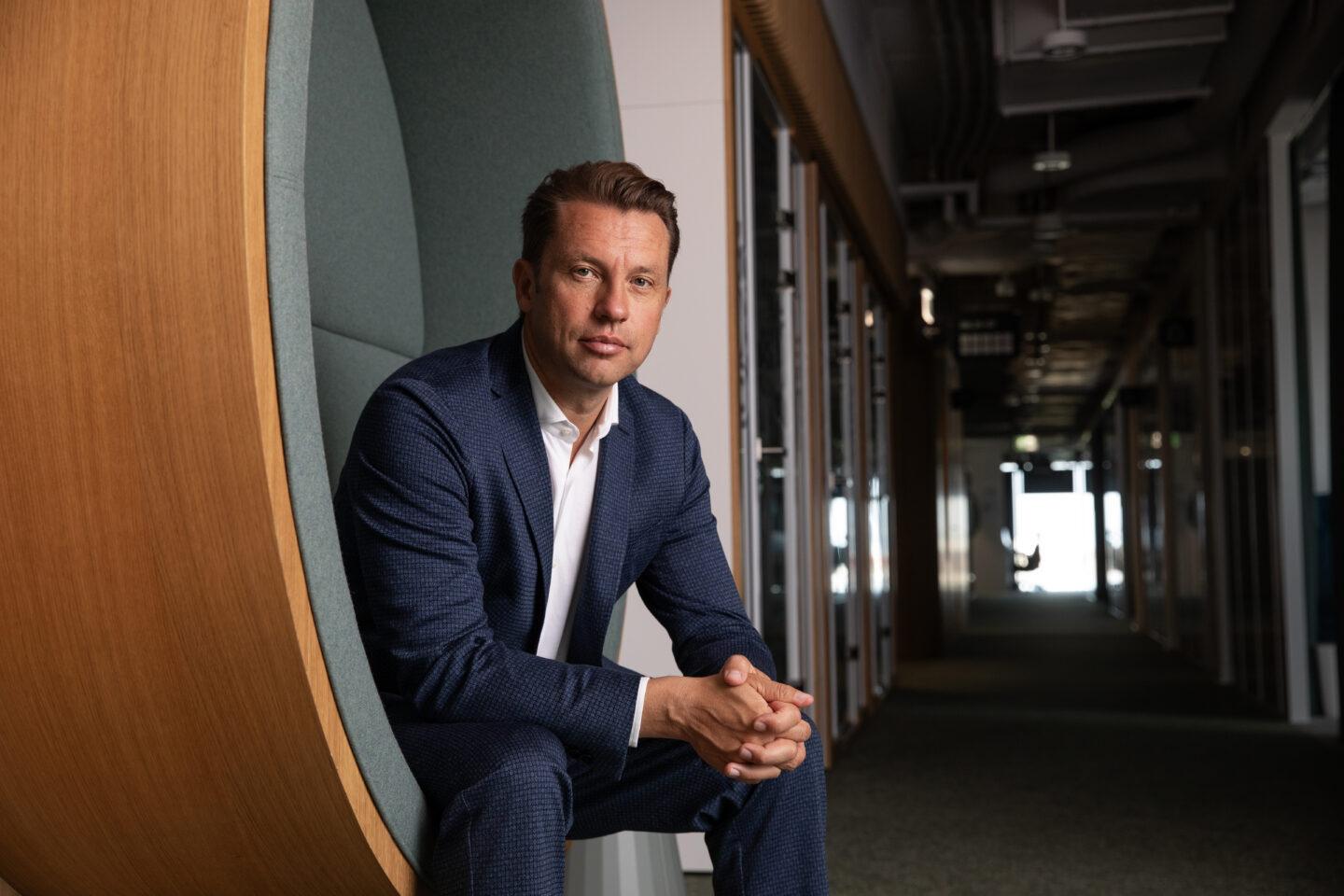
Speed, determination, and ambition—these traits have defined Jakub Dwernicki’s career in both sport and business. On the racetrack, he drives a Porsche 911 GT3 Cup, a top-tier racing car. In everyday life, he runs a brand with equally global ambitions: the technology group cyber_Folks.
The company’s market capitalization has quadrupled over three years to more than PLN 3 billion, while investors have benefited from generous dividends. Since 2020, the group has expanded its scale of operations roughly fourfold, reaching PLN 800 million in revenue and PLN 240 million in EBITDA. Analysts have issued five recommendations (four “buy” and one “hold”), with the average target price close to the current share price.
The cyber_Folks story began in 1999 in Poznań, with a hosting company called Spider founded by Jakub and Robert Dwernicki. Through consistent market consolidation, the group has become one of the largest hosting providers in Poland and now operates in around 180 countries, including following its acquisition of Romania’s Hosterion in 2025.
A pivotal step was the move into e-commerce. After launching its proprietary _Stores platform in 2022, cyber_Folks acquired Shoper in 2025 for PLN 547.5 million, and subsequently signed an agreement to purchase 100% of PrestaShop for EUR 55 million. Thanks to these transactions, the group is building Europe’s largest e-commerce ecosystem, with gross merchandise value (GMV) reaching PLN 35 billion.
The price of being the newcomer
Mariusz Bartodziej, XYZ: You took the company public in December 2017 at a valuation of nearly PLN 250 million. Did that seem high to you at the time?
Jakub Dwernicki, CEO and founder of the cyber_Folks Group: No. The market expected us to pay an “entry fee” of sorts. In our view, the business was already worth several dozen percent more—and the future proved us right. At the time, however, we were still a relatively unknown company.
And yet you decided to go ahead with the IPO. Was that driven by the need to access investors’ capital to execute ambitious acquisition plans?
Exactly. We knew that sooner or later we would want to tap into larger pools of capital. Being listed gives us the most attractive way of doing that.
The September share issue—in which you raised more than PLN 204 million in less than 24 hours—showed that the market is willing to finance your plans. Did that reinforce your belief that the stock market offers greater independence in pursuing a long-term growth and acquisition strategy than a private equity fund?
That was possible thanks to the credibility we have built consistently over years on the Warsaw Stock Exchange. We take our commitments very seriously. We set ambitious goals and deliver on them. That has become our hallmark.
Being listed now gives us genuine independence. If we had a private equity fund in our shareholder structure, we would to some extent have to align ourselves with its expectations—and sooner or later also with its exit scenario. The stock market, by contrast, allows entrepreneurs to run their businesses in line with their own long-term vision.
Eight years on, the group’s market capitalization comfortably exceeds PLN 3 billion—up almost 50% year on year. Does this success mean everything went according to plan and that no mistakes were made along the way?
More or less, yes. I admit there were several transactions on the table that we failed to complete. Had they gone through, things might have been even better—though I would not claim that for certain. Still, we have little to complain about. I would go so far as to say things are very good.
I do not see any major errors in our decisions. It is true that luck was on our side. But luck favors the prepared.
What has been one of the biggest challenges of being a listed company?
We had to learn a great deal about investor communication—it is essentially an endless process. Time and again we have realized that some things need to be explained ten times over. Even if something is obvious to us, it is not necessarily obvious to others. Information is not evenly distributed across the market.
I still feel that many issues that are crucial to understanding our strategy have yet to become part of the common perception of who we are. Our duty to shareholders is to explain the most important matters clearly, which is why we often rely on analogies. Finding the right ones is not easy.
“We are a globally unique company”
Back in 2020, when you were streamlining the group’s structure and rebranding from R22 to cyber_Folks, you pointed out that the company was valued below its peers—at around ten times annual EBITDA, compared with the low teens or even around 30 times for other companies in the sector. As CEO and one of the largest shareholders, how do you view the current valuation relative to the competition?
As the CEO of a listed company, I am not allowed to comment on our valuation. I can, however, refer to our competitors. Shopify is a good benchmark for us. While in terms of key metrics it is at most a dozen or so times larger than we are, its valuation is roughly 200 times higher than ours.
One has to factor in the premium that comes with being a global leader and being listed on a U.S. exchange, but I have doubts as to whether that fully justifies the gap. The comparative valuation methods used by the more conservative part of the market to assess us are inadequate. We still have a great deal of untapped potential to monetize. We are a globally unique company.
In what sense?
Broadly speaking, companies can be simplified into three categories: dividend payers, growth companies, and those that invest heavily in development. We combine all of these traits. We had to learn how to do that while operating in Polish market conditions.
We regularly share profits with shareholders: the combined value of dividends and share buybacks has been growing at a rate of 58% since 2020. At the same time, we are increasing revenue, net profit, and EBITDA by an average of 30–40% a year—very fast by any standard. That is growth typical of technology businesses such as Uber, which generated massive losses for years.
We could not afford that, because the Polish stock market does not accept such a situation. You never know whether “burning cash” will lead anywhere, or whether there will be enough of it. We carried out our first share issue only last year—almost eight years after our debut.
Despite spending what is needed to sustain rapid growth and paying out a significant share of net profit to shareholders, we continue to invest heavily in improving our own products and creating new ones. In 2025, the group allocated around PLN 40 million to this purpose, including PLN 25 million for e-commerce technologies. In 2026, we will maintain a similar level of investment.
Market capitalization is largely a reflection of a company’s scale and, above all, its potential. How far do your ambitions reach today? The rally in your shares began almost three years ago, with the price rising roughly fourfold over that period. It will be difficult to sustain that pace.
Those are our ambitions—but whether we succeed remains to be seen. Since the IPO, our share price has already increased twelvefold, and that is certainly not the end of the story. We are now in the best possible position to build a strong, European technology provider for the e-commerce industry. There is no larger company than us in this space in Europe today.
Everything else therefore depends on how effectively we are able to monetize the roughly PLN 35 billion in GMV generated by our clients. At our current scale, this is decidedly easier than it was before.
Why?
In our industry, everything rests on three interconnected pillars: the product, the brand, and customers and partners. The cost of developing technology is independent of how many companies use it. As a result, the larger the potential customer base, the lower the unit cost of the product.
The same applies to the brand. As consumers, we tend to value large, well-known brands most—and the same is true in business. Companies want to choose credible suppliers, and the stronger our position, the less we have to spend on building brand recognition.
And the third pillar?
A technology business like ours is built around partners. They implement, service, and customize the solutions. For partners to take an interest in a technology, there has to be a sufficiently large market for it. And conversely, it is difficult to expand the customer base if you cannot provide adequate support. Once you reach the right scale, however, the business becomes self-reinforcing. We have already reached that point.
Shopify, Microsoft, and Apple—all technology providers to businesses—have their own “stores” for partner solutions that they do not develop themselves. In Europe, we already work with several thousand such partners. Developing solutions for a base of 260,000 online stores built on Shoper, Presta, and Sylius technology is far more attractive than doing so for just over 20,000 stores on Shoper alone.
“Mediocrity is not enough for us”
Today you offer almost everything entrepreneurs need to establish an online presence and run a business on the internet. Yet it all began in 1999 with hosting. Back then, even individual entrepreneurs were rarely online. How many companies at the time thought this was necessary?
Almost none. We had to “evangelize” the market—convince people that the internet made sense. Most believed it was completely unnecessary and that they could continue running their businesses as they always had.
For years, our focus was simply on getting anyone to buy our service at all. Today, by contrast, clients’ questions are far more sophisticated. They ask about implementation time, availability, additional solutions, limits, security, and so on. At this stage, scale is extremely important, especially for large customers. They look for stable, predictable partners and are willing to pay a premium for that.
We are not the cheapest, but we offer a kind of quality guarantee. Lower prices from cheaper providers usually reflect savings made somewhere. Their solutions work as long as everything runs smoothly. But when a problem arises, it can be very costly.
You started with just a handful of employees, and with the latest acquisition the group will employ around 1,300 people. What changes in your management approach has that required?
Paradoxically, my role is still much the same: setting the direction of the business, shaping strategy, and developing products. There is simply more of it now, because many new areas have emerged. At the same time, I have teams that take other matters off my plate. Coordinating the work of several dozen board members across the group’s companies requires the right level of involvement. Above all, however, it is about choosing the right partners and building a strong team.
So what do you value most in an employee?
Genuine skills—being an absolute expert in one’s field—along with hard work and commitment. I value people who work because they want to, not out of a sense of obligation. There are times when a small group of us will discuss things until eleven at night, and no one at the table treats it as a chore. More often than not, I am the one who has to suggest it is time to cool down. I appreciate people who genuinely enjoy what they do. In such cases, shared success motivates them even more than money.
And what do you not tolerate?
Managers who manage but do nothing themselves. For years, we have followed the principle of the “player-coach.” That applies to me as well. I am not a CEO who merely reads reports and sets targets for others. I roll up my sleeves and work side by side with the team every day. It is a very effective approach when it comes to building morale and motivation.
We are not building an organization for people who want to simply “run out the clock” at work. An entitled attitude and a lack of genuine engagement do not fit with us. We set ambitious goals and expect the same mindset from our team. This is an environment for people who want to take responsibility and grow. Mediocrity is not enough for us.
Shoper’s IPO as a catalyst for change
When did the hosting business stop being enough for you? And was this more a response to needs signaled by customers, or an attempt to blaze a new trail?
It was more the latter. Customers always signal a huge number of initiatives. Most of them go beyond what we could—or would want to—do. We therefore have to be extremely selective, choosing areas that affect a large share of our customer base. E-commerce is one such area.
Indeed. For more than two decades, you limited yourselves to supporting entrepreneurs operating online. Only at the end of 2022 did you offer them your own product for creating and running a simple online store: _Stores. What tipped the balance toward a direct move into e-commerce?
Shoper’s high-profile debut. It listed on the Warsaw Stock Exchange in July 2021 at a valuation of PLN 1.3 billion, which rose to PLN 1.7–1.8 billion in the first trading sessions. It had twice our market capitalization despite clearly weaker performance across all key business metrics.
We started asking ourselves how that was possible. Was it simply because it operated in a slightly different sector? After all, even then we were already servicing tens of thousands of online stores by providing hosting.
So what did you decide to do about it?
Earlier, we had tried to acquire various e-commerce companies. We also held talks with Shoper before Value4Capital invested in it in May 2019. But it always seemed too expensive. We decided not to wait any longer.
In August 2021, we acquired a minority stake in SellIntegro for PLN 21.5 million and, in parallel, began work on _Stores. We were well aware that it would be difficult to grow from scratch in a market that was already very mature. Still, we wanted to use our own product to understand the industry’s needs from the inside—to build the necessary know-how before an investment opportunity emerged.
Three years of experience prepared us well for the acquisition of Shoper—so much so that we followed up quickly, signing another acquisition agreement less than a year later.
Sixteen-hour workdays for several months
You acquired 49.9% of Shoper’s shares in February 2025 for PLN 547 million, valuing the company at around PLN 1 billion. At its peak in 2021, its market capitalization exceeded PLN 2 billion. Was that already the right moment to stop overpaying for e-commerce companies?
Yes. The correction normalized valuations. I believe we bought Shoper on attractive terms, as evidenced by its current market capitalization of around PLN 1.6 billion.
That investment proved critical for us. Without it, we would not be where we are today. We probably would not have bought Presta, because we were not actively looking for opportunities in that area. Fortunately, I knew the founders of Sylius—Mikołaj Król, Damian Murawski, and Paweł Jędrzejewski—since we had built _Stores on their technology. Their expertise in the open-source model gave this transaction its rationale. We were able to connect dots that others did not see.
It is likely that Presta was not a good fit for anyone else in Europe in the way it was for us. It is a great place to be when you become the one obvious destination for a company that wants to be acquired.
You quickly moved from the role of vice president at Shoper to CEO. Was that the plan from the outset, or was it connected to Marcin Kuśmierz’s efforts to take over the top job at Allegro?
It was a coincidence. As Marcin admitted in a recent interview, he had been talking to Allegro several months earlier. Naturally, I was not aware of that at the time. The original plan was to work with Shoper’s existing management.
Things turned out the way they did, and I bear no grudges against anyone. I had to jump in at the deep end and, for the first two or three months, I was probably working 16 hours a day. Even so, I have no regrets—quite the opposite, in fact. In hindsight, I am very glad it happened. It allowed me to get to know the company extremely well and to gain a deep understanding of just how much potential it holds.
It is no secret that the IAI Group was also on your radar, and it will ultimately be acquired for around PLN 1.1 billion by Montagu Private Equity. The problem was that, given its shareholder structure, buying half of the company was probably not an option—so you would have had to beat your previous transaction record by a wide margin. Were there many other options on the table, or was PrestaShop the natural next target after Shoper?
There are always many options on the table. My role is to select the single best one and execute the transaction on our terms. Only that approach leads to successful acquisitions.
I do not want to dwell on IAI. I can only say that, in hindsight, I am glad that transaction did not go through. Otherwise, we would not have been able to buy Presta, which is a much better investment for us. It offers not only greater opportunities, but also stronger potential returns on the capital deployed.
To some extent, I regret that we were unable to acquire the Czech company Shoptet. Another bidder paid significantly more [cyber_Folks had signaled acquisitions of up to EUR 150 million in its most recent share issue; Shoptet was acquired by team.blue—ed.]. But again, had that deal gone through, we probably would not have bought Presta either.
So I believe things have worked out as they should. We will be serving far more online stores and will be able to monetize their GMV much more effectively.
“Everyone will benefit from this transaction”
Almost a year ago, you told me that you did not plan to expand in e-commerce into Western Europe, let alone globally, because of the sector’s specifics—its need for numerous integrations and the entrenched position of stronger global players, above all Shopify. What has changed?
For years, we limited ourselves to Central and Eastern Europe because we know the region extremely well. It was not a lack of capabilities that kept us out of the West, but a desire to avoid truly large investments. Organic growth would have meant losses in the early stages, and our shareholders do not like that.
An acquisition was therefore necessary, and Presta was the first opportunity to emerge. This transaction will significantly broaden the pool of potential companies we can bring into the group. All of a sudden, it will make sense to acquire smaller players in Poland, France, or Spain that offer e-commerce solutions complementary to ours.
After the deal was announced, concerns immediately surfaced about online merchants becoming overly dependent on you, as well as about the rationale for combining SaaS and open-source models. Let us start with the changes market participants should expect.
They will be entirely positive for everyone: customers, partners, ourselves, and employees across the group. Partners—specifically implementation firms—will be able to act in the client’s best interest. If someone runs a single-brand ski store, they will naturally promote and sell equipment from one brand. But in the case of a multibrand store, they can choose skis best suited to the customer’s skiing style. Partners who have so far implemented Presta will be equally able to offer Sylius or Shoper—and vice versa.
For customers, the benefits of greater choice are obvious. In terms of the cost of doing business, nothing will change. We will maintain the open-source model, and companies using Presta and Sylius will, if they wish, be able to take advantage of individual integrations and plug-ins provided within the group.
As for us, we will benefit from being able to offer an even more comprehensive proposition. We have an ace up our sleeve that we will reveal this quarter. It concerns the integration of all our services and products.
And what is your plan for having these two different business models coexist or complement each other? How will this affect the group’s EBITDA profitability, which has so far been maintained at 25–30%?
PrestaShop generates roughly EUR 30 million in revenue and EUR 3 million in EBITDA. We see significant room for growth on both fronts. We expect to obtain the necessary approvals this quarter and will immediately begin intensive work. I see no reason why Presta’s profitability should differ from the group’s level. A 10% EBITDA margin may be acceptable in retail, but not in the technology sector.
France’s labor market: the challenge ahead
On what timeline are you prepared to be held accountable for whether this transaction makes sense?
After just a few quarters we can already see how customer perceptions of Shoper’s product have improved, and this will soon be reflected in its results. We would like to replicate that with Presta.
Reportedly, in previous years Shoper had already been interested in Presta, but at the time the owner wanted about EUR 100 million. You negotiated a valuation of EUR 55 million. How do you assess it?
I believe that this valuation level works well for us—especially given the potential we can unlock in the company.
Fortidia acquired PrestaShop in 2021, when it was generating revenues of just over EUR 20 million and GMV of EUR 24 billion, after year-on-year growth of 9%. Today, those figures are roughly EUR 29 million and EUR 22 billion, respectively. That does not look encouraging, given the double-digit growth of the e-commerce market over that period. How much can you realistically “extract” from this business?
I will not provide specific numbers, as we do not publish forecasts. I can assure you, however, that we will materially improve these metrics. We would not have undertaken this investment if we were not confident in it.
Moreover, we are not alone in our conviction about future success. The owners of Sylius have put their entire wealth on the line, taking up more than one-fifth of the shares in the combined entity. They understand the open-source model far better than we do. For this transaction, we have chosen the best possible partner.
A major challenge—putting it mildly—will be integrating PrestaShop’s several-hundred-strong team, located primarily in France. A labor market that strongly favors employees is usually the first thing French entrepreneurs complain about. What is your plan?
That is true—we will have to face this head-on. We believe that, as an investor coming directly from the same industry, we will be able to build constructive relationships with the Presta team. In addition, France—despite its mildly socialist leanings—is performing quite well by European standards, clearly better than Germany. I am therefore optimistic about this transaction.
Readiness for multi-million acquisitions
What comes next? Are you prepared to consolidate the industry across Europe—or even beyond?
For now, we will focus primarily on integrating the group. I admit that at this stage we are not even looking in Western Europe at specific acquisition targets. If anything, our attention is closer to home—but it is too early to go into details.
After acquiring Shoper, you said that your budget for potential acquisitions had not changed and still stood at around PLN 1 billion. What does it look like after this transaction?
The budget has been reduced, but we still have the capacity to finance acquisitions worth several tens of millions of euros. These are not funds sitting idle in a bank account; rather, they reflect our financial capacity, including potential leverage. As a result, we are not compelled to spend that amount down to the last zloty. We are always guided by maximizing return on investment, so if an opportunity arises, we are ready to pursue it.
Not every company can be bought
You have participated in several dozen transactions so far. Does that lead to the conclusion that every company is for sale—it is merely a matter of price?
No. On the one hand, there are companies that very much want to sell, but we have no interest in buying them, regardless of the price. On the other, there are companies we would very much like to acquire, but whose owners have no interest in selling. Sometimes this goes on for several years and eventually a transaction happens; sometimes nothing changes. It takes two to tango. The same applies to M&A.
How does this relate to your group? NetArt, the owner of, among others, the hosting services provider Nazwa.pl, explicitly states in its financial report that it is interested in acquiring, among other things, the hosting business of cyber_Folks.
I do not take that declaration seriously.
A patriotic drive to build global companies from Poland
What most constrains your ambitions and plans?
I try never to think in those terms. I do not like focusing on obstacles.
So what motivates you?
The awareness that we built, from scratch in Poland, a group that has become a meaningful player on a European scale. In doing so, we are part of a broader trend of strengthening domestic companies abroad—particularly in Western Europe. Contributing to the building of Poland’s international standing motivates me for patriotic reasons.
Why is this so important to you?
For years, Poland has been rich in ideas and talent: outstanding engineers and entrepreneurs. Yet too rarely have we managed to build large, international organizations on that foundation—companies that truly matter in Europe. I am very keen to change that.
Building global companies from Poland is about more than financial results. It is about strengthening the entire ecosystem and fostering the sense that it is possible to create a world-class business without having to leave the country. If cyber_Folks becomes an example for other Polish companies—showing that it is worth thinking boldly, expanding internationally, and competing with the biggest players on equal terms—that will be just as meaningful a success to me as the numbers in the financial statements.