

This article is a part of Poland Unpacked. Weekly intelligence for decision-makers
This year, Poland’s Monetary Policy Council cut interest rates by a total of 1.75 percentage points, bringing the benchmark rate down to 4%. The move followed a rapid decline in inflation, which—according to preliminary data - fell to 2.4% year-on-year in November. The president of the National Bank of Poland has signalled that price growth has now been durably anchored at the inflation target.
Does that mean further rate cuts are likely in 2026? Most probably—though any reductions are expected to be far more modest.
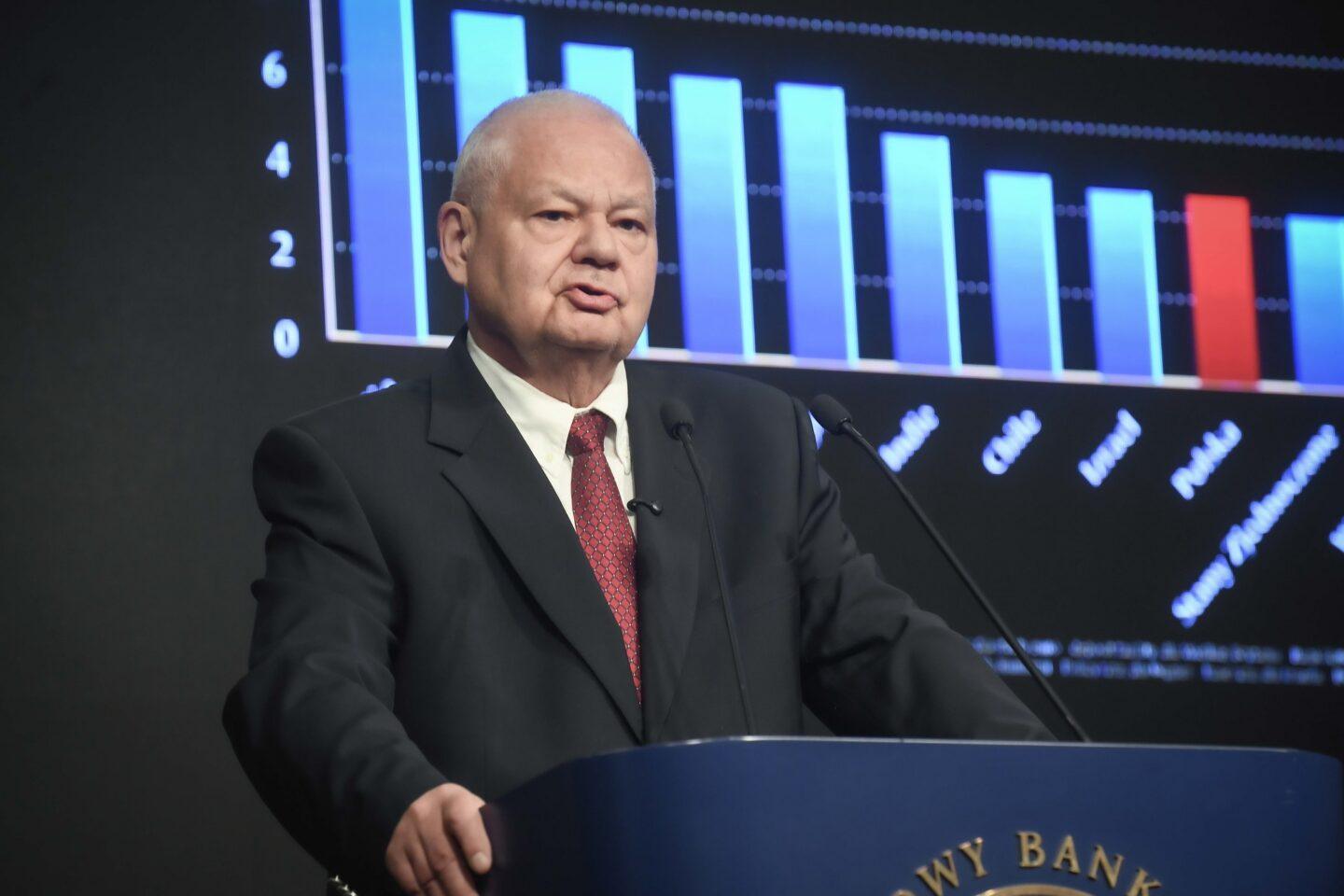
At the final press conference of the year following the Monetary Policy Council’s meeting, National Bank of Poland President Adam Glapiński declared that inflation had been brought back to target on a lasting basis. He even suggested it was “a moment for champagne.” Despite a few missteps along the way, the central bank’s campaign against rising prices has indeed proved effective. Crucially, the tightening cycle did not trigger higher unemployment, and the economy continued to expand throughout.
As inflation fell sharply over the course of this year, the Monetary Policy Council cut interest rates by a total of 1.75 percentage points, including a 0.25-point reduction in December. The benchmark rate now stands at 4%. What comes next? Market expectations and the NBP president’s own forecasts for 2026 largely point in the same direction.
A convergence of favourable forces is bringing inflation down
The head of the National Bank of Poland highlighted a number of encouraging price trends in the economy. Among them are falling service prices, driven by the sharp slowdown in wage growth—now at its lowest pace in nearly five years—and declining producer prices in industry. Together, these factors have pushed core inflation (which excludes energy and food) to its lowest level in six years. According to preliminary NBP data, core inflation dipped below 3% year-on-year in November, while headline inflation stood at 2.4%. External conditions are also helping: a strong złoty, low energy prices and falling commodity prices, partly due to a surge in imports from China.
 Interactive chart
 Still, Adam Glapiński pointed to three risks the central bank is monitoring. The first is the still-elevated pace of service-sector price growth. The second is the expected surge in EU-funded spending next year—from both the National Reconstruction Plan and the EU budget. The third is the sizeable public-finance deficit, projected to reach 6.5% of GDP in 2024, which he described as “the biggest problem facing the Polish economy.”
Yet each of these issues appears to have only a limited impact on overall price formation. Service-sector inflation should continue to ease as wage growth cools further. EU funds will be channelled mainly into investment projects, which are unlikely to generate broad inflationary pressure—though some sectors, such as construction or certain manufacturing niches, may feel upward price effects.
As for the deficit, a portion of it finances defence spending abroad and therefore does not fuel domestic demand. Moreover, the deficit is expected to be slightly lower than this year’s figure, meaning the fiscal impulse will not increase but remain broadly unchanged.
Markets and the NBP president see eye to eye
The president of the National Bank of Poland suggested that, for now, the most sensible course is to wait and watch - pausing further rate cuts to assess how the reductions already made are feeding through to inflation and the broader economy.
In the months ahead, he did not rule out small additional cuts. While he argued that current rates are close to their optimal level, he noted there is room to edge down to 3.75% or even 3.50%, provided favourable conditions persist and inflation remains within the target band.
Interactive chart Markets broadly share this outlook. FRA contracts - used to price expectations for Polish interest rates - indicate a 25-basis-point cut in the first quarter of 2026 and another 25-point reduction in the second. That would bring the benchmark rate to around 3.50%, where it is expected to remain through the end of the year.
XYZ’s take
Forecasting interest rates is a risky business for many reasons - not least because inflation itself is notoriously hard to predict. It reflects a tangle of underlying processes, each with effects that are difficult to quantify in advance.
Over the past year, markets correctly anticipated the direction of interest rates but underestimated the scale of the cuts. At the turn of the year, FRA contracts suggested rates would end 2024 in the 4.75–5% range. The most optimistic analysts expected they might fall to 4.50%. In the end, the benchmark rate settled at 4%.
A year ago, at the December press conference, the president of the National Bank of Poland said the prospect of rate cuts had been pushed back to 2026. This is worth recalling - not as a criticism, but as context for interpreting both the president’s remarks and the MPC’s messaging. One might argue it was a deliberate strategy: to dampen expectations for cuts and then surprise the market on the upside. But the broader point stands: even relatively near-term forecasts can diverge sharply from reality.
To be fair, there have also been years when market pricing turned out to be wildly off the mark.
What might 2026 bring?
For now, the macroeconomic backdrop looks relatively calm, and a decline in interest rates to around 3.50% appears plausible. A move towards 3–3.25% is not unimaginable if inflation settles near 2%. Yet risks remain. Some are familiar - rising commodity prices, a weakening złoty - while others are harder to handicap, such as the potential end of the war in Ukraine. According to a recent forecast by mBank economists, a resolution of the conflict could lift inflation by as much as 0.5 percentage points if it triggers a significant outflow of Ukrainian migrants from Poland.


Key Takeaways
- Inflation has returned to target. The National Bank of Poland says inflation has now durably returned to target, helped by slowing wage growth, falling producer prices, a strong złoty and low energy costs. At the same time, the central bank flags three potential risks ahead: persistent service-sector inflation, a surge in EU-funded spending, and a sizeable fiscal deficit—though their overall impact on price growth may be limited.
- Monetary policy enters a “wait-and-see” phase. After cutting rates by 1.75 percentage points this year, the Monetary Policy Council plans to pause and observe how its earlier moves are feeding through to the economy. President Glapiński has left the door open to small additional reductions in 2025—potentially to 3.75–3.50%—provided inflation stays on target and external conditions remain supportive.
- Markets and the NBP are aligned on the rate path—but forecasts remain fragile. FRA contracts point to rates falling to around 3.50% in the first half of 2026 and staying there. Yet history shows that both market expectations and the NBP’s own guidance often miss the mark. The baseline scenario assumes rates hover around 3.50%, with a move toward 3–3.25% possible if inflation stays very low. But risks linger in the background, from commodity and currency shocks to geopolitical uncertainty.