

This article is a part of Poland Unpacked. Weekly intelligence for decision-makers
“I am a member of this coalition, and I will support it. I will be a strong, loyal, and predictable partner in this cooperation,” Mr. Czarzasty declared upon taking office.
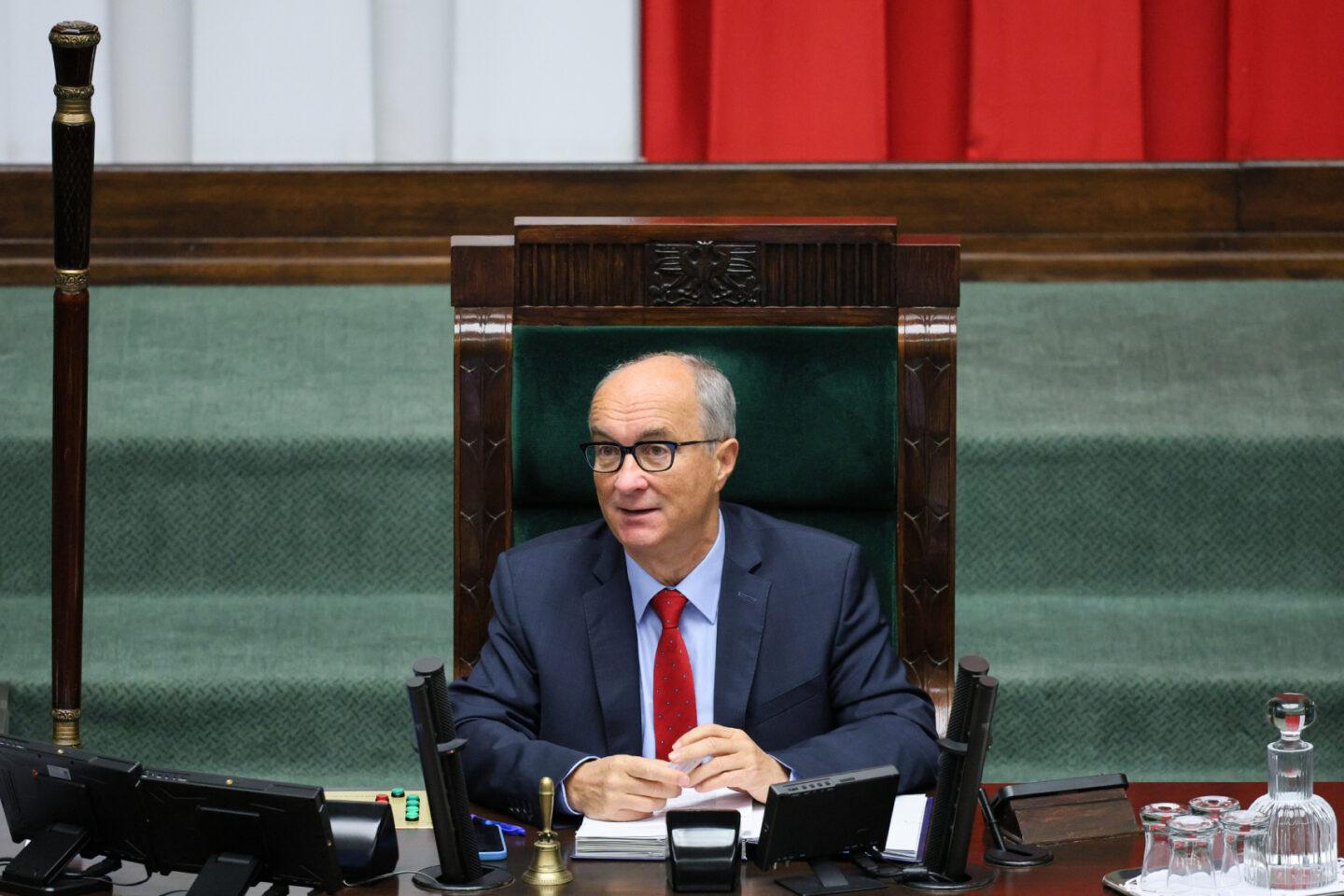
Mid-term leadership changes in this role are not unprecedented in Polish politics. On Tuesday, Włodzimierz Czarzasty, co-leader of Nowa Lewica (New Left), assumed the role, fulfilling a coalition agreement that called for Szymon Hołownia – a celebrity turned politician and a political party leader from one of coallition parties – to step aside.
Despite being spelled out in the coalition deal, the rotation wasn’t entirely smooth. Even before the vote, several MPs from Hołownia’s Polska 2050 bloc (part of the coalition) made clear they wouldn’t back Mr. Czarzasty.
In recent weeks, the opposition Law & Justice (PiS) politicians have been raising questions about Mr. Czarzasty’s past membership in the communist time-PZPR (Polish United Workers’ Party), which lasted from 1983 to 1990. They’ve also highlighted his tenure on the National Broadcasting Council (1999-2005) during the notorious Rywingate affair of 2002. It was a corruption scandal – named after a film producer who was a key figure in the affair – when a post-communist government was in power.
Now comes the irony. In 2023, PiS opposed Mr. Czarzasty’s Deputy Speaker bid. Yet back in 2019 – at the start of PiS’s second term – 177 of the party’s 195 MPs voted to appoint him to precisely that position.
PiS stages walkout
The vote on Mr. Czarzasty’s speakership was among the first orders of business on day one of the Sejm session. PiS demanded the vote be postponed and Mr. Czarzasty’s full biography be made public. One of PiS MPs stated the vote was a referendum on whether Poland should have “weak leadership”.
When Czarzasty’s nomination was made formal, the vast majority of PiS MPs – led by party chair Jarosław Kaczyński – staged a dramatic walkout, chanting “down with communism” as they exited the chamber.
Some later returned and took the floor to speak against the nomination. They invoked Mr. Czarzasty’s past praise of former communist leader and general Mr. Jaruzelski (who introduced martial law in Poland in 1981) and reminded of Mr. Czarzasty’s association with the Rywingate corruption scandal.
Long story short: they accused Czarzasty of whitewashing communist-era crimes. Chants of “down with communism” were once again heard.
Coalition MPs: honoring the agreement is what matters
MP from the Civic Coalition (KO) took the floor next, reminding the chamber of Jarosław Kaczyński’s own favorable comments about Edward Gierek, a communist leader who headed Poland in the 1970s and indebted the country heavily.
Mr. Urbaniak pointed out PiS’s track record of elevating figures with communist backgrounds, some of them appointed by PiS to chair the National Media Council.
An MP speaking for the Polish People’s Party (PSL, another coalition partner), announced his party’s backing for Mr. Czarzasty, emphasizing “the importance of honoring coalition commitments”.
Head of the Polska 2050 (another coalition partner), echoed that message. He confirmed his party would support Mr. Czarzasty despite some members’ earlier reservations.
Leader of the Left – Mr. Czarzasty’s party – suggested that PiS politicians are simply “afraid” of his leadership. She expressed confidence that her party leader would champion marriage equality and abortion law reform.
A member of the Confederation (Konfederacja, an antisystemic party) announced his opposition, again invoking anti-communist rhetoric.
A member of Razem party (leftist) challenged the coalition’s invocation of the agreement. She reminded of unfulfilled pledges on healthcare funding and depoliticizing state-owned enterprises. She said Razem would support the coalition on those issues -but not on Mr. Czarzasty’s election as Speaker.
To sum up, what began as a debate on Mr. Czarzasty’s speakership evolved into a broader reckoning over Poland’s failure to fully account for its communist past.
Mr. Czarzasty becomes one of Poland’s oldest Speakers
At 65, Włodzimierz Czarzasty has just become the second-oldest politician in Poland’s recent history to assume the Speaker’s chair. Only Mr. Chrzanowski – who was nearly 68 when he took office during the first Sejm term in 1991 – was older.
The average age of Speakers upon taking office is just under 54.
Mid-term Speaker changes are actually the norm
Statistically speaking, a mid-term change of Speaker is hardly unusual. In recent history, only three Speakers have served a complete term. The most recent was Ms. Elżbieta Witek, who held the position throughout the entire ninth term (2019-2023). Before that, you’d have to go back to the 1990s to find similar continuity.
What’s notable, however, is how Speaker transitions typically occur. Historically, most mid-term changes have resulted from political crises involving the officeholder – not from pre-negotiated coalition agreements like this one.


Główne wnioski
- The debate over the selection of the new Speaker was contentious. Right-wing opposition politicians raised concerns about Włodzimierz Czarzasty's ties to the communist-era regime. A large group of Law and Justice (PiS) MPs walked out of the chamber multiple times.
- Although representatives of the coalition parties justified their support for Włodzimierz Czarzasty as necessary to fulfill the coalition agreement, some individual MPs withheld their support for his candidacy. MPs from all opposition groups voted against him.
- The co-chairman of the New Left is one of the oldest Speakers of the Sejm in modern history. He is 65 years old, while the average age of Speakers (since 1989) at the time of election is under 54.