

This article is a part of Poland Unpacked. Weekly intelligence for decision-makers
Two Ukrainians created Osavul, a startup initially designed to help defend against Russia’s invasion. Today, its technology is used by NATO, and the company has raised EUR 8.5m, or nearly PLN 40m, from investors including Polish fund Balnord.
Osavul operates at the intersection of cybersecurity, intelligence and information analysis. Its platform combines signals related to disinformation, cyberattacks and physical acts of sabotage. It is designed not only to detect incidents already underway, but also to help identify an adversary’s intentions before an attack takes place. The startup already has more than 50 deployments in over 10 countries.
It has now attracted another group of investors. In its Series A round, Osavul raised EUR 8.5m. The financing was led by 33N Ventures, a fund specialising in cybersecurity, while Poland’s Balnord invested EUR 2.5m. The company, whose solutions are used by NATO as well as public-sector and defence institutions, now wants to expand more aggressively into energy, logistics, transport and financial services.
“Osavul was built during Russia’s invasion of Ukraine, in cooperation with defence institutions. The product has therefore been tested in real-world conditions. Very few teams operating in this field have comparable experience,” Gabriele Poteliunaite, one of Balnord’s investment managers, tells XYZ.
EUR 8.5m for technology and expansion
For Balnord, the Osavul investment is one of the larger positions in its portfolio to date. The Gdańsk-based fund invested EUR 2.5m, making it the second-largest investor in the round after the lead investor. Alongside 33N Ventures and Balnord, the financing also included G+D Ventures and existing Osavul investor 42CAP of Germany.
The new capital will be used primarily to develop proprietary AI models, increase the platform’s analytical capabilities and scale sales, initially with a strong focus on Europe.
“On the technology side, we want to continue building the most advanced sovereign security solutions and expand the capabilities of our AI. On the business side, we are increasing our global presence, starting with European markets. Europe is currently the most exposed, so we want to get the technology to customers as quickly as possible,” Dmytro Plieshakov, co-founder of Osavul, tells us.
The company does not disclose revenue, ARR or its valuation following the latest round. It says only that the total value of contracts signed in 2025 increased fourfold.
Its platform is used by government, defence and security institutions in countries including Poland, the UK, Germany, the Nordic states, the US and the Asia-Pacific region. Osavul is also one of three technology companies supplying solutions to the NATO Information Environment Assessment Capability.
Expert's perspective
How can technology help in warfare?


Before the attack happens. How Osavul protects companies and the military
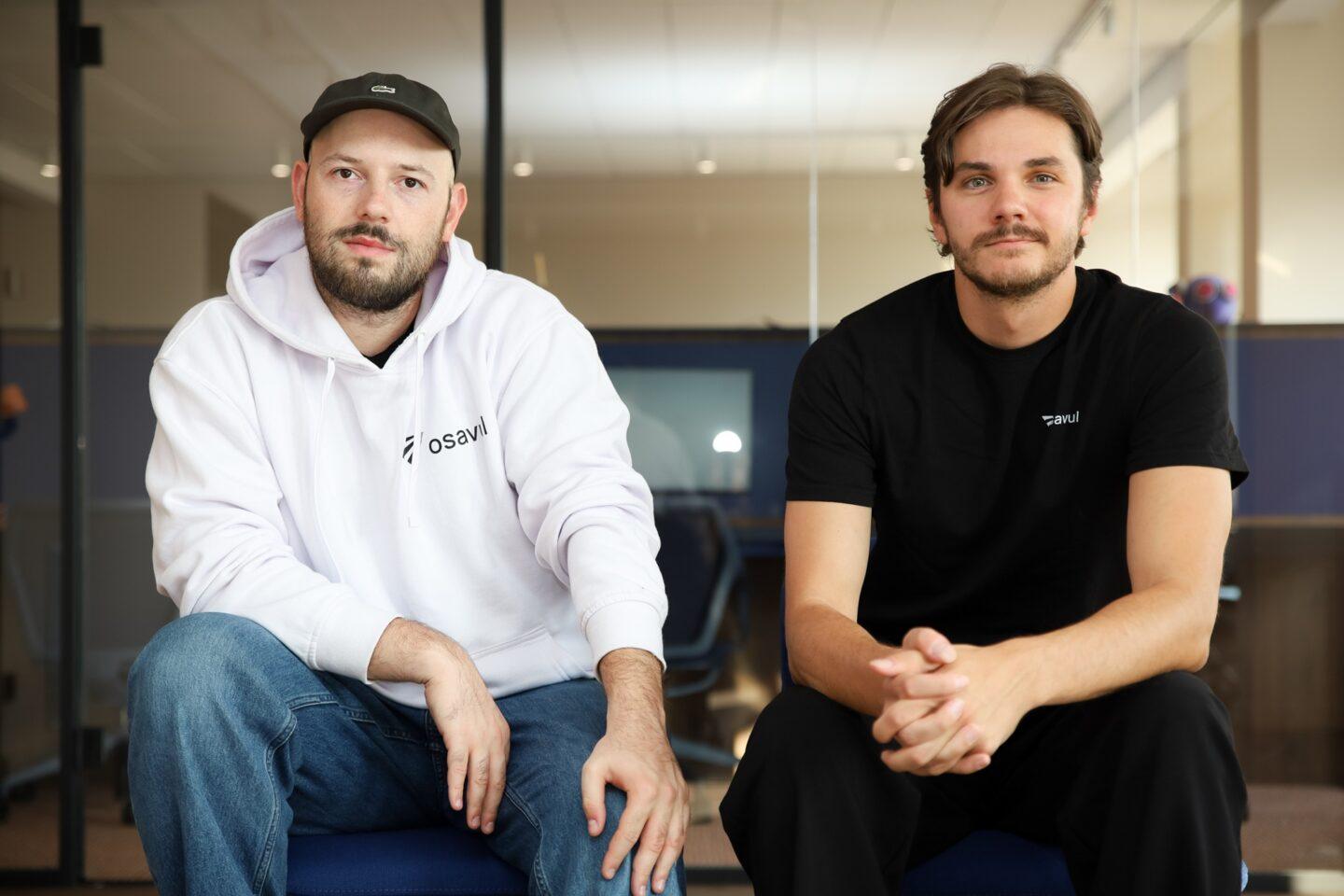
Osavul was created during Russia’s invasion of Ukraine. The company was founded by Dmytro Plieshakov and Dmytro Bilash, who had previously created Captain Growth and later sold the company to Perion.
From the outset, they developed the new business in cooperation with institutions working in defence, cybersecurity and information security.
The platform analyses open-source data as well as restricted-access information. It looks for links between information, cyber and physical activity.
Instead of treating a disinformation campaign, an attempted system breach and physical reconnaissance of a facility as three unrelated events, Osavul tries to determine whether they are elements of the same operation.
The technology then maps the potential adversary’s activities against the client’s assets – employees, locations, infrastructure and elements of the supply chain.
According to the company, this allows it to assess not only what has already happened, but also what an adversary may do next. The system’s assessments are supported by sources and verified by analysts.
The platform can also operate on-premise, meaning sensitive data does not have to leave the client’s infrastructure.
“Adversaries leave traces before an attack: they build infrastructure, conduct reconnaissance, recruit people and organize information operations. We identify those early signals and give clients a complete picture of the adversary’s intentions and capabilities,” explains Dmytro Bilash.
Expert's perspective
What does business need?
Cyber defense in practice
The company says this approach allows it to identify threats well in advance.
As one example, it points to a case from last year. Based on open-source information, its analysts say they spotted signs of preparations for sabotage in a European country six weeks before the incident occurred.
The company does not disclose the country or details of the operation.
Balnord argues that the experience gained from analyzing real hybrid operations is one of the hardest elements of Osavul’s technology to replicate.
“For four years, the company has been attributing real hostile campaigns together with defense and national-security institutions. Every identified campaign improves the models for the next one. You cannot reproduce that in a laboratory or simply buy it with money,” Poteliunaite says.
Military technology moves into energy and banking
The most important test following the funding round will be expansion beyond Osavul’s traditional public-sector and defense market.
The company wants to sell its solution to energy operators, ports, logistics companies, defence manufacturers and financial institutions.
“Hybrid attacks no longer affect states alone. Companies on which the daily functioning of the economy depends now face the same adversaries as governments, but they usually do not have the tools to spot them early enough. We will continue working with governments and the military because that is where our knowledge is developed. Now we want to make it available to business as well,” Plieshakov says.
The core technology is expected to remain the same. The bigger change will be on the sales side: Osavul is building a separate team focused on corporate customers.
“From a technology perspective, we want to bring advanced threat analysis, previously available only to governments and security agencies, into the commercial sector. The core technology remains the same and we will continue developing it for both governments and businesses. On the business side, we are building a new team focused on corporate clients,” Plieshakov adds.
This is also the area investors see as carrying the greatest risk.
Balnord says Osavul has already won its first commercial customers in sectors linked to defense, energy, transport and finance. It remains unclear, however, whether a solution developed primarily for governments can be sold to companies at much greater scale.
“The next 18 months will show how far this model can scale. This is precisely where we want to help the company through our network and our experience in scaling businesses,” Poteliunaite says.
Balnord says Osavul has already secured its first commercial customers in sectors linked to defense, energy, transport and finance.
Poland is one of the key markets
Poland is expected to be one of the company’s expansion markets. Osavul already has several clients there, although it does not disclose their names.
So far, it has worked with ministries, government agencies and research institutions, among others. It now wants to win corporate customers in energy, transport, logistics and the defence industry.
“Because of its geopolitical role, Poland is at the core of Europe’s security and resilience. It is therefore inevitable that hostile actors such as Russia will see it as a potential target. That position is driving demand for Osavul’s analysis,” Bilash says.
The company expects to win further contracts in Poland and Central and Eastern Europe. For 2027, it is considering beginning recruitment for a local team serving Poland and the broader Eastern European region.
Balnord keeps capital in reserve for follow-on rounds
Balnord closed a fund in November 2025 that aims to invest PLN 300m in dual-use startups. So far, it has invested in 15 companies.
The EUR 2.5m invested in Osavul does not necessarily represent Balnord’s final commitment to the company.
The fund follows a concentrated-portfolio strategy and says it reserves 60% of its investment budget for follow-on rounds in companies it has already selected. In total, it can invest up to EUR 12m in a single company.
“We check where a company’s data goes, who has access to it and who sits in the ownership structure. We focus on companies from NATO countries and allied states because trust is part of the product in this sector. Even the best technology is not enough if you cannot say whose hands it ultimately ends up in,” Poteliunaite says.
The fund does not intend to change its investment focus. It still wants to seek disruptive and dual-use technologies “from sea to space”.
Osavul is meant to be an example of a company that has proven its technology in state institutions and is now trying to bring it to a much larger commercial market.
“So many companies are building disruptive and dual-use technologies today that we will not run out of work,” the investor adds.


Key Takeaways
- Osavul raised EUR 8.5m in a Series A round led by 33N Ventures. Poland’s Balnord invested EUR 2.5m. The company has more than 50 deployments in over 10 countries, while the value of contracts signed in 2025 increased fourfold. It is also one of three technology providers for the NATO Information Environment Assessment Capability.
- The platform combines information about threats in the information, cyber and physical domains. It analyses data from multiple sources, looking for signals that may indicate preparations for a broader operation against a specific organization.
- The next test will be scaling into energy, transport, logistics and finance. Poland is expected to be one of the key expansion markets, while the next 18 months will show whether technology developed primarily for state institutions can also gain broad adoption among companies.