

This article is a part of Poland Unpacked. Weekly intelligence for decision-makers
As recently as last summer, the PiS leader Jarosław Kaczyński suggested that Mateusz Morawiecki could become prime minister should Law and Justice (PiS) return to power. Later, other names began to circulate, and Mr. Morawiecki appeared among them with increasing rarity. One of the criteria the PiS leader is said to be weighing is age. In the event of a PiS victory in next year’s election, the party’s prime ministerial nominee is to be under 50. Morawiecki turns 58 in June.
On Thursday, Mr. Kaczyński said on Radio Maryja, a catholic radio station, that he has already decided who will be his party’s candidate for prime minister. He is to announce the name in March.
The PiS leader’s signal
Shortly after the interview, the Polish Press Agency reported that the PiS leader had made his choice from a shortlist of four: Zbigniew Bogucki, Tobiasz Bocheński, Przemysław Czarnek, and Anna Krupka.
The last of these, speaking to Wirtualna Polska portal, distanced herself from such speculation. Although she sits in the party leadership, unlike the others she is not among the front-rank figures of Polish politics. Mr. Bogucki, for his part, heads the Chancellery of President Karol Nawrocki, who is said to be reluctant to see a key aide depart.
Mr. Czarnek and Mr. Bocheński are leading figures of the so-called maślarze faction. Or “butter boys” – nicknamed after an incident on board a Polish LOT airlines plane when one of these politicians was served German-branded butter and loudly complained about it in the social media). Its ranks also include politicians such as Jacek Sasin, Mariusz Błaszczak, and Patryk Jaki. For months, the group has been locked in open conflict with the faction aligned with Mateusz Morawiecki, known within the party as the harcerze or “boy scouts”. The tensions have spilled beyond internal party forums, playing out in full view of voters – both in traditional media and across social platforms. Recently, the PiS leader moved to shut down the public infighting, warning those involved that they could face suspension from the party.
Will it be history repeating itself?
Within PiS, not everyone takes Jarosław Kaczyński’s declarations at face value. One party insider suggests that the leader is using the move to test reactions within the organization. Another senior PiS figure adds that naming a prime ministerial candidate more than 18 months before an election does not necessarily mean the decision is final.
“Just recall how it was with Piotr Gliński’s candidacy. At the time, it was an important nomination that served its purpose. But Piotr Gliński did not become prime minister,” the PiS politician says.
Back when Poland was governed by the Civic Platform–Polish People’s Party coalition, Mr. Kaczyński put forward Mr. Gliński as the prime ministerial candidate for a potential technocratic government. When PiS eventually took power, however, the government was led by Ms. Beata Szydło, who had previously managed Andrzej Duda’s successful presidential campaign. Mr. Gliński went on to serve in her cabinet as minister of culture and deputy prime minister. He held the same posts under the government of Mateusz Morawiecki as well.
Mr. Morawiecki’s objective: the leadership of PiS
On the same day that the PiS leader gave his interview to Radio Maryja, the news site Zero.pl published an article suggesting that Mateusz Morawiecki might leave Law and Justice (PiS). He was reportedly to be joined by a group of several dozen MPs. In off-the-record conversations with XYZ, Mr. Morawiecki’s closest associates deny that the former prime minister has any such plans.
“Mateusz Morawiecki does not want to leave PiS – although there are those who would like him to be gone,” says a source from the former prime minister’s faction.
Mr. Morawiecki’s allies accept that he may not be Jarosław Kaczyński’s favored candidate. His ambitions now lie elsewhere. Suggestions that his group might break away from PiS are said to be a bargaining chip in internal party maneuvering over influence.
Mr. Morawiecki would like, in time, to become leader of PiS – but not in opposition to Mr. Kaczyński. The former prime minister is keen to demonstrate activism and to persuade the party chairman that he would be the best successor. Were PiS to return to power, holding the party leadership would matter more than being prime minister under a powerful chairman.
These ambitions, however, sit poorly with a rival faction whose leading figures – such as Mariusz Błaszczak and Jacek Sasin – have been in PiS far longer. Their camp favors a more radical rhetoric, closer to that of Konfederacja, while Mr. Morawiecki is seeking to appeal to centrist voters and opts for a softer tone. For now, the voices of his opponents are louder.
“In the other faction there is the largest group of people who have the closest access to the chairman’s ear,” says one of Mr. Morawiecki’s supporters.
A threat to PiS?
If the butter boys faction were to succeed in forcing Mateusz Morawiecki out of the party, it could pose a serious risk for Law and Justice (PiS). The former prime minister remains highly popular with voters, and the balance on the right is very different today from what it was in 2015, when PiS first took power.
At that time, there were no credible alternatives to the right of PiS. Today, on the right flank, Konfederacja, led by Sławomir Mentzen and Krzysztof Bosak, enjoys double-digit support. Polls also place Confederation of the Polish Crown, headed by Grzegorz Braun, close to double digits. In the past, a decision by the PiS leader was enough to push a politician to the margins of the right-wing scene. Today, his word carries less weight across the broader right. That is why, in the view of Mr. Morawiecki’s faction, any attempt to push him out of the party could be dangerous for PiS.
“Today it is easier to fight for your own position than it was even ten years ago,” says one PiS politician.
Mr. Morawiecki’s faction sidelined
The rival camp is nonetheless seeking to marginalize Mateusz Morawiecki and his allies. One example was the policy conference in the Thinking Poland (Myśląc Polska) series held on Saturday, February 21. The event focused on security, and its lineup was dominated by politicians associated with the faction led by Jacek Sasin and Mariusz Błaszczak.
Not invited was Michał Dworczyk, a Member of the European Parliament closely aligned with Mr. Morawiecki. One of the conference’s prominent figures was the former defense minister Antoni Macierewicz. Mr. Dworczyk had previously served as his deputy at the Ministry of National Defense before becoming head of the Chancellery of the Prime Minister when Mr. Morawiecki was in office. According to party insiders, the central leadership reacted negatively to Mr. Dworczyk’s recent media remarks. The MEP has been less critical of the SAFE program than the party mainstream – indeed, he has publicly highlighted its positive aspects.
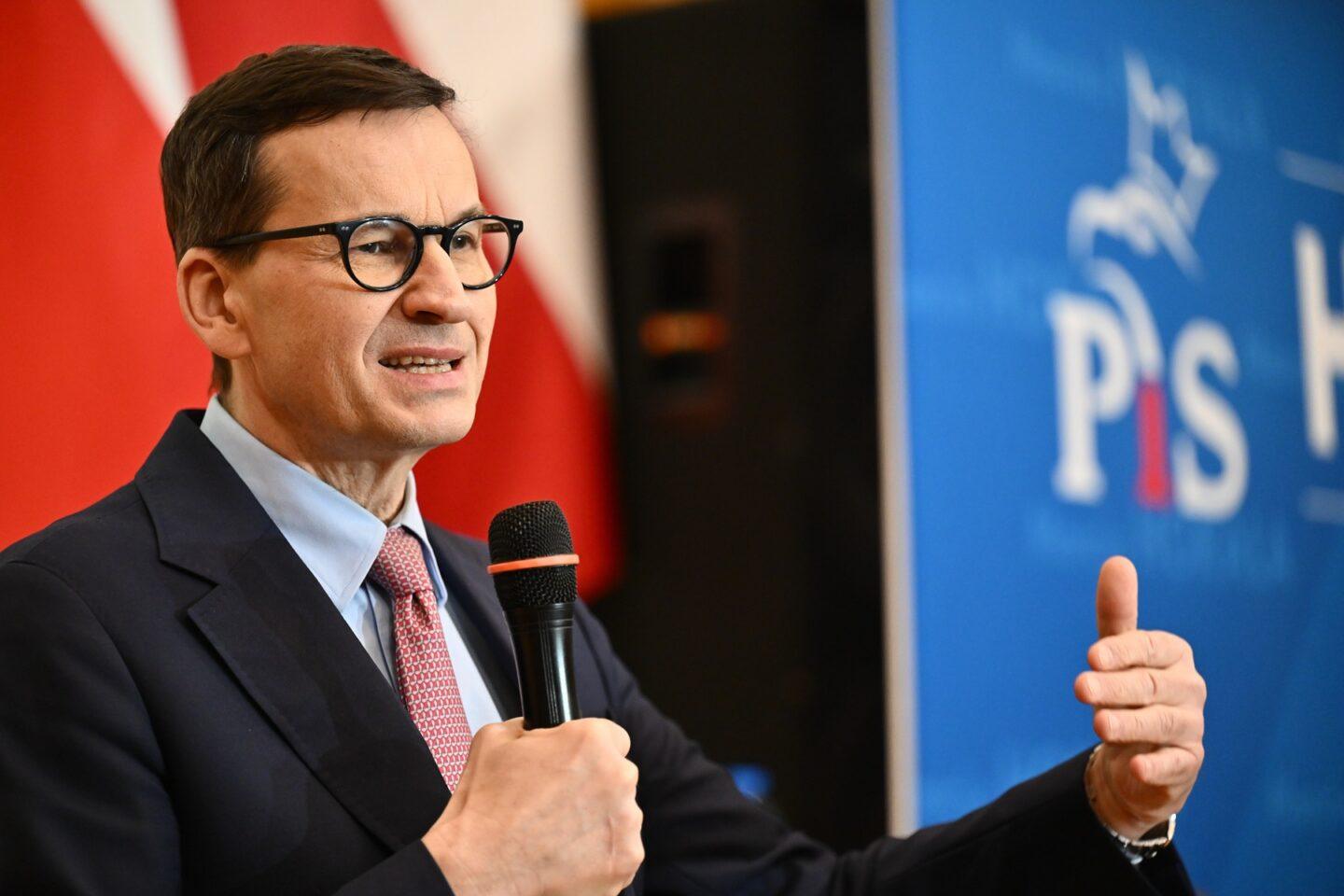
Mr. Morawiecki himself was also absent from the list of speakers. Instead, on Saturday he toured Pomerania region meeting supporters. The meetings drew considerable interest.
During the event in Słupsk, Mr. Morawiecki was asked about reports of a possible departure from Law and Justice (PiS). The issue was addressed by Piotr Müller, an MEP from Słupsk and former government spokesman under Morawiecki.
“There are absolutely no plans to leave PiS,” Müller said. “We want to build a strong wing within the party – rooted in conservative values, but also firmly focused on economic development, new technologies, and on what represents an opportunity for Poland.”
PiS’s coalition-building capacity
In his recent appearances, Mateusz Morawiecki focused squarely on the economy. He spoke about investments launched under PiS governments and criticized Donald Tusk’s administration for the budget deficit and shortfalls in the budget of the National Health Fund (NFZ). Above all, he argued that PiS must rebuild its ability to form coalitions.
“I want PiS to win outright, but things can turn out differently. That’s why I’m not closing the door either to the left or to the right. I would recommend this to everyone who wants to remove the current bad team from power. Coalition-building capacity matters. We lacked it in 2023,” Mr. Morawiecki said.
He returned to the same theme a few hours later at a meeting in Gdynia, reminding his audience that although PiS came first in the 2023 election, its inability to build a coalition prevented it from governing.
The strongest emotions were stirred when he turned to projects such as the Central Transport Hub (Port Polska). Morawiecki argued that under his government, Marcin Horała, then the government’s plenipotentiary for the project, had taken it as far as was possible at the time. Before the change of government, work on the CPK had not progressed beyond formal procedures.
“My successor said there would be no CPK – just like his deputy, Rafał Trzaskowski, who talked about an airport in Berlin. Six months passed, and the current prime minister had to come out with his tail between his legs and say he would build the CPK after all. Because the Polish people – using online debate – forced the prime minister and the entire government to do so. They slowed it down. (…) But they had to admit that Poles want this. Because Poles got angry. And you know what? I’d like Poles to get angry at this government again. There is plenty to be angry about. With this weapon – the internet – we will ensure that the current prime minister ends up where he belongs: on the opposition benches,” Mr. Morawiecki said in Gdynia.
Mr. Morawiecki’s ambitions
The former prime minister urged supporters to become active online, arguing that this was precisely how the current government had been persuaded to proceed with the Central Transport Hub – now renamed Port Polska. He also suggested that online mobilization had helped Karol Nawrocki win the presidential election.
“We need to shout across Poland: Enough of lies, destroying Poland’s development opportunities, and letting foreign entities execute contracts. Polish entrepreneurs are losing out. Today we have a chance to use the flywheel of the Polish economy. That flywheel is defense spending. But today the gears of the Polish economy are stuck. How do you see it? In the gigantic budget deficit,” Mr. Morawiecki told his supporters.
He focused on mobilizing his base by speaking about economic realities, explaining how the budget deficit can affect citizens’ lives. He emphasized that a rising deficit could drive up loan repayments.
“The NFZ budget will be short by PLN 23 billion this year. That’s what the current minister of health, from Pomorze, told us. Do you know what that means? If last year we were short by PLN 14 billion and doctors had to postpone surgeries into this year, then this year, by October, there may already be no money for procedures and operations. Expect calls from your doctors! They won’t be calling to ask how you feel, but to tell you that your procedure is postponed to 2027,” the former prime minister said in Gdynia.
Mr. Morawiecki on SAFE
He also acknowledged that he opposes the SAFE program, though he did not adopt the radical rhetoric of the rival PiS faction. Morawiecki expressed concern that the 55-year loan horizon for SAFE is too distant to justify committing to it now. The former prime minister said he does not trust the current government’s assurances that Polish producers would benefit most from the program.
“I voted against it because of the duration of the loan. Fifty-five years ago, Gdynia experienced the tragic events of December 1970 [workers strikes crushed by the communist authorities – ed.]. What will happen in 55 years? Politically, I cannot accept that someone else imposes their will on us – that is, conditionality. I also do not agree with spending the enormous sums that our children will repay in ways that are not optimal for us. I cannot accept weakening our alliance with the United States. We may not like certain statements by the US president. I have my disagreements too, for example regarding Afghanistan,” Mr. Morawiecki said.
Such meetings are likely to continue. As representatives of the butter boys faction – Patryk Jaki, Tobiasz Bocheński, and Przemysław Czarnek – tour Poland to meet students, Mr. Morawiecki aims to strengthen his own position within PiS.


Key Takeaways
- Morawiecki accepts that he is unlikely to be PiS’s candidate for prime minister. His long-term goal is to become party chairman. He does not, however, intend to pursue Mr. Kaczyński’s succession against the chairman’s wishes. The former prime minister’s ambitions are unpopular with his internal party rivals.
- In March, Jarosław Kaczyński, the PiS chairman, may announce his party’s nominee for prime minister ahead of next year’s election. In recent weeks, names circulating have included Anna Krupka, Zbigniew Bogucki, Tobiasz Bocheński, and Przemysław Czarnek, with the latter two considered the frontrunners. Within the party, however, there is a sense that the chairman’s choice does not guarantee that the nominated individual will actually become prime minister if PiS wins – an outcome seen previously in the case of Piotr Gliński.
- Mateusz Morawiecki no longer appears in the speculation, despite being described just months ago by the PiS leader as a capable prime minister. Kaczyński is likely to opt for someone younger than Mr. Morawiecki.