

This article is a part of Poland Unpacked. Weekly intelligence for decision-makers
The number of Poles crossing the second income tax threshold has once again reached a record high. It now stands at around 2.4 million people. Law and Justice (PiS) wants to halt this upward trend and raise the threshold. Although, given the current budget situation, this is not straightforward, the party could still cause significant disruption within the governing coalition.
Explainer
PiS (Law and Justice)
PiS (Law and Justice) is Poland's largest opposition party.
It governed alone from 2015 to 2023 and remains the dominant force on the Polish right, drawing its core support from older voters. It sits in the European Conservatives and Reformists (ECR) group in the European Parliament. Current polls put it at around 25% support. President Karol Nawrocki is closely associated with the party.
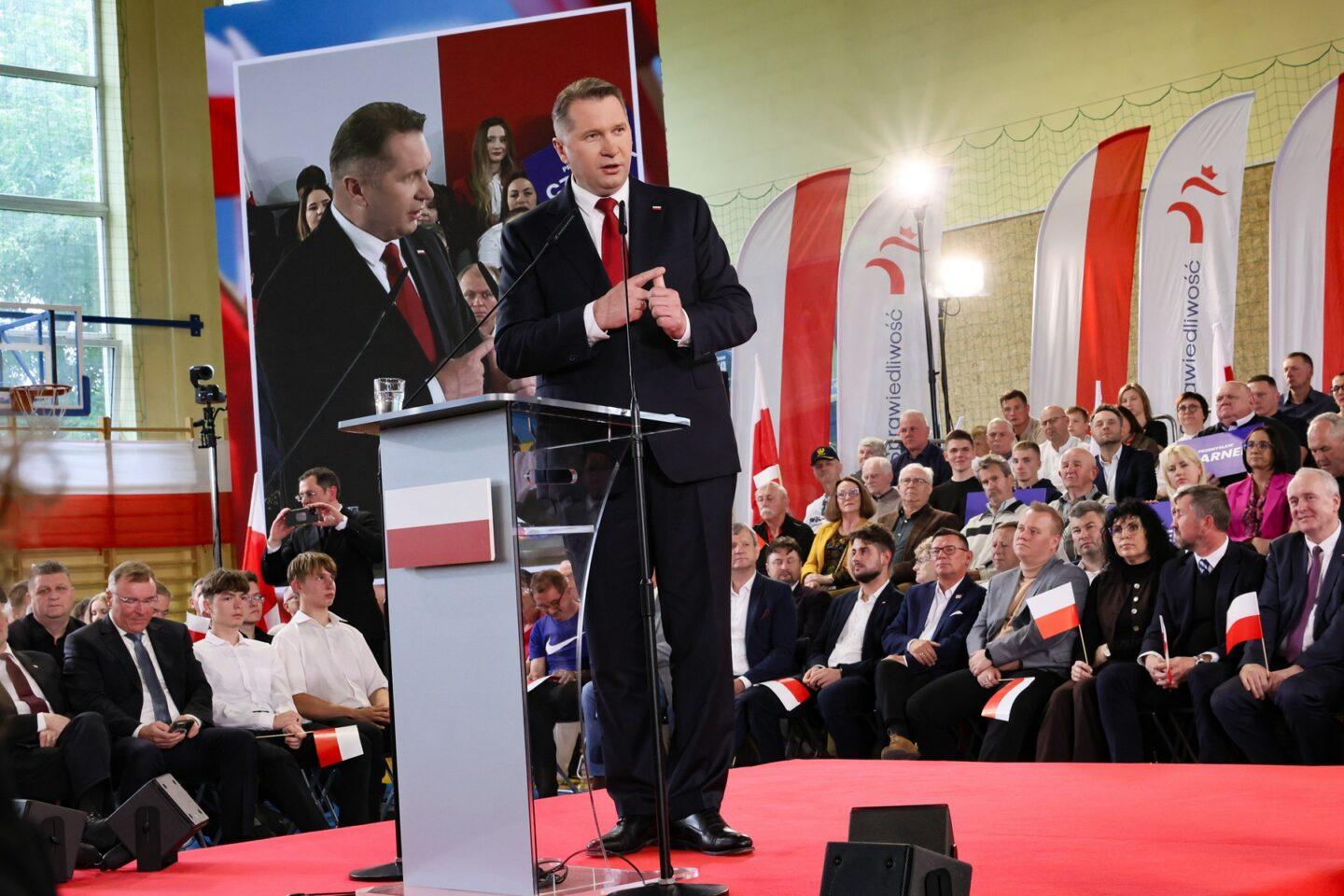
PiS is gradually unveiling proposals intended to form the backbone of its electoral programme for next year’s parliamentary elections. Last Sunday in Kalisz, Przemysław Czarnek presented the first three of 21 policy demands, which are meant to underpin the party’s campaign platform. The number is a deliberate reference to the 21 demands of the striking shipyard workers of August 1980.
The first three proposals include: Poland’s withdrawal from the European Emissions Trading System (ETS); exempting working pensioners from personal income tax (PIT) and pension and disability insurance contributions on earnings up to PLN 2,500 gross (approx. EUR 580); and changes to income tax thresholds.
Should it win next year’s elections, PiS plans to raise the second tax threshold from the beginning of 2028 to PLN 180,000 per year (approx. EUR 41,900) for individual taxpayers, and PLN 360,000 per year (approx. EUR 83,700) for jointly filing married couples.
“We were preparing comprehensive solutions for Poles, offering an ambitious vision of development in the near future. And we will deliver it,” declared Przemysław Czarnek, a PiS MP and the party’s candidate for prime minister.
Second tax bracket. Two consecutive record years
Let us take a closer look at the proposal to raise the second income tax threshold. The previous increase took place under the Law and Justice (PiS) government and was part of the so-called Polish Deal tax reform. The threshold was raised from PLN 85,528 (approx. EUR 19,800) to PLN 120,000 (approx. EUR 27,800).
Our chief economist wrote on the matter here: The invisible tax increase: How frozen brackets drive Poland’s budget
Earlier, the number of Poles exceeding the second tax threshold had been steadily rising. In 2021, the year before the changes came into force, the figure stood at 1.75 million taxpayers. After the new rules were introduced the following year, it fell sharply. Only 738,000 Poles then exceeded the second threshold.
That decline, however, proved to be temporary. Year after year, more Poles have been crossing the second tax threshold, with 2024–2025 marking record highs. In 2024, 1.9 million Poles exceeded the threshold. A year later, the figure had already risen to 2.4 million – around 10% of all taxpayers.
Income up to PLN 120,000 (approx. EUR 27,800) is taxed at 12%, while income above that level is taxed at 32%.
 Interactive chart
 Raising the threshold? The need for offsetting measures
Are conditions in place for raising the second income tax threshold? Artur Krawczyk, an economist and expert at the Centre for Economic Thought, believes such a move would be justified. He notes that “the threshold has not been indexed for some time in a relatively high inflation environment.” However, he adds that such a policy shift would require accompanying protective measures.
“There must be awareness that these measures affect the top decile – the highest-earning 10% of Poles. It would be advisable to find parallel instruments to offset this loss. Raising the threshold to PLN 180,000 (approx. EUR 41,900) could cost around PLN 20 billion (approx. EUR 4.6 billion). Poland’s current fiscal position does not justify such an expenditure benefiting the top decile. If such a measure were to be introduced, it should be accompanied by safeguards for public finances. One could imagine a range of actions targeted at the highest income group – for example, a modest increase in health contribution rates for those on flat tax regimes, lower limits for lump-sum taxation, or reduced caps on author-related costs,” says Artur Krawczyk.
The economist argues that “in an ideal scenario, tax thresholds should be automatically indexed.” However, the absence of such indexation also has certain advantages, which the Polish budget currently benefits from.
“As incomes rise, state budget revenues grow faster than they would under automatic indexation. This acts as a kind of safety valve protecting us from excessive deficits. Given the very high deficit and EU constraints requiring its reduction, there should be no move toward automatic indexation for now,” the Centre for Economic Thought expert assesses.
An incentive to choose other forms of taxation
On the other hand, the economist argues that failing to raise the second tax threshold may also carry negative consequences.
“Raising the threshold is, in a sense, a cat-and-mouse game. A large share of those affected by the top bracket are the highest earners. Among them is a significant group of entrepreneurs and individuals who can switch their employment contracts to B2B arrangements. On the one hand, increasing the threshold may encourage them to remain within the progressive tax scale. If we do not raise it, we incentivize a shift into other forms of taxation and into quasi-fictitious business activity under the tax scale or lump-sum regime. In an ideal system, such optimization opportunities should not exist: the threshold should be automatically indexed, but there should also be no incentives to escape it by switching into alternative forms of taxation,” says Artur Krawczyk.
Explainer
A quick look at Polish PIT options
Poland uses a two-tier progressive tax system:
First threshold (up to 120,000 PLN annual income):
12% tax rate
Minus tax-free amount: 30,000 PLN annually
Second threshold (above 120,000 PLN annual income):
32% tax rate on income above 120,000 PLN (the 12% still applies to the first 120,000 PLN).
Several alternatives to standard PIT for entrepreneurs and certain situations:
1. Lump-sum tax:
For self-employed/sole proprietorsFixed percentage of revenue (not profit) based on business type, e.g. 17% for most professional services (IT, consulting, etc.)
No deduction of costs - you pay tax on gross revenue
2. Linear flat tax rate - 19%:
Flat 19% rate on all income regardless of amount
No tax-free amount
Can deduct business costs
Used by higher earners to avoid 32% rate
“A right-wing voter can be fickle”
PiS places considerable political hopes in its proposals. Patryk Jaki, a Member of the European Parliament from PiS, has described the plan to raise the second income tax threshold as a political gamechanger. He has declared it the most important promise and said it would be the first decision implemented should PiS return to power.
The party led by Jarosław Kaczyński is currently in a difficult position. It is affected by internal conflicts, while competition to its right is becoming increasingly strong. Dr Mateusz Zaremba, a political scientist at SWPS University, believes the proposal is an attempt to win over economically liberal voters sympathetic to the Confederation party.
“This raises the question of whether it would be implemented in a credible way. PiS does have arguments. Its politicians point out that they have fulfilled their previous promises. The tax threshold is a model that helps form the middle class. The number of people exceeding the second threshold has increased significantly. PiS can appeal to the credibility of its promises, but right-wing voters have a broader choice. On the other hand, this is an economically liberal proposal. Until now, PiS has been oriented toward redistribution and social programs. I wonder whether this is not an attempt to compete with the right-wing located to the right of PiS. For those voters, PiS may be seen as lacking credibility, not least because of the Polish Deal tax reform. A right-wing voter is in a difficult position in that they have a wide range of options and can be rather fickle,” comments Dr Mateusz Zaremba.
Poland 2050’s idea
The proposal presented by PiS on Sunday also carries an additional political context. Ideas to raise the second income tax threshold have also emerged on the governing coalition side. The first to raise the issue was MP Rafał Komarewicz, then still a member of Poland 2050 (he now belongs to the Centrum parliamentary group). As part of a broader package aimed at the middle class, he proposed increasing the second tax threshold from PLN 120,000 (approx. EUR 27,800) to PLN 200,000 (approx. EUR 46,500).
Explainer
Poland 2050 (Polska 2050)
Polska 2050 is a centrist party and part of Poland's ruling coalition. It was founded by Szymon Hołownia, a former Speaker of the Sejm (Poland's lower house of parliament) who joined politics after a succesful journalistic and media carreer.
Its MPs broadly hold centrist, liberal, and social-liberal views. Although Polska 2050 is a coalition partner, it frequently criticises Prime Minister Donald Tusk's decisions. The party is now led by Katarzyna Pełczyńska-Nałęcz. It currently polls at around 2%.
Following the split within Poland 2050, the idea was increasingly promoted by the party’s new leader, Katarzyna Pełczyńska-Nałęcz, and her closest associates. In mid-April, the party submitted a draft law proposing to raise the second tax threshold to PLN 140,000 (approx. EUR 32,500). In her narrative, the party leader argues that the issue could prove fundamental ahead of next year’s elections.
“PiS is going after the middle class. Either we raise the second tax threshold, or they will. This is the equivalent of the ‘500+ child benefit’ of this election. In 2015, they also said it couldn’t be done. At least once, let the ‘democratic side’ be wise before it is too late,” Katarzyna Pełczyńska-Nałęcz wrote on the X platform, commenting on the PiS proposal.
Explainer
What is the '500+/800+' benefit?
Poland’s most famous social program goes by two names because it changed. Originally launched in April 2016 as Rodzina 500+ (Family 500+), it is a state child benefit program that provides monthly payments for each child in the family.
From 1 January 2024, the benefit was raised from PLN 500 to PLN 800 per child per month – hence the new nickname 800+. Most Poles still use both names interchangeably.
It covers every child under 18, regardless of family income or birth order.
Will PiS force the government’s hand?
Finance and Economy Minister Andrzej Domański has dismissed coalition partners’ proposals. He has repeatedly stated that tax brackets will remain unchanged in 2026.
Ryszard Petru, an MP from the Centrum parliamentary group who was recently tipped as a potential deputy to Domański, said on TVN24 channel that raising the second income tax threshold is among the solutions that “should be on the table.” He pointed out that it would be a cheaper solution for the budget than the increase in the tax-free allowance to PLN 60,000 (approx. EUR 13,900) promised before the previous elections.
Although neither the prime minister nor Minister Domański are giving the green light to changes, even some Civic Coalition (KO) politicians acknowledge that the issue may become increasingly socially salient. The second tax threshold is now being crossed by growing groups of professionals, including those with relatively modest earnings who only marginally exceed it. This includes, for example, teachers working simultaneously in multiple jobs.
Explainer
Koalicja Obywatelska (Civic Coalition, KO)
Koalicja Obywatelska (Civic Coalition, KO) is the largest party in Poland's ruling coalition and the political home of Prime Minister Donald Tusk and most of his cabinet.
It is a broad-church party with roots in Christian democratic and centre-right traditions, though it now serves as the main political home for centrist and liberal voters. KO is a member of the European People's Party (EPP). It leads the polls with around 33% support.
Dr Mateusz Zaremba believes PiS’s proposal may not only create confusion within the coalition but also put pressure on it to act, with just over a year left until the next elections.
“This will raise the question of whether the change should be forced through earlier in order not to leave political space to PiS. It is a clever move, because the budget is in a weak position and so is the governing coalition. On the one hand, they should implement it to ‘politically defang’ their opponents and move in a deregulatory direction; on the other hand, there is probably not enough money for it, as can be seen for example in the phasing out of the so-called CPN [lower fuel prices – ed.],” the political scientist assesses.


Key Takeaways
- PiS has proposed withdrawing from the EU Emissions Trading System (ETS), exempting working pensioners from personal income tax (PIT), and raising the second income tax threshold to PLN 180,000 (approx. EUR 41,900) and to PLN 360,000 (approx. EUR 83,700) for jointly filing married couples. The latter measure would take effect from the beginning of 2028 if PiS were to win next year’s parliamentary elections. The number of Poles exceeding the second tax threshold is steadily increasing. In 2024, it stood at 1.9 million people, rising to 2.4 million in 2025.
- Experts note that raising the second tax threshold would compensate households for the effects of inflation. At the same time, it would be costly for the state budget. According to preliminary estimates by economist Artur Krawczyk, the measure would cost around PLN 20 billion (approx. EUR 4.6 billion). The lack of automatic indexation of tax thresholds increases budget revenues and limits the risk of a widening deficit. On the other hand, keeping thresholds unchanged may encourage taxpayers to seek alternative forms of settlement.
- Through this announcement, PiS is seeking support from economically liberal right-wing voters. Dr Mateusz Zaremba argues that PiS politicians are finding it increasingly difficult to compete for such voters against rival right-wing parties. By putting forward such proposals, PiS may also be adding fuel to an ongoing coalition dispute, where Poland 2050 is calling for a higher second tax threshold. The finance minister, however, does not agree. The leader of Poland 2050 believes the coalition should raise the second tax threshold before the elections.