

This article is a part of Poland Unpacked. Weekly intelligence for decision-makers
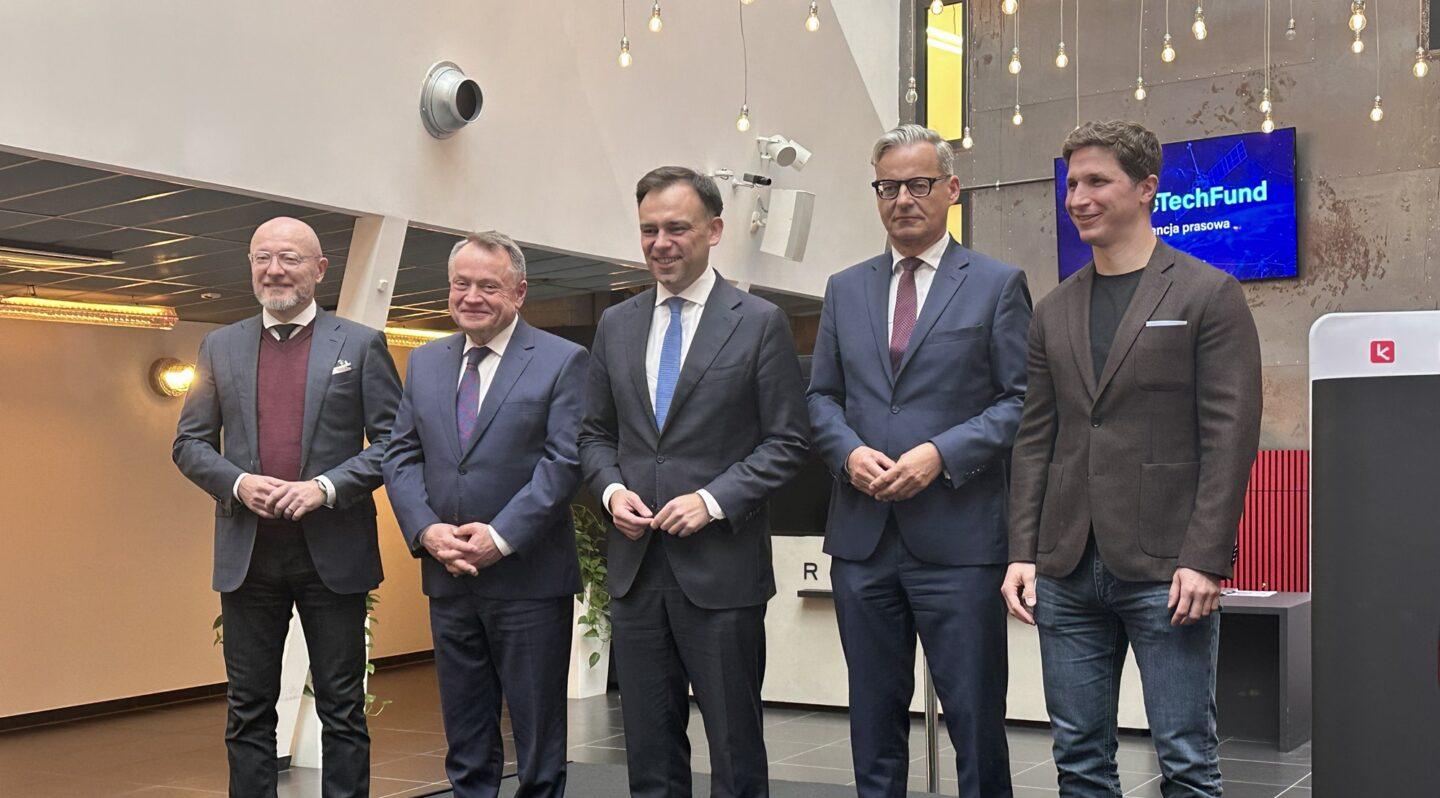
Polish companies developing space technologies will gain access to a new source of capital. In Kraków, Finance and Economy Minister Andrzej Domański announced the launch of the SpaceTech Fund.
Poland’s space industry is set to receive additional public funding. Vinci, an investment company belonging to the state development bank BGK Group, is launching a PLN 500m SpaceTech Fund. The money is intended to help Polish technology companies scale their operations and expand into international markets. At the same time, BGK is preparing financing for local government projects supporting the development of the space sector.
“We are announcing a fund for the space industry. This is half a billion zlotys that will help build our economic sovereignty and security. Space and quantum technologies can strengthen security and support economic development,” says Andrzej Domański, Minister of Finance and Economy.
He added that the sector’s development demonstrates the ability of Polish companies to create technologies with global potential.
“Your technologies embody Poland’s ambitions and the strength of its economy,” he told executives from space companies. “We must do much more to help Polish technologies succeed in global markets. I am proud that, together with BGK, we can announce the creation of this fund today. We want the most advanced digital technologies to be developed here in Poland, in Kraków,” the minister added.
Domański also announced trade missions and additional support for Polish space companies seeking to expand abroad.
“Vinci’s funding will allow Polish companies to scale up while attracting external capital,” he said.
The mission: scaling up
According to the announcement, the fund intends to invest in 15–20 companies. Individual investments could range from PLN 10m to as much as PLN 100m.
The Vinci SpaceTech Fund is designed to address one of the main challenges facing Poland’s space technology industry: a shortage of capital needed to move from research, prototypes and initial contracts to large-scale production and international expansion.
The fund will target businesses that have already identified viable market opportunities but need financing to take the next steps in their development.
Good to know
Where has Vinci invested so far?
As of September 2026, Vinci held stakes in 17 companies. It had invested more than PLN 600m out of a total available capital pool of PLN 1.1bn.
Selected major investments include:
- ICEYE – satellites, space technology and defense.
- Mewo – maritime technologies, seabed surveying and critical infrastructure.
- ElevenLabs – generative artificial intelligence.
- SR Robotics – underwater robotics and drones, including dual-use technologies.
- Jutro Medical – health technology and AI in primary healthcare.
- Fluence Technology – femtosecond lasers, photonics and deep technology.
- Intelliseq – bioinformatics and genomics.
- Sybilla Technologies – space technology, orbital observation and monitoring.
First investment on the horizon
“We will announce the first investment decisions under the new fund within the next few to several weeks,” says Mirosław Czekaj, CEO of BGK.
He emphasizes that the fund is intended to bring together the expertise of engineers, scientists and entrepreneurs.
“Innovation, competitiveness and technological sovereignty are important issues for Europe, Poland and development banks. We are pursuing numerous initiatives to support Poland’s long-term economic growth. We have invested PLN 4bn in Polish innovation. Through Vinci, we finance new technologies, including ICEYE. Our role is to bridge the investment gap and create opportunities for private capital,” the BGK chief says.
“Vinci will manage one of the few funds in Europe dedicated to the space industry. An investment of PLN 10m–100m is substantial by Polish standards. Our priority areas are satellites, optics and Earth observation, photonics, propulsion systems, data and artificial intelligence. We believe Poland has the necessary potential,” says Bartosz Drabikowski, CEO of Vinci.
A promise made with ESA as witness
The government announced plans for a dedicated financing instrument for the space industry in July, when it revealed which Polish city would host a new facility of the European Space Agency (ESA).
When Prime Minister Donald Tusk and ESA Director General Josef Aschbacher announced that a new ESA research and development center would be established in Warsaw, the finance minister promised a special fund to support the sector’s development in other Polish cities and regions.
He also pledged to establish a regional network for space industry development and a fund with approximately PLN 500m in capital. BGK was to prepare additional financing for local government projects.
Seven Polish metropolitan areas competed to host the ESA investment: Kraków, Katowice, Wrocław, Poznań, Łódź, Gdańsk and Warsaw.
“We see this new funding as a way of calming tensions in cities that lost the competition for the ESA center. Throughout the process, all of them were invited to Warsaw for successive consultations, sometimes at a day’s notice. Ultimately, Warsaw won, despite having been the least engaged in the competition,” says a representative of one of the cities, who asked to remain anonymous.
Expert's perspective
The fund should support projects across regions
The new fund should be accompanied by a clear direction for the sector’s development and the creation of a shared national project around which Poland could build distinctive capabilities. We have centers with considerable potential and expertise, even though, for various reasons, they were unable to meet all the requirements of the ESA selection process. They should be given an opportunity to develop further.
The real added value, however, would come from cooperation rather than competition. The same principle applies to universities: they should collaborate on research instead of competing by launching more space-related degree programs.
We need to ask ourselves what expertise already exists at individual centers and how we can develop it to strengthen the competitiveness of Poland’s space sector as a whole. We need something resembling a national network of space technology capabilities.
Currently, universities establish their own degree programs, develop similar specializations and often compete with one another. We should build this system collectively, without excluding anyone and with a sensible division of responsibilities and expertise among institutions.


A significant investment
The SpaceTech Fund is one of Poland’s largest dedicated equity investment vehicles focused on a single technology industry.
“It is important that Poland seizes this opportunity and that Polish companies become international businesses,” says Rafał Modrzewski, founder of ICEYE.
Determining the size of Poland’s space sector remains difficult, partly because the figure depends on how the industry is defined.
Using a broad definition, the Polish Space Agency identifies more than 400 organizations, including companies and research institutions. Professor Tadeusz Uhl, Dean of the Faculty of Space Technologies at AGH University of Kraków, has cited a similar figure.
ESA, meanwhile, has reported that more than 70 companies across ten regions are actively developing Poland’s space industry.
The commercial core of the sector can therefore be estimated at no fewer than several dozen companies, while its broader technological and scientific base is several times larger.
Why Kraków?
Kraków Technology Park has been developing initiatives for the space industry for years, including through ESA BIC Poland and Space Arena, a program connecting young companies with investors. The park also hosts activities involving several rapidly growing Polish space businesses.
Kraków has a long-standing interest in developing its space sector. Nevertheless, the timing and location of the government announcement are difficult to overlook.
The new fund was unveiled in the city just days before its mayoral election, in which a candidate representing the governing political camp is competing against a local rival.
Three senior officials traveled to Kraków to present the project: Finance and Economy Minister Andrzej Domański, BGK CEO Mirosław Czekaj and Vinci CEO Bartosz Drabikowski.


Key Takeaways
- Poland is committing new public capital to its space industry. BGK and Vinci are launching the PLN 500m SpaceTech Fund to finance Polish space technology companies and support the industry’s development across regions. The fund will focus on helping businesses scale their operations, commercialize technology and enter international markets.
- The announcement has a political and regional dimension. The fund was first promised in July, when Warsaw was selected to host a new European Space Agency research and development center. Its formal launch in Kraków comes shortly before the city’s mayoral election, raising questions about the political timing of the announcement.
- How the money is invested will matter as much as its size. Space industry expert Maciej Myśliwiec argues that public funding should primarily support projects spanning multiple regions and help create a national network of complementary expertise, rather than intensify competition between cities, universities and companies. The fund’s effectiveness will also depend on its investment criteria and its ability to attract private capital.