Poland Unpacked week 5 (19 January - 25 January 2026)
Welcome to this week’s edition of our Poland Unpacked, where we deliver key insights and trends shaping the economic, corporate and political landscape. Catch the most important insights from Poland in this week’s briefing.
This article is a part of Poland Unpacked. Weekly intelligence for decision-makers
Speed, determination and ambition define Jakub Dwernicki’s career - in both sport and business. On the track, he drives a Porsche 911 GT3 Cup, one of the top-tier racing cars. Off the track, he runs a brand with global ambitions: the technology group cyber_Folks. The group, which offers a comprehensive set of tools for online sales, has multiplied its revenues several times since the pandemic, reaching PLN 800m (around EUR 185m), with PLN 240m (around EUR 55m) in EBITDA. Its stock-market capitalization has quadrupled in three years to more than PLN 3bn (around EUR 700m). And that, its founder insists, is not the end of the story. In an interview, he talks about the company’s journey, plans and goals - including acquisitions - as well as the secret of its success, putting it bluntly: “We don’t want people who just want to get through the day at work.” This is how a European e-commerce leader is being built in Poland.
Many readers were electrified by our report on a spectacular move by tax inspectors, who recovered PLN 512m (around EUR 120m) in unpaid corporate income tax from a Japanese giant. Investigators found that Poland’s largest beer producer had shifted profits outside the EU through a series of intra-group transactions, reducing its CIT bill. Kompania Piwowarska has announced it will challenge the decision in court - but the transfer to the state budget has already been made. Here are the details of this record tax assessment.
Strong emotions were stirred elsewhere - in trade-union circles - by news that a foreign company wants to build a coal mine in Poland. Coal Energy, a listed firm that lost ten mines in Ukraine as a result of the war, remains undeterred by conditions on Europe’s coal market and has announced plans to develop a mine in Silesia, as well as to provide mining services to domestic companies. “We are closing state-owned mines because supposedly we no longer need coal, and at the same time we are to open private ones? What is this really about?” asks the head of the miners’ Solidarity union. We looked into the issue.
Who really dominates Poland’s housing market? For years, debates about the state of the residential market have been accompanied by claims that foreign capital - large funds and developers - has been driving up home prices in Poland. We examined whether the data confirm or challenge this thesis, and what impact investors from outside Poland are actually having on the market.
Each week, we aim to summarize key developments on Poland’s domestic political scene. Occasionally, however, there are weeks when Polish politics must yield to the primacy of international affairs.
Even more rarely does a prominent Western leader quote an intellectual from Central and Eastern Europe (CEE). Rarer still are speeches such as – according to some commentators – the now-famous address delivered by Canadian prime minister Mark Carney at the World Economic Forum in Davos.
Carney quoted the historic essay The Power of the Powerless by Václav Havel:
“The system’s power comes not from its truth, but from everyone’s willingness to perform as if it were true. And its fragility comes from the same source. When even one person stops performing, when the greengrocer removes his sign, the illusion begins to crack. Friends, it is time for companies and countries to take their signs down.”
Discussions over Havel’s metaphorical “removal of signs from shop windows” framed much of last week’s debate – not only in Davos or Brussels, but also in Warsaw. For Poland, the dispute between the administration of Donald Trump and the European Union is not merely uncomfortable; it is plainly dangerous.
During visits to London and then Davos, the pro-Atlantic president Karol Nawrocki struck a cautious tone when it came to choosing sides. Although it is no secret that Nawrocki and his party, Law and Justice (PiS), are far closer to Donald Trump’s administration than to Ursula von der Leyen, Nawrocki – despite meeting Trump in Davos – avoided stepping too far out in front.
A similar approach was taken by prime minister Donald Tusk. The pro-European head of government did voice support for Greenland’s independence in a joint statement by European leaders, yet he, too, stopped short of openly criticizing Donald Trump. On matters of security, both the president and the prime minister – albeit in slightly different ways – are once again employing a rhetoric of being “in between.”
In XYZ, we analyzed the rhetoric of Poland’s political parties and shed light on the background to the government’s decision not to send troops to Greenland.
This week brought a fresh batch of data from Poland’s economy, shedding light on current business conditions. Statistics were released on industrial output, construction activity, as well as wages and employment.
Manufacturing ended last year on a strong note. According to figures published by Statistics Poland (GUS), industrial output in December 2025 rose by 7.8% year on year. The recovery is spreading across successive segments of manufacturing. Alongside investment goods - which had already been performing well - output of durable consumer goods has also joined the upswing. In December alone, production growth in these categories reached 17.1% and 7.8% year on year, respectively.
The rebound in investment-goods production remains in full swing, driven by the energy transition and EU funding. By contrast, the increase in output of durable goods appears to reflect primarily stronger demand from Polish consumers, supported by robust growth in real incomes and interest-rate cuts. Over the whole of 2025, manufacturing output increased by 3.4% year on year.
Construction output was also solid in December, rising by 4.5%, although a significant portion of this increase can be attributed to a favorable calendar of working days. After seasonal adjustment, output stood at roughly the same level as a year earlier.
Over the full year 2025, however, the construction sector lagged behind manufacturing: output grew by just 0.7% year on year. An improvement is expected this year, linked to greater use of EU funds, in particular under the National Recovery Plan (KPO).
In December, average wages in the enterprise sector rose by 8.6% year on year, up from 7.1% in November. The result came as a surprise: forecasts had pointed to wage growth of only 6.9%. This was the strongest reading since mid-year. Real wages, adjusted for inflation, increased by 6%. By comparison, the same indicator in France or Germany remains below 1%. This is supporting consumption growth in Poland, although the savings rate is still elevated.
As part of our structural analysis this week, we revisited the historical relationship between real wages and consumption, and outlined the outlook for 2026. For years, consumption has tended to grow more slowly than real wages. This largely reflects rising household wealth, which in turn increases the propensity to save.
Ukrainian company Preply has completed a Series D funding round, raising USD 150m, with WestCap as the lead investor. The transaction lifted the company’s valuation to USD 1.2bn, making Preply another global unicorn. Over more than a decade, Polish individual investors and venture-capital funds have also held minority stakes in the company. These include Przemysław Gacek, co-founder of Grupa Pracuj, as well as the funds Inovo.vc and Orbit Capital. They have reason to be proud of the company’s achievements: the value of their holdings has risen markedly.
Polish funds occupy a modest position in the global venture-capital market. Even so, in an effort to increase their clout and operating scale, they increasingly co-invest - particularly those established under public support programs. Since 2020, nearly 75 funding rounds have been recorded in which at least two funds from the portfolio of PFR Ventures were involved simultaneously. On the one hand, this is a natural stage in the development of the funds; on the other, excessive concentration of capital from public–private vehicles in the same companies could prove harmful to the market.
A debate has begun in Poland over which city could host a potential AI gigafactory. One of the candidates is Wrocław, backed by Wrocław University of Science and Technology and local business leaders. According to Arkadiusz Wójs, the university’s rector, only close cooperation between local government, academia and business can generate a sufficiently large base of users for the services and products such a gigafactory would provide to make the project economically viable. He also points to ways in which Polish universities could improve their effectiveness in education and innovation.
TikTok, which has a sizable user base in Poland, has for the first time published its own analysis of its impact on the country’s economy. It disclosed the economic value generated by Polish companies advertising on the platform. The article also examines how local businesses and marketing agencies approach advertising and promotional campaigns on TikTok in light of the controversies surrounding the global activities of the platform’s owner, ByteDance, as well as concerns over its impact on underage users.
This week will also bring a set of important macroeconomic releases. On Monday, Statistics Poland will publish retail sales data for December. On Friday, the first estimate of Poland’s GDP for 2025 will be released. Market forecasts suggest that the Polish economy expanded by 3.5–3.6% last year, making it the fastest-growing among the EU’s large economies.
At Warsaw’s State Ethnographic Museum, the exhibition “Forms of Presence. Art of Lemkos/Carpatho-Rusyns” invites visitors to step into a story of identity, migration, and rediscovery.
The show opens with a striking pairing: Andy Warhol’s Marilyn Monroe facing a 17th-century icon of St. Nicholas – not as a clash between pop and sacrum, but as a dialogue on devotion and repetition. Warhol, the son of Lemko emigrants from present-day Slovakia, emerges here not just as a pop icon, but as a figure of cultural intersection – someone fluent in the visual language of both America and the Carpathians.
Where: Warsaw (https://ethnomuseum.pl/en/wystawy-lista/forms-of-presence-art-of-lemkos-carpatho-rusyns/)
When: until 30 June 2026
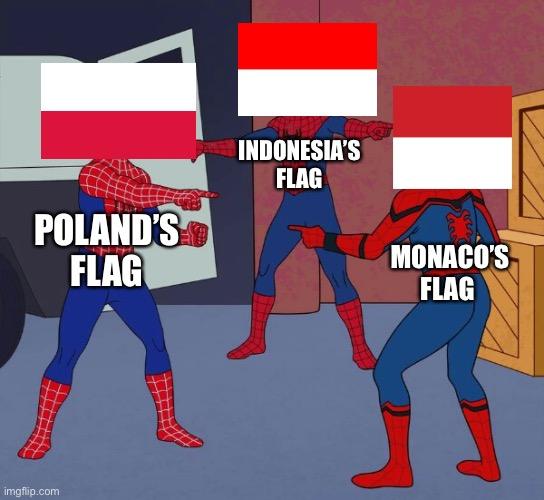
Poland’s flag shares its simplicity with Indonesia’s and Monaco's sparking endless memes like this Spider-Man classic where Poland points accusingly at the copycats – because who wouldn’t claim dibs on the chicest two-tone look?
While official shades differ slightly (Poland’s red is a muted crimson - you're welcome), the proportions flip just enough to fuel global flag quizzes.
Quick tip so that you’ll never get it wrong: Polish is the one with red at the bottom.