

This article is a part of Poland Unpacked. Weekly intelligence for decision-makers
A project to develop a breakthrough biomaterial led by researchers at Wrocław University of Science and Technology has secured EU funding. Yet the scientists already fear that Poland may lack a company capable of commercializing the technology. As a result, they are looking for a business partner in California.
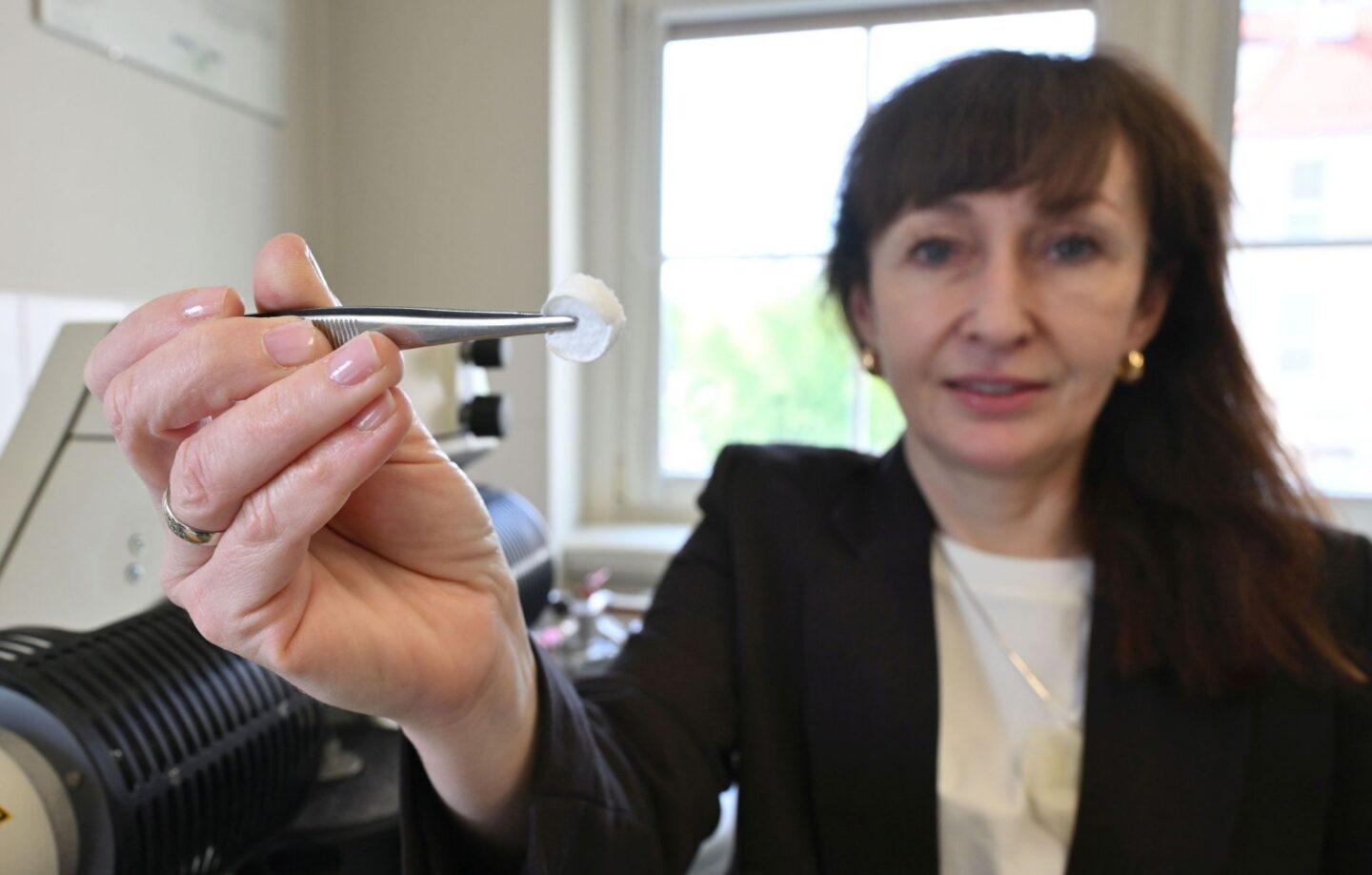
Researchers from the Wrocław University of Science and Technology, working with partners from other Polish universities in Łódź and Gdańsk, as well as institutions in Slovenia and Canada, are developing an innovative biomaterial for joint regeneration. Early results have been highly promising, the researchers say.
An innovation the world has been waiting for
The project could mark a global breakthrough in technologies for treating damaged joints. It has the potential not only to transform the treatment of injuries, but also to significantly improve therapeutic outcomes. Current methods often fail to restore full joint function.
“This material has the potential to become a breakthrough solution on a global scale,” says Dr. Małgorzata Gazińska of the Faculty of Chemistry at Wrocław University of Science and Technology, who is coordinating the project.
The researchers have two objectives.
“Our goal is to design and manufacture an innovative bioactive implant, as well as develop a regenerative technology for the effective healing of the interface between bone and cartilage tissue,” Professor Gazińska explains.
The scientists hope the new technology could be used in the treatment of injuries to knees, ankles and the small joints of the hand, among others. The innovation is expected to improve the effectiveness of procedures such as arthroscopy, a minimally invasive technique used in joint surgery. Arthroscopy is one of the most commonly performed orthopedic procedures in Poland. Worldwide, around 2m knee arthroscopies alone are carried out each year.
The EU has also backed the concept
Each member of the consortium has its own responsibilities, ranging from supplying components for the biomaterial to conducting in vitro and in vivo studies. A pivotal role, however, is played by the team from the Faculty of Chemistry at Wrocław University of Science and Technology. Researchers from the university are responsible for developing and manufacturing the biomaterial itself, along with its individual layers.
The Regenesis project has just secured funding from the European Union. It is also co-financed by Poland’s National Centre for Research and Development (NCBR), the Canadian organization Prima Quebec and Slovenia’s Ministry of Higher Education, Science and Innovation. The total value of the project exceeds EUR 1.44m.
A Nobel Prize if it works?
Experts who have spent years developing biomaterials are rooting for the researchers at Wrocław University of Science and Technology. They acknowledge that an effective joint-regeneration technology could prove to be a breakthrough on a global scale.
“Cartilage regeneration is one of the most difficult processes in medicine. Professor Krzysztof Ficek, an outstanding specialist in orthopedics and musculoskeletal traumatology who has long collaborated with engineers and chemists on innovative biomaterials, once told me that whoever successfully implements such a solution will win a Nobel Prize,” says Marcin Wątrobiński, inventor and owner of Chitomed, a company producing biomaterials for the treatment of complex wounds and bone regeneration.
He adds that any material capable not only of rebuilding a functional joint, but also of restoring mobility quickly, would attract enormous interest.
The biomaterial being developed in Wrocław is designed to combine various bioactive components that would be released gradually in order to “guide” the regeneration of cartilage and bone.
“There are many biomaterials and suppliers worldwide, but most of these products are used primarily in bone treatment. Focusing on joint regeneration bodes well for the project at the Wrocław University of Science and Technology,” says Dr. Anna Kasprzak-Czelej, vice-president of Medical Inventi, a biomaterials company that also emerged from an academic environment.
What comes next for the invention?
The experts we spoke to stress that many research centers around the world are pursuing similar work, and that the journey from laboratory breakthrough to commercial application is a long one.
“It took us ten years, which is fairly standard,” says the vice-president of Medical Inventi.
The Regenesis project is currently in its sixth month. At this stage, the aim is to develop a biomaterial prototype that will be tested both in the laboratory and on animal models to assess its safety and effectiveness.
“Our goal is to raise the technology readiness level from TRL 3 to TRL 5. In practice, that means moving from early-stage laboratory research to a phase in which the solution is tested in conditions resembling real-world use. That is what we can realistically achieve within this budget and timeframe,” explains Professor Małgorzata Gazińska.
According to the project schedule, Regenesis is due to conclude in 2028 with in vivo validation of the technology on a small animal model. If the studies confirm the solution’s breakthrough potential, further stages of development will be required.
“After that, additional preclinical and clinical studies will be needed, followed by product certification,” Professor Gazińska says.
Will an American company take over the invention?
Professor Gazińska fears that Poland may lack business partners willing to finance the next stages of research needed to commercialize such an innovative solution. That is why she is considering conducting clinical trials at the California Institute for Regenerative Medicine.
“Enormous funding is required. Poland does have companies producing implants, but our discussions so far have not produced positive results. Today, the greatest opportunities for biomaterials development are in the United States, especially in California. Funding for clinical research is awarded there several times a year, and the amounts available are incomparable with what can be obtained in Poland or even Europe. Preclinical studies alone can receive as much as USD 13m–15m [roughly EUR 11.5m–13.3m or PLN 49m–56m]. We will certainly seek patents both in Europe and the United States so that we can commercialize this product wherever it proves possible,” stresses the head of the research team at Wrocław University of Science and Technology.
Marcin Wątrobiński also believes this stage of developing medical innovation remains one of the biggest challenges in Poland.
“Poland does not have a genuine support system for implementation in the field of medical innovation, especially when it comes to biomaterials. Germany has such mechanisms, and even Ukraine does. Here, it is impossible to conduct clinical trials cheaply. For many hospitals, they are simply a way of plugging holes in overstretched budgets,” the inventor says.
Professor Małgorzata Gazińska does not hide the fact that she is already looking for a potential commercial partner in California.
“There are a great many companies there that could be interested in such a solution. This is technology designed to help people. Regardless of where it is eventually commercialized, it will still be a success,” the researcher says.
“This could also be interesting for our company”
The vice-president of Medical Inventi points out that funding for clinical trials can also be sought from Poland’s Medical Research Agency. She also expresses interest in the project being developed at Wrocław University of Science and Technology.
“Biomaterials for joint treatment are currently one of the most promising fields worldwide. I do not agree with the view that there are no entities in Poland interested in such an invention. Without looking far, this could also be interesting for our company,” says Anna Kasprzak-Czelej.
At the same time, she acknowledges that cooperation between business and university-based projects often runs into formal barriers.
“A prerequisite for commercialization is usually that research be conducted under a framework that allows the results to be used later in the certification process. Universities conduct research to a very high standard, but often not in the formal regulatory standard required for market approval. That means the studies have to be repeated, which increases costs and lengthens the entire process,” she explains.
Success has many fathers
An additional challenge for potential investors may lie in the structure of the invention’s intellectual-property rights.
“The intellectual-property rights will belong to all entities that contributed to the development of the technology. Each consortium member has its share, so the rights will most likely be jointly owned. Each party will also have the opportunity to continue developing the solution toward commercialization – naturally with the consent of, and after informing, the other partners. As the project leader, we are the most interested in pursuing that path,” Professor Gazińska explains.
How do you turn a university idea into a company?
To date, projects and research conducted at Polish universities have led to the creation of 248 spin-off companies – firms developing academic technologies in which universities also hold indirect stakes through their special-purpose entities. Of those, 110 remain active today.
In most cases, however, their commercialization potential remains limited. Poland still lacks mechanisms to support the development of such ventures, from financing prototype construction and certification to legal simplifications enabling technology transfer from universities to private companies.
“About 30 of these spin-offs are deep-tech projects that could be particularly attractive to venture-capital funds,” says Jakub Jasiczak, head of the Alliance of Special Purpose Vehicles.
One project that has successfully made the transition from academia to the commercial market is Medical Inventi. The company originated at the Medical University of Lublin. To this day, both the creators of the biomaterial and the university itself remain shareholders in the company.
“After obtaining Polish and European patents, the technology was transferred into the company, which then secured financing from a private investor. That opened the way for further research and development,” recalls Anna Kasprzak-Czelej.
Maciej Maniecki, the company’s chief executive, remains Medical Inventi’s lead investor.
Today, the company operates in 11 European markets, eight Asian markets and Chile. It is currently seeking accreditation from the U.S. Food and Drug Administration (FDA).
Good to know
Only big business can carry commercialization through
According to experts involved in transferring technology from academia to business, improving the commercialization of university inventions will require the creation of genuine demand for innovation – especially among state-controlled companies. Large public enterprises, they argue, should become partners for universities in defining technological challenges, testing prototypes and implementing new solutions. In other words, they should act as the first customers for Polish technologies developed in laboratories.
Poland’s economy is built primarily on small and medium-sized enterprises, which account for more than 95% of all businesses. Yet according to World Bank data, only 8–10% of Polish SMEs engage in innovation partnerships, while just 15% have implemented any form of improvement within their operations.
Without the involvement of large public companies in creating and testing new technologies, Poland is unlikely to move from isolated success stories to the large-scale commercialization of homegrown inventions.
Biomaterials are an attractive and rapidly growing global market. As Marcin Wątrobiński notes, many companies and research institutions in Poland are also active in this field.
“However, the inflow of new companies spun out of universities is steadily declining,” says the owner of Chitomed.


Key Takeaways
- High potential, but major barriers. The technology could become a global breakthrough in regenerative medicine and carries significant commercial potential. However, a key challenge remains the lack of capital and systemic support for clinical trials and certification of such solutions in Poland. As a result, the project leader is already seeking business partners primarily in California, where far larger funding programs for medical innovation are available.
- A breakthrough medical project from Poland. Researchers at the Wrocław University of Science and Technology, led by Professor Małgorzata Gazińska, are carrying out an international project with partners from Poland, Slovenia, and Canada. The team is developing an innovative biomaterial for the regeneration of damaged joints. The aim is to significantly improve the treatment of injuries for which current methods often fail to fully restore function.
- Project status and funding. The project has received more than EUR 1.44m (approximately PLN 6.2m) in funding from the European Union. It has been underway for six months and, according to the schedule, is expected to conclude in 2028 with an increase in technology readiness level (TRL) from 3 to 5 – meaning the development of a prototype and in vivo testing. Researchers stress that early results are highly promising.